Is crypto legal in Canada?
Yes. Canadians can buy, hold and trade crypto in every province. What the law regulates is the businesses that serve them, through provincial securities rules and federal anti-money-laundering registration.
There is no single crypto statute for trading. Securities regulators treat a platform’s customers as holding contracts: the registration decisions say a user’s contractual right to a crypto asset may itself be a security or a derivative, so the platform needs to be registered with the provinces. The Canadian Securities Administrators (CSA) have warned since 2022 that unregistered platforms may lack basic protections.
The second layer is federal. A business dealing in virtual currency must register with FINTRAC as a money services business, and a foreign business that directs services at people in Canada counts as one even with no office here. The sections below cover who holds which registration, and how it limits what you can use.
Which crypto exchanges work in Canada?
Three of the exchanges we track serve Canadians through a registered Canadian company: Coinbase, Kraken and Crypto.com. KuCoin works outside Ontario and British Columbia, and the other open platforms are DeFi apps with no Canadian licence.
The route is the restricted dealer registration, which the securities regulators created as an interim, time-limited step for platforms that trade crypto contracts with clients. Each registration comes with conditions. Crypto.com’s decision, for example, bars margin, credit and leverage, short positions, and any derivative other than the crypto contract itself, runs for two years from 8 May 2025, and requires the company to work toward investment dealer registration and membership of the self-regulatory organization CIRO.
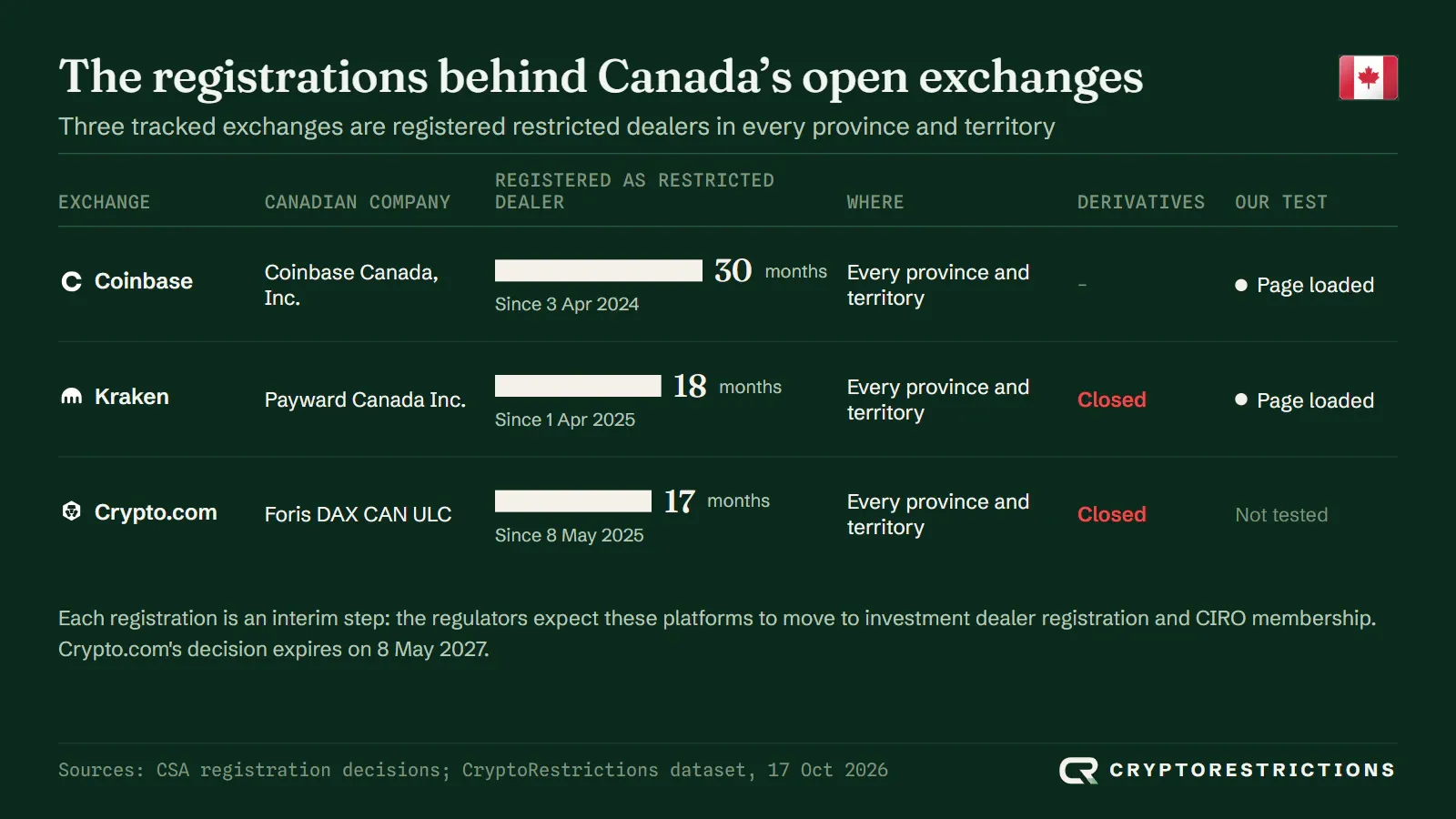
Coinbase was first, registered as Coinbase Canada in April 2024. Kraken follows through Payward Canada, which also holds a FINTRAC money services business registration (M19343731); the Ontario Securities Commission (OSC) lists it on its register of crypto trading platforms. Crypto.com moved its Canadian platform into Foris DAX CAN ULC in May 2025, after operating under a pre-registration undertaking since August 2022.
KuCoin is the cautionary case. Ontario and British Columbia are on its restricted list, and FINTRAC fined its operator C$19,552,000 in 2025, partly for failing to register as a foreign money services business.

Best crypto platforms for Canadian residents
By our access score, Coinbase (9.0 out of 10), Kraken (7.3) and Crypto.com (6.8) are the exchanges most open to Canadian residents, Polymarket (5.8) is the only prediction market we can score, and Uniswap and Jupiter (8.0 each) are the most open DeFi platforms.
The score rates how fully a Canadian resident can use each platform, not its fees or safety. It is computed from our data and moves when a row changes: access status (4 points), the share of the platform’s products open here (3), the Canadian licences we hold on file (2) and what our geo-access test saw from a Canadian address (1). Platforms that refuse Canadians are not scored. The full method is on our methodology page.
Exchanges

Coinbase
Best for A registered dealer in every province and territory
9.0/10- Access
- 4/4
- Products
- 3/3
- Licences
- 1/2
- Our test
- 1/1
Read our Coinbase reportPros
- Registered as Coinbase Canada since April 2024, the earliest of the three exchanges
- Serves every province and territory
Cons
- A restricted dealer, not yet an investment dealer
- We hold no Canada source for its derivatives or prediction markets

Kraken
Best for Spot trading with a registered Canadian company
7.3/10- Access
- 3.5/4
- Products
- 1.8/3
- Licences
- 1/2
- Our test
- 1/1
Read our Kraken reportPros
- Payward Canada is a restricted dealer in every province and territory
- Also registered with FINTRAC as a money services business
Cons
- Margin and derivatives closed to Canadian clients
- Opt-in Rewards not offered to Canadian clients

Crypto.com
Best for Spot trading in an app run by a registered dealer
6.8/10- Access
- 3.5/4
- Products
- 1.8/3
- Licences
- 1/2
- Our test
- 0.5/1
Read our Crypto.com reportPros
- Foris DAX CAN ULC is a restricted dealer in every province and territory
Cons
- No derivatives, margin or short positions for Canadian clients
- Registration decision expires on 8 May 2027
Prediction markets

Polymarket
Best for Event markets outside four provinces
5.8/10- Access
- 3/4
- Products
- 2.3/3
- Licences
- 0/2
- Our test
- 0.5/1
Read our Polymarket reportPros
- Not named in its terms outside Alberta, British Columbia, Ontario and Quebec
Cons
- Blocked in Alberta, British Columbia, Ontario and Quebec
- Its operators paid the OSC C$200,000 in 2025 over binary options
- No Canadian regulator recognizes it
DeFi

Jupiter
Best for Solana swaps and staking
8.0/10- Access
- 4/4
- Products
- 3/3
- Licences
- 0/2
- Our test
- 1/1
Read our Jupiter reportPros
- Canada is not among its prohibited localities
Cons
- No Canadian licence on file

Uniswap
Best for Swapping tokens from your own wallet
8.0/10- Access
- 4/4
- Products
- 3/3
- Licences
- 0/2
- Our test
- 1/1
Read our Uniswap reportPros
- Its terms bar only places under comprehensive US sanctions
Cons
- No Canadian licence on file

PancakeSwap
Best for BNB Chain swaps and pools
6.3/10- Access
- 3.5/4
- Products
- 1.8/3
- Licences
- 0/2
- Our test
- 1/1
Read our PancakeSwap reportPros
- Swaps, pools and staking are not excluded by the terms
Cons
- PCS Perps bars users in Canada
- No Canadian licence on file
Which platforms block Canada users?
13 of the 22 platforms we track refuse Canadian residents: ten exchanges (Binance, Bybit, OKX, Bitstamp, Gemini, Bitget, Gate, MEXC, HTX and Bitfinex), one prediction market (Kalshi) and two DeFi platforms (Lighter and Aster).
Some left after the rules arrived. HTX closed the accounts of all Canada-based users on 31 December 2021, OKX ended service in 2023, and Bitstamp moved its Canadian clients to Bitbuy in 2024. Gemini followed, closing its Canadian accounts on 31 December 2024. Others were pushed. Binance gave the OSC an undertaking in 2022 and now lists Canada as a prohibited country, and Bybit settled with the OSC in June 2022, disgorging US$2,468,910.


What our geo-access test saw from Canada
From a Canadian address on 14 and 16 October 2026 we loaded 17 of the platforms we track: 6 refused us, 2 showed a notice and 9 loaded with no barrier.
An open page is not permission. HTX, MEXC and Bitstamp loaded although their terms or exit notices say Canada is closed, and Aster’s trading app loaded with no barrier although its terms name Canada. Two notices were not refusals in the usual sense: Gate showed a message about the EU region, and Kalshi said prediction markets are not available. Swipe through the screenshots below; each card quotes the message the page showed.
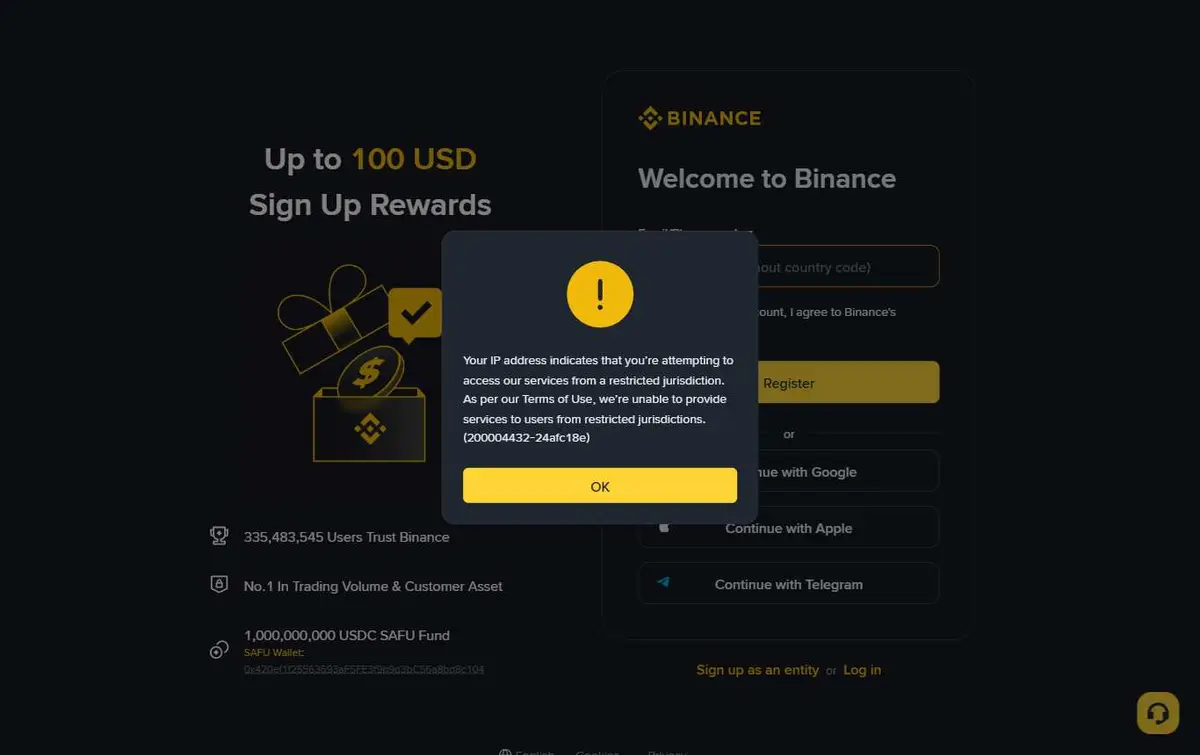
Blocked Binance · Sign-up page
Sign-up refused by IP address: a restricted jurisdiction
“Your IP address indicates that you're attempting to access our services from a restricted jurisdiction.”
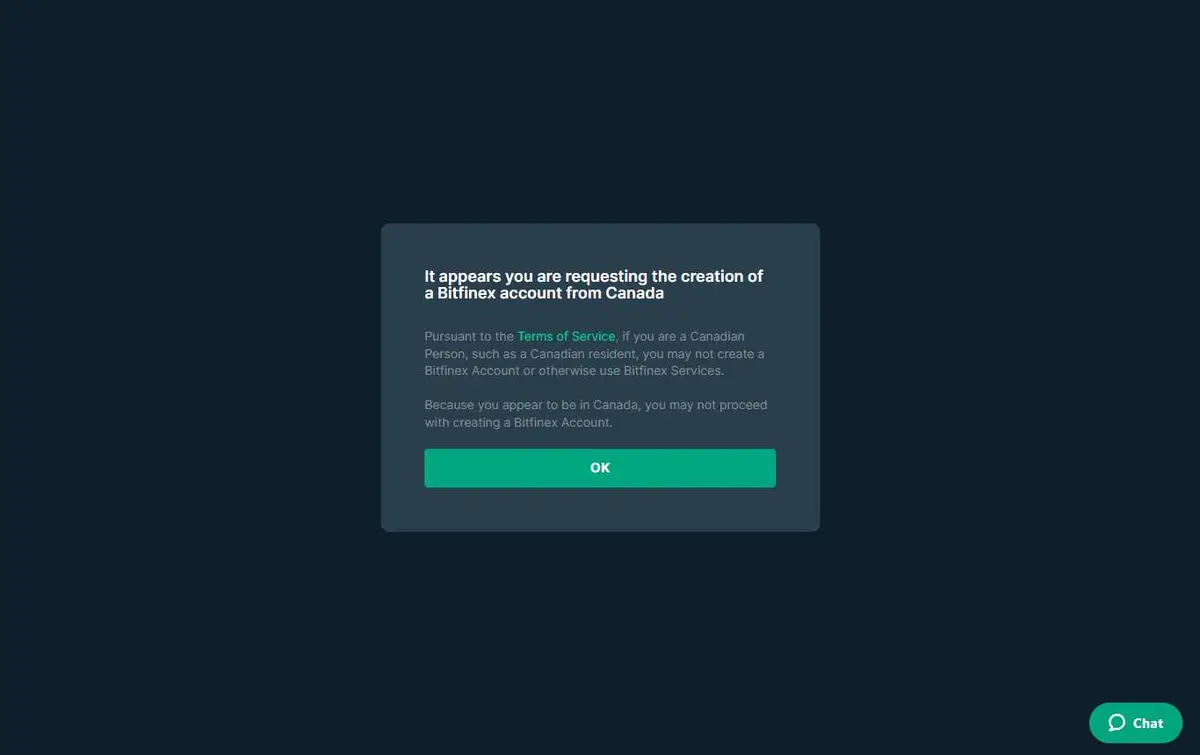
Blocked Bitfinex · Sign-up page
Canada gets the same refusal, citing the terms of service
“It appears you are requesting the creation of a Bitfinex account from Canada”
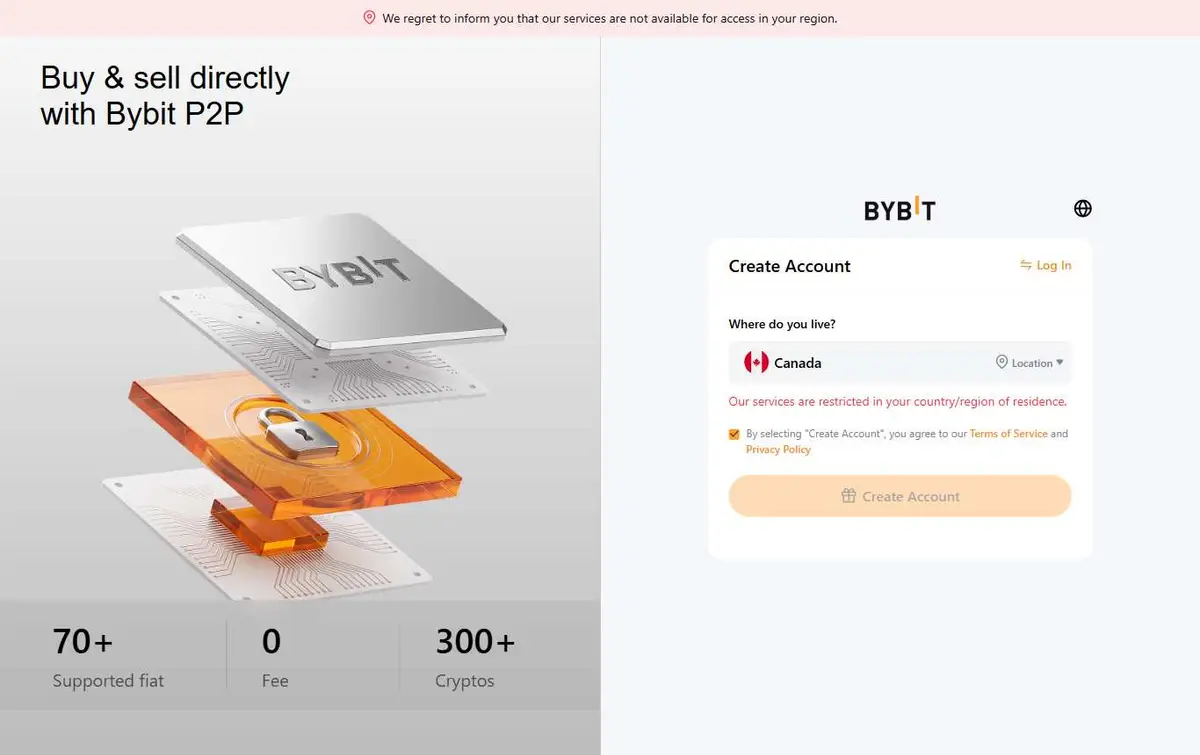
Blocked Bybit · Sign-up page
The same banner from a Canadian address
“We regret to inform you that our services are not available for access in your region.”
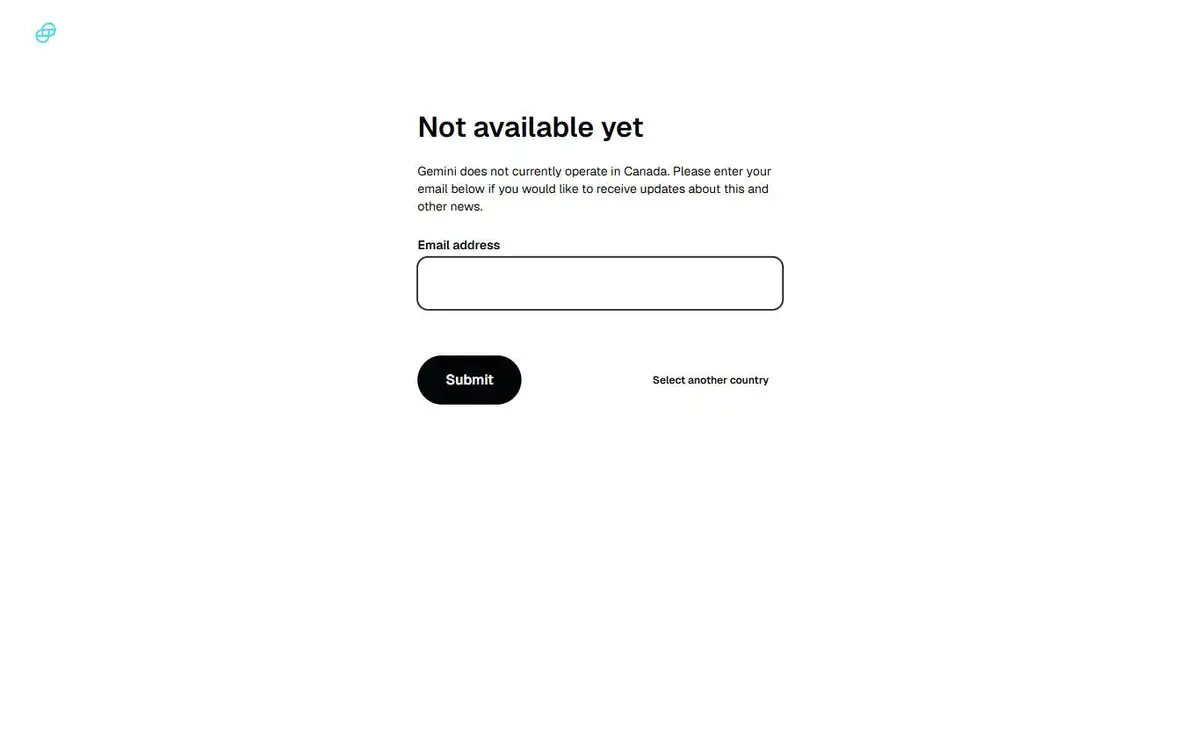
Blocked Gemini · Sign-up page
Canada, which is not on Gemini's list of supported countries
“Gemini does not currently operate in Canada.”
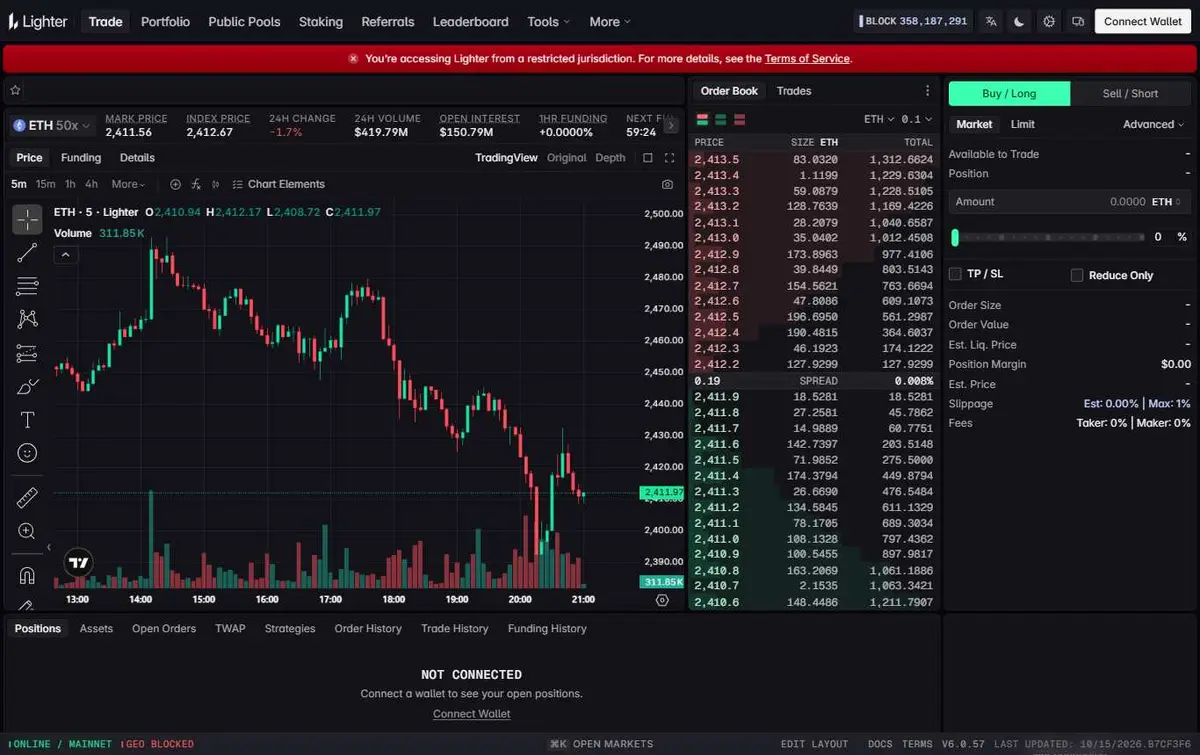
Blocked Lighter · Trading app
Canada, named in the terms as a whole country: blocked by IP
“You’re accessing Lighter from a restricted jurisdiction.”
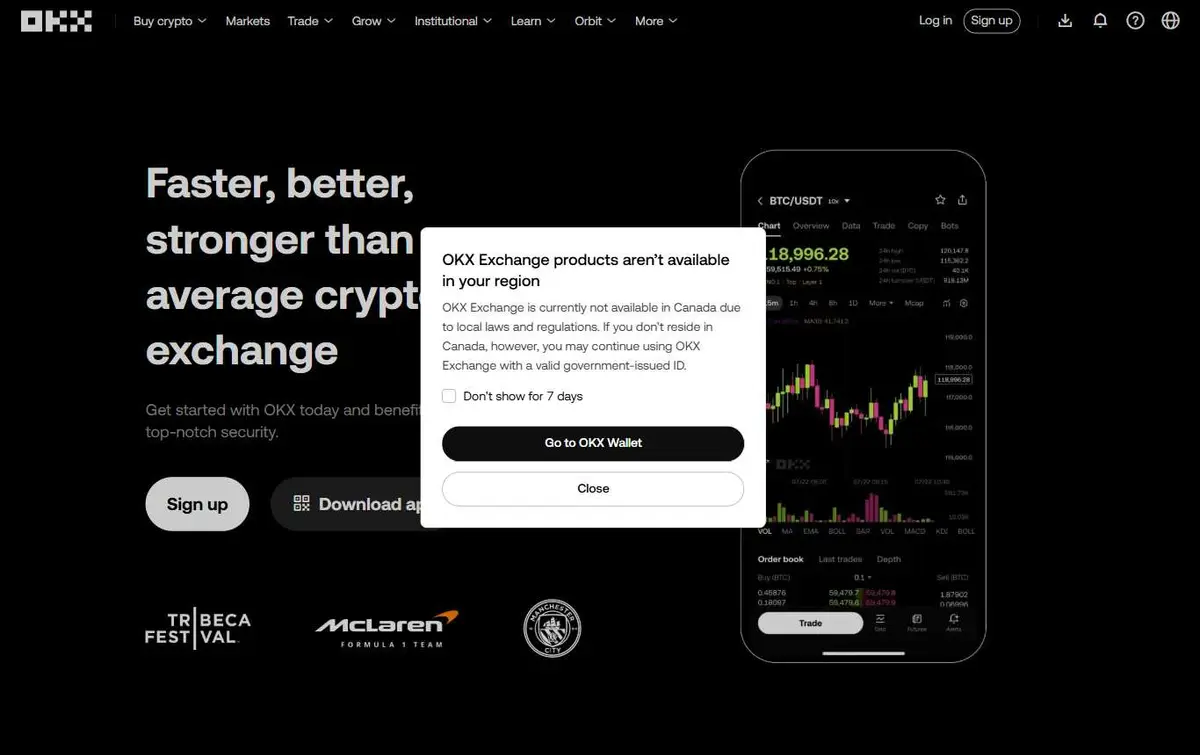
Blocked OKX · Home page
Blocked by IP: a pop-up over the home page
“OKX Exchange is currently not available in Canada due to local laws and regulations.”
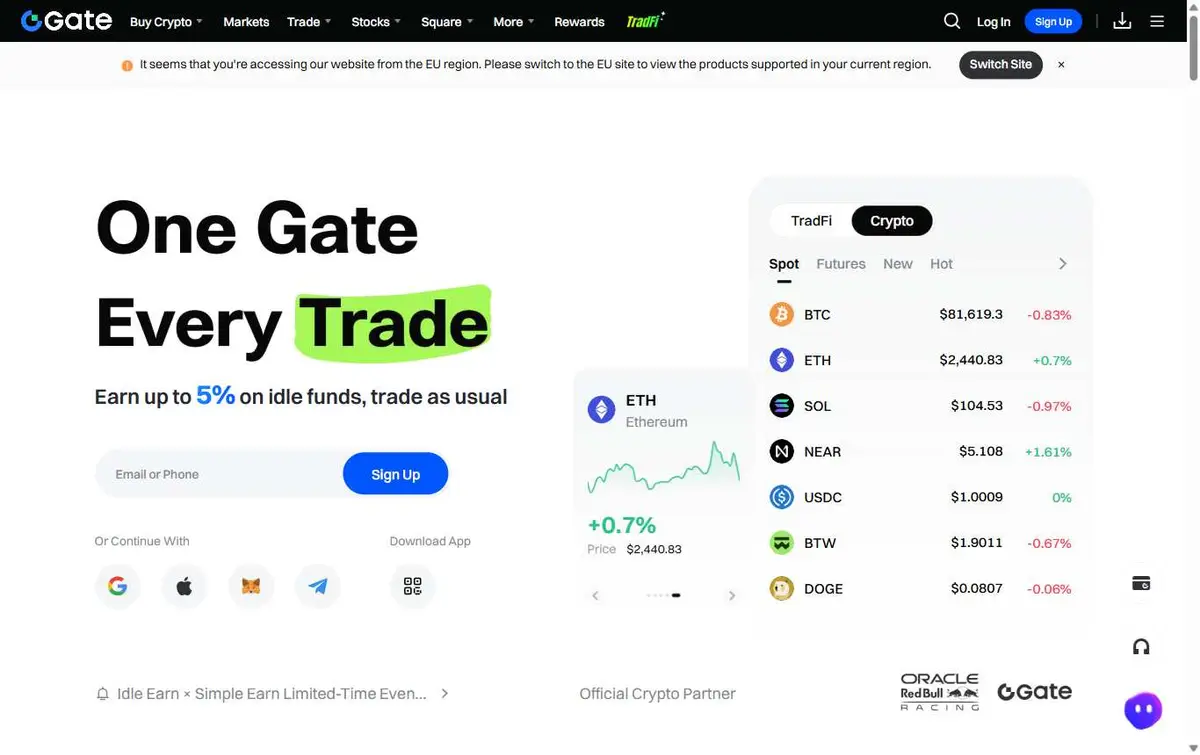
Notice shown Gate · Home page
Canada is on Gate's list, yet the page loaded with only a site-switch banner
“It seems that you're accessing our website from the EU region.”
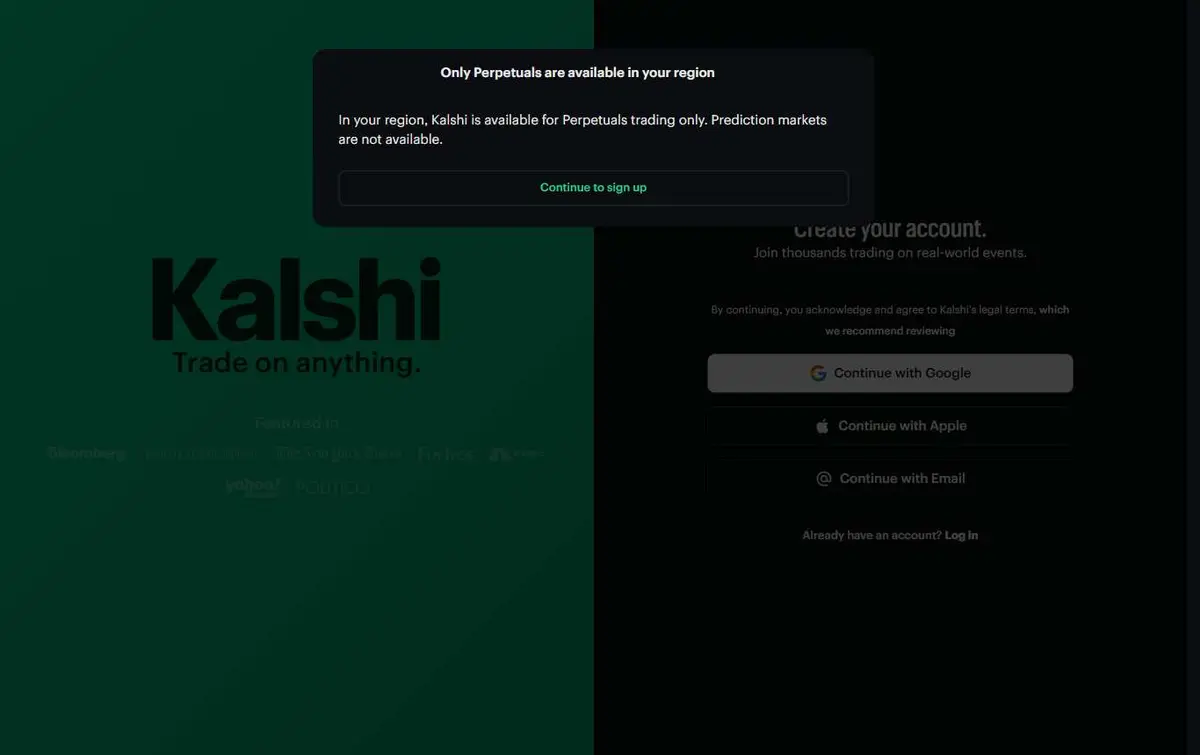
Notice shown Kalshi · Sign-up page
Canada: perps-only on Kalshi's site; Canadians reach some Kalshi contracts through a local broker instead
“Prediction markets are not available.”
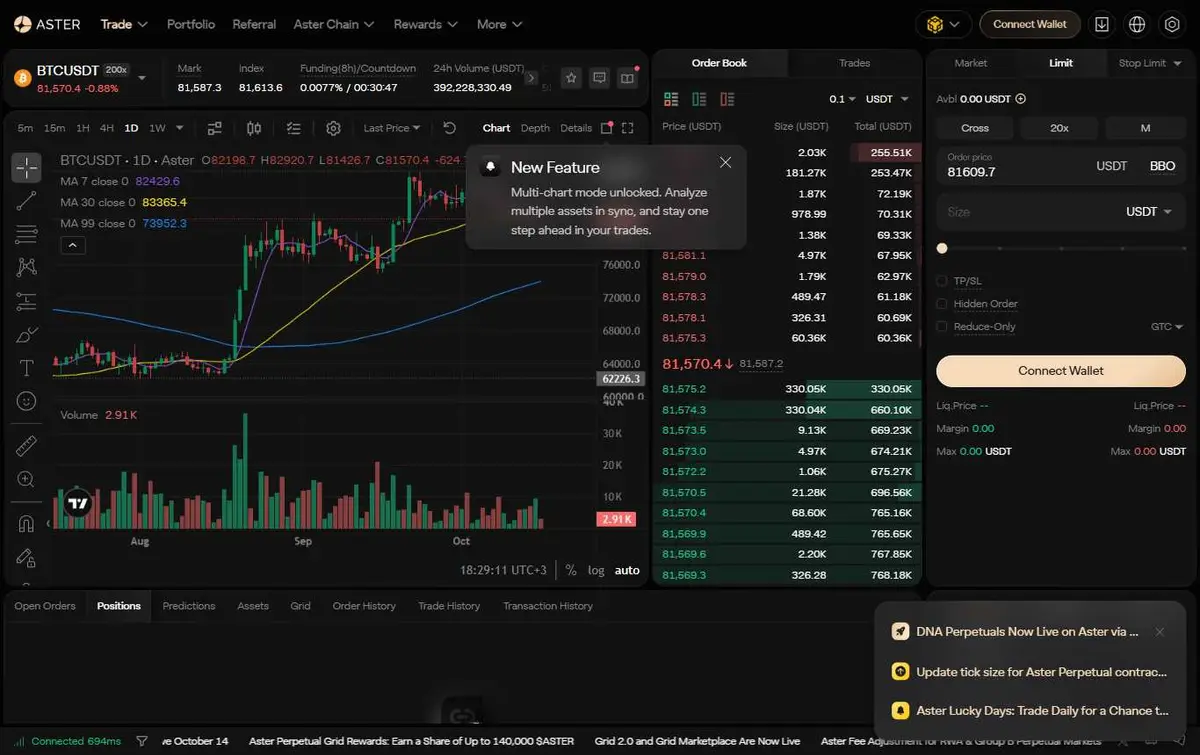
No barrier Aster · Trading app
Canada, also named in the terms: no barrier
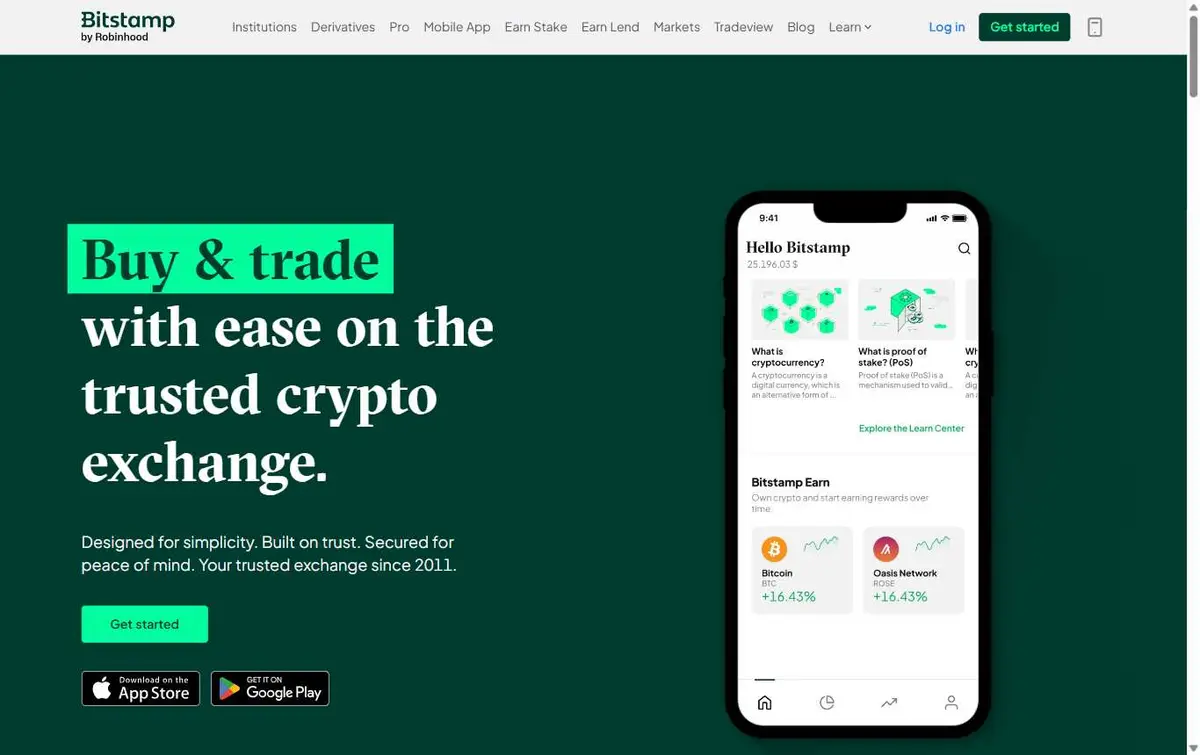
No barrier Bitstamp · Home page
Canada, which Bitstamp left in 2024: the global home page loads with no notice
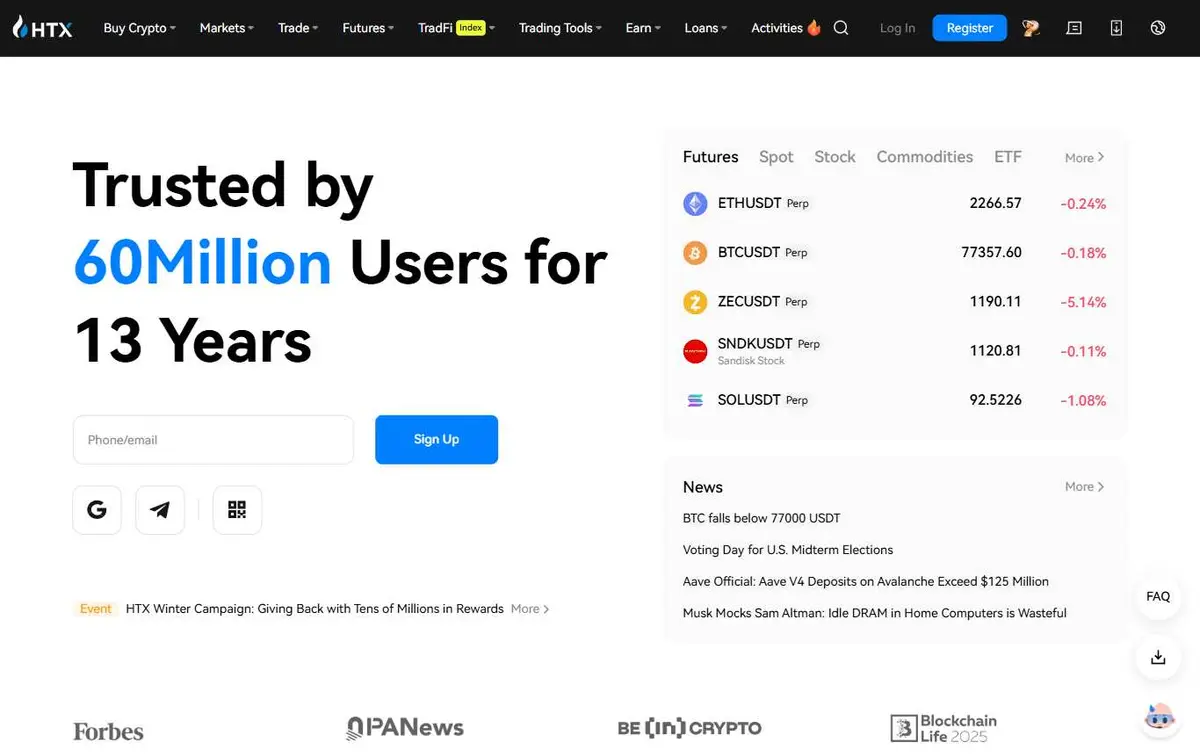
No barrier HTX · Home page
Canada, closed to HTX users since 2021, loads with no notice
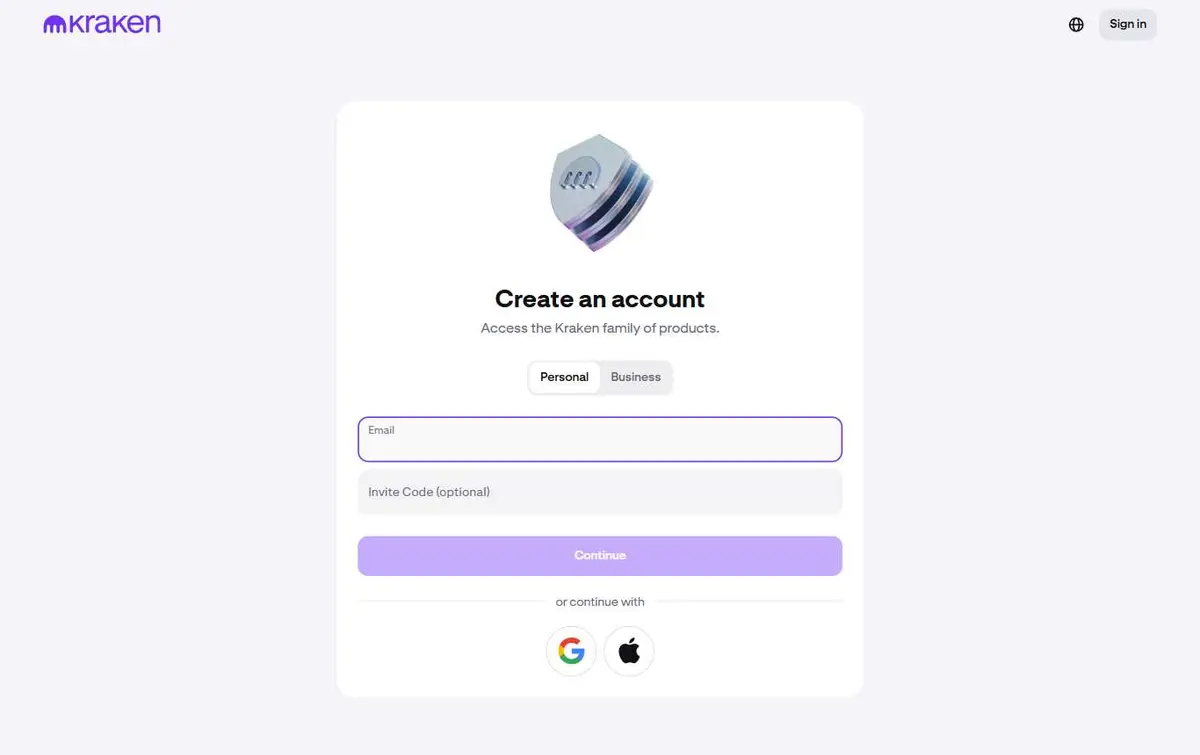
No barrier Kraken · Sign-up page
Canada: sign-up open, but no margin or derivatives for Canadian clients
“Create an account”
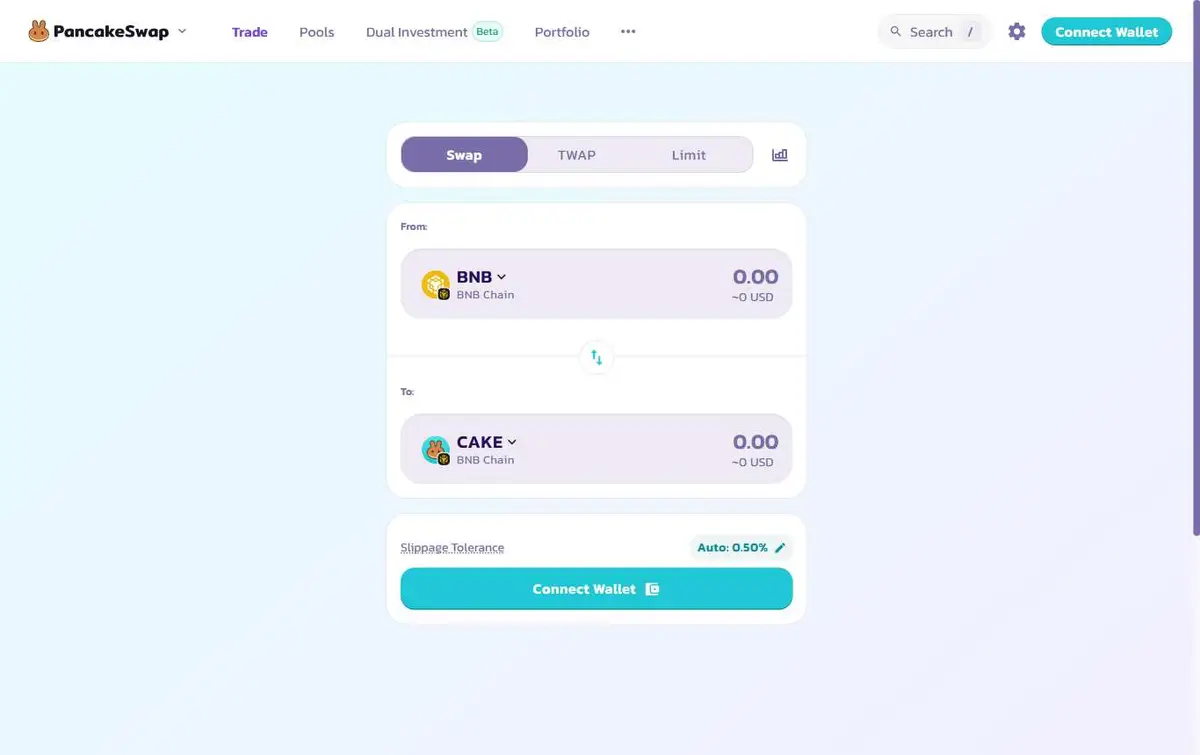
No barrier PancakeSwap · Trading app
Canada, barred from perps: the swap page loads
 CRYPTORESTRICTIONS
Do crypto rules differ by province in Canada?
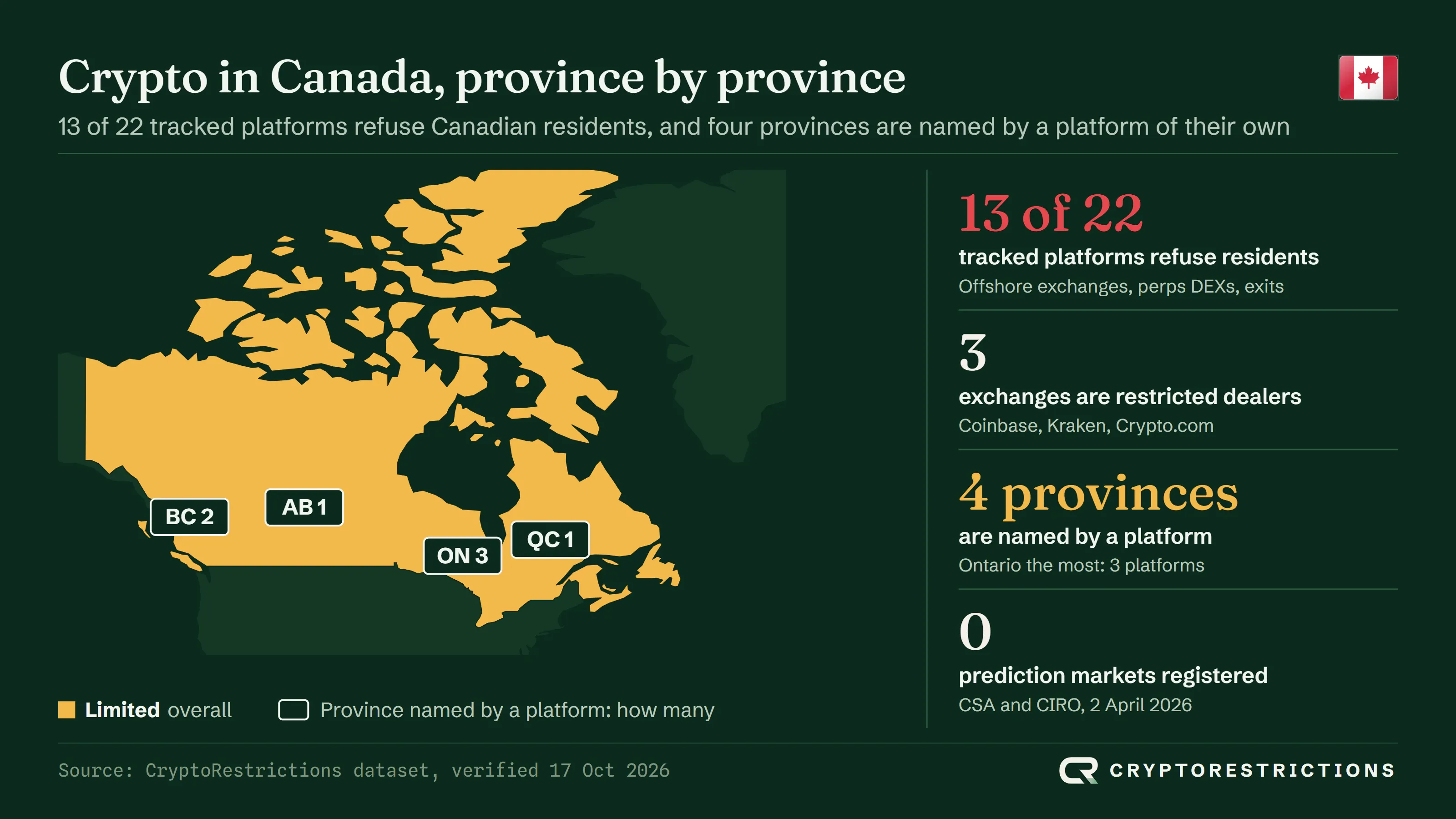
Yes. Platforms name four provinces in their own terms, Ontario for three of them, and five provinces sit outside the C$30,000 yearly cap that limits purchases of most coins elsewhere.
Ontario sees the most action: the OSC is the principal regulator for the registrations and has acted against offshore platforms. KuCoin and Hyperliquid close Ontario, and Polymarket’s operators agreed in April 2025 to keep Ontario residents out. Bitfinex ended service for Ontario customers in 2022. British Columbia is named by KuCoin and Polymarket. Alberta and Quebec are named by Polymarket alone.

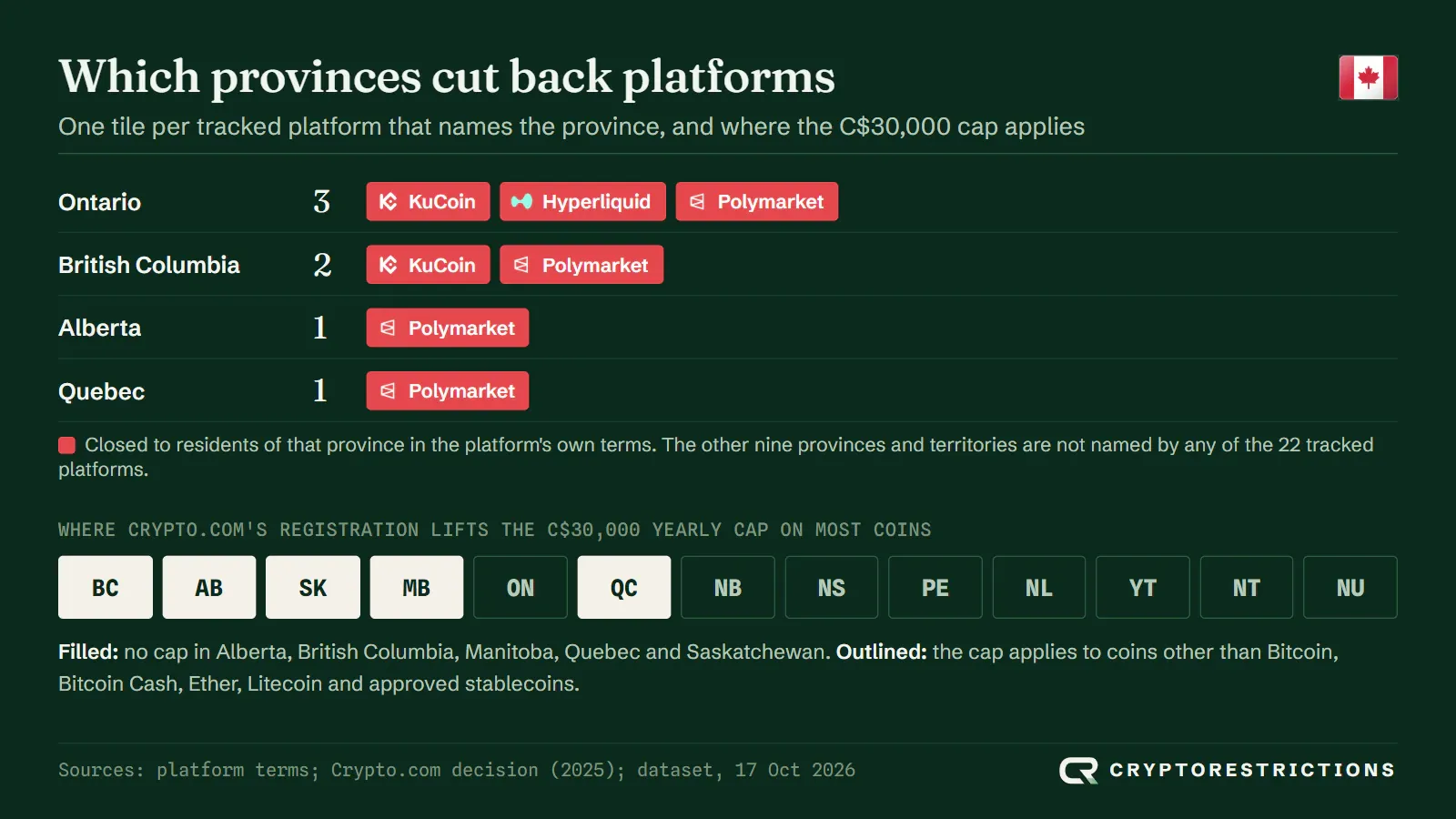
The cap is the other difference. Under the Crypto.com decision, clients outside Alberta, British Columbia, Manitoba, Quebec and Saskatchewan may buy and sell no more than C$30,000 a year, net, of coins other than Bitcoin, Bitcoin Cash, Ether, Litecoin and compliant stablecoins. Saskatchewan went further: its General Order 25-505 of 16 April 2025 gave residents of the province broader relief on certain platforms. Alberta’s regulator keeps Bitget on its caution list.
Who regulates crypto in Canada?
No single regulator. The provincial securities regulators, coordinated by the CSA, register trading platforms; FINTRAC supervises anti-money-laundering registration; CIRO oversees investment dealers; the CRA handles tax; and Parliament has passed a stablecoin law.
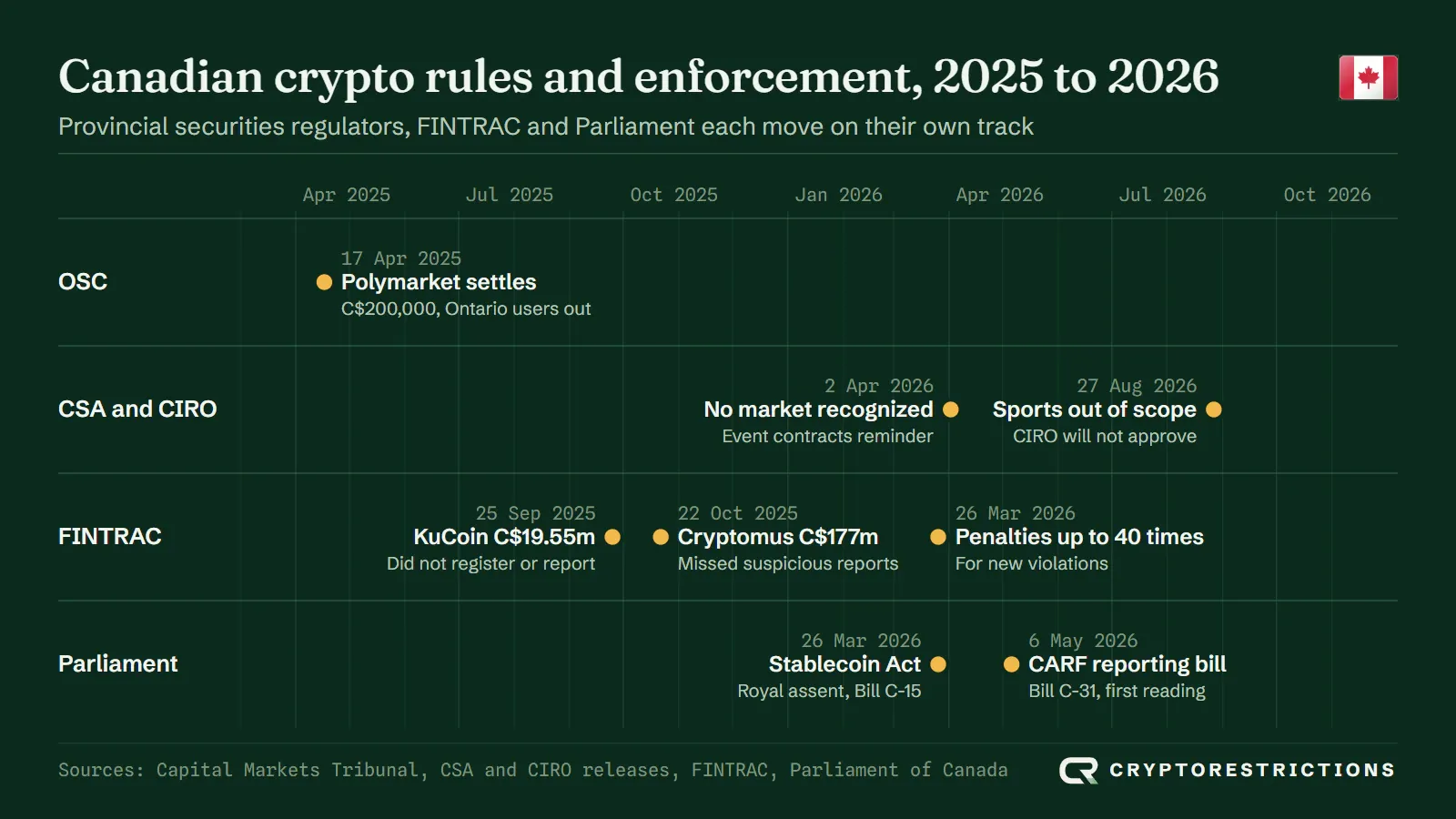
- Securities regulators. Each province and territory licenses on its own. The OSC is the principal regulator for the registrations we read (Coinbase, Kraken and Crypto.com), and Quebec’s AMF is named in the multi-province decisions. In October 2023 the CSA set terms for platforms trading value-referenced crypto assets, the stablecoin category.
- FINTRAC. It fined KuCoin’s operator C$19,552,000 in 2025 and Cryptomus’s operator Xeltox Enterprises C$176,960,190 a month later, for failures that included suspicious transaction reporting. From 26 March 2026 its maximum penalties rose by up to 40 times for new violations.
- CIRO. The self-regulatory organization for investment dealers, the category restricted dealers are expected to move into, and the body that will not approve dealers to offer sports event contracts.
- Parliament. Bill C-15 received royal assent on 26 March 2026 and carries the Stablecoin Act. Bill C-31, first read on 6 May 2026, would add a Crypto-Asset Reporting Framework to the Income Tax Act.
Which crypto products are limited in Canada?
Derivatives are the most closed product: Kraken, Crypto.com and PancakeSwap bar Canadian clients from them, and Crypto.com’s registration rules out margin and leverage altogether. Spot trading is open at six of the nine platforms and limited by province at KuCoin and Hyperliquid.
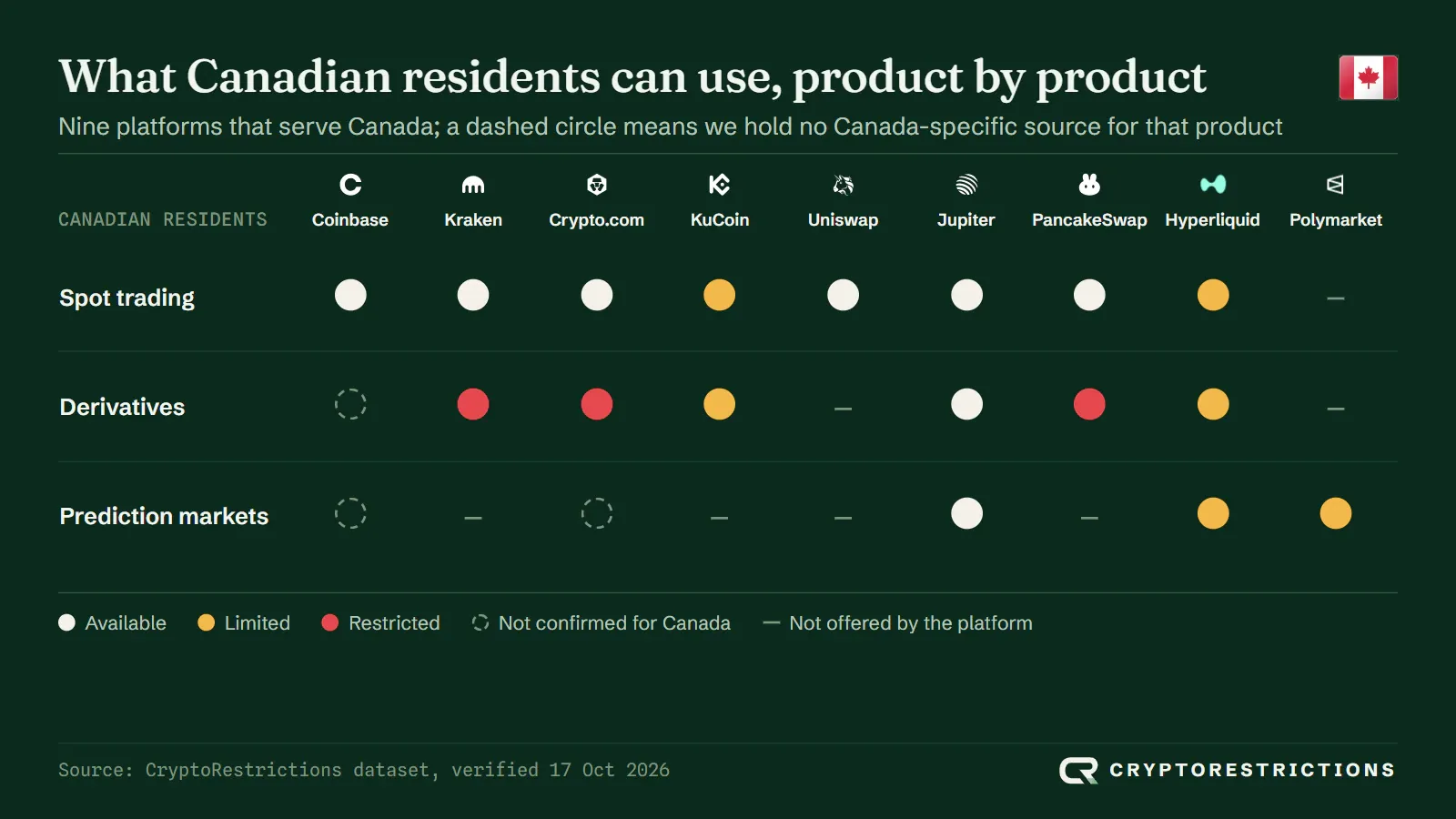
- Derivatives and margin. Crypto.com’s registration bars margin, credit and leverage for Canadian clients, short positions, and any derivative other than the crypto contract. Kraken excludes Canada from its derivatives and does not offer margin to Canadian clients, and PancakeSwap’s perps FAQ bars users in Canada.
- Stablecoins. Platforms may offer only the stablecoins that meet the CSA’s terms, and the Stablecoin Act adds a federal framework for issuers. The C$30,000 yearly cap does not apply to compliant ones.
- Staking. Kraken’s Opt-in Rewards are not offered to Canadian clients. The CRA treats staking rewards earned on a centralized exchange as generally income.
Are prediction markets legal in Canada?
Not as a registered activity. No prediction market is recognized as an exchange or registered as a dealer, and since 27 August 2026 securities regulators say sports and entertainment event contracts sit outside securities law altogether.
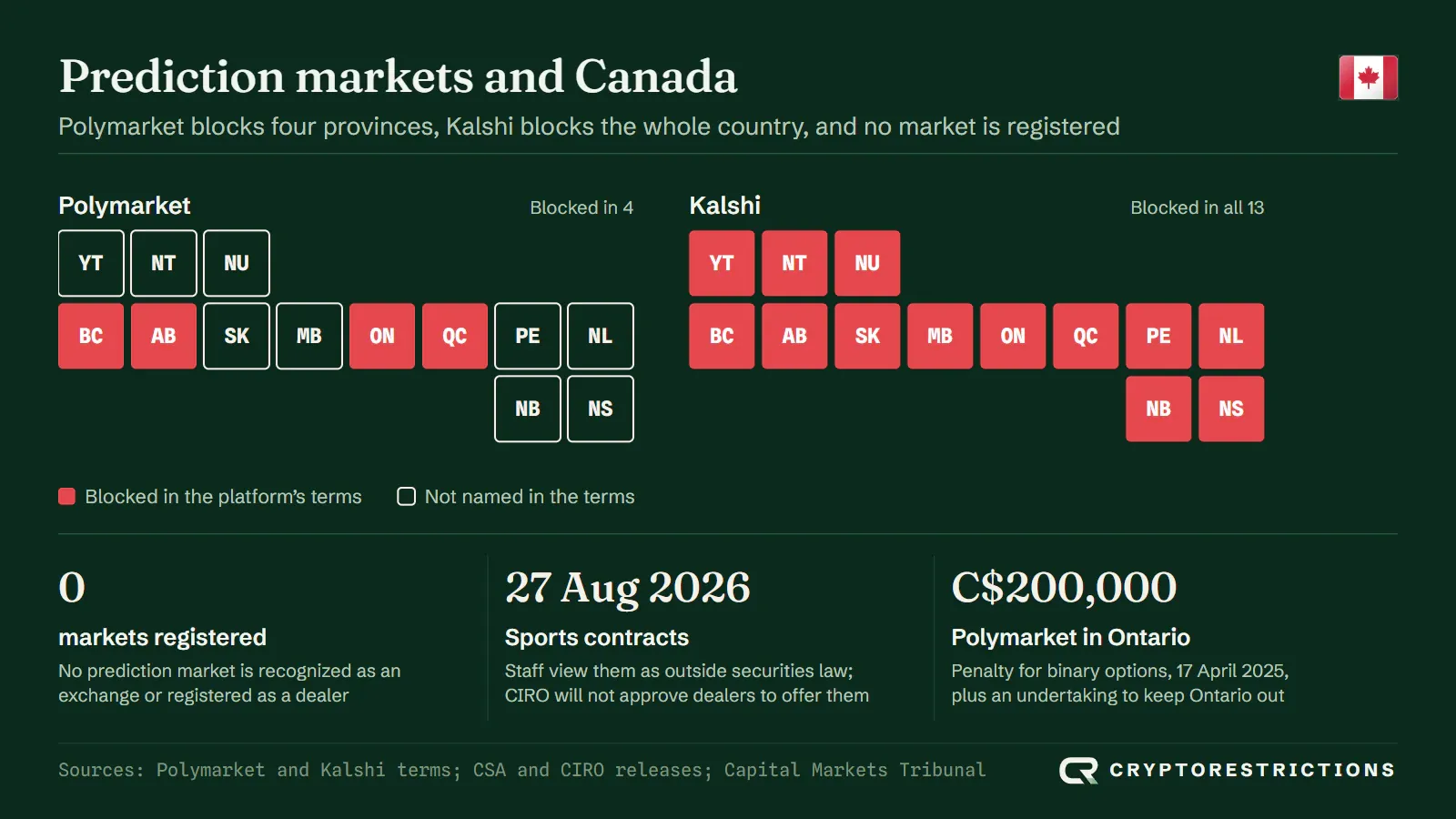
On 2 April 2026 the CSA and CIRO reminded the industry that anyone trading or facilitating event contracts that are securities or derivatives must follow securities or derivatives law, and that no prediction market holds an exemption. Binary options with a term under 30 days are banned for individuals by Multilateral Instrument 91-102 in most participating jurisdictions, though British Columbia did not adopt it. That is the rule the OSC applied to Polymarket’s operators, who settled in April 2025 for offering binary options to Ontario residents between June 2020 and May 2023.
The 27 August guidance adds that CIRO will not approve dealer applications to offer sports and entertainment event contracts, while other kinds of event contract are still being assessed. Polymarket’s own geographic restrictions list Alberta, British Columbia, Ontario and Quebec as blocked regions. Kalshi refuses the whole country.

How is crypto taxed in Canada?
The CRA treats crypto as property, not currency. Selling, swapping or spending it is a disposal, and half of a capital gain is added to your income and taxed at your marginal rate, unless your activity looks like a business.
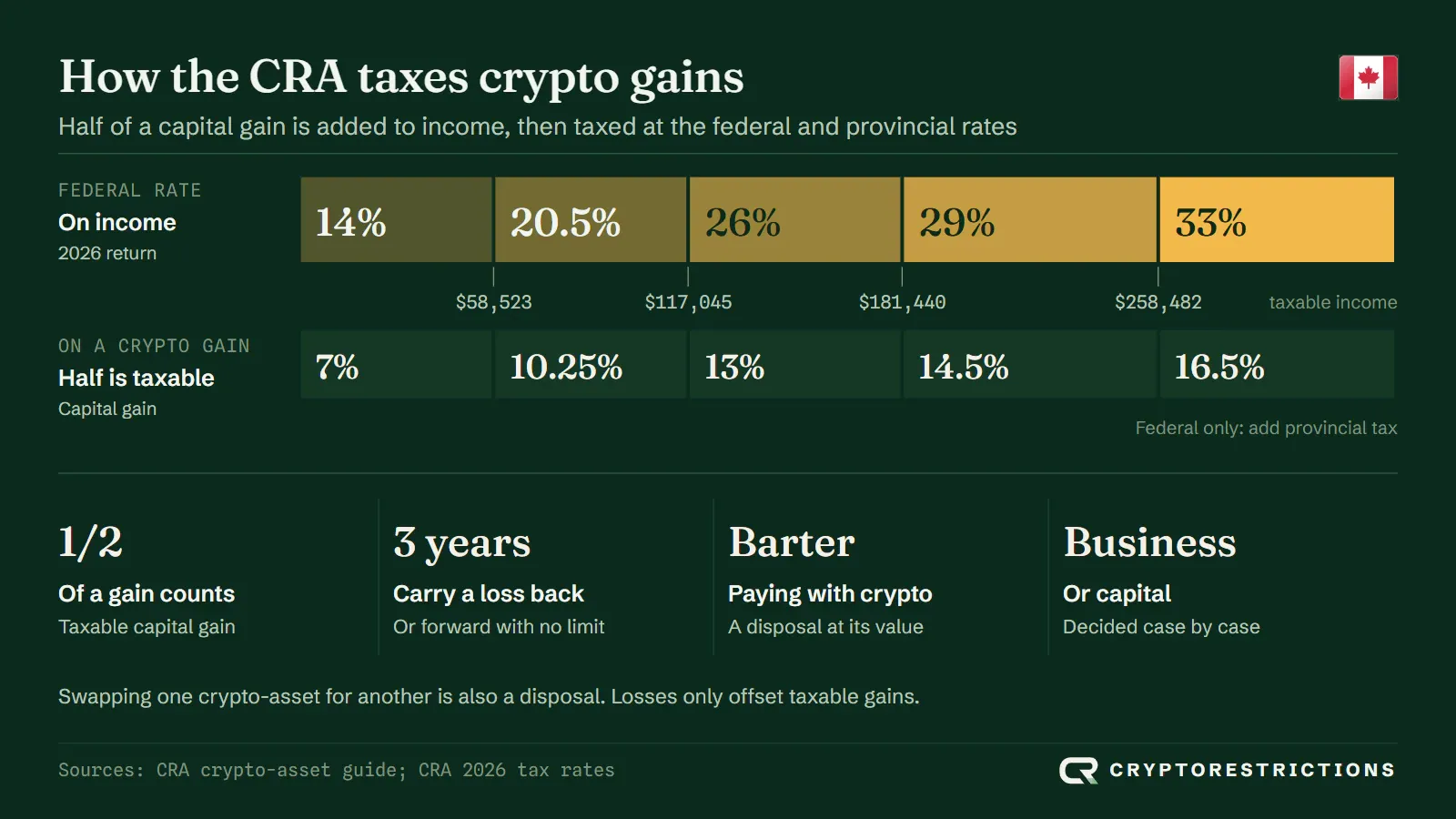
The bands are the federal rates on the CRA’s 2026 return page, and the rate on a gain is half of each because only half counts. Provincial tax comes on top. Half of a capital loss is an allowable loss, usable only against taxable capital gains, carried back three years or forward with no limit. Paying for goods or services with crypto is treated as barter, and swapping one crypto-asset for another is a disposal. Whether activity is capital or a business is decided case by case, and even an isolated transaction can count as business income.
Bill C-31 would add the OECD’s Crypto-Asset Reporting Framework to the Income Tax Act, requiring crypto service providers that carry on business in Canada to report their customers’ exchange transactions. Until then the records are yours to keep. Reporting runs in four steps:






 Costa Rica
 Mexico
 Panama
 El Salvador
 Dominican Republic
 Puerto Rico
 Bermuda
 British Virgin Islands
 Cayman Islands
 Jamaica
 Saint Lucia