

Is crypto legal in the Dominican Republic?
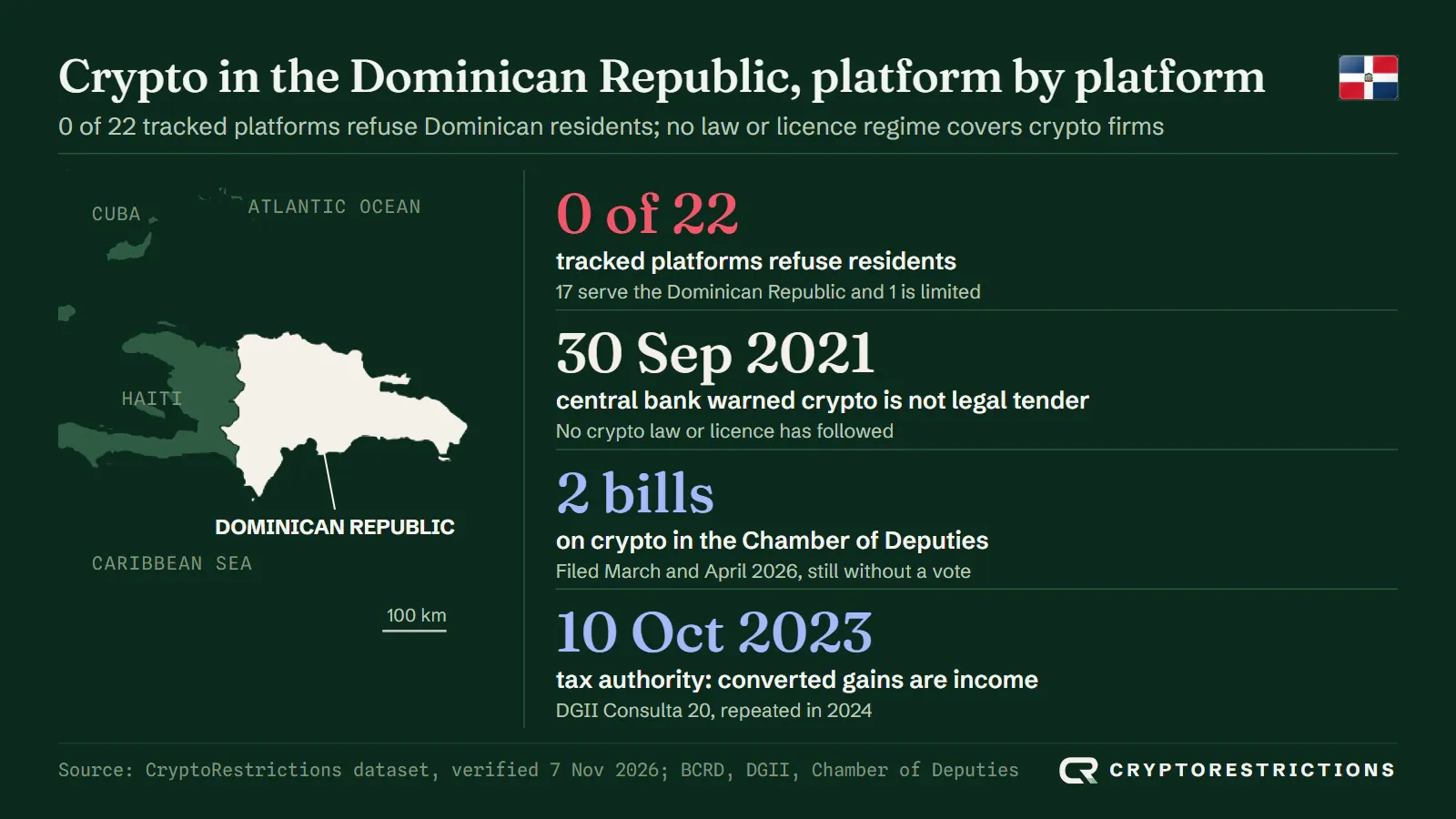
In practice yes: we found no Dominican law that bans holding or trading crypto, but none regulates it either, and the central bank says it is not legal tender. Rules for exchanges exist only as two bills.
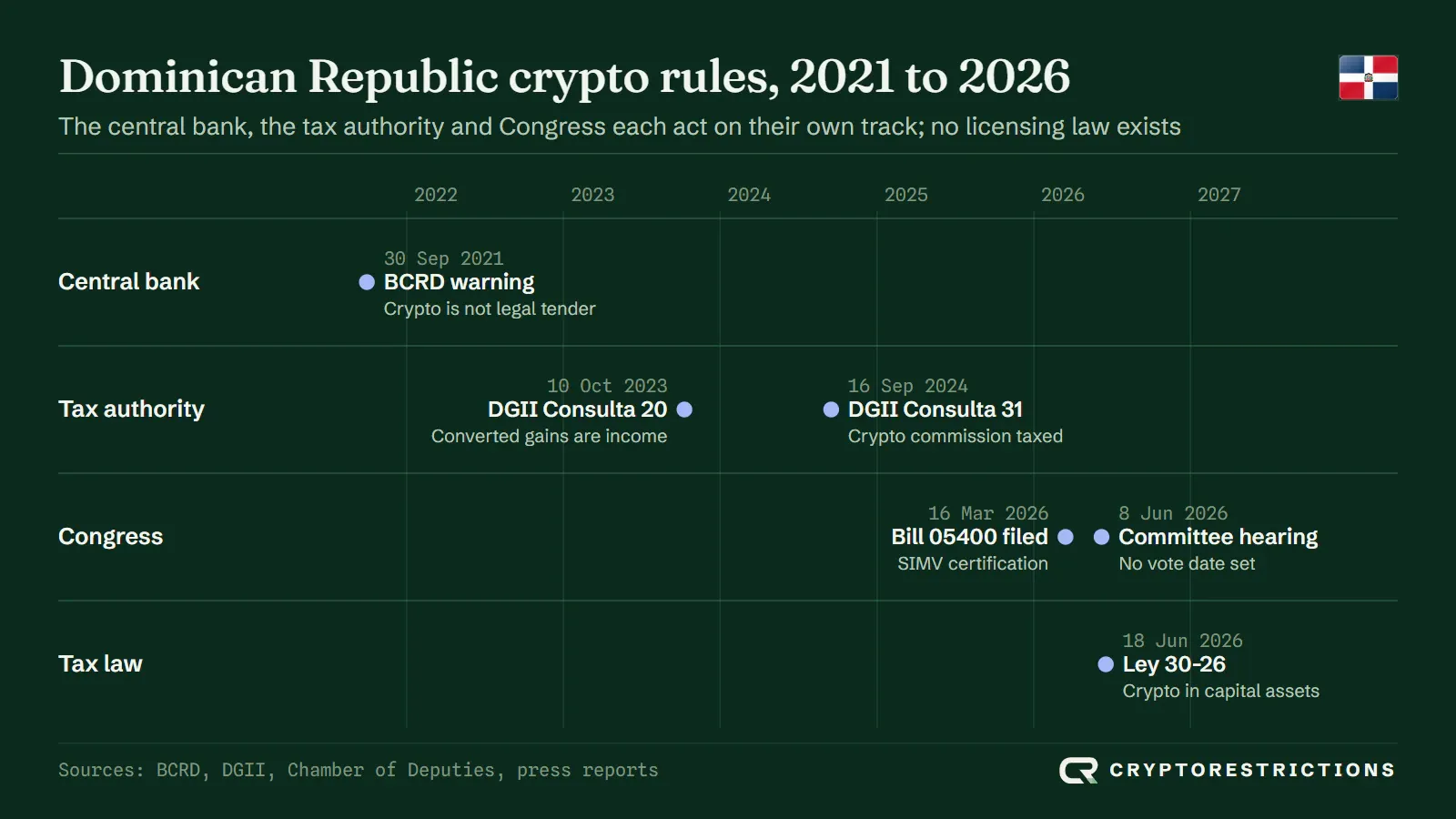
The central bank, the Banco Central de la República Dominicana (BCRD), warned on 30 September 2021, in a notice reported by the press, that crypto has no legal tender status, that Bitcoin, Litecoin and Ethereum cannot be treated as foreign currency, and that regulated financial entities that trade or use it could be sanctioned under the Monetary and Financial Law, 183-02. The notice was a second warning; the first dates from 27 June 2017, as the tax authority’s own papers record. We could not open the BCRD’s page for the notice, so we rely on the press report.
The tax authority, the DGII, said the same in its Consulta 20 of 10 October 2023: crypto is not regulated or supervised, is not currency under the monetary regime and is not under the securities regulator, the SIMV. Nothing in what we read makes holding or trading by an individual an offence.
Two bills would change that. Bill 05400 on prevention, control and regulation of crypto was filed in the Chamber of Deputies on 16 March 2026, and bill 05569 on digital assets and crypto-assets followed in April. The Finance Committee heard industry and legal experts on 8 June 2026 and planned to ask the BCRD, the bank supervisor and the DGII for opinions. A 19 August 2026 report says neither had reached a vote. We read the bills through press coverage, not the Chamber’s own pages, so check its records for the current status.
Which crypto exchanges work in the Dominican Republic?
Thirteen of the 14 exchanges we track serve Dominican residents, Gemini for spot trading only. Bitstamp has no verified status, and no exchange holds a Dominican licence because none exists to hold.
Without a licence register there is nothing to check an exchange against, so every status below rests on the platform’s own documents and our geo-access test. A virtual location tests a platform’s own geo-blocking only, and most platforms enforce at identity verification.
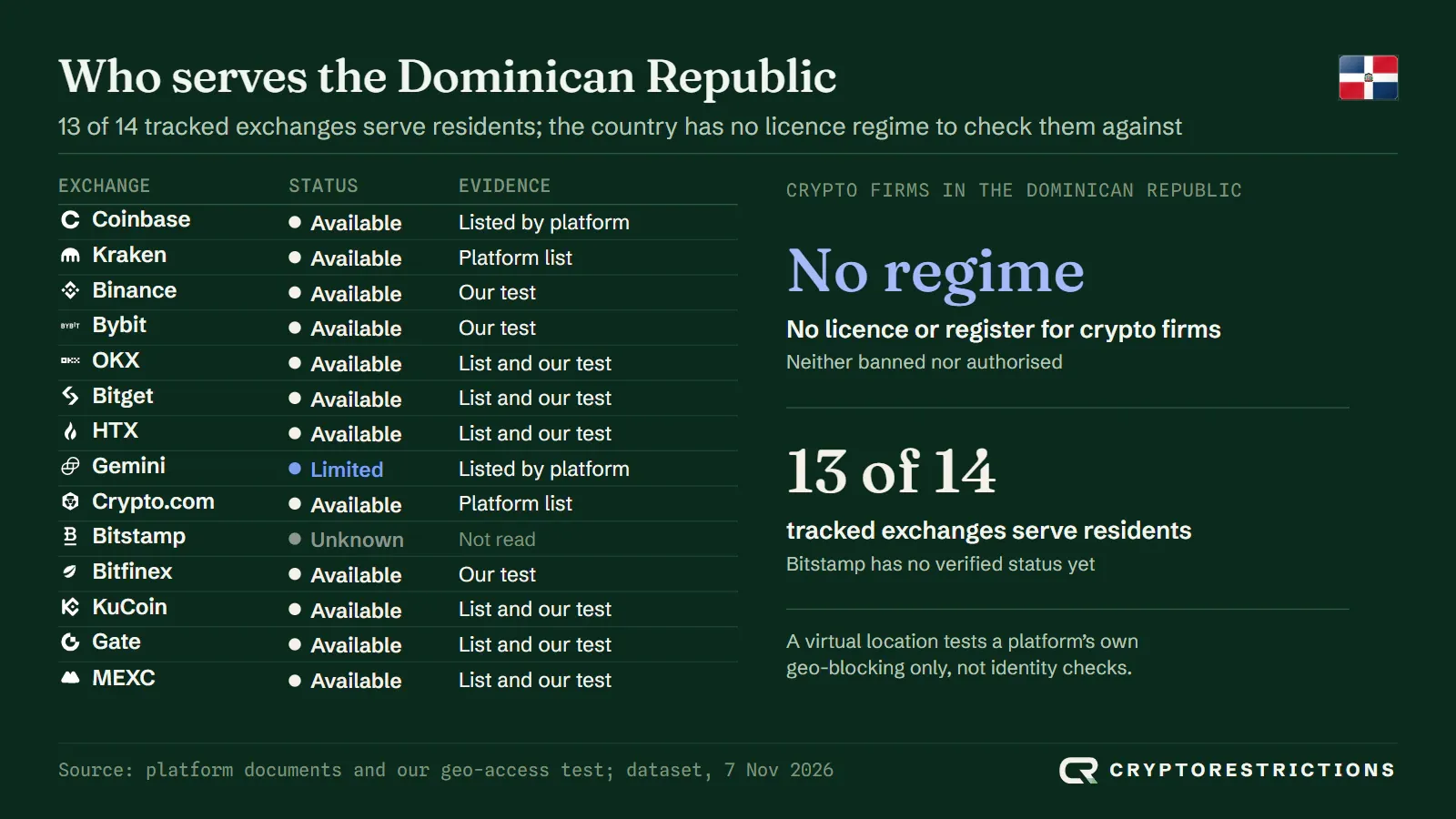
- Coinbase lists the Dominican Republic among its sign-up countries in the identity-verification guide.
- Gemini says on its country page that it is available in the Dominican Republic. It is not on the perpetuals list, so derivatives are not offered. We could not open Gemini’s perpetuals page this time, so that part rests on our earlier reading of 17 October 2026.
- Bitstamp has no status: its terms page returned no text for us and we did not test it.

Local exchanges exist, but none is licensed or supervised for crypto, and we do not track them as platforms.
Best crypto platforms for Dominican residents
Nine exchanges, including OKX, Bitget, KuCoin, Gate, MEXC and HTX, tie at 8 out of 8 possible points. Platforms we could not test score 7.5, and Gemini, which lacks derivatives, 5.9.
The score rates how fully a Dominican resident can use each platform, not its fees or safety. It is computed from our data and moves when a row changes: access status (4 points), the share of the platform’s products open here (3), the licences we hold on file for the Dominican Republic (2) and what our geo-access test saw from a Dominican address (1). With no licence regime, nobody earns the licence points, so 8 is the top. The full method is on our methodology page.
Exchanges

Binance
Best for The widest range of markets
8.0/10- Access
- 4/4
- Products
- 3/3
- Licences
- 0/2
- Our test
- 1/1
Read our Binance reportPros
- Its pages loaded in our test
Cons
- We could not read its country list as text

Bitfinex
Best for Spot and margin for experienced traders
8.0/10- Access
- 4/4
- Products
- 3/3
- Licences
- 0/2
- Our test
- 1/1
Read our Bitfinex reportPros
- Its pages loaded in our test
Cons
- We could not read its terms as text

Bitget
Best for Spot and derivatives in one account
8.0/10- Access
- 4/4
- Products
- 3/3
- Licences
- 0/2
- Our test
- 1/1
Read our Bitget reportPros
- Not on its prohibited-countries list
- Its pages loaded in our test
Cons
- Its list of prohibited countries is non-exhaustive

Bybit
Best for Spot and derivatives in one account
8.0/10- Access
- 4/4
- Products
- 3/3
- Licences
- 0/2
- Our test
- 1/1
Read our Bybit reportPros
- Its pages loaded in our test
Cons
- We could not read its country list as text

Gate
Best for A wide range of listed tokens
8.0/10- Access
- 4/4
- Products
- 3/3
- Licences
- 0/2
- Our test
- 1/1
Read our Gate reportPros
- Not named in its restricted-locations clause
- Its pages loaded in our test
Cons
- Its list is non-exhaustive and can change without notice

HTX
Best for Spot and derivatives in one account
8.0/10- Access
- 4/4
- Products
- 3/3
- Licences
- 0/2
- Our test
- 1/1
Read our HTX reportPros
- Not on the restricted list in its user agreement
- Its pages loaded in our test
Cons
- Its list can change without notice

KuCoin
Best for A wide range of listed tokens
8.0/10- Access
- 4/4
- Products
- 3/3
- Licences
- 0/2
- Our test
- 1/1
Read our KuCoin reportPros
- Not on its restricted-locations list
- Its pages loaded in our test
Cons
- Its list can be updated at its discretion

MEXC
Best for A wide range of listed tokens
8.0/10- Access
- 4/4
- Products
- 3/3
- Licences
- 0/2
- Our test
- 1/1
Read our MEXC reportPros
- Not on its prohibited-jurisdictions list (updated 13 October 2026)
- Its pages loaded in our test
Cons
- Its list is non-exclusive

OKX
Best for A global brand with a wide product range
8.0/10- Access
- 4/4
- Products
- 3/3
- Licences
- 0/2
- Our test
- 1/1
Read our OKX reportPros
- Not on its restricted-locations list (updated 8 July 2026)
- Its pages loaded in our test
Cons
- Its list is subject to change

Coinbase
Best for A familiar US exchange for spot buying
7.5/10- Access
- 4/4
- Products
- 3/3
- Licences
- 0/2
- Our test
- 0.5/1
Read our Coinbase reportPros
- A listed sign-up country in its identity-verification guide
Cons
- Not covered by our geo-access test

Crypto.com
Best for Trading in an app
7.5/10- Access
- 4/4
- Products
- 3/3
- Licences
- 0/2
- Our test
- 0.5/1
Read our Crypto.com reportPros
- Not on its app restricted-locations list (12 May 2026)
Cons
- Not covered by our geo-access test

Kraken
Best for Plain spot trading
7.5/10- Access
- 4/4
- Products
- 3/3
- Licences
- 0/2
- Our test
- 0.5/1
Read our Kraken reportPros
- Not on its prohibited-regions list (updated 4 November 2026)
Cons
- Not covered by our geo-access test

Gemini
Best for Plain spot trading
5.9/10- Access
- 3.5/4
- Products
- 1.9/3
- Licences
- 0/2
- Our test
- 0.5/1
Read our Gemini reportPros
- On its list of supported countries
Cons
- Not on its perpetuals list, so no derivatives
- Not covered by our geo-access test
DeFi

Aster
Best for Perpetuals from your own wallet
8.0/10- Access
- 4/4
- Products
- 3/3
- Licences
- 0/2
- Our test
- 1/1
Read our Aster reportPros
- Not on its prohibited-jurisdictions list
- Its trading app loaded in our test
Cons
- No funding in dollars: you need crypto from another source

Hyperliquid
Best for Perpetuals and spot on its own chain
8.0/10- Access
- 4/4
- Products
- 3/3
- Licences
- 0/2
- Our test
- 1/1
Read our Hyperliquid reportPros
- Its trading app loaded in our test
Cons
- We could not read its terms as text
- No funding in dollars: you need crypto from another source

Lighter
Best for Perpetuals from your own wallet
8.0/10- Access
- 4/4
- Products
- 3/3
- Licences
- 0/2
- Our test
- 1/1
Read our Lighter reportPros
- Not named in its terms
- Its trading app loaded in our test
Cons
- No funding in dollars: you need crypto from another source

Jupiter
Best for Solana swaps
7.5/10- Access
- 4/4
- Products
- 3/3
- Licences
- 0/2
- Our test
- 0.5/1
Read our Jupiter reportPros
- Not named in its prohibited localities
Cons
- No funding in dollars: you need crypto from another source
- Not covered by our geo-access test

Uniswap
Best for Swapping tokens from your own wallet
7.5/10- Access
- 4/4
- Products
- 3/3
- Licences
- 0/2
- Our test
- 0.5/1
Read our Uniswap reportPros
- Its terms bar only places under comprehensive US sanctions
Cons
- No funding in dollars: you need crypto from another source
- Not covered by our geo-access test
Which platforms block Dominican Republic users?
None of the 22 platforms we track refuses Dominican residents. Gemini is limited to spot, and four platforms have no verified status yet: Bitstamp, Kalshi, Polymarket and PancakeSwap.
Dominican law gives a platform no reason to close the country: individuals may hold and trade crypto, and no registration duty falls on firms. Several exclusion lists are non-exhaustive, so an absence is not a guarantee, and most platforms enforce at identity verification, not at the page. An unknown row means we could not read the platform’s own list and had no test result, not that it blocks the country.
What our geo-access test saw from the Dominican Republic
From a Dominican virtual location on 14 and 16 October 2026 we loaded 12 of the platforms we track and none refused us; the other 10 were not tested from the Dominican Republic.
The 12 were Aster, Binance, Bitfinex, Bitget, Bybit, Gate, HTX, Hyperliquid, KuCoin, Lighter, MEXC and OKX, and each one’s home and sign-up pages, or trading app, opened with no barrier. A virtual location, an address registered to the country but served elsewhere, tests a platform’s own geo-blocking only, and an open page is not permission: the test cannot see identity checks or blocks by internet providers. We hold no screenshots from the Dominican Republic, so there is no gallery.
Who regulates crypto in the Dominican Republic?
No body regulates crypto firms. The BCRD and the bank supervisor oversee the banks and payment institutions that touch it, the DGII taxes it, and the SIMV, which says it does not supervise crypto, would be the natural regulator if a bill passes.
- BCRD. The central bank and its governing board, the Junta Monetaria, set monetary and payment-system rules. Its 2021 notice, described in the legal section, warns regulated entities away from crypto.
- Superintendencia de Bancos. The bank supervisor. We found no crypto circular from it, and the Finance Committee planned to ask it for an opinion on the bills.
- SIMV. The Superintendencia del Mercado de Valores supervises the securities market under Law 249-17. The DGII records that crypto is not under its supervision, and we found no SIMV circular or sandbox for crypto. Bill 05400 would have it certify crypto businesses, per press coverage.
- DGII. The tax authority, covered in the tax section.
- UAF. The Unidad de Análisis Financiero is the financial intelligence unit. We could not open its site or the anti-money-laundering law, 155-17, and a single secondary source says crypto firms are not among the obliged entities, so we leave that open. We did not find the country on the FATF grey list in the lists we could search, but the October 2026 FATF page returned an error, so confirm it there.
The two crypto bills above are the stalled items: no committee report or vote date had been announced.
Are prediction markets legal in the Dominican Republic?
We found no Dominican rule or action that names prediction markets. A new gambling law, Ley 86-26, is reported to license online betting, and we could not confirm whether it reaches event contracts.
A law firm summary says Ley 86-26, published in the Gaceta Oficial of 2 October 2026, regulates betting through physical, electronic and virtual channels, creates a gambling directorate under the finance ministry and allows online betting only by licensed entities. The summary is undated and says nothing about foreign operators or prediction markets, and we did not read the Gaceta text. Whether an event contract on an election or a price counts as a bet under it is our question, not a ruling.
We found no Dominican action against Polymarket or Kalshi, but we could not read either platform’s own country list, so both stay unknown in our data.
How is crypto taxed in the Dominican Republic?
The DGII treats gains from crypto as taxable income once they are converted to cash, and Ley 30-26 of June 2026 is reported to add crypto to the capital-asset definition. We found no crypto-specific rate, form or reporting rule.
The DGII’s Consulta 20 says that gains made when crypto in a wallet is converted to legal money are taxable income, and that no register exists yet for reporting crypto operations. Consulta 31 of 16 September 2024 applies the same reasoning to a commission paid in crypto: it counts as income once converted. Both cite articles 267, 268 and 297 of the Tax Code.
Press reports say Ley 30-26, promulgated on 18 June 2026, amends article 289 of the Tax Code through its article 19 so that capital assets include digital goods and crypto-assets. The reported 10% rate applies to real estate only. A KPMG note says a draft regulation for the law, which lists a definition of digital goods and crypto-assets, was open for public consultation from 7 September to 8 October 2026. We did not read the Gaceta text, and we could not confirm the DGII’s rate tables, so we give no bands here: check dgii.gov.do for your year.
We found no DGII statement on value-added tax for crypto, no holding-period rule, and no word on swaps between crypto-assets, which the sources leave unsettled.



 Costa Rica
 Mexico
 Panama
 El Salvador
 Puerto Rico
 Canada
 Bermuda
 British Virgin Islands
 Cayman Islands
 Jamaica
 Saint Lucia