
Is crypto legal in Puerto Rico?
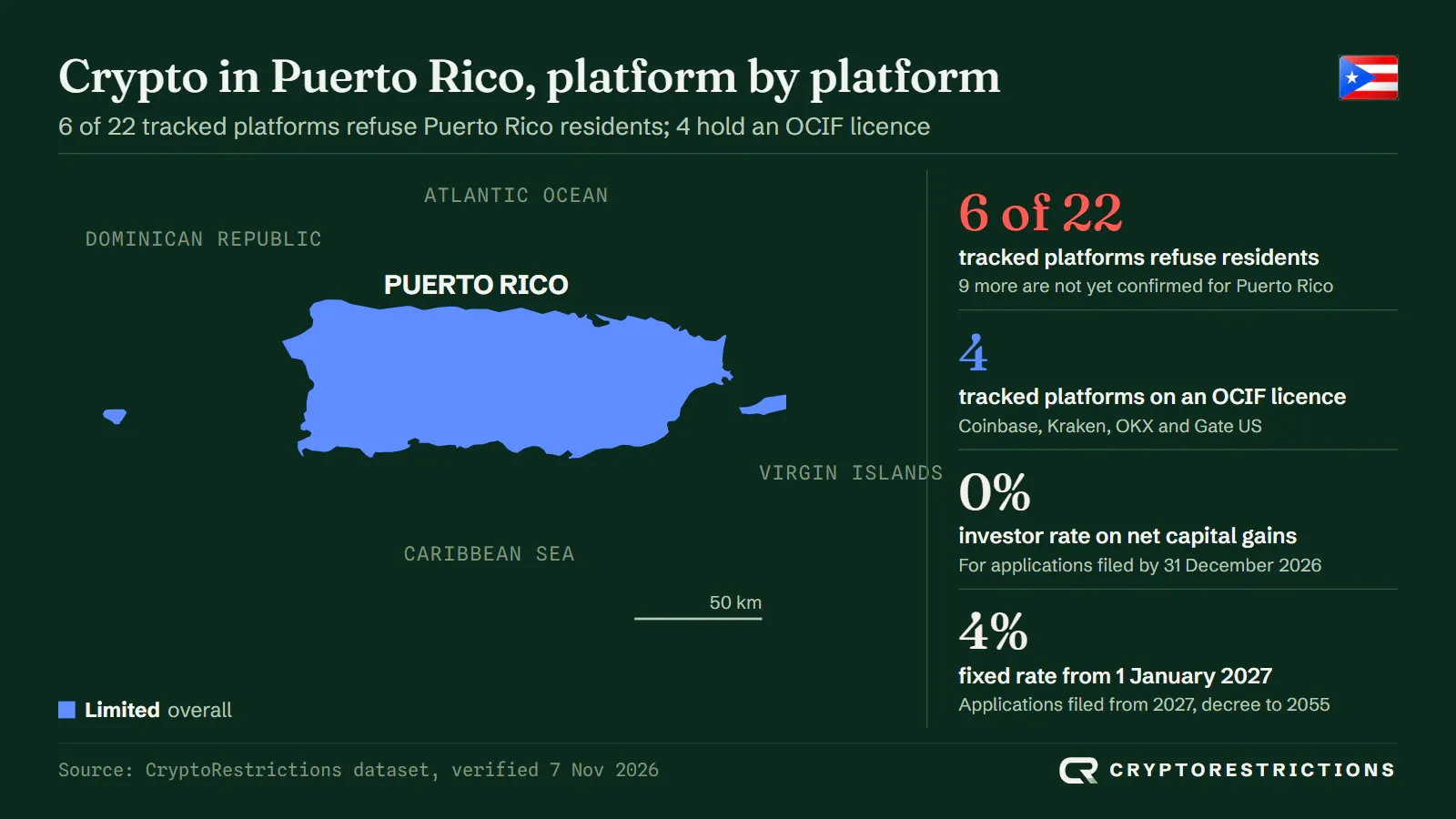
Yes. Puerto Rico is a US territory, and we found no local law that bans owning or trading crypto, so US federal rules apply, and the IRS treats digital assets as property rather than currency.
Everything federal, from the SEC and CFTC to anti-money-laundering rules and federal tax, works the same on the island as in the states, and our United States guide covers it. This page covers what is local: who licenses platforms on the island, which platforms serve it, and the tax incentive regime run from San Juan.
We found no Puerto Rico statute written for crypto, and no crypto notice from the Office of the Commissioner of Financial Institutions (OCIF) that we could read. What we can show is the licensing the platforms themselves disclose, covered in the next section. Puerto Rico also differs from the 50 states in how platforms treat it: some list it with the states, some name it as an excluded US territory, and some say nothing, which is why nine of our 22 tracked platforms stay unconfirmed below.
Which crypto exchanges work in Puerto Rico?
Coinbase, Kraken, OKX and Gate US each print a Puerto Rico money transmitter licence number issued by OCIF, and Binance.US, Crypto.com and Gemini also serve the island.
The licence numbers come from each platform’s own pages: Coinbase TM-053, Kraken TM-131, OKX TM-116 and Gate TM-160. We could not read OCIF’s own register, so these are the platforms’ disclosures, not a regulator confirmation.
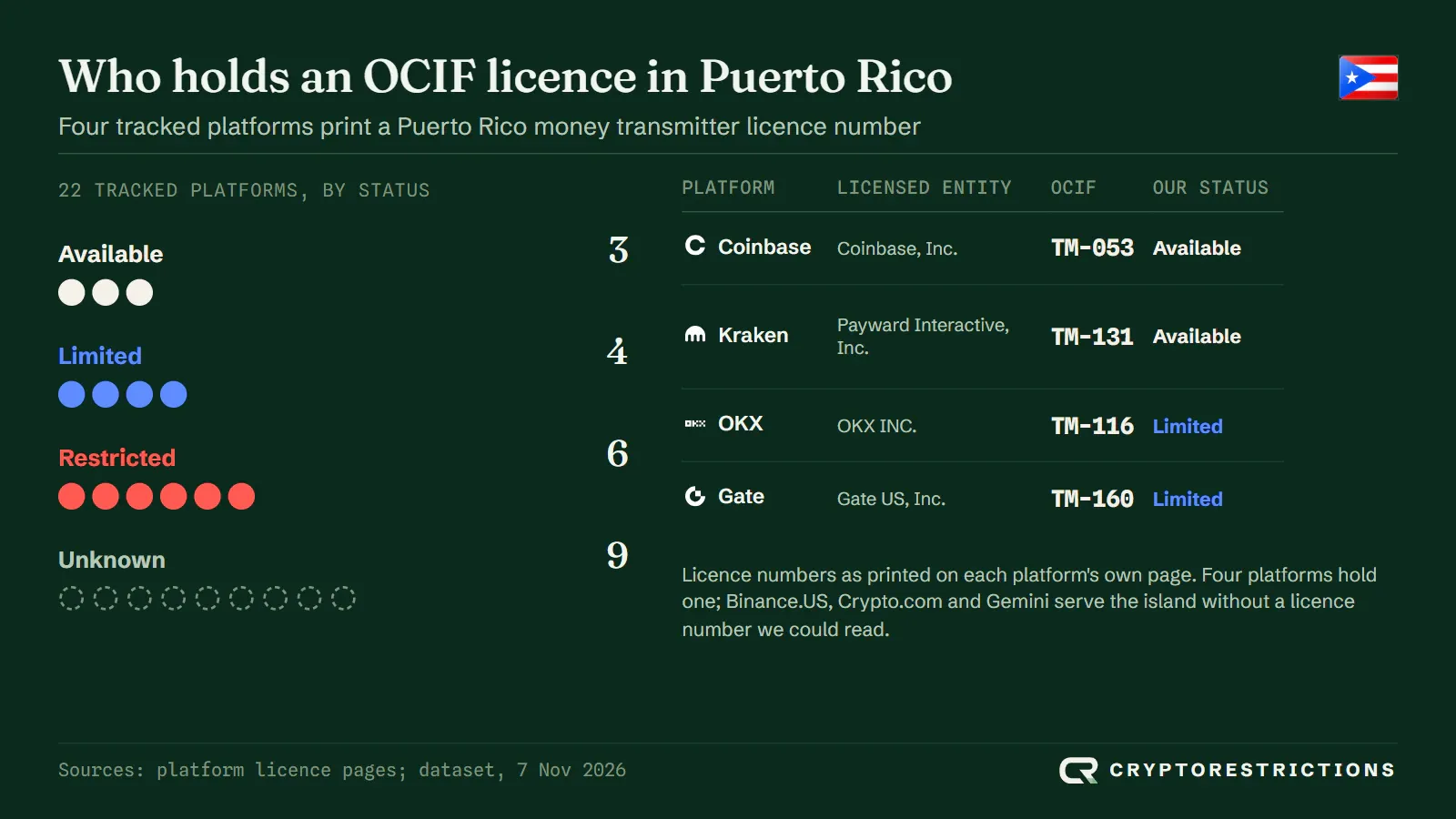
Binance is the other route. Binance.com prohibits US users, and Binance.US lists Puerto Rico among the regions it serves, so we record the global platform as restricted. Crypto.com says its app is available in the US territories including Puerto Rico, and Gemini lists Puerto Rico on its areas of availability. Neither prints a licence number we could read.

Best crypto platforms for Puerto Rico residents
By our access score, Coinbase and Kraken (8.5 out of 10 each) are the exchanges most open to Puerto Rico residents, followed by Gate (6.1), OKX (6.0), Gemini (5.9) and Crypto.com (5.8), and Uniswap scores 7.5.
The score rates how fully a Puerto Rico resident can use each platform, not its fees or safety. It is computed from our data and moves when a row changes: access status (4 points), the share of the platform’s products open here (3), the Puerto Rico licences we hold on file (2) and what our geo-access test saw from a Puerto Rican address (1). Platforms that refuse residents are not scored, and platforms we could not confirm are left out. The full method is on our methodology page.
Exchanges

Coinbase
Best for Spot trading with a local licence
8.5/10- Access
- 4/4
- Products
- 3/3
- Licences
- 1/2
- Our test
- 0.5/1
Read our Coinbase reportPros
- Holds Puerto Rico licence TM-053
- No state exclusion on our file names Puerto Rico
Cons
- Staking and derivatives for Puerto Rico are not confirmed

Kraken
Best for Spot trading and staking on a local licence
8.5/10- Access
- 4/4
- Products
- 3/3
- Licences
- 1/2
- Our test
- 0.5/1
Read our Kraken reportPros
- Holds Puerto Rico licence TM-131
- Puerto Rico is on its list for onchain staking
Cons
- Derivatives for Puerto Rico are not confirmed

Gate
Best for Spot trading through Gate US
6.1/10- Access
- 3/4
- Products
- 1.1/3
- Licences
- 1/2
- Our test
- 1/1
Read our Gate reportPros
- Holds Puerto Rico licence TM-160
Cons
- Gate US offers spot, convert and staking only
- Global Gate derivatives are closed to US residents

OKX
Best for Spot and OTC trades through OKX US
6.0/10- Access
- 3/4
- Products
- 1.5/3
- Licences
- 1/2
- Our test
- 0.5/1
Read our OKX reportPros
- Holds Puerto Rico licence TM-116
Cons
- Spot and OTC only, no derivatives for US customers

Gemini
Best for Spot trading from the main list
5.9/10- Access
- 3.5/4
- Products
- 1.9/3
- Licences
- 0/2
- Our test
- 0.5/1
Read our Gemini reportPros
- Puerto Rico is on its main list of supported places
Cons
- Not on its perpetuals list

Crypto.com
Best for Buying in the app
5.8/10- Access
- 3/4
- Products
- 2.3/3
- Licences
- 0/2
- Our test
- 0.5/1
Read our Crypto.com reportPros
- The app is available in Puerto Rico
Cons
- The prepaid debit card is not available there
DeFi

Uniswap
Best for Swapping tokens from your own wallet
7.5/10- Access
- 4/4
- Products
- 3/3
- Licences
- 0/2
- Our test
- 0.5/1
Read our Uniswap reportPros
- Its terms bar only places under comprehensive US sanctions
Cons
- No Puerto Rico licence on file
- We did not test it from a Puerto Rican address
Which platforms block Puerto Rico users?
Six of the 22 platforms we track refuse Puerto Rico residents: Binance, Bybit, KuCoin, Bitget, Hyperliquid and Lighter. Bitget and KuCoin name Puerto Rico in their terms; the rest exclude the US as a whole.
Bitget and KuCoin are the explicit cases. Bitget’s terms list the United States together with Puerto Rico, Guam, the US Virgin Islands, American Samoa, the Northern Mariana Islands and the US Minor Outlying Islands, and KuCoin’s Article 17(5) names Puerto Rico among the restricted US territories. The others exclude the United States and enforce it on a Puerto Rican address, as the next section shows. Nine more platforms, including Bitstamp, MEXC, HTX, Bitfinex and both prediction markets, are not confirmed for Puerto Rico: their terms bar the US or we could not read them, and none names the island.


What our geo-access test saw from Puerto Rico
From a Puerto Rican address on 14 and 16 October 2026 we loaded 12 platforms: 4 refused us, 1 showed a notice and 7 loaded with no barrier.
Bybit, Hyperliquid, KuCoin and Lighter refused the page or the sign-up form. OKX sent us to its US site. Aster, Binance, Bitfinex, Bitget, Gate, HTX and MEXC loaded, although Bitget’s terms name Puerto Rico as prohibited. An open page is not permission, because most platforms enforce at identity verification. The test also used a virtual location, which exercises a platform’s geo-blocking and cannot see a block by a local internet provider. We have no screenshots from Puerto Rico to show here.
Who regulates crypto in Puerto Rico?
OCIF licenses money transmitters on the island, the Department of Economic Development and Commerce (DDEC) runs the tax-incentive decrees, and the federal agencies regulate crypto itself as they do in the states.
- OCIF. The Office of the Commissioner of Financial Institutions issued the licences the platforms print above. We could not read its register or any crypto bulletin, so we cannot say how many firms it has licensed or what rules it applies to crypto.
- DDEC. It processes Individual Resident Investor applications under Act 60. Its Informative Bulletin 2026-004, dated 24 April 2026, explains Act 38-2026, enacted on 10 March 2026.
- Federal agencies. The IRS, SEC, CFTC and FinCEN apply on the island. See the United States guide.
Which crypto products are limited in Puerto Rico?
Derivatives are the most closed product: OKX and Gate US offer none to US customers, and Gemini’s perpetuals list leaves Puerto Rico out.
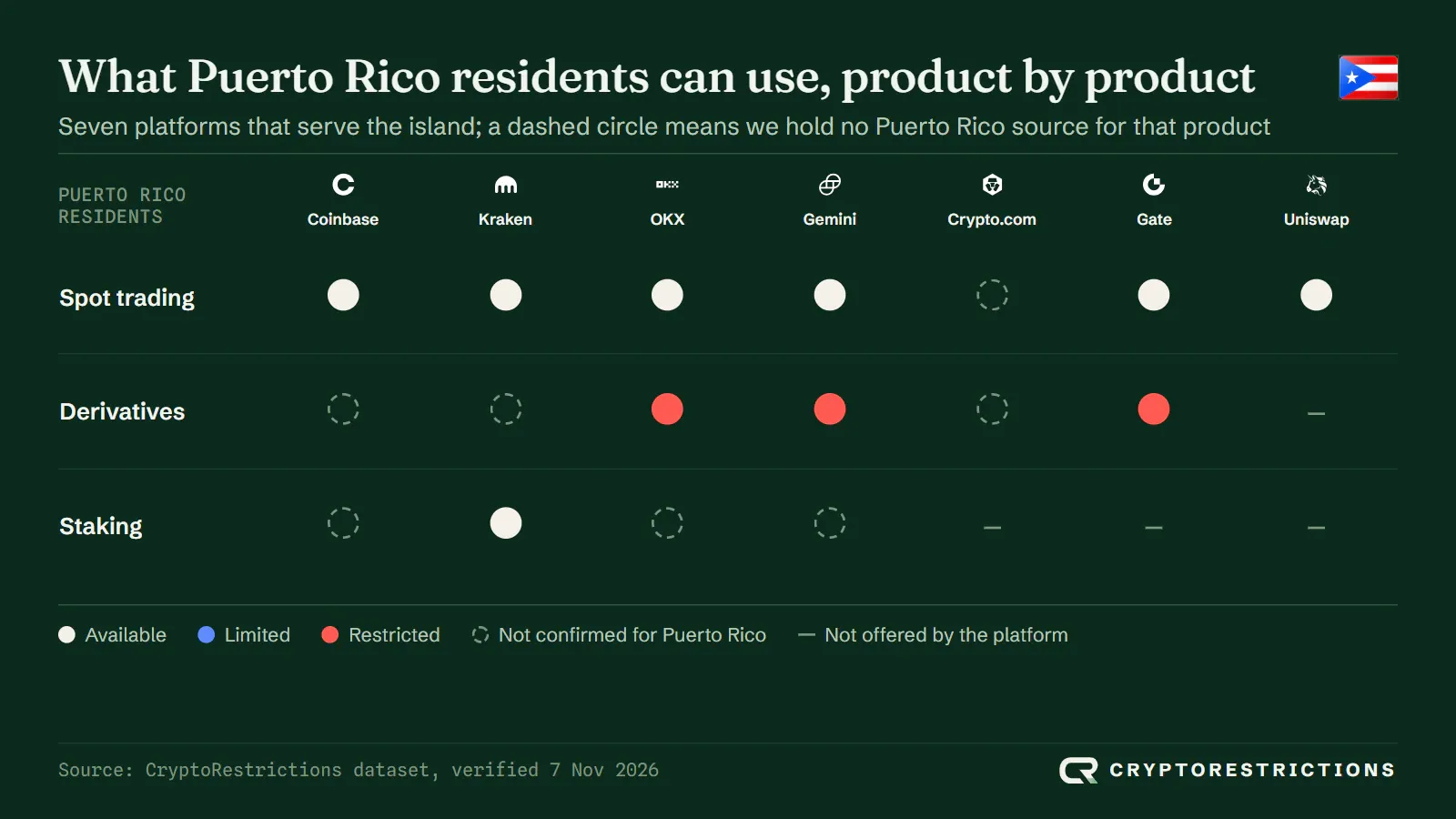
- Derivatives. OKX offers spot trading and OTC buy, sell and convert only to US customers. Gate launched Gate US with spot trading, and its global derivatives are not open to US residents. Gemini leaves Puerto Rico off its perpetuals list.
- Staking. Kraken’s US quick start lists Puerto Rico among the US states and territories where it offers onchain staking.
- Cards. Crypto.com does not offer its prepaid debit card in the US territories.
- Prediction markets. We could not confirm Polymarket or Kalshi for Puerto Rico, and found no statement from Puerto Rican authorities about them, so this guide has no prediction-market section.
How is crypto taxed in Puerto Rico?
The IRS treats crypto as property, and Puerto Rico’s resident investor decree gives a 0% rate on net capital gains to applications filed by 31 December 2026 and a fixed 4% to those filed from 1 January 2027.
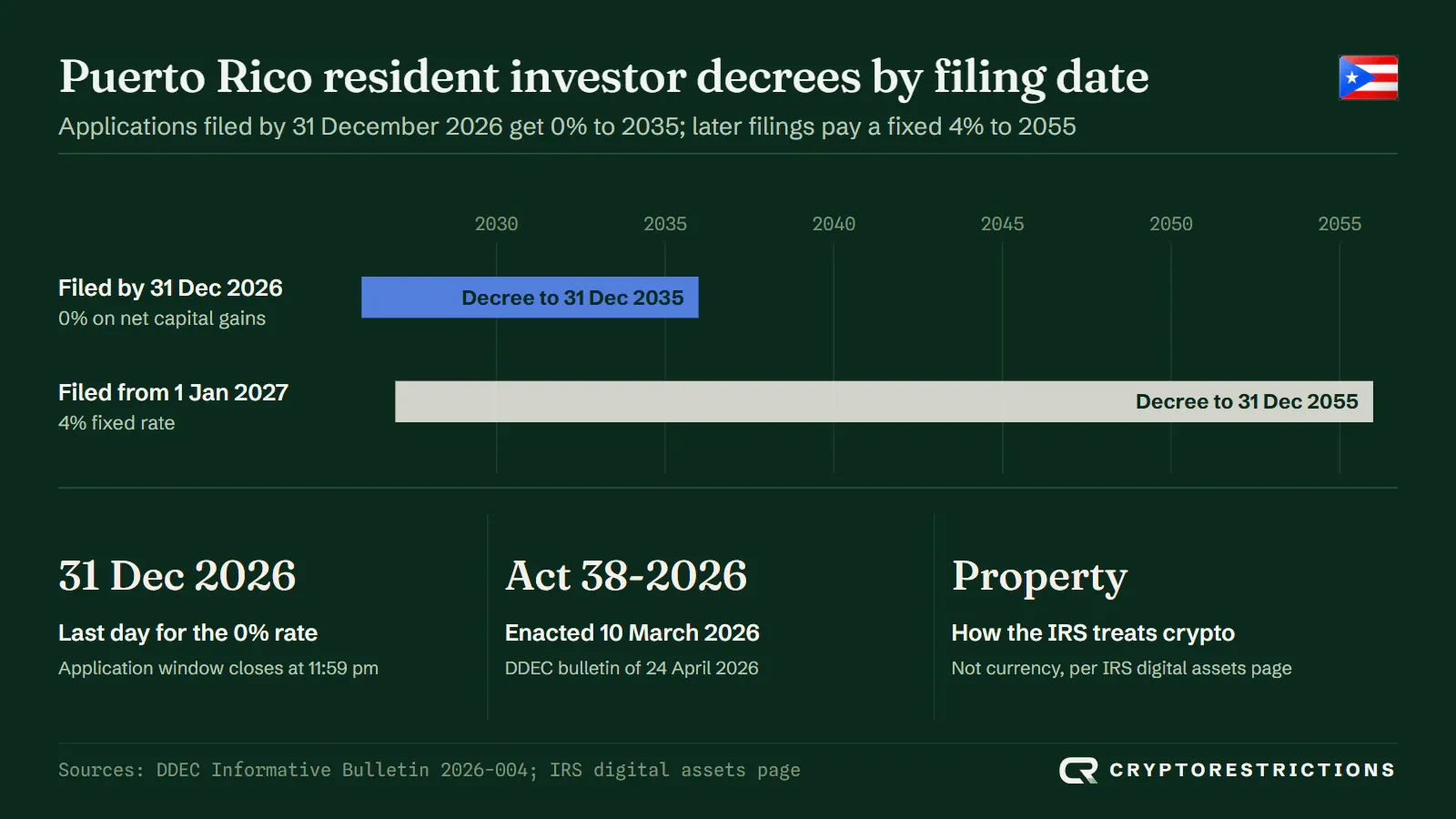
The DDEC bulletin sets out the change from Act 38-2026. Individual Resident Investor applications for the 0% rate on net capital gains, interest and dividends are accepted until 11:59 pm on 31 December 2026, and those decrees run to 31 December 2035. Applications filed from 1 January 2027 get a fixed 4% rate with a decree to 31 December 2055, and extending an existing decree to 2055 also moves it to 4%. For filings after 2026 the applicant must not have been a Puerto Rico resident in the six years before relocating, and the primary residence must be bought in the applicant’s own name, jointly with a spouse or through a grantor trust, not through a company. A criminal record report and a background check are required.
The IRS digital assets page says digital assets are property and that the Form 1040 digital asset question applies. It does not mention Puerto Rico, and we could not read Hacienda, the Puerto Rico Treasury Department, on crypto, so we state no island-level rate for ordinary residents. Brokers report to the IRS on Form 1099-DA: gross proceeds for sales after 2025 and basis for certain sales after 2025. The instructions exclude a “territory financial institution” from the definition of a US digital asset broker without defining it, so we cannot say how that applies to a platform based on the island. Ask a Puerto Rico tax adviser about your own residency, since the decree depends on it.










 Costa Rica
 Mexico
 Panama
 El Salvador
 Dominican Republic
 Canada
 Bermuda
 British Virgin Islands
 Cayman Islands
 Jamaica
 Saint Lucia