
Is crypto legal in Romania?
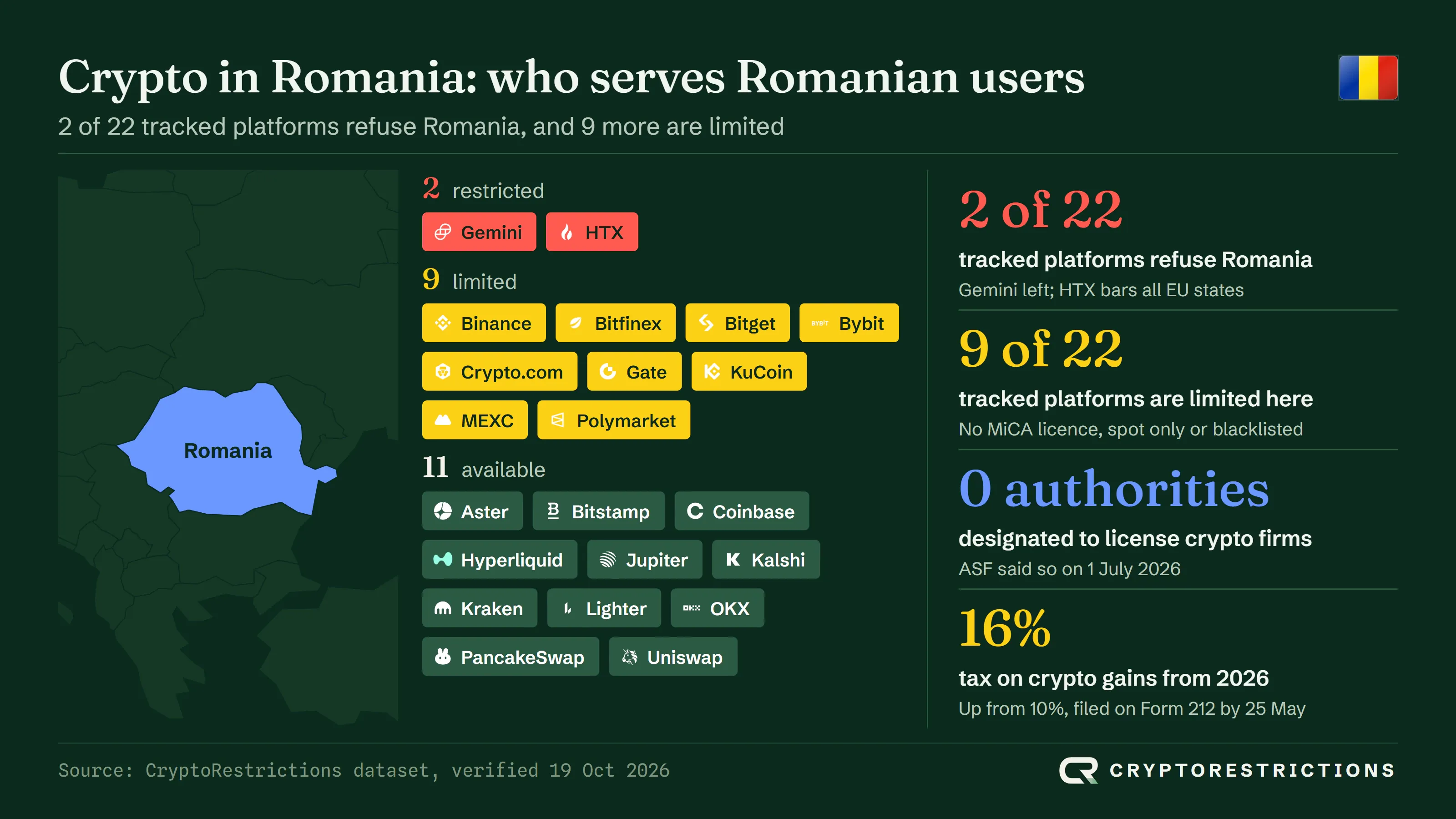
Yes. We found no Romanian law that bans holding or trading crypto, and the tax authority taxes the gains. What Romania lacks is the national law that would let a regulator license crypto firms under MiCA.
The EU’s Markets in Crypto-Assets Regulation (MiCA) applies in Romania directly, but each country must name a regulator to authorise providers. In a 1 July 2026 interview with Ziarul Bursa, the ASF’s first vice-president said no authority is currently designated, and the ASF repeated in a written reply to StartupCafe that it cannot receive applications. The licensing procedure can start only after a national law designates the authority. We could not read the Monitorul Oficial text ourselves, so this rests on those press reports of ASF statements. Some law-firm pages say an ordinance of March 2025 already named the ASF; the ASF’s own July statements say otherwise, and we found no text that settles it.
The designation is a draft. A government ordinance on MiCA implementation had its first reading on 2 April 2026. A law-firm commentary on an earlier version says it gives the ASF supervision of crypto-asset service providers and leaves the National Bank (BNR) with e-money tokens issued by banks and e-money institutions. We found no report of its adoption, and the government that put it forward fell in May 2026. The European Commission has opened an infringement case over the missing legislation.
The EU-wide transition ended on 1 July 2026, and ESMA says unauthorised firms must stop serving EU clients. Before MiCA, Romanian virtual-currency providers notified the anti-money-laundering office (ONPCSB) under Law 129/2019, and those registered before 30 December 2024 could keep operating under national rules until July 2026. We found no ANAF register of crypto providers: ANAF is the tax authority. Providers licensed in another EU country can still serve Romania on a passport, which is how every exchange in the next section reaches Romanian users.
Which crypto exchanges work in Romania?
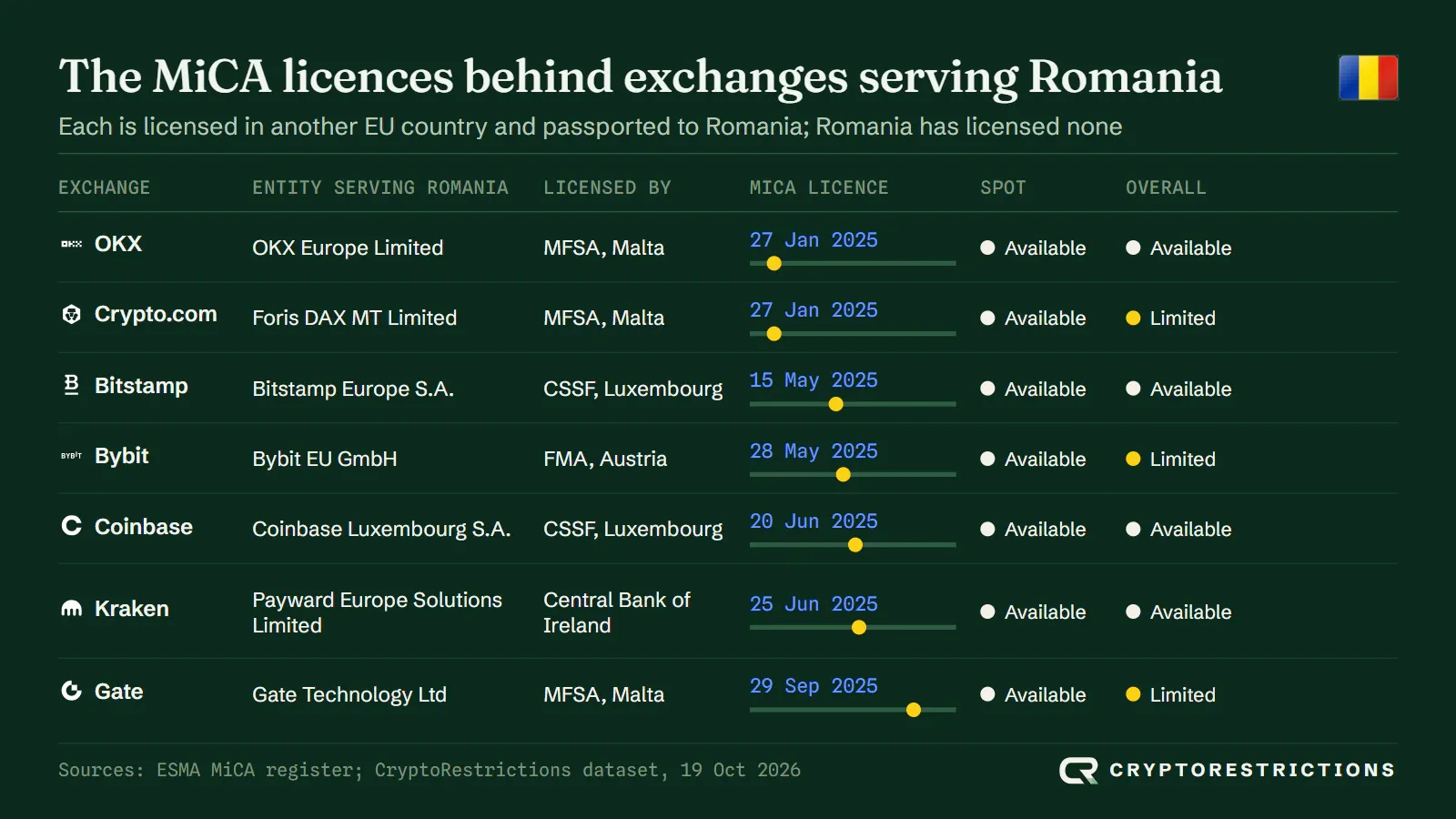
Seven of the exchanges we track serve Romanian users under a MiCA licence from another EU country: Coinbase, Kraken, OKX, Bitstamp, Bybit, Crypto.com and Gate. Four are fully available; Bybit, Crypto.com and Gate are limited because they offer no derivatives here.
None of them holds a Romanian licence, because none can be granted. ESMA’s interim MiCA register has no authorised provider with Romania as its home country, and it lists Romania as a passport country for each of the seven. KuCoin EU and Gemini also carry a Romanian passport, but KuCoin’s trading is suspended and Gemini has closed every EEA account, so both sit among the platforms below.
Best crypto platforms for Romanian residents
By our access score, Bitstamp and Kraken (each 8.0 out of 10) are the most open exchanges for Romanian users, with Coinbase and OKX (7.5) next. Kalshi and all six on-chain platforms we track score 8.0, while Polymarket, on the gambling blacklist, scores 6.3.
The score rates how fully a Romanian resident can use each platform, not its fees or safety. It is computed from our data and moves when a row changes: access status (4 points), the share of the platform’s products open here (3), the licences we hold on file for Romania (2) and what our geo-access test saw from a Romanian address (1). No platform earns the licence points, because no licence can be booked to Romania. Platforms that refuse Romanian users are not scored. The full method is on our methodology page.
Exchanges

Bitstamp
Best for Spot trading from a long-running EU licence
8.0/10- Access
- 4/4
- Products
- 3/3
- Licences
- 0/2
- Our test
- 1/1
Read our Bitstamp reportPros
- Bitstamp Europe S.A. holds a CSSF MiCA licence from 15 May 2025, passported to Romania
- Our test loaded the site with no barrier
Cons
- No Romanian entity: served from Luxembourg

Kraken
Best for A MiCA-licensed exchange with a wide product range
8.0/10- Access
- 4/4
- Products
- 3/3
- Licences
- 0/2
- Our test
- 1/1
Read our Kraken reportPros
- Payward Europe Solutions holds a Central Bank of Ireland MiCA licence with a Romanian passport
- Our test loaded sign-up from a Romanian address with no barrier
Cons
- No Romanian entity: served from Ireland

Coinbase
Best for A MiCA-licensed exchange from Luxembourg
7.5/10- Access
- 4/4
- Products
- 3/3
- Licences
- 0/2
- Our test
- 0.5/1
Read our Coinbase reportPros
- Coinbase Luxembourg S.A. holds a CSSF MiCA licence with a Romanian passport
- Our data shows no carve-outs for Romania
Cons
- No Romanian entity: served from Luxembourg
- Our test showed a notice that stocks and prediction markets are unavailable

OKX
Best for A global brand with a local EU site
7.5/10- Access
- 4/4
- Products
- 3/3
- Licences
- 0/2
- Our test
- 0.5/1
Read our OKX reportPros
- OKX Europe Limited holds an MFSA MiCA licence from 27 January 2025, passported to Romania
- okx.com sends Romanian visitors to OKX Europe
Cons
- Served from Malta, not by a Romanian entity

Bybit
Best for Spot trading on an Austrian licence
6.9/10- Access
- 3.5/4
- Products
- 2.4/3
- Licences
- 0/2
- Our test
- 1/1
Read our Bybit reportPros
- Bybit EU GmbH holds an Austrian MiCA licence with a Romanian passport
- Our test loaded sign-up with no barrier
Cons
- Bybit EU offers no derivatives
- EEA access to Bybit Global, which does, is being wound down

Crypto.com
Best for Spot trading in an app
6.3/10- Access
- 3.5/4
- Products
- 1.8/3
- Licences
- 0/2
- Our test
- 1/1
Read our Crypto.com reportPros
- Foris DAX MT Limited holds a Malta MiCA licence from 27 January 2025, passported to Romania
- Spot trading and the app are offered
Cons
- Derivatives are on its geo-restrictions list for Romania

Gate
Best for Spot trading on a licensed EU arm
5.5/10- Access
- 3.5/4
- Products
- 1.5/3
- Licences
- 0/2
- Our test
- 0.5/1
Read our Gate reportPros
- Gate Technology Ltd holds a Maltese MiCA licence with a Romanian passport
- Spot trading is open to Romanian users
Cons
- No derivatives: global Gate stopped taking EEA users in March 2025
- Our test showed an EU-region notice at sign-up
Perpetuals

Aster
Best for Perpetuals from your own wallet
8.0/10- Access
- 4/4
- Products
- 3/3
- Licences
- 0/2
- Our test
- 1/1
Read our Aster reportPros
- Romania is not on its prohibited-jurisdictions list
- Its trading app loaded in our test
Cons
- No licence on file for Romania

Hyperliquid
Best for Perpetuals and spot on a decentralised exchange
8.0/10- Access
- 4/4
- Products
- 3/3
- Licences
- 0/2
- Our test
- 1/1
Read our Hyperliquid reportPros
- Romania is not excluded by its terms
- Its app loaded in our test with no barrier
Cons
- No licence on file for Romania

Lighter
Best for Perpetual futures from your own wallet
8.0/10- Access
- 4/4
- Products
- 3/3
- Licences
- 0/2
- Our test
- 1/1
Read our Lighter reportPros
- Romania is not named in its terms
- Its trading app loaded in our test
Cons
- No licence on file for Romania
DeFi

Jupiter
Best for Solana swaps
8.0/10- Access
- 4/4
- Products
- 3/3
- Licences
- 0/2
- Our test
- 1/1
Read our Jupiter reportPros
- Romania is not in its terms
- Its app loaded in our test
Cons
- No licence on file for Romania

PancakeSwap
Best for BNB Chain swaps and pools
8.0/10- Access
- 4/4
- Products
- 3/3
- Licences
- 0/2
- Our test
- 1/1
Read our PancakeSwap reportPros
- Not excluded by its terms
- The swap page loaded in our test
Cons
- No licence on file for Romania

Uniswap
Best for Swapping tokens from your own wallet
8.0/10- Access
- 4/4
- Products
- 3/3
- Licences
- 0/2
- Our test
- 1/1
Read our Uniswap reportPros
- Its terms bar only places under comprehensive US sanctions
- Our test loaded the swap app from a Romanian address
Cons
- No licence on file for Romania
Prediction markets

Kalshi
Best for Event contracts on a US-regulated exchange
8.0/10- Access
- 4/4
- Products
- 3/3
- Licences
- 0/2
- Our test
- 1/1
Read our Kalshi reportPros
- Romania is not on its restricted-jurisdictions list
- Its sign-up page loaded in our test with no barrier
Cons
- No licence on file for Romania
- The gambling regulator blacklisted its peer Polymarket in October 2025

Polymarket
Best for The widest range of event markets
6.3/10- Access
- 3/4
- Products
- 2.3/3
- Licences
- 0/2
- Our test
- 1/1
Read our Polymarket reportPros
- Romania is not on its own restricted list
- Its site loaded from our test address
Cons
- The gambling regulator ONJN blacklisted it and asked providers to block it
- A court declined to suspend the blacklisting, according to press reports
Which platforms block Romanian users?
Two of the 22 platforms we track refuse Romanian users: Gemini and HTX. Nine more are limited: five lack a working MiCA licence, three offer only part of their service, and one is on the gambling blacklist.
Gemini closed every UK and EEA account on 6 April 2026, and HTX’s user agreement bars all EU member states. Since 23 August 2026 EU sanctions on Russia-linked providers also ban dealings with HTX, under Regulation (EU) 2026/1848.

The limited platforms are mostly MiCA casualties. Binance told European users about its licensing delay in June 2026, and Euronews reported that it would halt services across EU countries; its Romanian status follows that wind-down, with existing users able to withdraw. Bitget applied to Austria’s FMA on 2 July 2026 and says it will serve the EU once authorised. KuCoin EU’s trading has been suspended since February 2026.

What our geo-access test saw from Romania
From a Romanian address on 14 and 16 October 2026 we loaded 22 of the platforms we track: 1 refused us, 5 showed a notice or a redirect, and 16 loaded with no barrier.
An open page is not permission. Binance, HTX, MEXC and Polymarket all loaded although their terms, notices, sanctions or a regulator say Romania should not be served; our test address sees a platform’s own geo-blocking, not a block applied by a Romanian internet provider. The one refusal was Gemini (“Gemini does not currently operate in Romania”). The five notices were a European regulatory information link at Binance, Coinbase’s notice that stocks and prediction markets are unavailable, an EU-region prompt at Gate, a KuCoin suggestion to switch to its EU site and OKX’s redirect to its European site. Swipe through the screenshots below; each card quotes what the page showed.
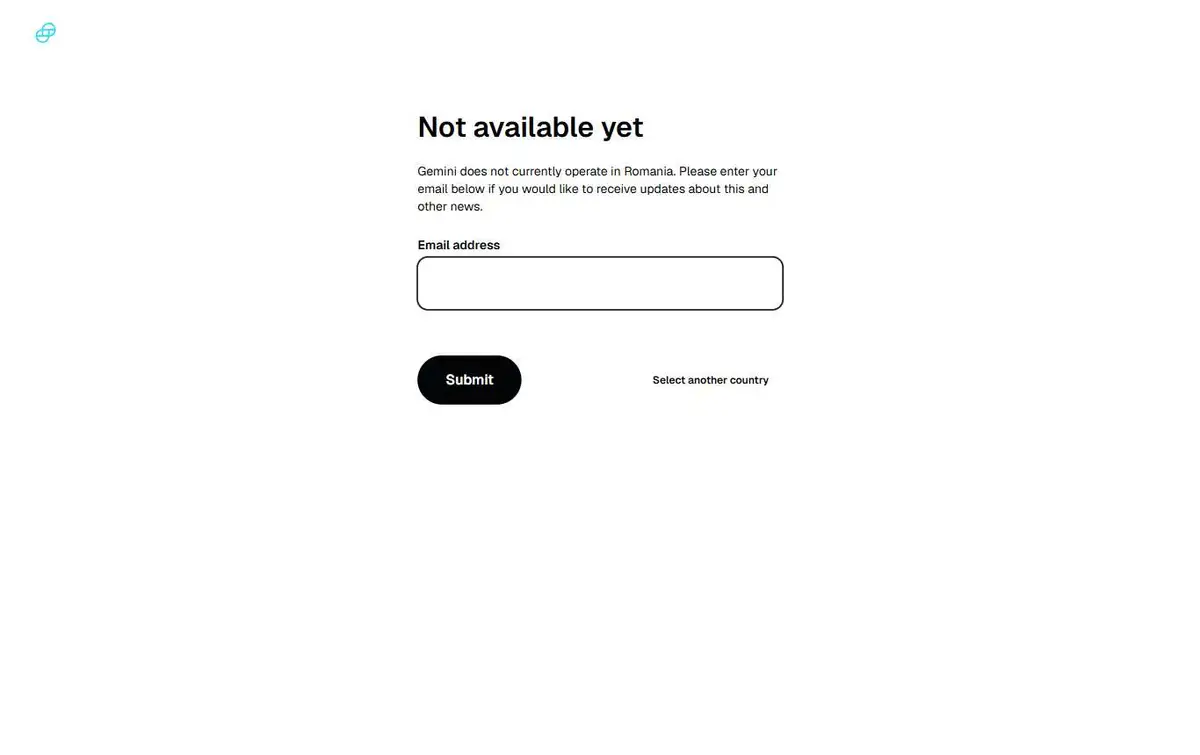
Blocked Gemini · Sign-up page
Romania, one of the EEA countries Gemini closed in April 2026, gets the same refusal
“Gemini does not currently operate in Romania.”
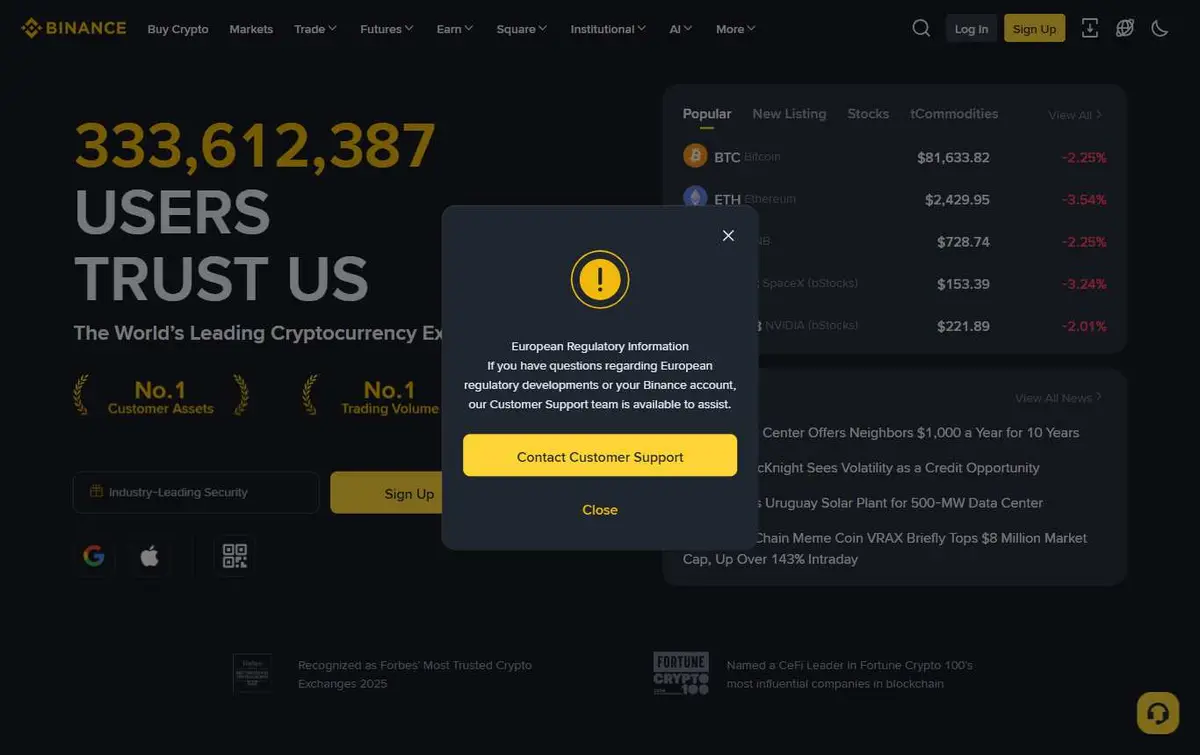
Notice shown Binance · Home page
Romania: the global site loads, with a European regulatory information link
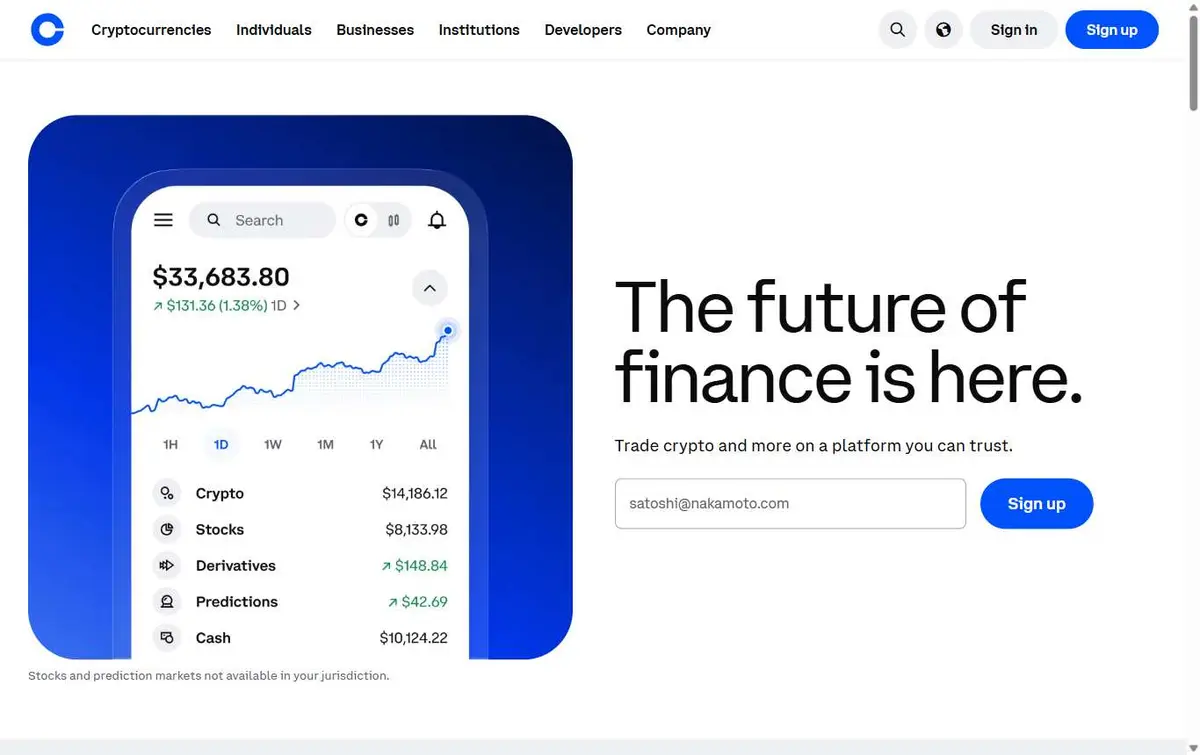
Notice shown Coinbase · Home page
Romania: the site loads, with a notice that stocks and prediction markets are not available
“Stocks and prediction markets not available in your jurisdiction.”
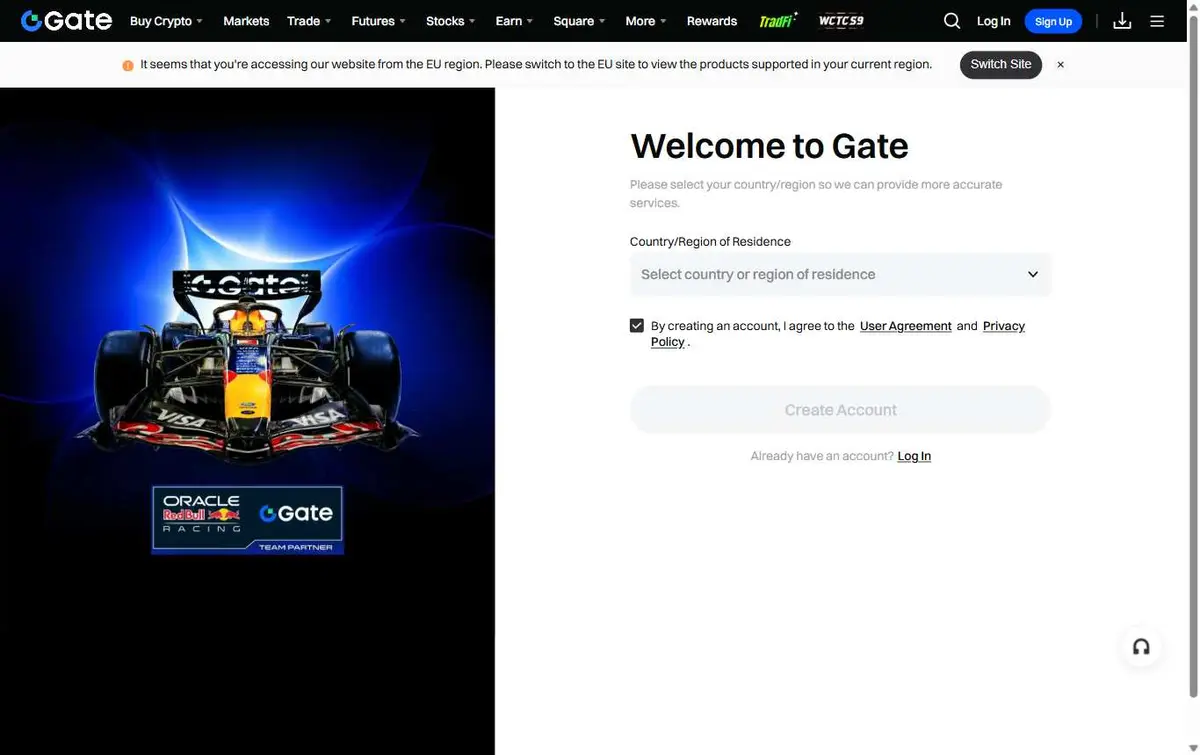
Notice shown Gate · Sign-up page
Romania gets an EU-region notice at sign-up
“It seems that you're accessing our website from the EU region.”
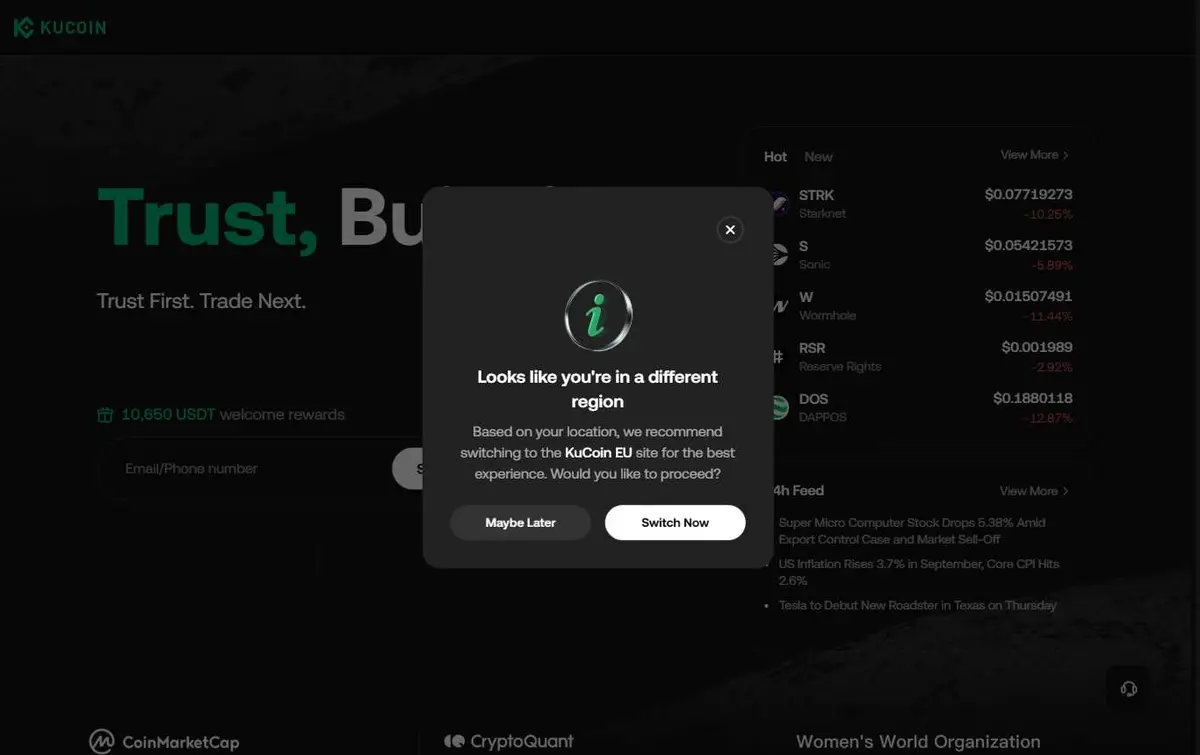
Notice shown KuCoin · Home page
Romania is pointed to the KuCoin EU site, which has had trading suspended since February 2026
“Based on your location, we recommend switching to the KuCoin EU site for the best experience.”
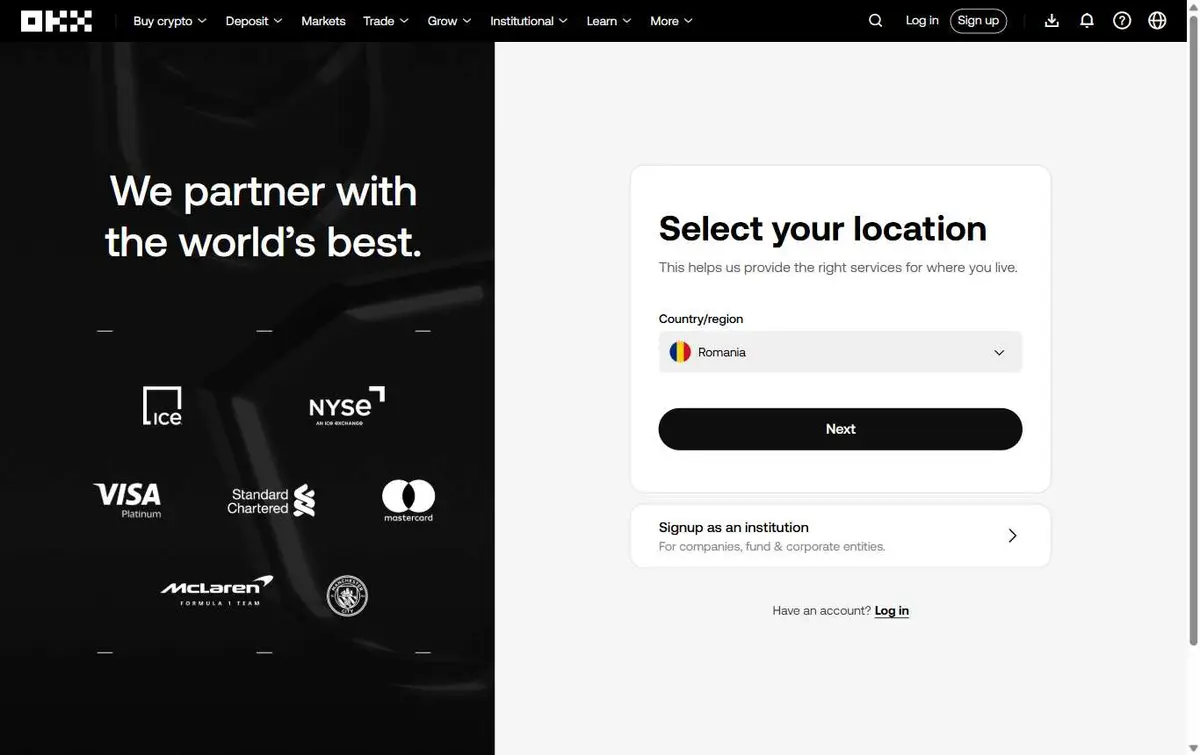
Notice shown OKX · Sign-up page
Romania: sign-up is served by OKX Europe
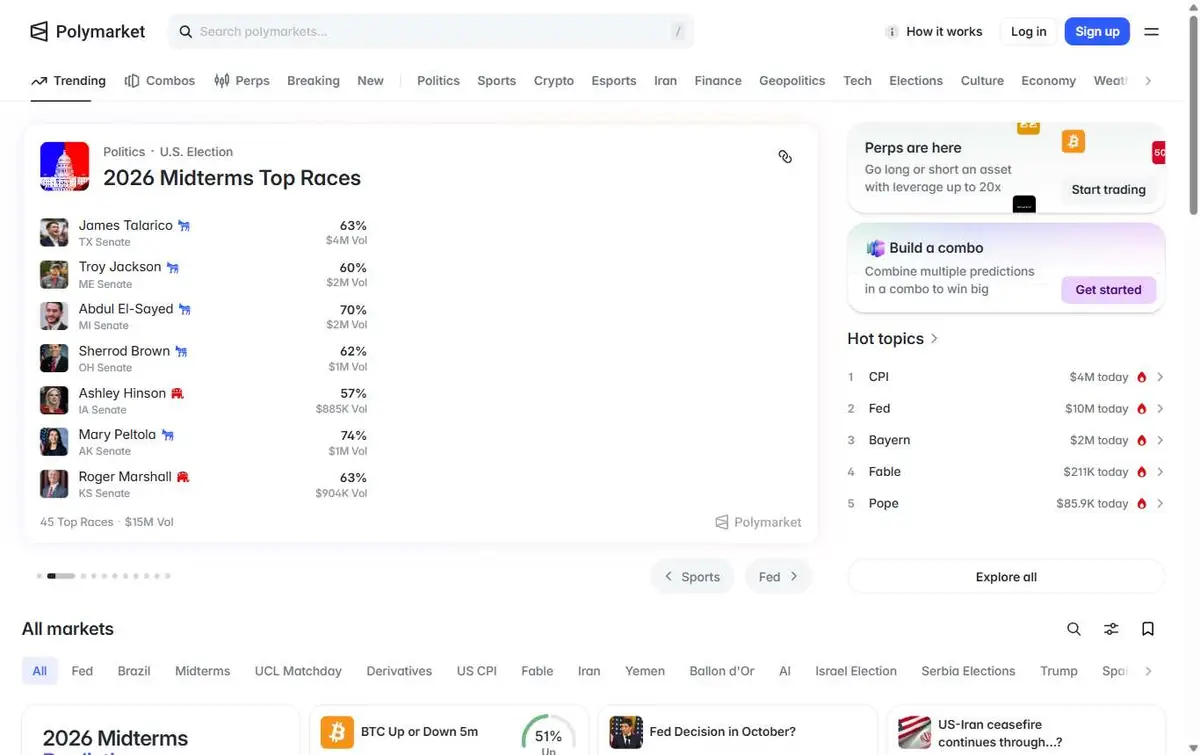
No barrier Polymarket · Home page
Romania, blacklisted by the gambling regulator ONJN: the site still loads from our test address, so any block sits with internet providers
 CRYPTORESTRICTIONS
Who regulates crypto in Romania?
Nobody yet licenses crypto firms. The ASF is expected to, once a national law names it; the anti-money-laundering office keeps the old provider notifications, the gambling office runs a blacklist, and the tax agency ANAF taxes gains and receives DAC8 reports.
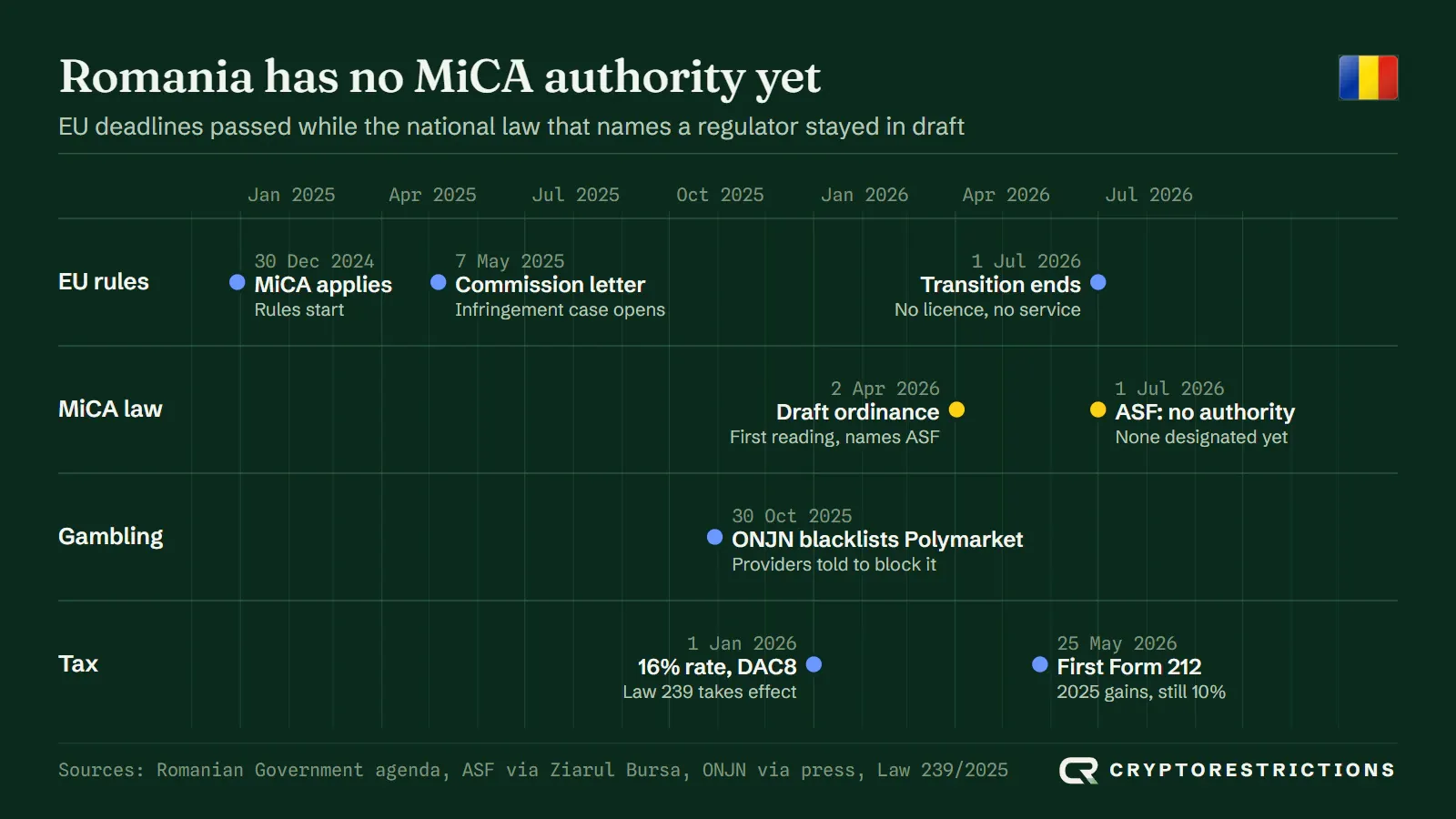
- ASF. The Financial Supervisory Authority is not yet designated. The draft ordinance would make it the MiCA authority for crypto-asset service providers, and it already authorises crypto ATM operators, according to Piata Financiara. We found no ASF warning naming any platform we track.
- BNR. The National Bank is slated, under the same draft, to supervise e-money token issuers that are banks or e-money institutions.
- ONPCSB. The anti-money-laundering office took notifications from virtual-currency providers under Law 129/2019. We could not read its register, and we found no source for its status after 1 July 2026.
- ONJN. The National Gambling Office keeps the blacklist of unlicensed gambling sites, covered in the prediction-markets section.
- ANAF. The tax agency sets the crypto tax rules and receives provider reports, covered in the tax section.
Which crypto products are limited in Romania?
Spot trading is the open product. Derivatives are the narrowest: Bybit EU, Crypto.com and Gate offer none to Romanian users, and the one prediction market we track as limited is blacklisted.
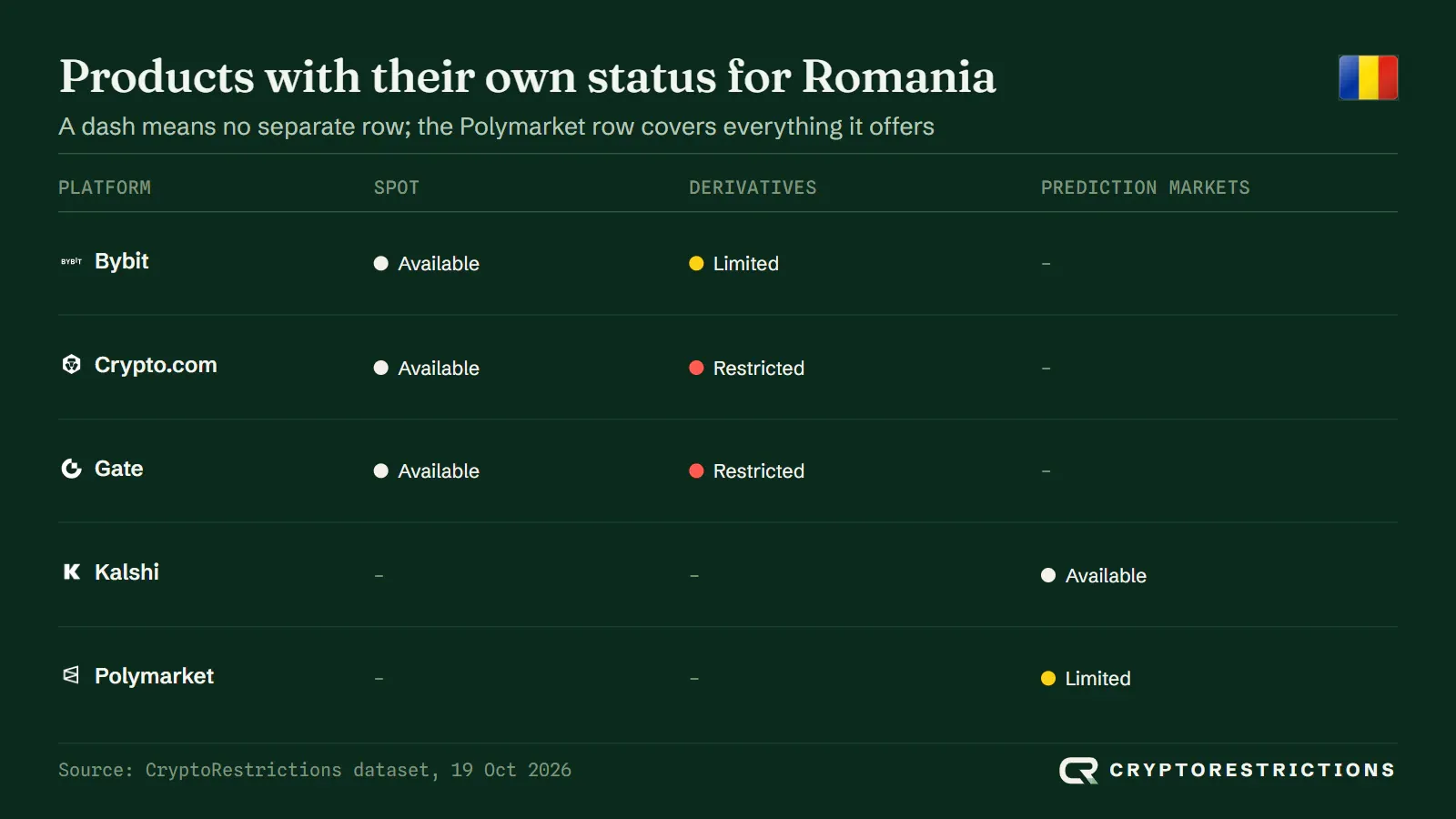
- Derivatives. Bybit EU offers no derivatives, and EEA access to Bybit Global is being wound down. Crypto.com lists Romania on its derivatives geo-restrictions. Gate’s EU arm has no derivatives, and global Gate stopped taking EEA users in March 2025. Perpetuals on Aster, Hyperliquid and Lighter load from Romania and are not excluded by their terms.
- Prediction markets. Kalshi is open and Polymarket is limited, as the next section explains.
Are prediction markets legal in Romania?
Unsettled in law, and blocked in practice for one platform. The gambling regulator ONJN blacklisted Polymarket in October 2025 as unlicensed betting, while Kalshi is open to Romanian addresses and we found no Romanian action naming it.
Press reports of the ONJN notice, such as Financial Intelligence on 30 October 2025, say the office put Polymarket on its blacklist as an unlicensed operator of counterparty bets and told internet providers to block access for players in Romania. Decrypt reports the legal basis as the gambling ordinance 77/2009. A Bucharest court reportedly declined to suspend the decision in April 2026. We could not read the ONJN’s own notice, because its website returned errors, so every ONJN detail here comes from press reports.
Polymarket does not list Romania itself, and its site loaded from our test address, so the practical block sits with Romanian providers. Kalshi does not name Romania either. We found no Romanian bill on prediction markets, and no ONJN action against Kalshi or any other platform.
How is crypto taxed in Romania?
Selling crypto at a profit is taxed as income from other sources, at a rate Law 239 raised for gains made from 1 January 2026. A gain under 200 lei on a sale is untaxed if the year’s gains total 600 lei or less, and you work out and declare the tax yourself.
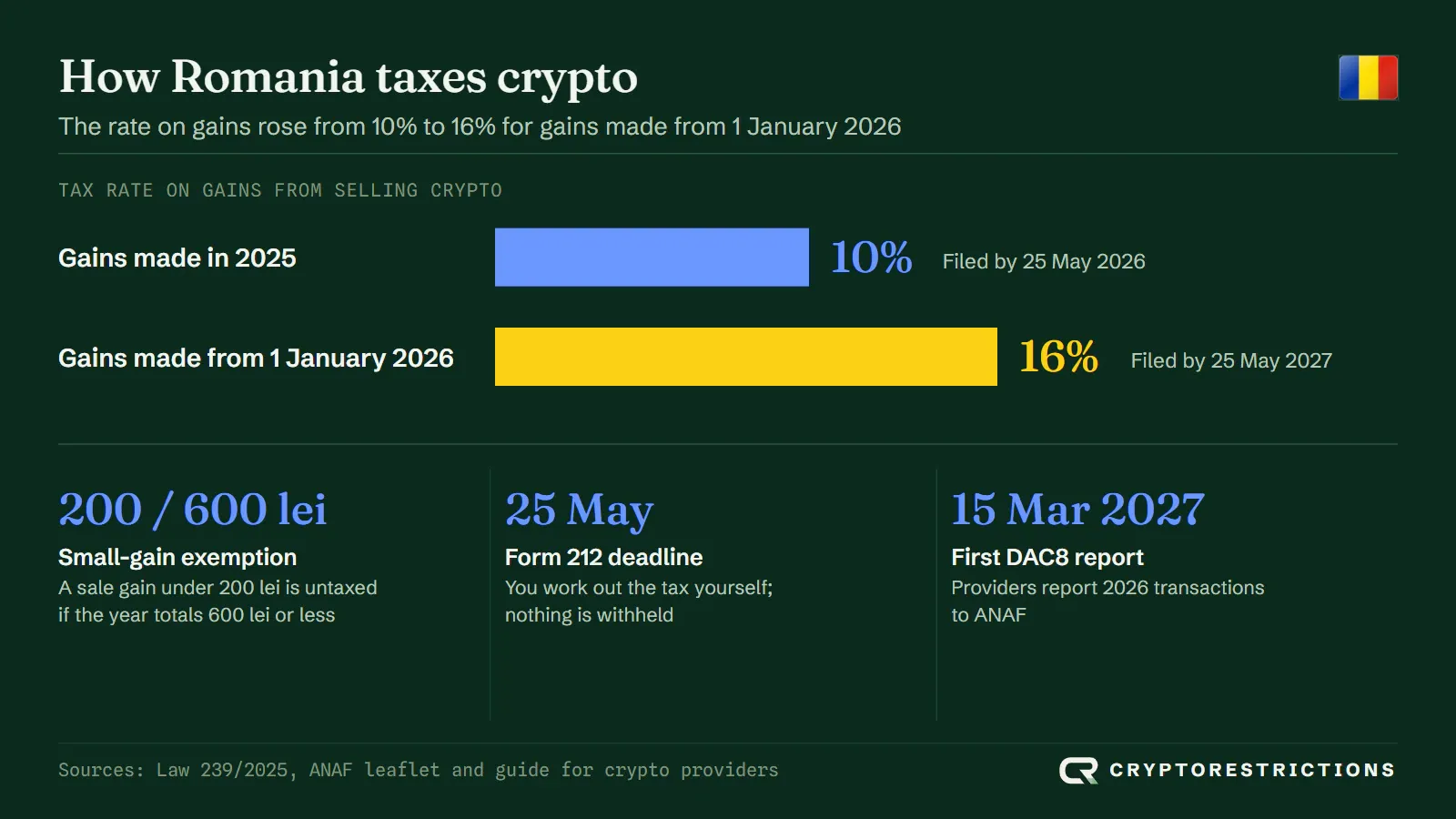
Crypto gains of individuals count as “income from other sources” under the Fiscal Code, according to an ANAF leaflet that still shows the old 10% rate, so we use it for classification and procedure only. The rate comes from Law 239 of 15 December 2025, which repeals the 10% rule and sets 16% on the gain from transferring virtual currency, meaning the sale price minus the purchase price and direct transaction costs. It applies to gains made from 1 January 2026, so the first returns at 16% are due in May 2027. The same law keeps the exemption for a gain under 200 lei per transaction when the year’s gains total no more than 600 lei.
You work out the tax yourself in the single return (Form 212), converting to lei at the National Bank rate; nothing is withheld. The Fiscal Code defines a transfer to include exchanging one property right for another, so a swap between cryptocurrencies falls inside it, though the ANAF leaflet does not name swaps. It does not address mining, staking or airdrops either, and we could not verify from the primary text whether health contributions (CASS) apply on top.
Reporting is tightening. Emergency Ordinance 71/2025 carries the EU’s DAC8 rules into Romanian law, and ANAF’s guide for providers says the rules apply from 1 January 2026, with the first reports, covering 2026 transactions, due in 2027 by 15 March.


 Serbia
 Turkey
 Switzerland
 Iceland
 Liechtenstein
 Norway
 Croatia
 Estonia
 Finland
 Greece
 Latvia