Is crypto legal in Colombia?
Yes in practice: no Colombian law bans holding or trading crypto, but none regulates it either. The financial regulator says it supervises no crypto provider, and the licensing bill filed in 2025 was archived.
The Superintendencia Financiera (SFC) said in Carta Circular 29 of 2014 that the institutions it supervises are not authorised to custody, invest in or intermediate virtual currencies, and that the peso is the only legal tender. A notice of 26 July 2024 adds that the SFC does not regulate, supervise, endorse or grant permits for crypto business models. Its innovation-hub page, modified on 15 September 2026, still says virtual assets are not regulated and that the SFC has no power to supervise or authorise their providers. Another SFC page, modified 11 June 2026, says Colombia has no legal definition of crypto and that a shop may refuse it as payment.
We found no Constitutional Court, Supreme Court or Council of State ruling on whether crypto is legal. The central bank’s own opinions say crypto is not currency, but its pages refused our connection, so we could not confirm their dates.
The SFC ran a pilot in its regulatory sandbox, laArenera, in which banks tested deposit accounts for crypto exchanges. It ended on 13 June 2024 with seven alliances, each a supervised entity and a Colombian exchange, according to the SFC’s closing report of 27 June 2024. The report names none of them; Portafolio lists Bitso, Buda, Gemini and Binance among them. Taking part was not an authorisation, and we found no new crypto cohort in 2025 or 2026.
Congress has not filled the gap. Bill 510 of 2025 would have set up a registry of virtual asset service providers at the Superintendencia de Sociedades; per Holland & Knight it was filed on 25 February 2025. It passed its first debate, but the Chamber’s page now shows it archived under article 190 of Law 5 of 1992, without a date. A government framework bill for stablecoins and tokens was reported ready on 25 February 2026, according to Valora Analitik, but Infobae reported on 17 August 2026 that no new bill had been filed.
Which crypto exchanges work in Colombia?
13 of the 14 exchanges we track serve Colombian residents and Gemini does not. Colombia licenses none of them, so there is no register to check; we confirmed peso funding only at Binance and Kraken.
Because the SFC supervises no provider, an exchange cannot hold a Colombian licence. The statuses below come from each platform’s own country lists and our geo-access test, not from a Colombian register.
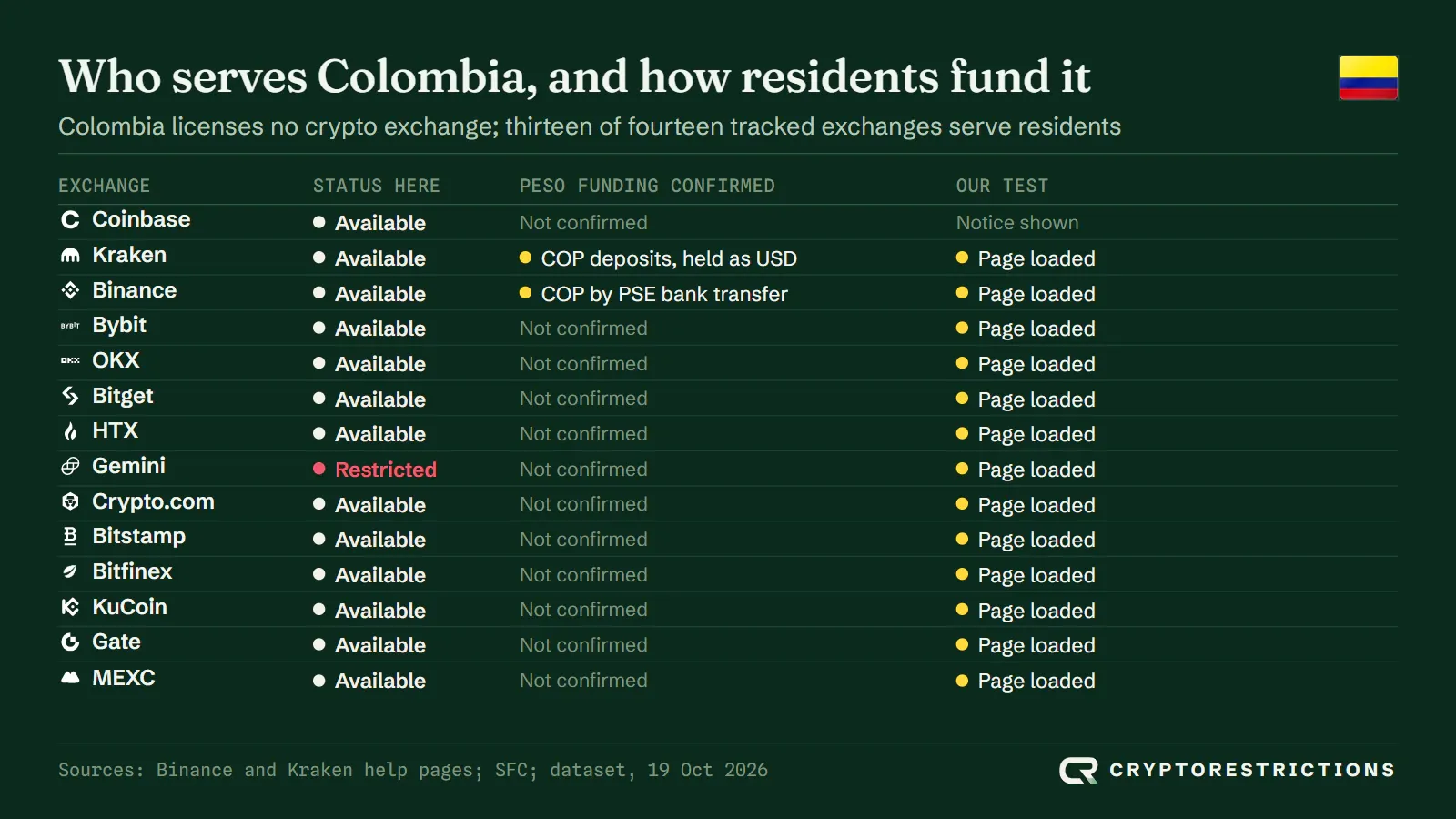
Binance takes peso deposits by PSE bank transfer, per its help page updated on 9 September 2025. Forbes Colombia reported on 16 February 2026 that it connected to Bre-B, the instant bank-transfer rail, for deposits and withdrawals around the clock; we could not find Binance’s own page on it. Kraken launched local peso funding on 4 December 2025, but its post does not name the payment methods, and the pesos convert to US dollars.
Local exchanges such as Bitso, Buda and Panda are not among the platforms we track.
Best crypto platforms for Colombian residents
By our access score the 20 available platforms all get the same 8.0 out of 10, because Colombia issues no licence that could earn the last two points, and Polymarket (limited) gets 6.3. The picks below differ by funding options and by what we found.
The score rates how fully a Colombian resident can use each platform, not its fees or safety. It is computed from our data and moves when a row changes: access status (4 points), the share of the platform’s products open here (3), the licences we hold on file for Colombia (2) and what our geo-access test saw from a Colombian address (1). Platforms that refuse Colombian residents are not scored, which leaves out Gemini. The full method is on our methodology page.
Exchanges

Binance
Best for Peso deposits by PSE
8.0/10- Access
- 4/4
- Products
- 3/3
- Licences
- 0/2
- Our test
- 1/1
Read our Binance reportPros
- Takes COP by PSE bank transfer, per its help page of 9 September 2025
- Colombia is not on its prohibited-countries list
Cons
- Its Bre-B support is known only from press reports

Bitfinex
Best for Spot and margin for experienced traders
8.0/10- Access
- 4/4
- Products
- 3/3
- Licences
- 0/2
- Our test
- 1/1
Read our Bitfinex reportPros
- Colombia is not a prohibited jurisdiction under its terms
- Its pages loaded in our test
Cons
- Peso funding not confirmed on its own pages

Bitget
Best for Spot and derivatives in one account
8.0/10- Access
- 4/4
- Products
- 3/3
- Licences
- 0/2
- Our test
- 1/1
Read our Bitget reportPros
- Colombia is not on its prohibited-countries list (updated 16 October 2026)
- Its pages loaded in our test
Cons
- Its list is non-exhaustive, so absence is not a guarantee

Bitstamp
Best for Plain spot trading
8.0/10- Access
- 4/4
- Products
- 3/3
- Licences
- 0/2
- Our test
- 1/1
Read our Bitstamp reportPros
- No Bitstamp document excludes Colombia
- Its home page loaded in our test
Cons
- Peso funding not confirmed on its own pages

Bybit
Best for Spot and derivatives in one account
8.0/10- Access
- 4/4
- Products
- 3/3
- Licences
- 0/2
- Our test
- 1/1
Read our Bybit reportPros
- Colombia is not on its excluded-jurisdictions list
- Its pages loaded in our test
Cons
- Peso funding not confirmed on its own pages

Crypto.com
Best for Trading in an app
8.0/10- Access
- 4/4
- Products
- 3/3
- Licences
- 0/2
- Our test
- 1/1
Read our Crypto.com reportPros
- Colombia is not on its app or spot geo-restriction lists
- Its home page loaded in our test
Cons
- Peso funding not confirmed on its own pages

Gate
Best for A wide range of listed tokens
8.0/10- Access
- 4/4
- Products
- 3/3
- Licences
- 0/2
- Our test
- 1/1
Read our Gate reportPros
- Colombia is not named in its restricted-locations clause (updated 22 July 2026)
- Its pages loaded in our test
Cons
- Its list is non-exhaustive, so absence is not a guarantee

HTX
Best for Spot and derivatives in one account
8.0/10- Access
- 4/4
- Products
- 3/3
- Licences
- 0/2
- Our test
- 1/1
Read our HTX reportPros
- Colombia is not on the restricted lists in its user agreement
- Its pages loaded in our test
Cons
- Peso funding not confirmed on its own pages

Kraken
Best for Funding with pesos
8.0/10- Access
- 4/4
- Products
- 3/3
- Licences
- 0/2
- Our test
- 1/1
Read our Kraken reportPros
- Launched local peso funding on 4 December 2025
- Colombia is not on its do-not-serve list
Cons
- Pesos convert to US dollars on deposit
- Its launch post names no payment methods

KuCoin
Best for A wide range of listed tokens
8.0/10- Access
- 4/4
- Products
- 3/3
- Licences
- 0/2
- Our test
- 1/1
Read our KuCoin reportPros
- Colombia is not on its restricted-locations list (updated 29 September 2026)
- Its pages loaded in our test
Cons
- The list may be updated at any time, so absence is not a guarantee

MEXC
Best for A wide range of listed tokens
8.0/10- Access
- 4/4
- Products
- 3/3
- Licences
- 0/2
- Our test
- 1/1
Read our MEXC reportPros
- Colombia is not on its prohibited-jurisdictions list (updated 13 October 2026)
- Its pages loaded in our test
Cons
- Its list is non-exclusive, so absence is not a guarantee

OKX
Best for A global brand with a wide product range
8.0/10- Access
- 4/4
- Products
- 3/3
- Licences
- 0/2
- Our test
- 1/1
Read our OKX reportPros
- Colombia is not on its restricted-locations list (updated 8 July 2026)
- Its pages loaded in our test
Cons
- Peso funding not confirmed on its own pages

Coinbase
Best for A familiar US exchange for spot buying
7.5/10- Access
- 4/4
- Products
- 3/3
- Licences
- 0/2
- Our test
- 0.5/1
Read our Coinbase reportPros
- Colombia is a listed sign-up country in its identity-verification guide
Cons
- Its home page told us stocks and prediction markets are not available here
- Peso funding not confirmed on its own pages
Prediction markets

Kalshi
Best for Regulated event contracts
8.0/10- Access
- 4/4
- Products
- 3/3
- Licences
- 0/2
- Our test
- 1/1
Read our Kalshi reportPros
- Colombia is not on its restricted-jurisdictions list
- Its home page loaded in our test
Cons
- No Colombian rule covers prediction markets

Polymarket
Best for The largest prediction market
6.3/10- Access
- 3/4
- Products
- 2.3/3
- Licences
- 0/2
- Our test
- 1/1
Read our Polymarket reportPros
- Colombia is not on its own blocked-countries list
- Its home page loaded in our test
Cons
- Coljuegos asked internet providers to block it on 29 September 2025
DeFi

Aster
Best for Perpetuals from your own wallet
8.0/10- Access
- 4/4
- Products
- 3/3
- Licences
- 0/2
- Our test
- 1/1
Read our Aster reportPros
- Colombia is not on its prohibited-jurisdictions list
- Its trading app loaded in our test
Cons
- No peso funding: you need crypto from another source

Hyperliquid
Best for Perpetuals and spot on its own chain
8.0/10- Access
- 4/4
- Products
- 3/3
- Licences
- 0/2
- Our test
- 1/1
Read our Hyperliquid reportPros
- Not excluded by its terms
- Its trading app loaded in our test
Cons
- No peso funding: you need crypto from another source

Jupiter
Best for Solana swaps
8.0/10- Access
- 4/4
- Products
- 3/3
- Licences
- 0/2
- Our test
- 1/1
Read our Jupiter reportPros
- Colombia is not named in its terms
- Its app loaded in our test
Cons
- No peso funding: you need crypto from another source

Lighter
Best for Perpetuals from your own wallet
8.0/10- Access
- 4/4
- Products
- 3/3
- Licences
- 0/2
- Our test
- 1/1
Read our Lighter reportPros
- Colombia is not named in its terms
- Its trading app loaded in our test
Cons
- No peso funding: you need crypto from another source

PancakeSwap
Best for BNB Chain swaps and pools
8.0/10- Access
- 4/4
- Products
- 3/3
- Licences
- 0/2
- Our test
- 1/1
Read our PancakeSwap reportPros
- Not excluded by its terms
- The swap page loaded in our test
Cons
- No peso funding: you need crypto from another source

Uniswap
Best for Swapping tokens from your own wallet
8.0/10- Access
- 4/4
- Products
- 3/3
- Licences
- 0/2
- Our test
- 1/1
Read our Uniswap reportPros
- Its terms bar only places under comprehensive US sanctions
- Our test loaded the swap app from a Colombian address
Cons
- No peso funding: you need crypto from another source
Which platforms block Colombian users?
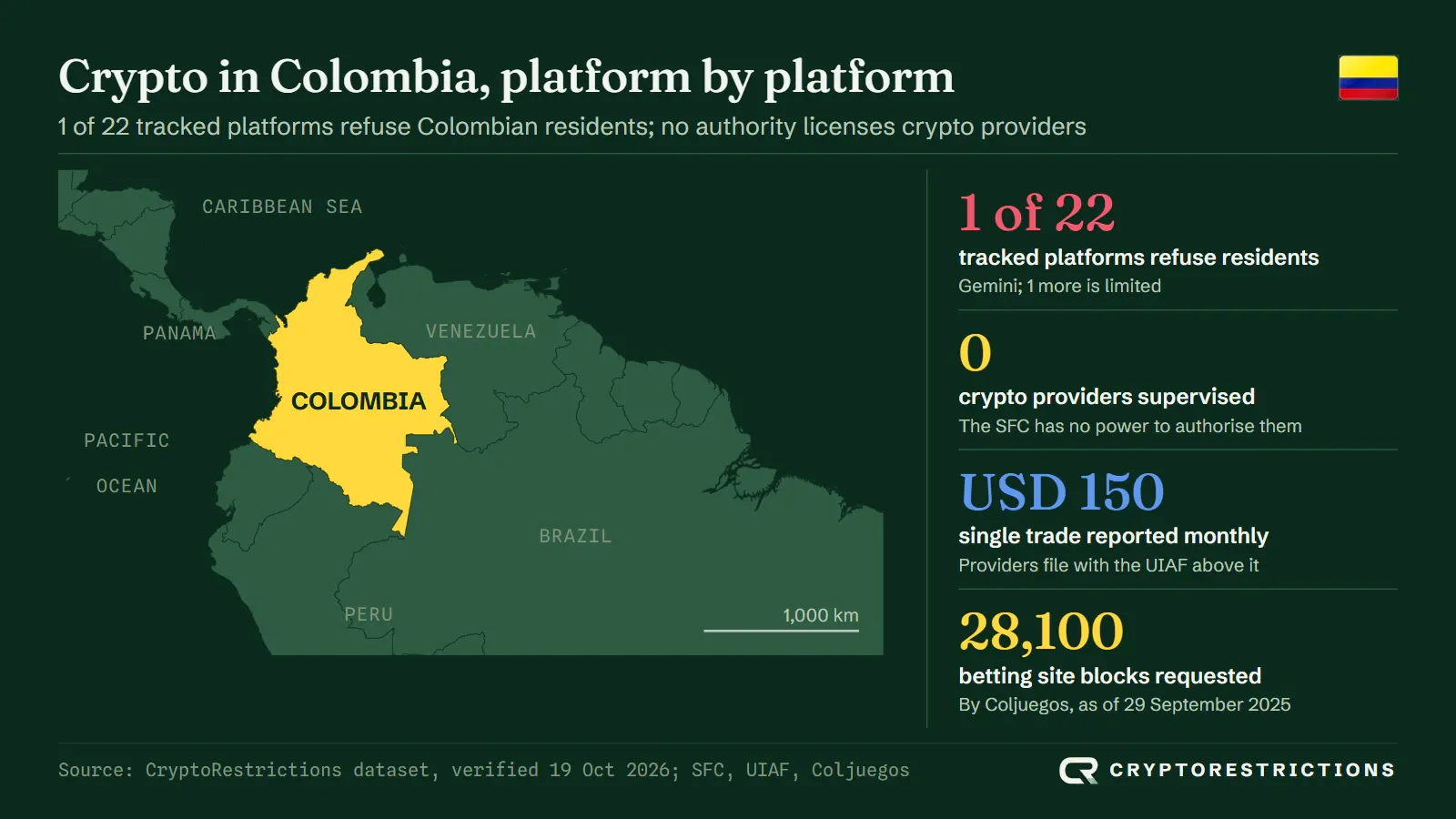
Of the 22 platforms we track, Gemini refuses Colombian residents and Polymarket is limited because the gambling regulator asked for it to be blocked. The other 20 are available.
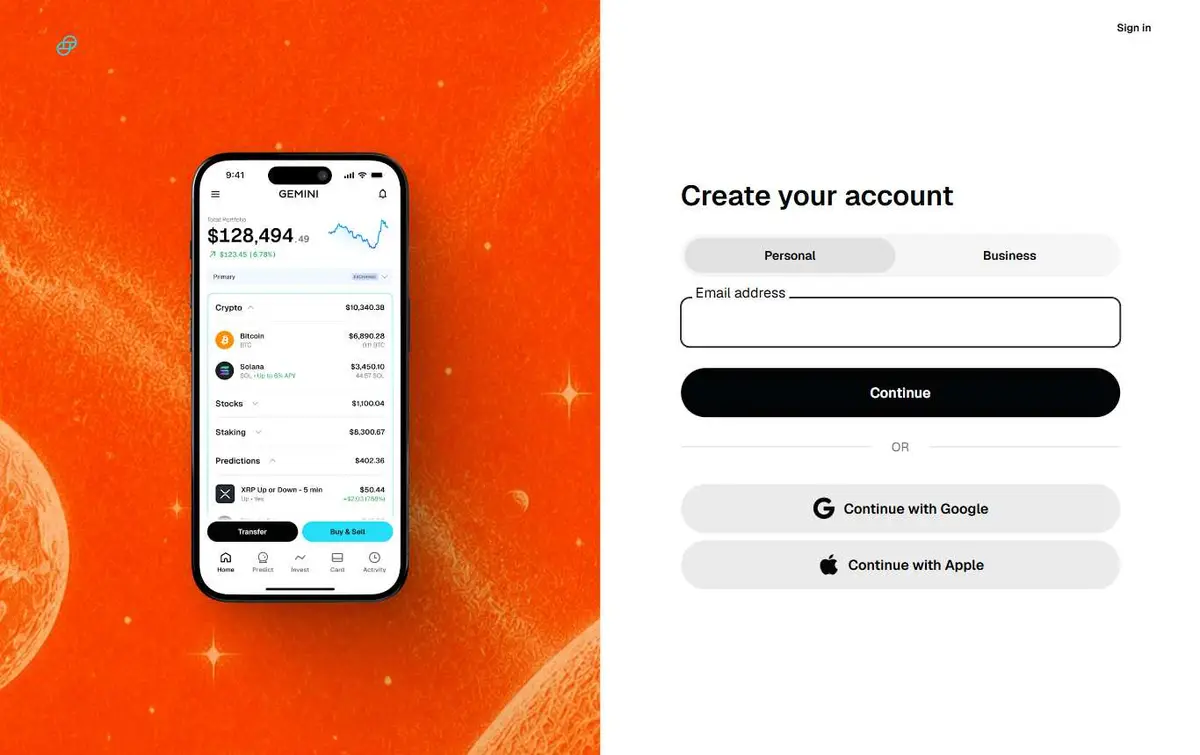
Gemini is the only refusal: Colombia is on neither its list of supported countries nor its list for derivatives. That reads oddly beside the press reports that Gemini joined the SFC pilot with a Colombian bank; we found no Gemini page that says it still serves Colombia, and its sign-up form still opened in our test. Polymarket’s row is described in the prediction markets section below.

The exchanges that exclude residents elsewhere in the world do not name Colombia, but several of those lists are non-exhaustive, so an absence is not a guarantee, and most platforms enforce at identity verification, not at the page. Colombian law gives a platform no reason to close the country, since individuals may hold crypto.
What our geo-access test saw from Colombia
From a Colombian address on 14 and 16 October 2026 we loaded all 22 platforms we track: none refused us, 1 showed a notice and 21 loaded with no barrier.
An open page is not permission, and the test cannot see identity checks or blocks by internet providers. The notice was Coinbase’s, which said stocks and prediction markets are not available in our jurisdiction. Gemini’s sign-up form opened even though Colombia is on none of its lists, which is why a page that loads does not change a platform’s status. The screenshot below is Gemini’s; each card quotes what the page showed.
No barrier Gemini · Sign-up page
Colombia, missing from every Gemini list, still gets the sign-up form
 CRYPTORESTRICTIONS
Who regulates crypto in Colombia?
No regulator licenses crypto firms in Colombia. The SFC watches the banks, the UIAF collects anti-money-laundering reports from crypto providers, the tax authority DIAN collects tax data, and Coljuegos blocks betting sites.
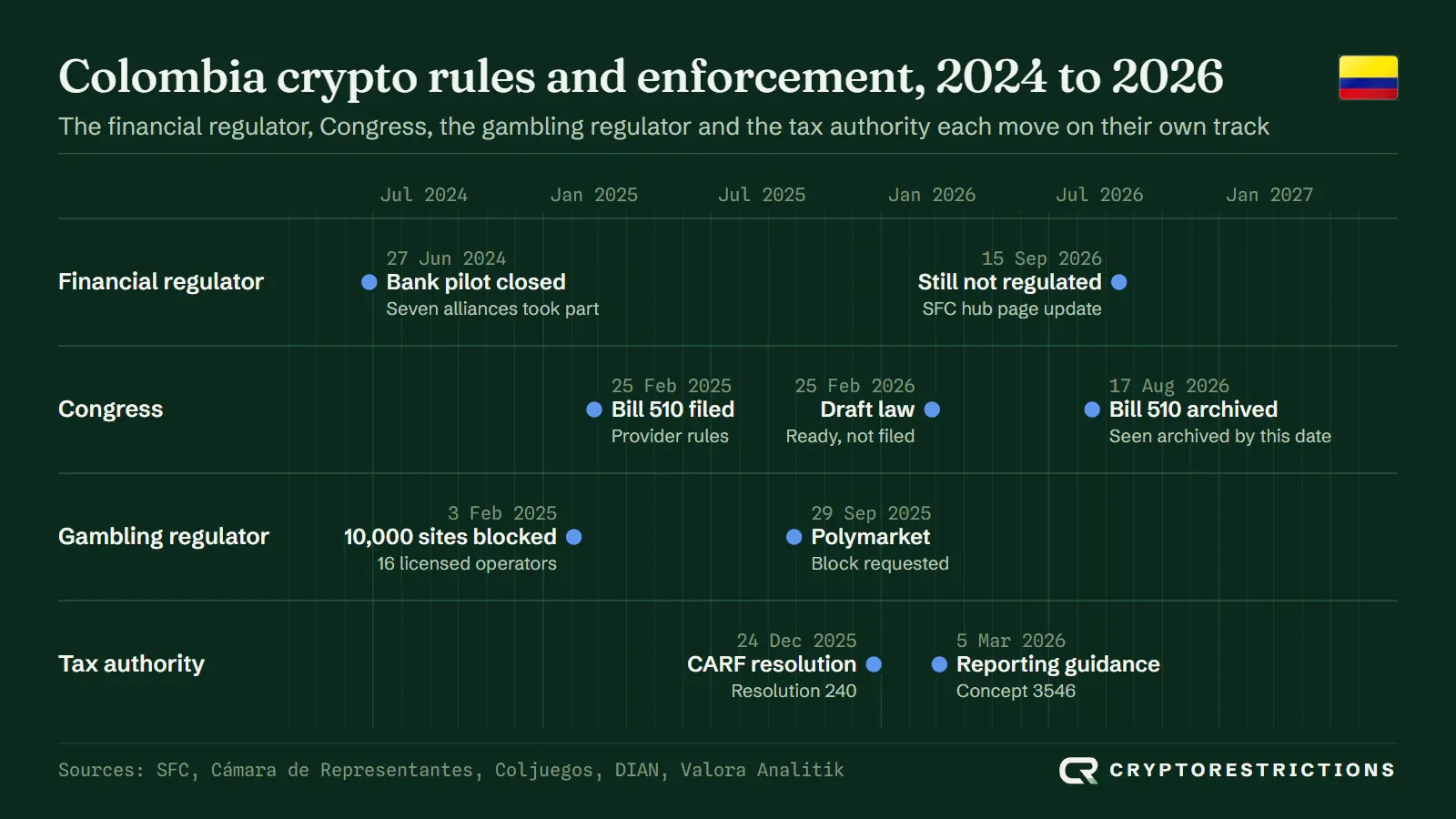
- SFC. Supervises banks and other financial institutions, not crypto businesses; see the legal section above for its statements. It ran the sandbox pilot that closed in 2024.
- UIAF. The financial intelligence unit’s Resolution 314 of 2021 covers anyone providing virtual-asset services for others, whatever the amount. They report suspicious operations at once, file a monthly report of transactions of USD 150 or more singly or USD 450 or more in multiples, and file a monthly client report. Reporting began on 1 April 2022, and sanctions come from the Superintendencia de Sociedades or the relevant supervisor. We read the resolution on a copy, because the UIAF’s own PDF would not open.
- Superintendencia de Sociedades. Names the sanctioning body in that resolution and would have run the registry in Bill 510. We found no source that applies its SAGRILAFT risk-management system to crypto providers, so we do not claim it does.
- DIAN. The tax authority. Its CARF reporting duty and information-return rules are covered in the tax section.
- Coljuegos. The gambling regulator, covered in the prediction markets section.
- Congress. Bill 510 of 2025 was archived and the government’s framework bill was reported ready on 25 February 2026 but unfiled by 17 August 2026.
We found no travel-rule instrument in Colombian law. Colombia’s next FATF-style evaluation by GAFILAT is expected in 2027 or 2028, according to a secondary report.
Which crypto products are limited in Colombia?
We found one Colombia-specific product closure: Polymarket is limited by a block request. Banks cannot offer crypto custody or trading, and Kraken converts pesos to US dollars on deposit.
- Bank products. Under Carta Circular 29 of 2014 the SFC says its supervised institutions are not authorised to custody, invest in or intermediate crypto, and the SFC’s hub page says it has authorised none to operate with virtual assets. Crypto sits with exchanges outside the banking system.
- Pesos. Binance takes COP by PSE; Kraken takes COP but converts it to US dollars. For other exchanges we found no peso-funding source on their own pages, though press reports mention peer-to-peer pesos at some.
- Stocks and prediction markets. Coinbase showed us a notice that both are unavailable in Colombia.
- Derivatives. Gemini’s derivatives list omits Colombia; as the exchange is restricted anyway, this changes nothing. We hold no Colombia-specific derivatives source for any other platform.
Are prediction markets legal in Colombia?
No Colombian law names them, and the gambling regulator Coljuegos treated Polymarket as an illegal betting site. It asked internet providers to block it on 29 September 2025; Kalshi has drawn no action that we found.
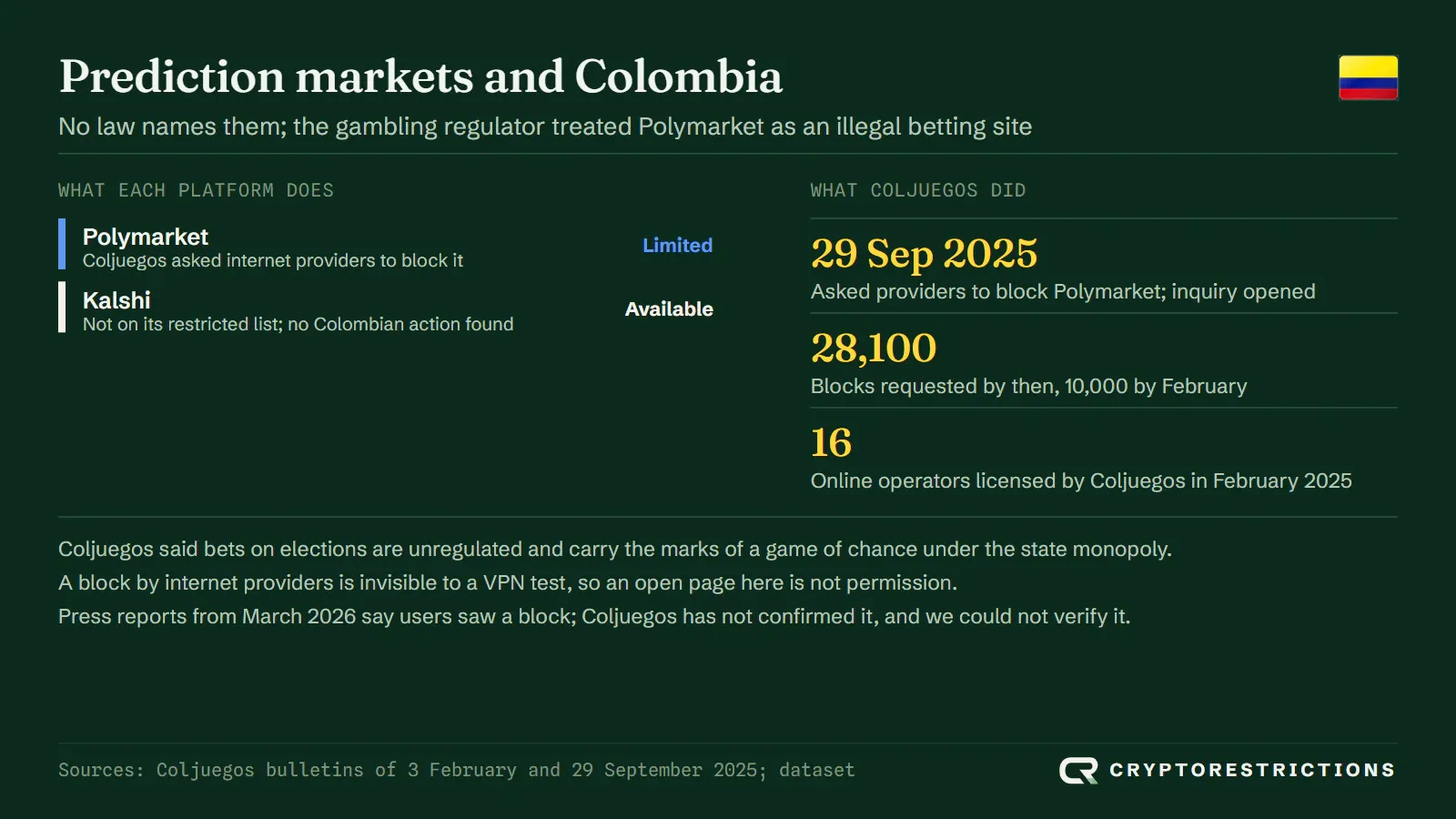
Coljuegos’ bulletin of 29 September 2025 says bets on electoral events are not regulated, that they combine risk, a prize and an uncertain event, which are the marks of a game of chance, and that games of chance are a state monopoly. It asked internet providers to block Polymarket, opened an investigation, and added that crypto payments are not authorised. The bulletin cites no statute; secondary summaries point to Law 643 of 2001, which we could not read. It puts the total of block requests at 28,100.
Online gambling needs a Coljuegos concession. A February 2025 bulletin counted 16 authorised online operators and about 10,000 sites and social profiles blocked, and says unauthorised gambling is a crime under article 312 of the Penal Code. Pulzo reported on 18 March 2026 that users saw an illegal-gambling notice on Polymarket; Coljuegos has not confirmed the execution, and a block by internet providers is invisible to our VPN test, so we treat Polymarket as limited, not restricted.
We found no Coljuegos or other statement naming Kalshi.
How is crypto taxed in Colombia?
The tax authority DIAN treats crypto as an intangible asset, not currency. Under tax advisers’ reading of the statute, a gain on crypto held under two years is ordinary income at 0% to 39%, and a gain after two years is an occasional gain at a flat 15%.
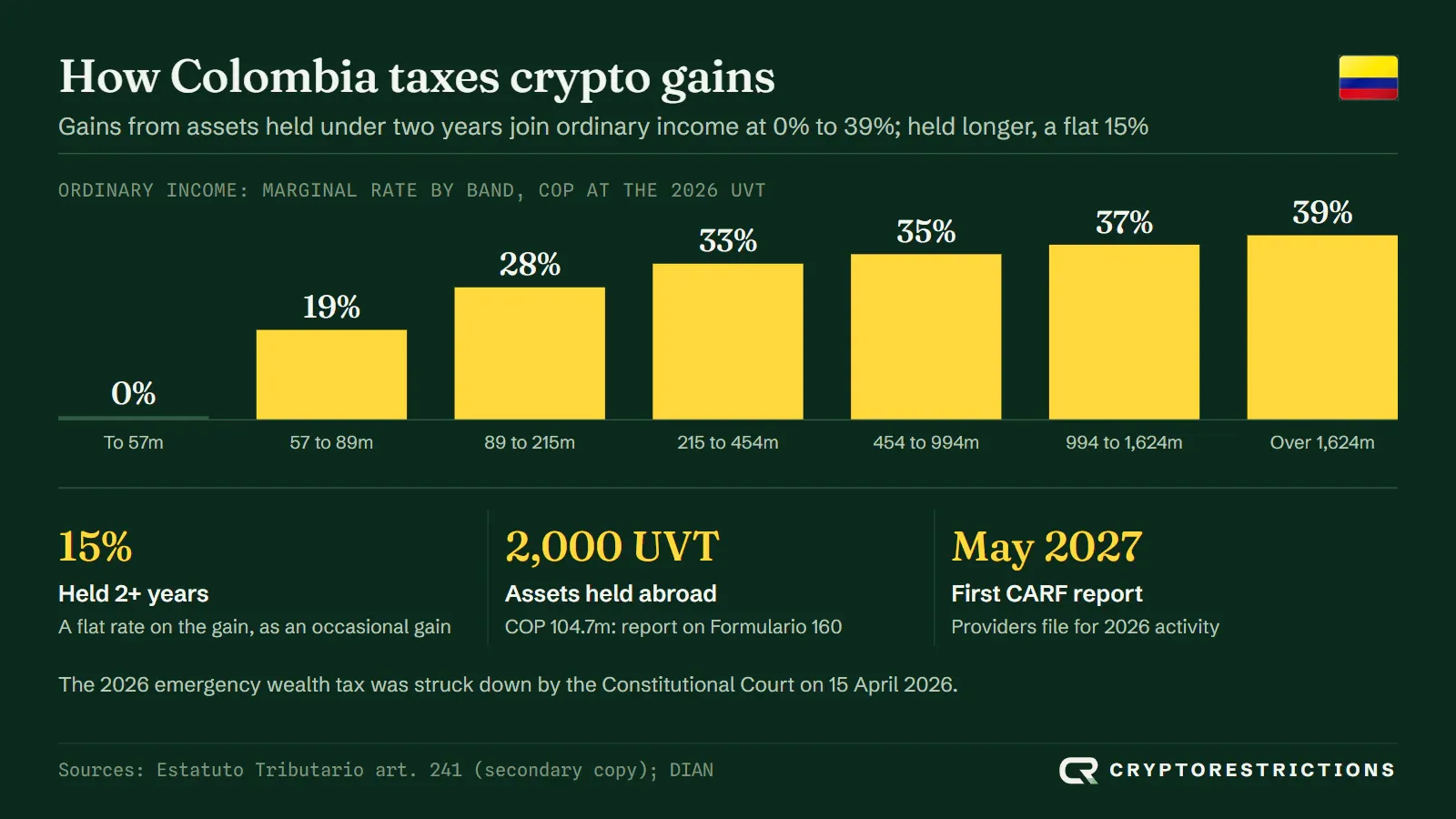
We could not open the tax statute on DIAN’s site, so the classification and rates come from secondary copies. An Accounter compilation of DIAN opinions says crypto is not recognised currency, that selling it is not subject to VAT and that exchange services are. Estatuto.co gives the occasional-gains rate as 15% under article 314, as changed by Law 2277 of 2022. Actualícese reproduces the article 241 table of marginal rates: 0% up to 1,090 tax units (UVT), then 19%, 28%, 33%, 35%, 37% and 39% above 31,000 UVT. We found no DIAN text that sets a separate crypto rule, and DIAN’s 2026 position, per Infobae, is that it created no new tax. The 2026 UVT is COP 52,374, set by Resolution 000238; a return for tax year 2025 uses the 2025 value, so the peso bands in the graphic are for 2026.
Reporting is moving fast. DIAN Concepto 3546 of 5 March 2026 says crypto providers report fiat-to-crypto operations on format 2856 from tax year 2026, and that users may need formats 1001, 1007 and 1012. DIAN’s press page of 6 May 2026 says crypto firms must report under the OECD CARF standard under Resolution 240; law-firm summaries date that resolution to 24 December 2025 and set the first report for May 2027, which we could not confirm on DIAN’s own text. Assets held abroad worth more than 2,000 UVT on 1 January go on Formulario 160, per DIAN’s page; one news report says that includes crypto on foreign platforms, but we found no DIAN opinion saying so.
The 2026 emergency wealth tax, set at 40,000 UVT, no longer exists: DIAN’s Concepto 11166 of 26 June 2026 says it ceased to exist after the Constitutional Court struck it down.
 Chile
 Peru
 Uruguay
 Argentina
 Brazil
 Venezuela
 Ecuador
 Paraguay
 Bolivia
 Guyana
 Suriname