

Is crypto legal in Uruguay?
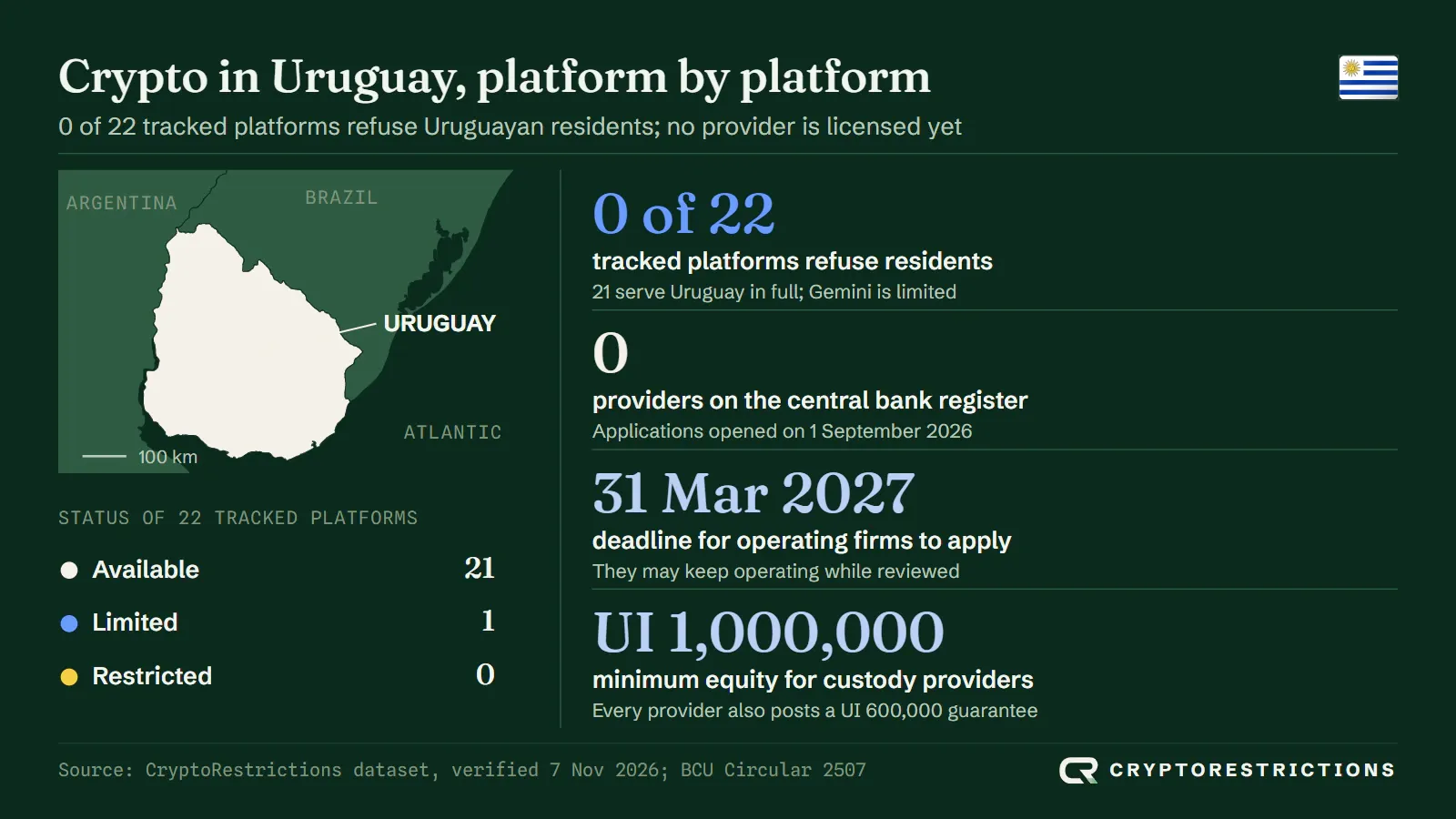
Yes: we found no Uruguayan rule that bans holding or trading crypto, and a 2024 law puts the firms that sell it under the central bank. Since July 2026 final licensing rules are in force.
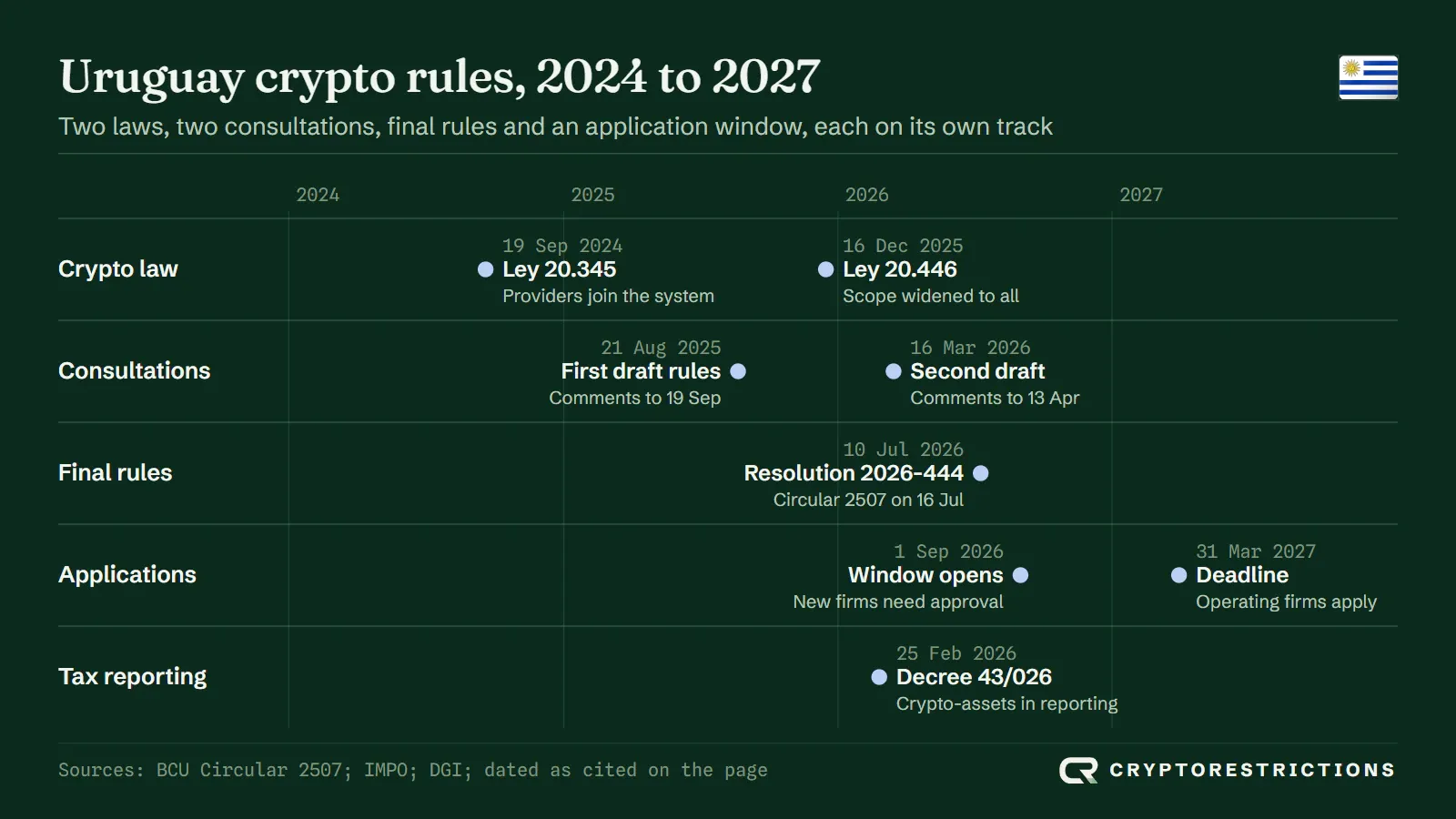
Ley 20.345, promulgated on 19 September 2024 and published on 27 September, amends the central bank’s charter, Ley 16.696, and the securities market law, Ley 18.627. According to the recitals of Circular 2507, article 1 made providers of virtual asset services an entity of the financial system and told the Superintendencia de Servicios Financieros (SSF) of the Banco Central del Uruguay (BCU) to regulate and control them. Ley 20.446, promulgated on 16 December 2025, then dropped the split between financial and non-financial virtual assets, so every provider falls under the same article.
The SSF put its first draft rules out for comment on 21 August 2025 (comments closed on 19 September) and a second draft on 16 March 2026 (closed on 13 April). It adopted the final text as resolution 2026-444 on 10 July 2026 and communicated it as Circular 2507 on 16 July; the BCU announced it on 22 July. The rules target consumer protection and the prevention of money laundering and terrorist financing. They regulate firms, not holders: we found no rule that restricts an individual’s own crypto.
Two limits apply to providers. Under article 127.25 they may not carry out any activity with virtual assets that amounts to financial intermediation under Decreto-Ley 15.322, and they may not use clients’ assets without the client’s express authorisation. We found no ban, stalled bill or official warning against any of the platforms we track.
Which crypto exchanges work in Uruguay?
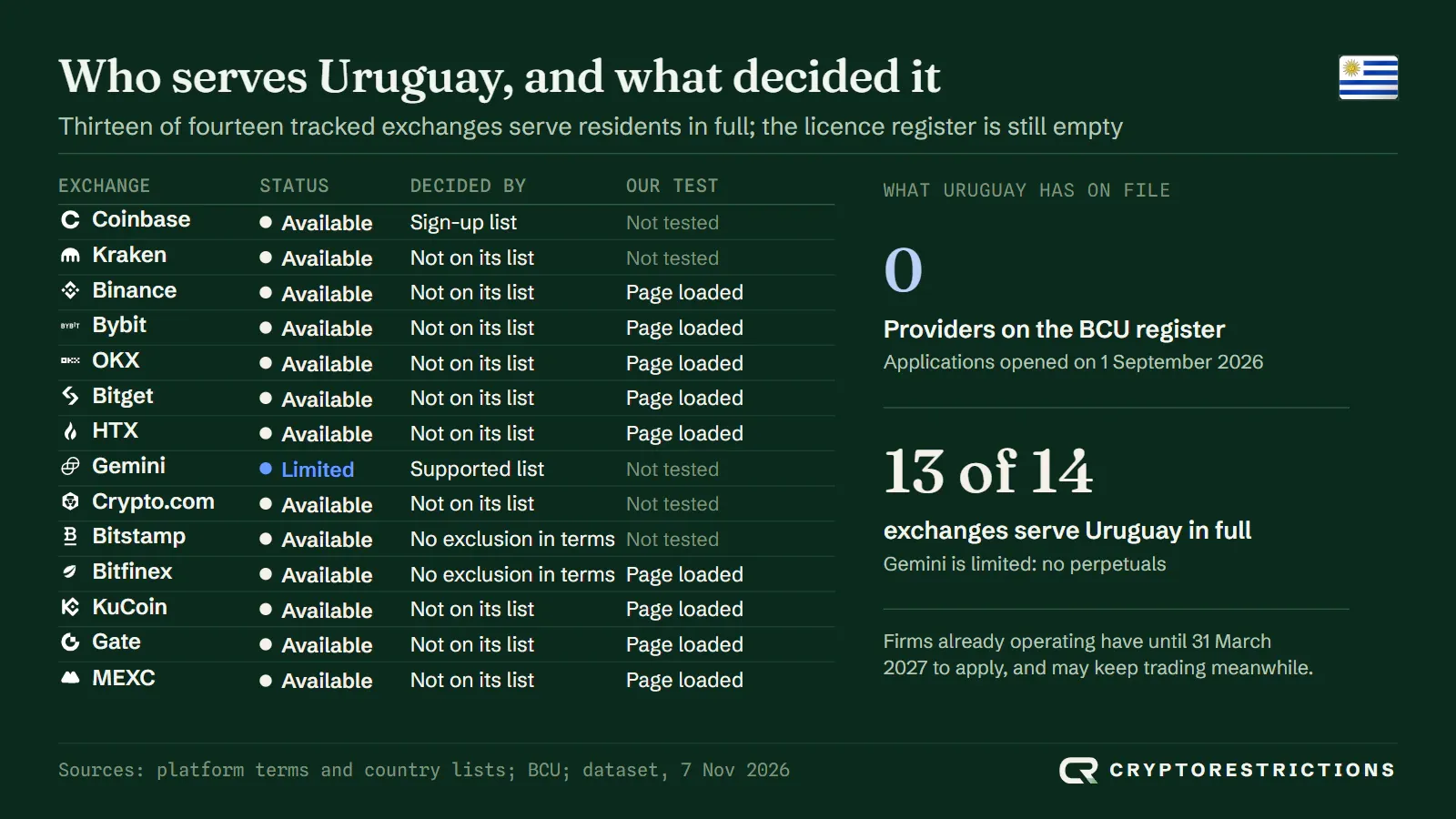
All 14 exchanges we track serve Uruguayan residents, 13 of them in full. None holds a Uruguayan licence yet: the BCU’s register of providers showed no entries on 7 November 2026.
Article 127.22 of Circular 2507 covers firms that habitually and professionally exchange virtual assets for fiat or for each other, transfer them, hold or control them for others, or help issue them. It also covers these activities when users deal directly through smart-contract protocols. Providers need the SSF’s prior authorisation, must be a commercial company or the branch of a foreign one, and must tell the SSF which of these services they will run.
Custody providers must keep at least UI 1,000,000 (indexed units) of equity at all times. Every provider must hold a guarantee of at least UI 600,000 in favour of the BCU, as a pledged UI deposit or national public securities, plus a UI 50,000 demand deposit at the BCU. The window opened on 1 September 2026: firms already operating have until 31 March 2027 to apply and may keep operating while the SSF reviews them, and new entrants must be authorised first. The register page read “No hay elementos que mostrar” on 7 November 2026, so we hold no Uruguayan licence entry for any platform. Binance, Ripio Uruguay and Nexchange were among the bodies that commented on the first draft, according to the resolution.
Best crypto platforms for Uruguayan residents
Nine exchanges tie at 8 out of 10: Binance, Bitfinex, Bitget, Bybit, Gate, HTX, KuCoin, MEXC and OKX are open to Uruguayans and loaded in our test. No platform earns licence points yet, because the central bank’s register is empty.
The score rates how fully a Uruguayan resident can use each platform, not its fees or safety. It is computed from our data and moves when a row changes: access status (4 points), the share of the platform’s products open here (3), the licences we hold on file for Uruguay (2, so none can earn them yet) and what our geo-access test saw from a Uruguayan address (1). The full method is on our methodology page.
Exchanges

Binance
Best for The widest range of markets
8.0/10- Access
- 4/4
- Products
- 3/3
- Licences
- 0/2
- Our test
- 1/1
Read our Binance reportPros
- Uruguay is not on its prohibited-countries list
- Its pages loaded in our test
Cons
- No Uruguayan licence on file yet

Bitfinex
Best for Spot and margin for experienced traders
8.0/10- Access
- 4/4
- Products
- 3/3
- Licences
- 0/2
- Our test
- 1/1
Read our Bitfinex reportPros
- Uruguay is not a prohibited jurisdiction in its terms
- Its pages loaded in our test
Cons
- No Uruguayan licence on file yet

Bitget
Best for Spot and derivatives in one account
8.0/10- Access
- 4/4
- Products
- 3/3
- Licences
- 0/2
- Our test
- 1/1
Read our Bitget reportPros
- Uruguay is not on its prohibited-countries list (updated 20 October 2026)
- Its pages loaded in our test
Cons
- Its list of prohibited countries is non-exhaustive

Bybit
Best for Spot and derivatives in one account
8.0/10- Access
- 4/4
- Products
- 3/3
- Licences
- 0/2
- Our test
- 1/1
Read our Bybit reportPros
- Uruguay is not on its excluded-jurisdictions list
- Its pages loaded in our test
Cons
- No Uruguayan licence on file yet

Gate
Best for A wide range of listed tokens
8.0/10- Access
- 4/4
- Products
- 3/3
- Licences
- 0/2
- Our test
- 1/1
Read our Gate reportPros
- Uruguay is not named in its restricted-locations clause
- Its pages loaded in our test
Cons
- Its list is non-exhaustive

HTX
Best for Spot and derivatives in one account
8.0/10- Access
- 4/4
- Products
- 3/3
- Licences
- 0/2
- Our test
- 1/1
Read our HTX reportPros
- Uruguay is not on the restricted lists in its user agreement
- Its pages loaded in our test
Cons
- Its list is non-exclusive

KuCoin
Best for A wide range of listed tokens
8.0/10- Access
- 4/4
- Products
- 3/3
- Licences
- 0/2
- Our test
- 1/1
Read our KuCoin reportPros
- Uruguay is not on its restricted-locations list (updated 29 September 2026)
- Its pages loaded in our test
Cons
- Its list may be updated from time to time

MEXC
Best for A wide range of listed tokens
8.0/10- Access
- 4/4
- Products
- 3/3
- Licences
- 0/2
- Our test
- 1/1
Read our MEXC reportPros
- Uruguay is not on its prohibited-jurisdictions list (updated 13 October 2026)
- Its pages loaded in our test
Cons
- Its list is non-exclusive

OKX
Best for A global brand with a wide product range
8.0/10- Access
- 4/4
- Products
- 3/3
- Licences
- 0/2
- Our test
- 1/1
Read our OKX reportPros
- Uruguay is not on its restricted-locations list (updated 8 July 2026)
- Its pages loaded in our test
Cons
- No Uruguayan licence on file yet

Bitstamp
Best for Plain spot trading
7.5/10- Access
- 4/4
- Products
- 3/3
- Licences
- 0/2
- Our test
- 0.5/1
Read our Bitstamp reportPros
- No Bitstamp document excludes Uruguay
Cons
- Not covered by our geo-access test

Coinbase
Best for A familiar US exchange for spot buying
7.5/10- Access
- 4/4
- Products
- 3/3
- Licences
- 0/2
- Our test
- 0.5/1
Read our Coinbase reportPros
- Uruguay is a listed sign-up country in its identity-verification guide
Cons
- Not covered by our geo-access test

Crypto.com
Best for Trading in an app
7.5/10- Access
- 4/4
- Products
- 3/3
- Licences
- 0/2
- Our test
- 0.5/1
Read our Crypto.com reportPros
- Uruguay is not on its app or spot geo-restriction lists
Cons
- Not covered by our geo-access test

Kraken
Best for Plain spot trading
7.5/10- Access
- 4/4
- Products
- 3/3
- Licences
- 0/2
- Our test
- 0.5/1
Read our Kraken reportPros
- Uruguay is not on its do-not-serve list
Cons
- Not covered by our geo-access test

Gemini
Best for Plain spot trading
5.9/10- Access
- 3.5/4
- Products
- 1.9/3
- Licences
- 0/2
- Our test
- 0.5/1
Read our Gemini reportPros
- Uruguay is on its supported-country list for spot
Cons
- No derivatives: Uruguay is not on its perpetuals list
- Not covered by our geo-access test
Prediction markets

Kalshi
Best for Regulated event contracts
7.5/10- Access
- 4/4
- Products
- 3/3
- Licences
- 0/2
- Our test
- 0.5/1
Read our Kalshi reportPros
- Uruguay is not on its restricted-jurisdictions list
Cons
- No Uruguayan rule names prediction markets
- Not covered by our geo-access test

Polymarket
Best for The largest prediction market
7.5/10- Access
- 4/4
- Products
- 3/3
- Licences
- 0/2
- Our test
- 0.5/1
Read our Polymarket reportPros
- Uruguay is not on its blocked-countries list
Cons
- No Uruguayan rule names prediction markets
- Not covered by our geo-access test
DeFi

Aster
Best for Perpetuals from your own wallet
8.0/10- Access
- 4/4
- Products
- 3/3
- Licences
- 0/2
- Our test
- 1/1
Read our Aster reportPros
- Uruguay is not on its prohibited-jurisdictions list
- Its trading app loaded in our test
Cons
- No funding in dollars: you need crypto from another source

Hyperliquid
Best for Perpetuals and spot on its own chain
8.0/10- Access
- 4/4
- Products
- 3/3
- Licences
- 0/2
- Our test
- 1/1
Read our Hyperliquid reportPros
- Not excluded by its terms
- Its trading app loaded in our test
Cons
- No funding in dollars: you need crypto from another source

Lighter
Best for Perpetuals from your own wallet
8.0/10- Access
- 4/4
- Products
- 3/3
- Licences
- 0/2
- Our test
- 1/1
Read our Lighter reportPros
- Uruguay is not named in its terms
- Its trading app loaded in our test
Cons
- No funding in dollars: you need crypto from another source

Jupiter
Best for Solana swaps
7.5/10- Access
- 4/4
- Products
- 3/3
- Licences
- 0/2
- Our test
- 0.5/1
Read our Jupiter reportPros
- Uruguay is not named in its terms
Cons
- No funding in dollars: you need crypto from another source
- Not covered by our geo-access test

PancakeSwap
Best for BNB Chain swaps and pools
7.5/10- Access
- 4/4
- Products
- 3/3
- Licences
- 0/2
- Our test
- 0.5/1
Read our PancakeSwap reportPros
- Not excluded by its terms
Cons
- No funding in dollars: you need crypto from another source
- Not covered by our geo-access test

Uniswap
Best for Swapping tokens from your own wallet
7.5/10- Access
- 4/4
- Products
- 3/3
- Licences
- 0/2
- Our test
- 0.5/1
Read our Uniswap reportPros
- Its terms bar only places under comprehensive US sanctions
Cons
- No funding in dollars: you need crypto from another source
- Not covered by our geo-access test
Which platforms block Uruguayan users?
None of the 22 platforms we track refuses Uruguayan residents. One, Gemini, is limited: it serves Uruguay for spot trading but offers no perpetuals.
Uruguayan law gives a platform no reason to close the country, since the rules cover providers, not holders. Exclusion lists can be non-exhaustive, so an absence is not a guarantee, and most platforms enforce at identity verification, not at the page.
What our geo-access test saw from Uruguay
From a Uruguayan virtual location on 14 and 16 October 2026, all 12 platforms we tested loaded with no barrier. The other 10 platforms were not tested.
The 12 that opened were Aster, Binance, Bitfinex, Bitget, Bybit, Gate, HTX, Hyperliquid, KuCoin, Lighter, MEXC and OKX. A virtual location, an address registered to the country but served elsewhere, tests a platform’s own geo-blocking only, and an open page is not permission: the test cannot see identity checks or blocks by internet providers. We hold no screenshots from Uruguay, so there is no gallery.
Who regulates crypto in Uruguay?
The central bank’s financial services regulator, the SSF, licenses and supervises crypto providers. The tax authority DGI sets tax rules, and the lottery regulator DNLQ can have unauthorised betting sites blocked.
- SSF. The Superintendencia de Servicios Financieros of the BCU wrote Circular 2507 and authorises providers, as described in the exchanges section. The framework’s stated aims include user protection, risk management, information security and anti-money-laundering controls.
- UIAF. The BCU’s site lists a money-laundering prevention unit, the UIAF, in its financial-system menu. We did not open its own page, so we cannot describe its crypto duties beyond the anti-money-laundering rules in Circular 2507.
- DGI. The Direccion General Impositiva issued the 2021 ruling that treats crypto as an intangible good and Decreto 43/026 on account reporting, both covered in the tax section.
- DNLQ and URSEC. The Direccion Nacional de Loterias y Quinielas is the competent body under the betting decree, and the telecoms regulator URSEC passes its blocking orders to operators; both are covered in the prediction markets section.
Which crypto products are limited in Uruguay?
Derivatives are the one product limit we found at platform level: Gemini lists Uruguay for spot but not for perpetuals. Circular 2507 also bars providers from financial intermediation and from tools built to hide transaction trails.
- Perpetuals on Gemini. Uruguay is on Gemini’s supported-country list but not on its perpetuals list, so we record the platform as limited.
- Intermediation. Article 127.25 forbids a provider from any activity with virtual assets that amounts to financial intermediation under Decreto-Ley 15.322. We did not find official guidance on how this applies to staking or lending products, so we do not call any product barred.
- Anonymising tools. Under article 127.24 a provider may not offer virtual assets, services or tools designed to make the origin and destination of transactions harder to identify.
- NFTs. Services that use only non-fungible assets are outside the authorisation rule, unless the assets serve as a means of payment, an investment instrument or a digital representation of a value.
Are prediction markets legal in Uruguay?
No Uruguayan rule names them. Online betting without authorisation is illegal under Ley 19.535, and the DNLQ can have unauthorised sites blocked, but we found no ruling on whether event contracts count as betting.
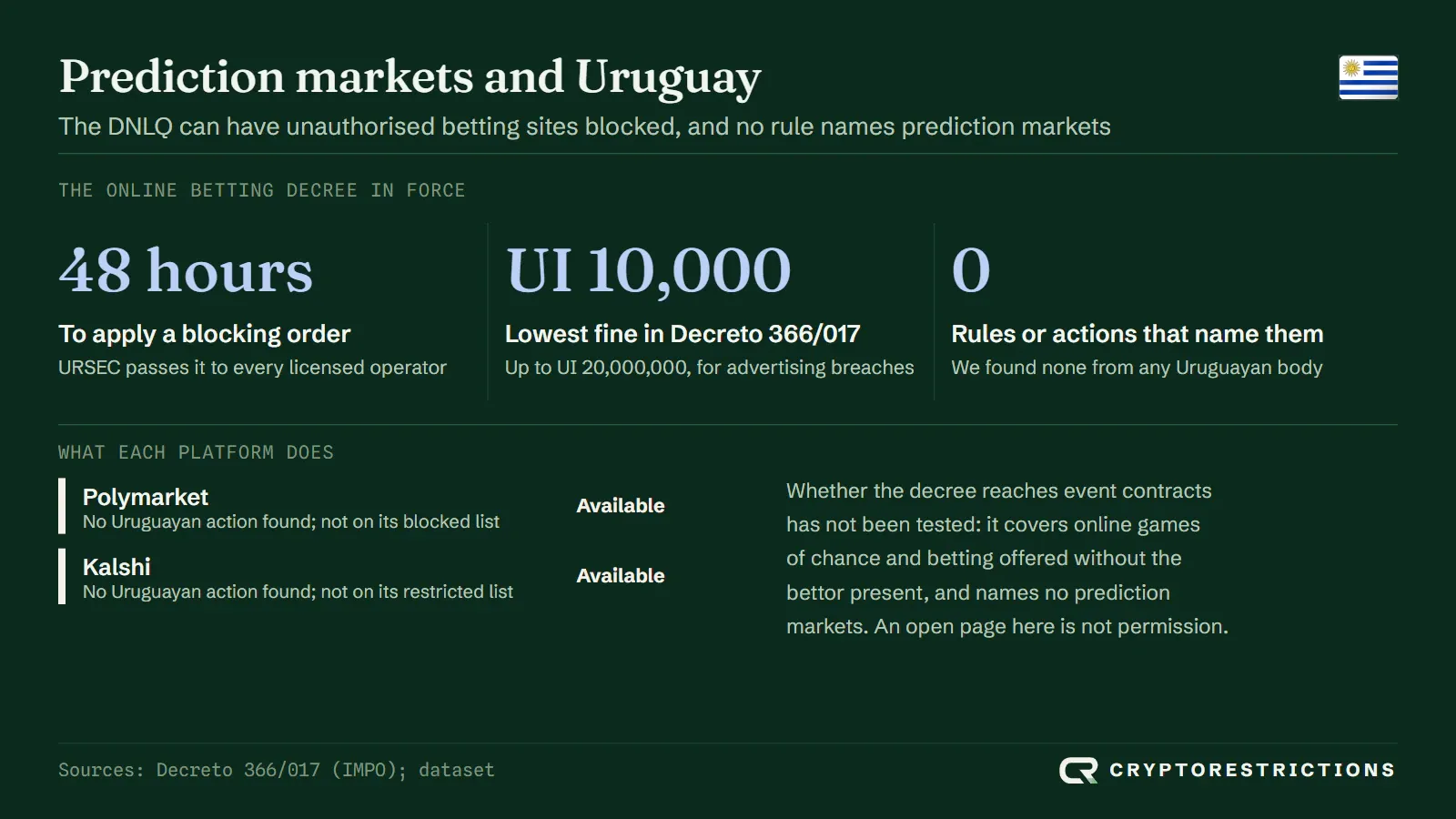
Decreto 366/017, which regulates articles 244 and 245 of Ley 19.535, names the Direccion Nacional de Loterias y Quinielas as the competent body. Article 8 covers online games of chance or betting offered over the internet that do not require the bettor’s physical presence and are not authorised. After an investigation and a hearing, the DNLQ orders a domain or URL blocked; the order goes to URSEC, which passes it to all licensed operators, who must apply it within 48 hours, and a preventive block in a serious case cannot last more than a year. Under article 1, payment issuers regulated by the BCU may not authorise payments tied to unauthorised gambling or its prizes. Article 11 sets fines of UI 10,000 to UI 20,000,000 for breaches of the advertising rules.
Whether an event contract on an election or a price counts as a bet under article 8 is our reading, not a ruling: no regulator statement or court decision we found says so. Polymarket and Kalshi are open to Uruguayans on their own lists, and we found no action against either. We could not open the DNLQ’s own site on 7 November 2026, so we have no current count of blocked sites.
How is crypto taxed in Uruguay?
The tax authority DGI treats crypto as an intangible movable good, not money, but we found no DGI page that sets a crypto rate. Its general rule for gains on movable property is 12% of the gain, with a deemed gain of 20% of the sale price.
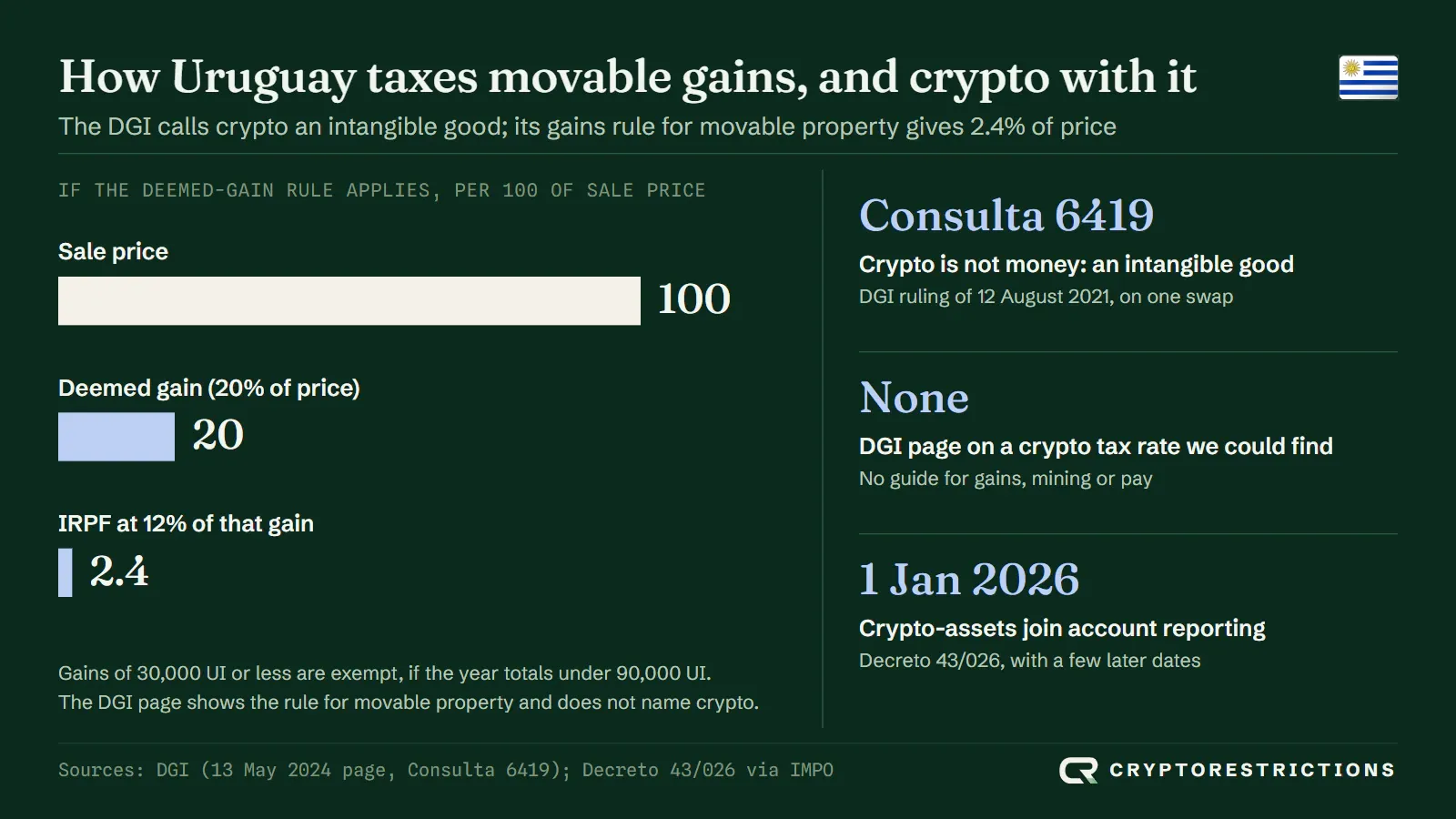
In Consulta 6419 of 12 August 2021, a notary asked how to tax a swap of real estate for cryptocurrency. The DGI’s commission answered that crypto does not meet the tests of money, and is not electronic money under Ley 19.210, so the deal is a barter of a property for an intangible movable good. It said the crypto must be valued at current market values, which the DGI may reject, so supporting records should be kept. It is a ruling on one swap, not a general rule.
The DGI’s page on gains from transfers of movable property (13 May 2024) sets personal income tax (IRPF) at 12% of the computable gain. The default is a deemed gain of 20% of the sale price, which works out to 2.4% of the price; a real gain (price minus indexed cost) is allowed only for listed cases such as registered vehicles and some securities. Gains from operations of 30,000 UI or less are exempt if the year’s total stays below 90,000 UI. The page does not mention crypto, so whether a crypto sale takes the deemed route is our reading of the ruling, not DGI guidance. We did not confirm how the DGI taxes foreign-source gains, trading as a business or mining.
On reporting, Decreto 43/026 (25 February 2026, published on 9 March) adds “criptoactivos relevantes” to the financial assets covered by Uruguay’s account-reporting regime, with effect from 1 January 2026 apart from a few later dates, and the DGI’s 11 June 2026 page lists it too. Exchange services for these assets are excluded from the investment-entity definition. The decree refers to the OECD crypto-asset reporting standard only as one that applies “if it is in force”, so we cannot give a date from which exchanges must report under it.
 Chile
 Peru
 Colombia
 Argentina
 Brazil
 Venezuela
 Ecuador
 Paraguay
 Bolivia
 Guyana
 Suriname