Is crypto legal in Venezuela?
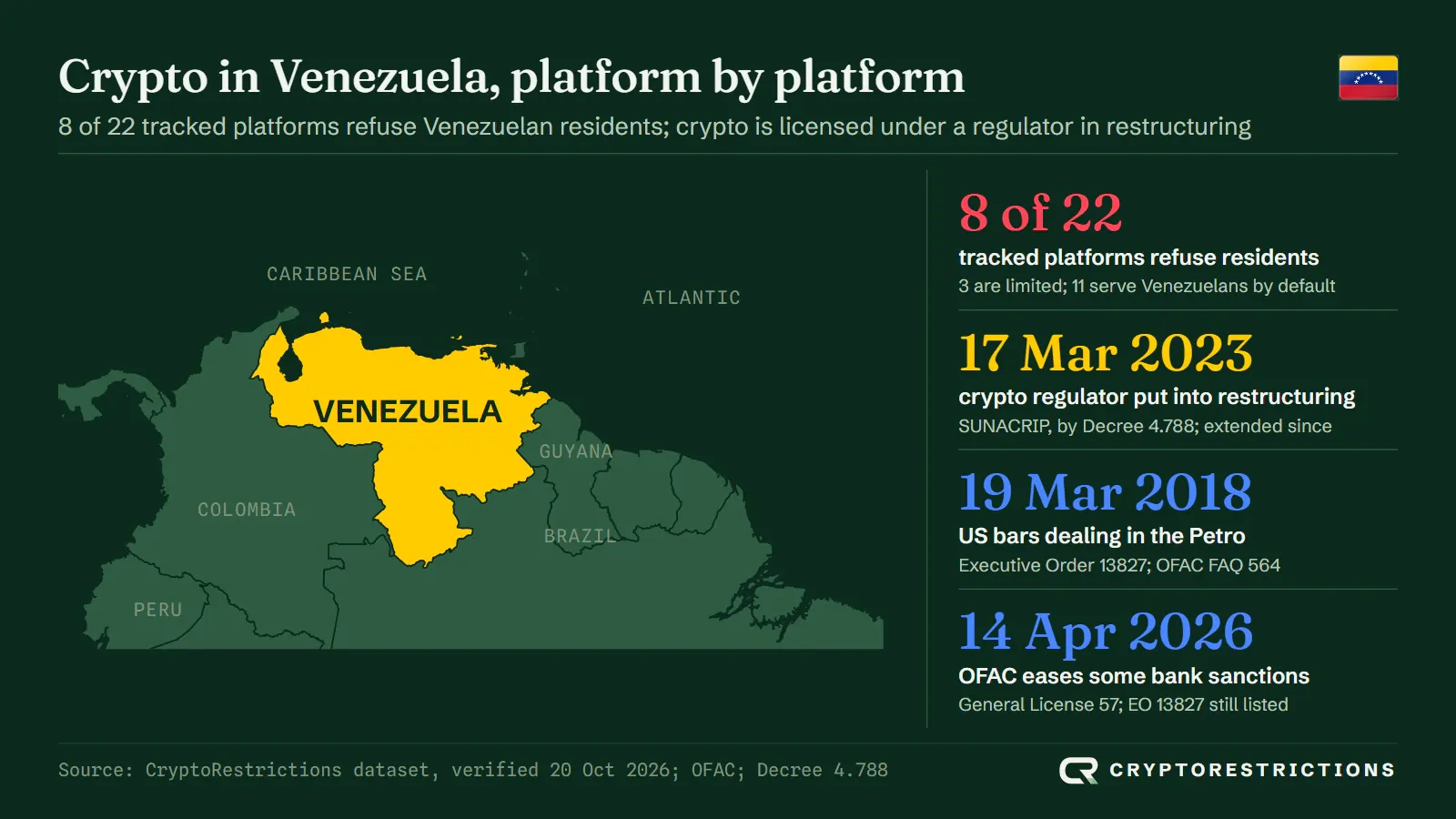
Yes. Crypto is legal and licensed, not banned: a 2019 decree puts exchanges and miners under the regulator SUNACRIP, which has been in restructuring since March 2023 and was still issuing licences in January 2026.
The legal base is the integral crypto-asset decree published in Gaceta Oficial 41.575 on 31 January 2019, as CriptoNoticias reported it. It covers exchange houses, mining and intermediation, lets SUNACRIP set which crypto-assets may be traded and lets it seize unregistered mining equipment. We could not open SUNACRIP’s own site or the Gaceta, so this and most other Venezuelan facts below rest on press accounts of the documents and are marked as reported.
SUNACRIP is not dissolved, but it is not settled either. Decree 4.788 of 17 March 2023 ordered its restructuring after the arrest of its head, Joselit Ramírez, in the PDVSA-crypto corruption case, and Acceso a la Justicia lists three six-month extensions, the last by Decree 5.003 of 16 September 2024. We found no extension after that, and no word on whether the process ended. In January 2026 CriptoNoticias reported a SUNACRIP licence for the exchange Crixto signed by an acting superintendent, valid to 31 December 2026.
The state’s own token has been wound down. The Petro was the government’s oil-backed digital currency, and Contxto reported that the Patria platform would close its crypto wallets on 15 January 2024 and convert balances to bolivars. Diario Bitcoin notes that the notice named only Bitcoin, Litecoin and Dash wallets, and we found no SUNACRIP or central bank statement on the Petro’s end.
Mining is licensed in principle and curbed in practice. In May 2024 Cointelegraph reported plans to disconnect mining farms from the power grid and seizures of about 2,000 machines in Maracay. The line that mining is prohibited came from an industry association, not the government, and we found no decree for a 2024 or 2026 ban, nor a lifting.
Day to day, Venezuelans use dollar stablecoins as money. A report cited by La Patilla puts 47% of payments under US$10,000 in stablecoins for July 2023 to July 2024, and CriptoNoticias relays a Reuters note of 3 September 2025 that the government itself had increased its use of USDT. Both are secondary, and the figures use different methods.
Which crypto exchanges work in Venezuela?
Fourteen of the exchanges and DeFi platforms we track are not barred for Venezuelan residents, and none holds a SUNACRIP licence we could confirm.
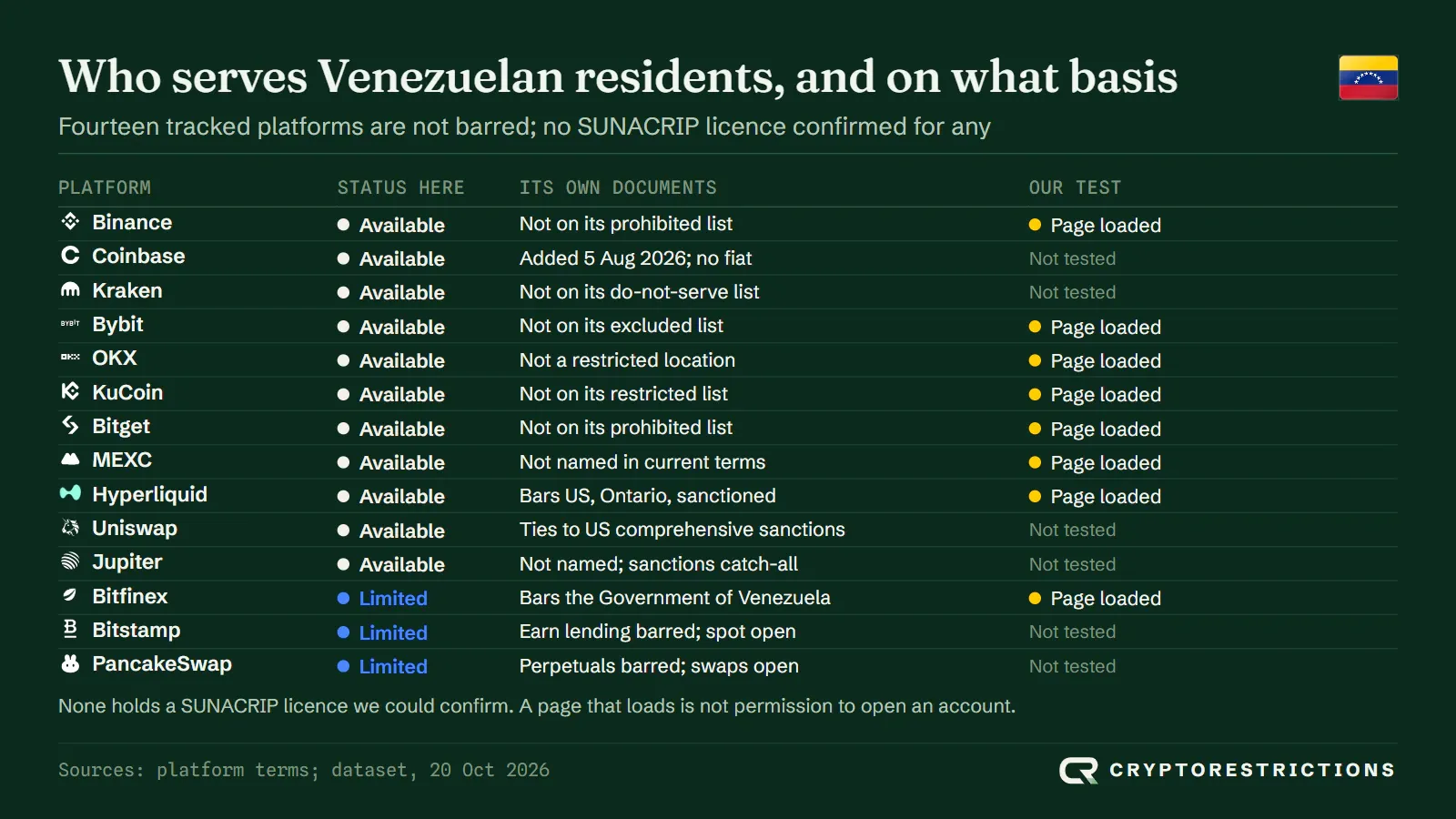
Under our evidence order, a platform whose documents do not name Venezuela and whose site loads in our test is recorded as available. That is a statement about the platform, not about Venezuelan law. The two firms we saw reported as licensed, Crixto and, until 8 January 2027, Kontigo, are local services we do not track, and the count of two comes from press reports, not a SUNACRIP register.
US sanctions explain less than people expect. The OFAC Venezuela programme blocks the Government of Venezuela under Executive Order 13884 of 5 August 2019 and lists a run of 2026 general licences that ease it, among them General License 57 of 14 April 2026 on financial services involving certain Venezuelan banks. It is not an embargo on residents, so platform terms that cite comprehensively sanctioned places do not reach Venezuela, and it is not on our sanctions review list. The one place a platform names the government is Bitfinex, which bars the Government of Venezuela and leaves other residents free.
Several documents settle the rest. Kraken lists 14 places it does not serve, updated 30 September 2026, and Venezuela is not one. OKX names its restricted locations in a disclosure updated 8 July 2026, again without Venezuela. KuCoin, Bitget and MEXC do not name it either, although an older Spanish MEXC help article from 2023 did. Coinbase bars users from comprehensively sanctioned places only, and CriptoNoticias reports that it added Venezuela on 5 August 2026 with wallet and crypto-to-crypto access but no fiat deposits or withdrawals.
Best crypto platforms for Venezuelan residents
By our access score, Binance, Bitget, Bybit, KuCoin, MEXC and OKX tie at 8.0 out of 10 for Venezuelan residents, Coinbase and Kraken follow at 7.5, and Hyperliquid leads the DeFi platforms at 8.0. No platform earns licence points, because none holds a Venezuelan licence we could confirm.
The score rates how fully a Venezuelan resident can use each platform, not its fees or safety. It is computed from our data and moves when a row changes: access status (4 points), the share of the platform’s products open here (3), the Venezuelan licences we hold on file (2) and what our geo-access test saw from a Venezuelan address (1). Platforms that refuse Venezuelan residents are not scored, and eight do. The full method is on our methodology page.
Exchanges

Binance
Best for Spot and derivatives on the largest exchange
8.0/10- Access
- 4/4
- Products
- 3/3
- Licences
- 0/2
- Our test
- 1/1
Read our Binance reportPros
- Venezuela is not on its prohibited-countries list
- Its site loaded in our test
Cons
- Reported blocked by a Venezuelan internet provider in August 2024
- No SUNACRIP licence we could confirm

Bitget
Best for Spot and futures with a stated prohibited list
8.0/10- Access
- 4/4
- Products
- 3/3
- Licences
- 0/2
- Our test
- 1/1
Read our Bitget reportPros
- Venezuela is not on its prohibited-countries list (16 October 2026)
- Its site loaded in our test
Cons
- No SUNACRIP licence we could confirm

Bybit
Best for Spot and derivatives on a global exchange
8.0/10- Access
- 4/4
- Products
- 3/3
- Licences
- 0/2
- Our test
- 1/1
Read our Bybit reportPros
- Venezuela is not on its excluded-jurisdictions list
- Its site loaded in our test
Cons
- No SUNACRIP licence we could confirm

KuCoin
Best for A wide coin list on a global exchange
8.0/10- Access
- 4/4
- Products
- 3/3
- Licences
- 0/2
- Our test
- 1/1
Read our KuCoin reportPros
- Venezuela is not on its restricted-locations list (29 September 2026)
- Its site loaded in our test
Cons
- No SUNACRIP licence we could confirm

MEXC
Best for Spot and futures with a short prohibited list
8.0/10- Access
- 4/4
- Products
- 3/3
- Licences
- 0/2
- Our test
- 1/1
Read our MEXC reportPros
- Venezuela is not named in its user agreement (13 October 2026)
- Its site loaded in our test
Cons
- An older Spanish help article from 2023 named Venezuela

OKX
Best for Spot trading with a short restricted list
8.0/10- Access
- 4/4
- Products
- 3/3
- Licences
- 0/2
- Our test
- 1/1
Read our OKX reportPros
- Venezuela is not a restricted location in its disclosure (8 July 2026)
- Its site loaded in our test
Cons
- No SUNACRIP licence we could confirm

Coinbase
Best for A regulated US brand, wallet and crypto-to-crypto
7.5/10- Access
- 4/4
- Products
- 3/3
- Licences
- 0/2
- Our test
- 0.5/1
Read our Coinbase reportPros
- Added Venezuela on 5 August 2026, per CriptoNoticias
Cons
- Fiat deposits and withdrawals are not offered
- We did not test it from Venezuela

Kraken
Best for A regulated global exchange
7.5/10- Access
- 4/4
- Products
- 3/3
- Licences
- 0/2
- Our test
- 0.5/1
Read our Kraken reportPros
- Venezuela is not on its list of places it does not serve (30 September 2026)
Cons
- We did not test it from Venezuela
- No SUNACRIP licence we could confirm

Bitfinex
Best for Spot and margin for private residents
6.3/10- Access
- 3/4
- Products
- 2.3/3
- Licences
- 0/2
- Our test
- 1/1
Read our Bitfinex reportPros
- Its terms bar only the Government of Venezuela
- Its site loaded in our test
Cons
- Government bodies cannot use it
DeFi

Hyperliquid
Best for Perpetuals from your own wallet
8.0/10- Access
- 4/4
- Products
- 3/3
- Licences
- 0/2
- Our test
- 1/1
Read our Hyperliquid reportPros
- Its terms bar only the US, Ontario and sanctioned places
- Its app loaded in our test
Cons
- No Venezuelan licence applies

Jupiter
Best for Solana swaps
7.5/10- Access
- 4/4
- Products
- 3/3
- Licences
- 0/2
- Our test
- 0.5/1
Read our Jupiter reportPros
- Venezuela is not named in its terms
Cons
- Its terms add places under US, UK or EU sanctions
- We did not test it from Venezuela

Uniswap
Best for Swapping tokens from your own wallet
7.5/10- Access
- 4/4
- Products
- 3/3
- Licences
- 0/2
- Our test
- 0.5/1
Read our Uniswap reportPros
- Its terms tie eligibility to US comprehensive sanctions
Cons
- We could not read its current terms page (HTTP 403)
- We did not test it from Venezuela

PancakeSwap
Best for BNB Chain swaps and pools
5.8/10- Access
- 3.5/4
- Products
- 1.8/3
- Licences
- 0/2
- Our test
- 0.5/1
Read our PancakeSwap reportPros
- Its terms do not exclude swaps, pools or staking
Cons
- PCS Perps bars users in Venezuela
Which platforms block Venezuelan users?
Eight of the 22 platforms we track refuse Venezuelan residents and three more are limited. Every refusal comes from the platform’s own terms or lists, not from a Venezuelan order.
We found no Venezuelan block order against a tracked exchange in 2026. The one block we saw reported was local and political: Cointelegraph reported that Binance was cut off on the state internet provider CANTV on 9 August 2024 during the election dispute, and we could not confirm when it came back. Binance’s own terms do not name Venezuela, and the site loaded in our test.
What our geo-access test saw from Venezuela
From a Venezuelan address on 14 and 16 October 2026 we tested 12 platforms: 11 loaded with no barrier and one blocked us, Lighter.
An open page is not permission. Three of the platforms that loaded, Gate, HTX and Aster, refuse Venezuelan residents in their own documents, so a loading page says nothing about whether they will open an account. Ten platforms we track were not covered by a usable Venezuelan scan, among them Kraken, Coinbase and Polymarket. Our test used a virtual location, which sees a platform’s own geo-blocking but not a national block such as the CANTV one. Swipe through the screenshots below; each card quotes what the page showed.
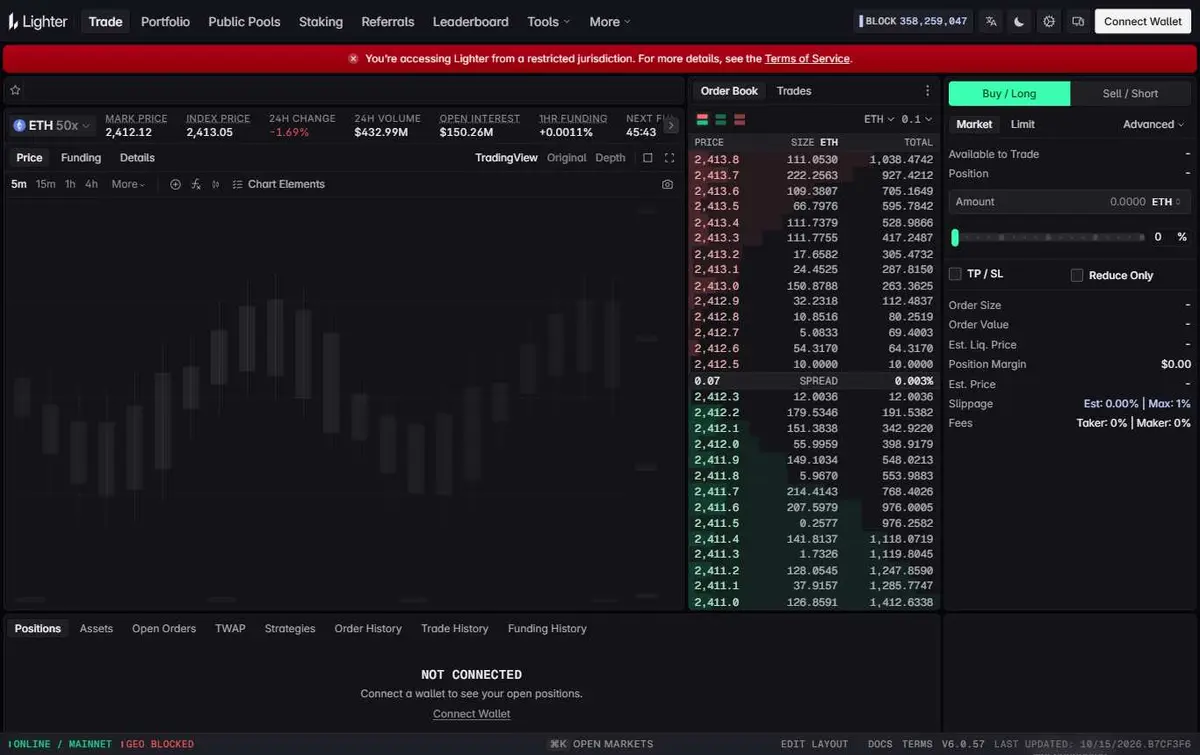
Blocked Lighter · Trading app
Venezuela: the trading app shows a red restricted-jurisdiction banner and a geo-blocked flag
“You’re accessing Lighter from a restricted jurisdiction.”
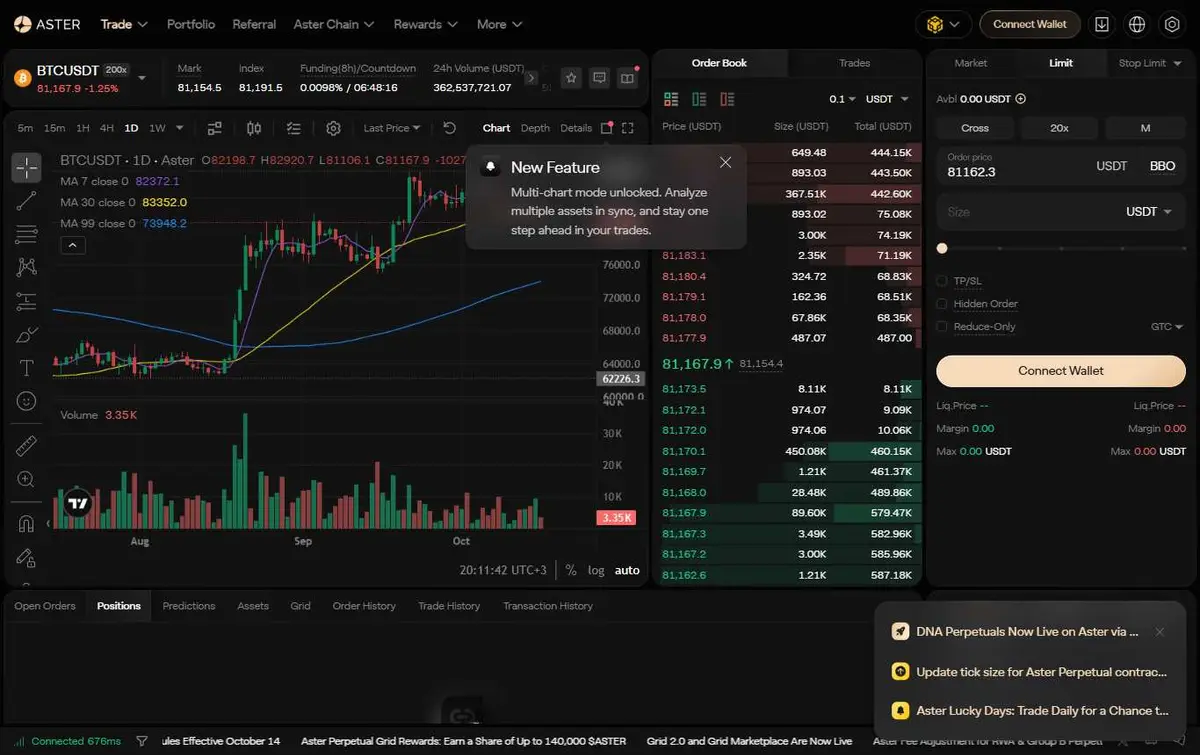
No barrier Aster · Trading app
Venezuela is named in Aster’s terms, yet the trading app loads with no notice
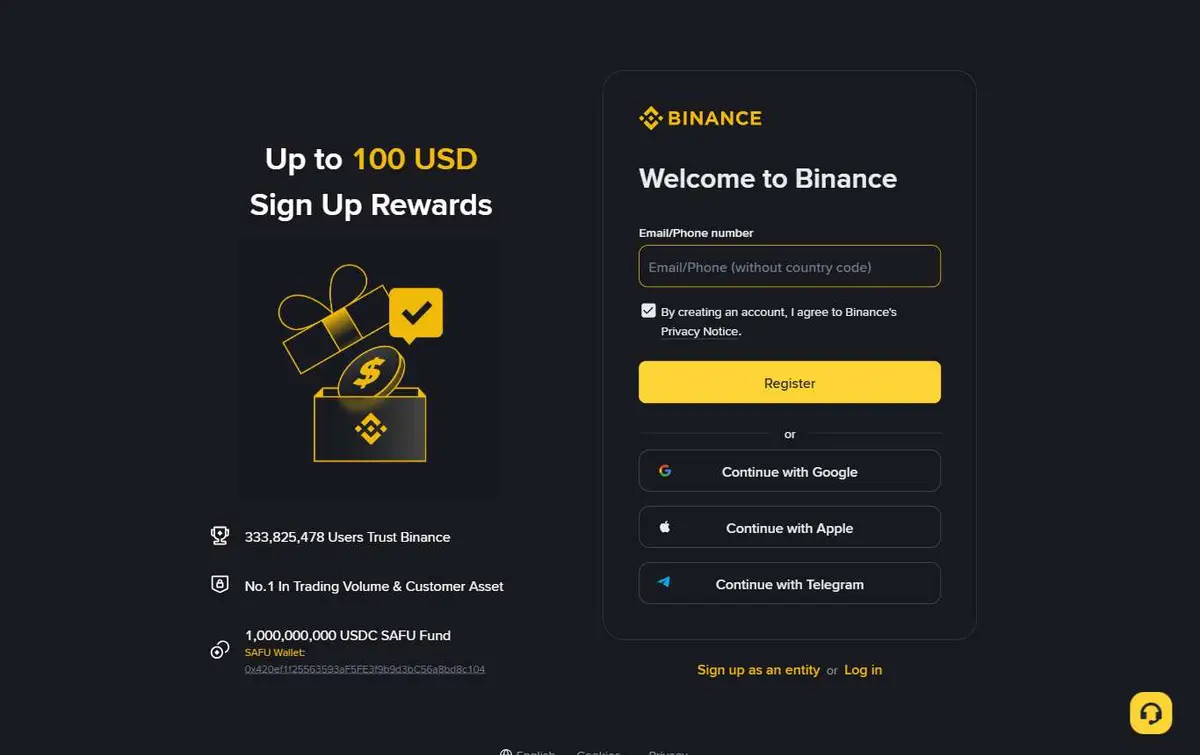
No barrier Binance · Sign-up page
Venezuela: sign-up loads with no barrier
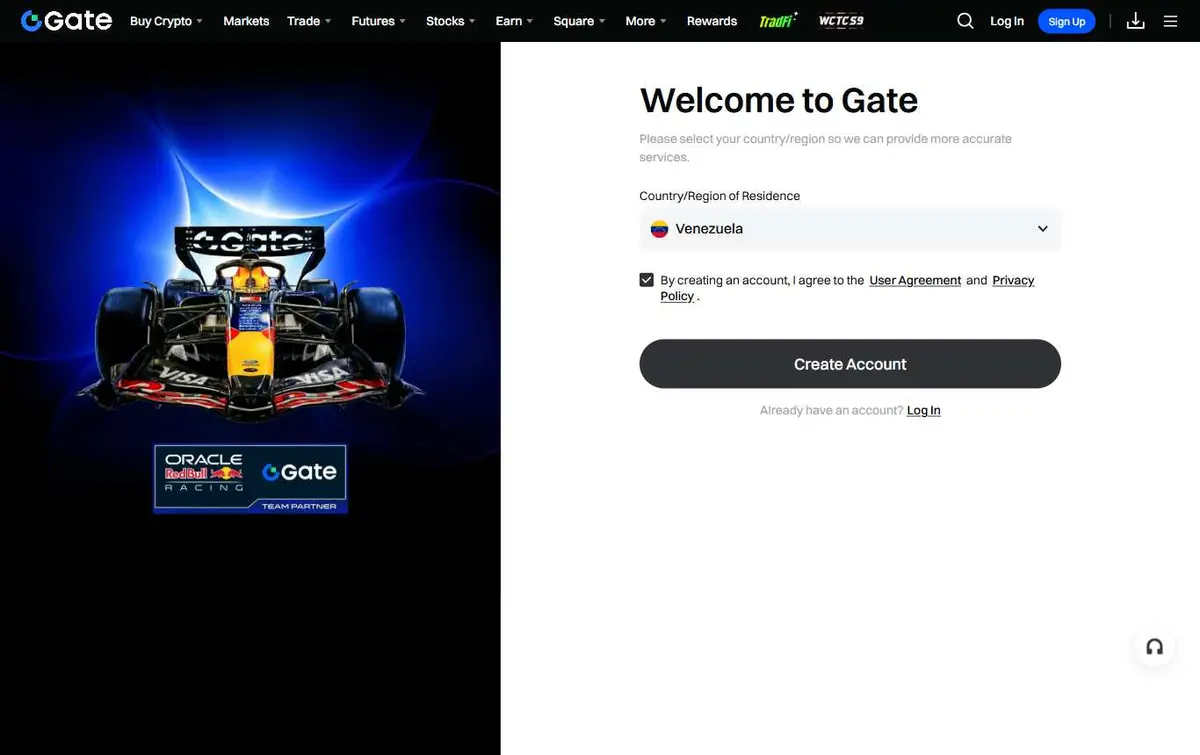
No barrier Gate · Sign-up page
Venezuela is on Gate’s restricted list in its user agreement, yet the sign-up form offers it and loads without a notice
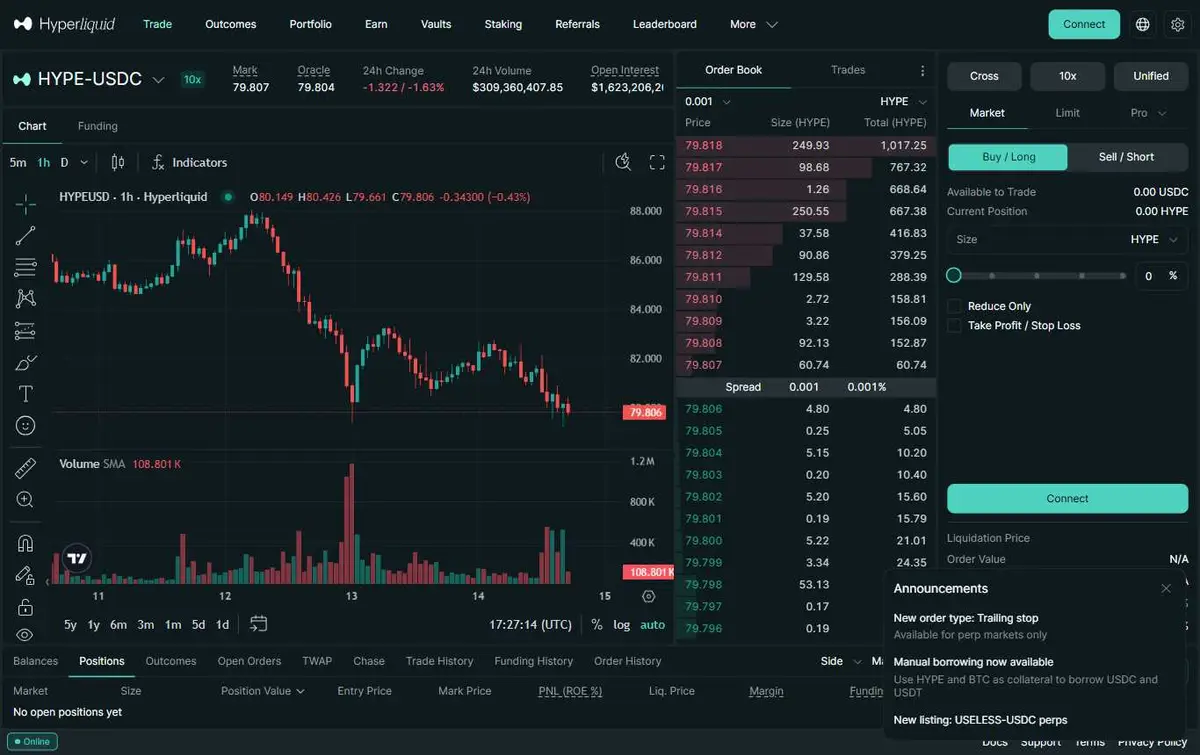
No barrierHyperliquid · Trading app
Venezuela: the trading app loads with no notice
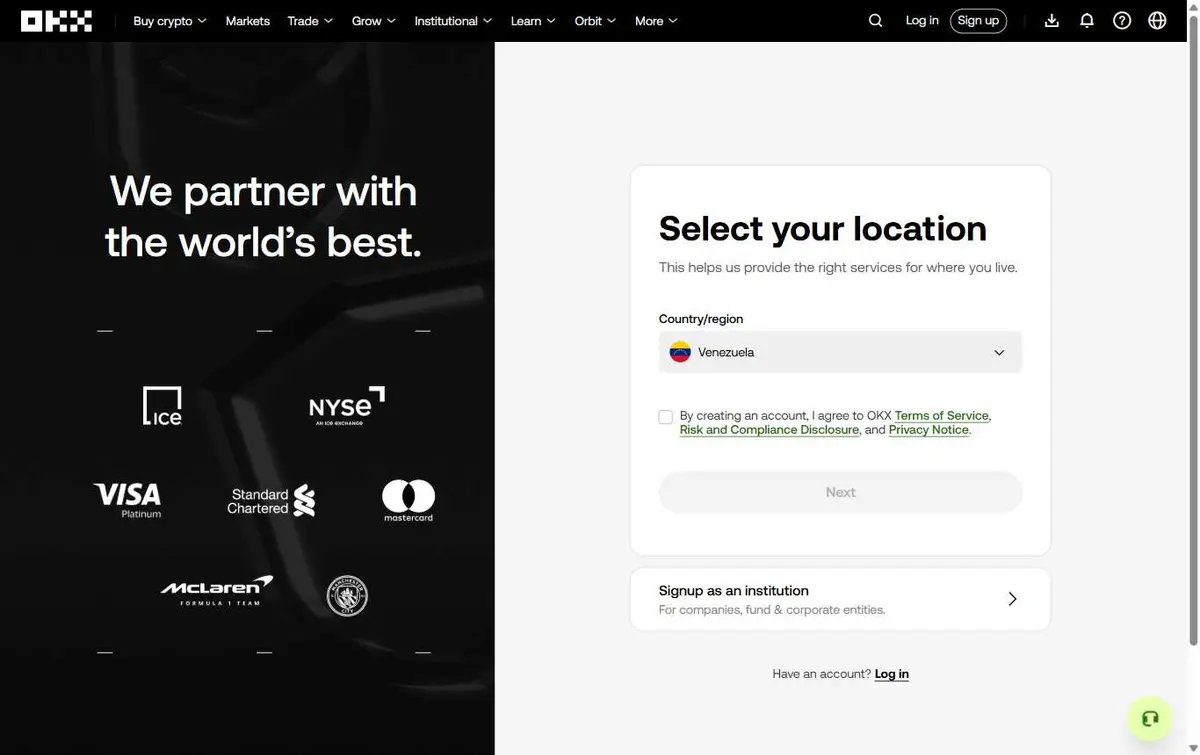
No barrier OKX · Sign-up page
Venezuela: sign-up loads with no barrier
 CRYPTORESTRICTIONS
Who regulates crypto in Venezuela?
SUNACRIP licenses and supervises exchanges and miners under a 2019 decree and is itself under a restructuring process, SENIAT collects tax, CONALOT supervises gambling, and OFAC in the US acts from outside through sanctions.
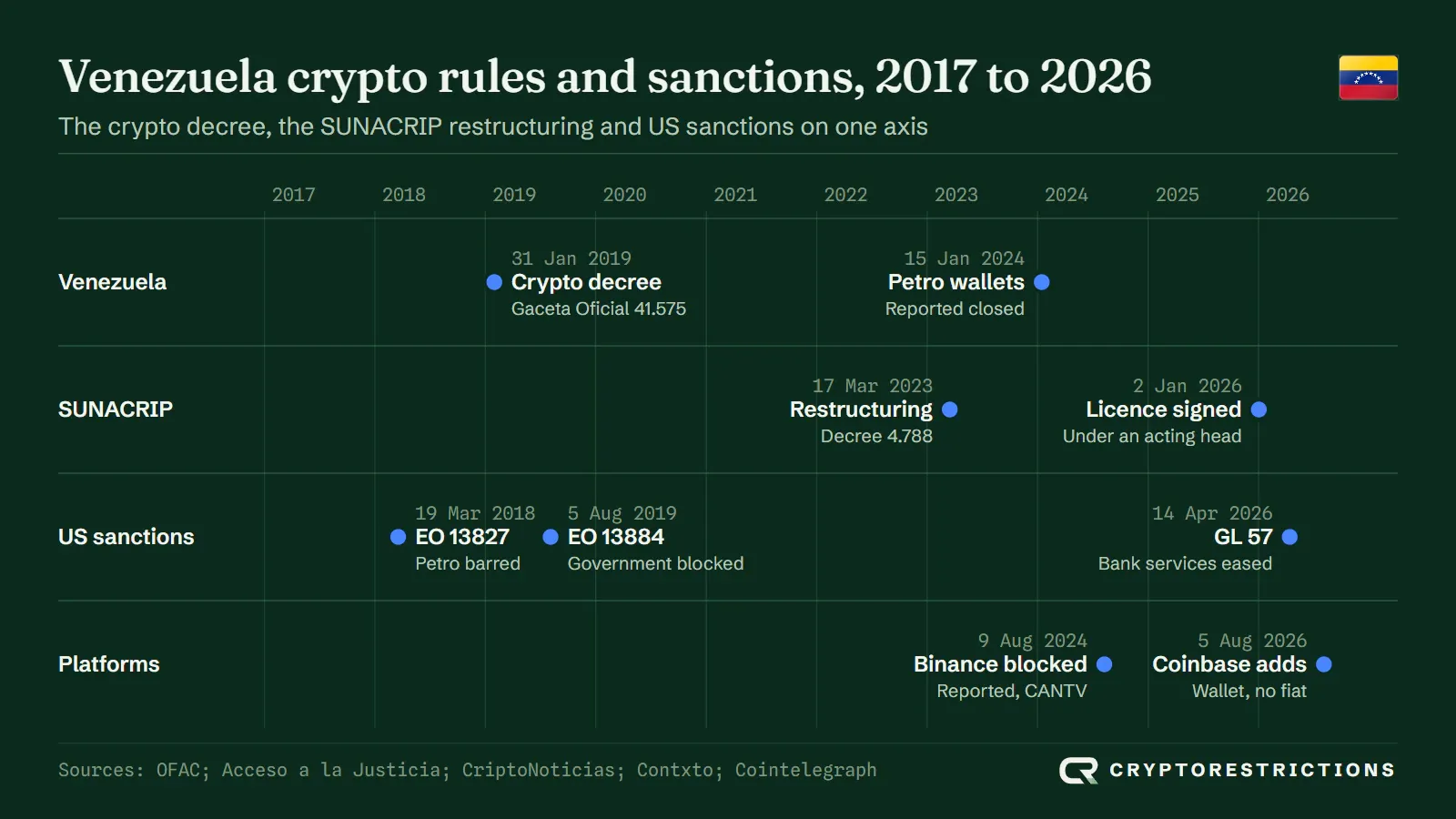
- SUNACRIP. The crypto-asset regulator created by the 2018 and 2019 decrees. Its restructuring began on 17 March 2023, was extended three times to September 2024, and we found no later extension or new head. Exchange and mining registers are kept by SUNACRIP, and we could not read them.
- SENIAT. The tax authority (see the tax section).
- Central bank. We found no Banco Central de Venezuela statement on crypto or stablecoins on a page we could read, and no new SUDEBAN rule for exchanges in 2024 to 2026.
- CONALOT. The lottery and gambling regulator, which began a national audit of raffle systems in January 2026.
- OFAC. Executive Order 13827 of 19 March 2018 bars US persons from dealing in Venezuelan digital currency. OFAC’s FAQ 564 answers yes to whether the Petro and the petro-gold token are covered, and FAQ 566 says dealings stay prohibited without a licence. We found nothing revoking the order. The 2026 licences ease banks and oil, and King & Spalding says General License 56 still excludes payment in digital tokens, the Petro included.
Which crypto products are limited in Venezuela?
The clearest limits are on the Petro, which US persons cannot touch, on fiat access at Coinbase, which has none, and on mining, which is licensed but reported curbed. Apart from PancakeSwap’s perpetuals, we hold no Venezuela-specific source for other products.
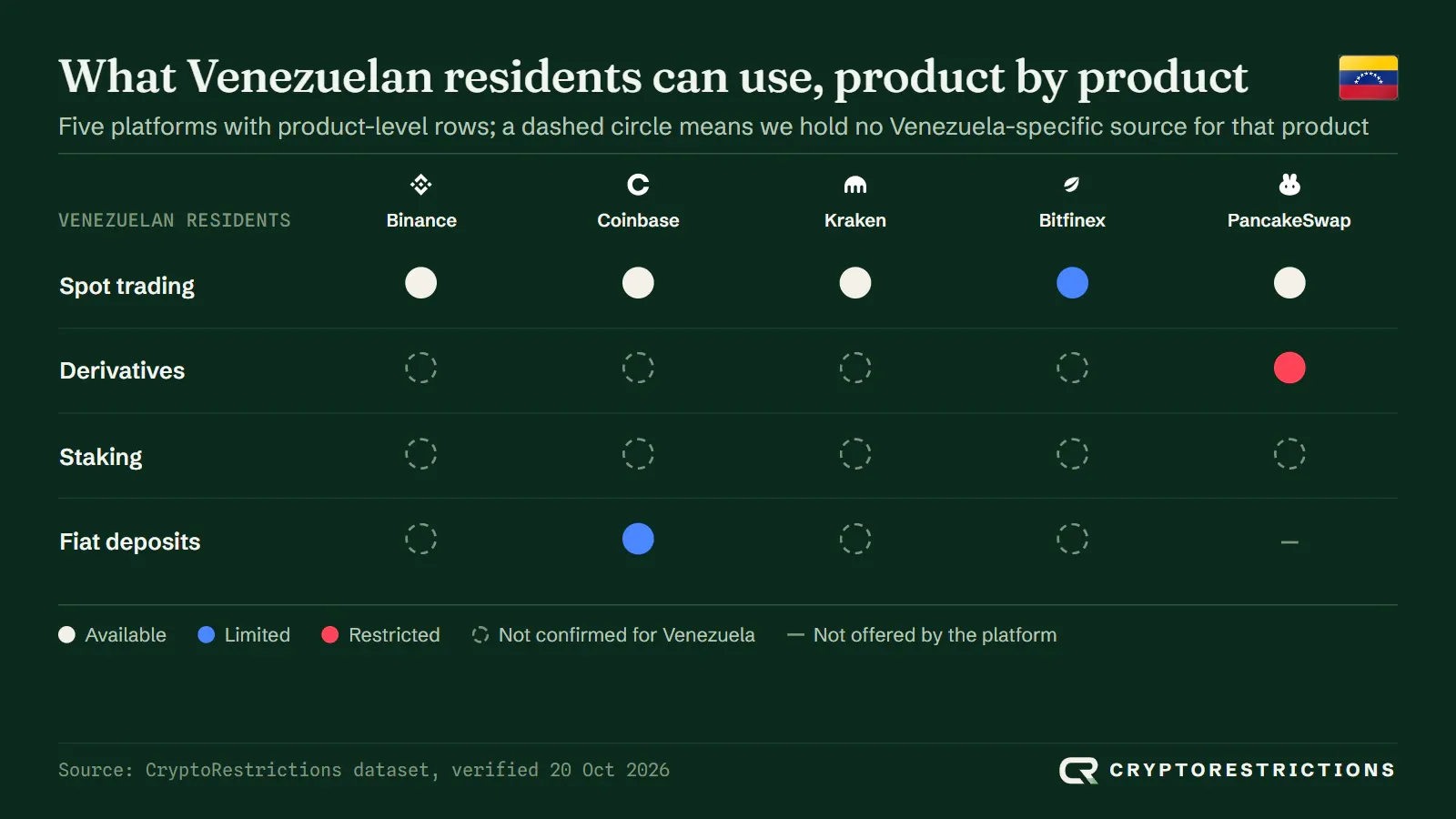
- Petro. The government token is barred to US persons and reported wound down from January 2024.
- Fiat. Coinbase’s Venezuela access has no fiat deposits or withdrawals, per CriptoNoticias.
- Derivatives. PancakeSwap bars users in Venezuela from PCS Perps.
- Mining. Registration with SUNACRIP is the legal route, and farms were reported cut from the grid in 2024.
Are prediction markets legal in Venezuela?
We could not confirm that they are legal or illegal. Five of the seven platforms with prediction markets refuse Venezuelans themselves, and we found no Venezuelan online-betting law or action naming a prediction market.
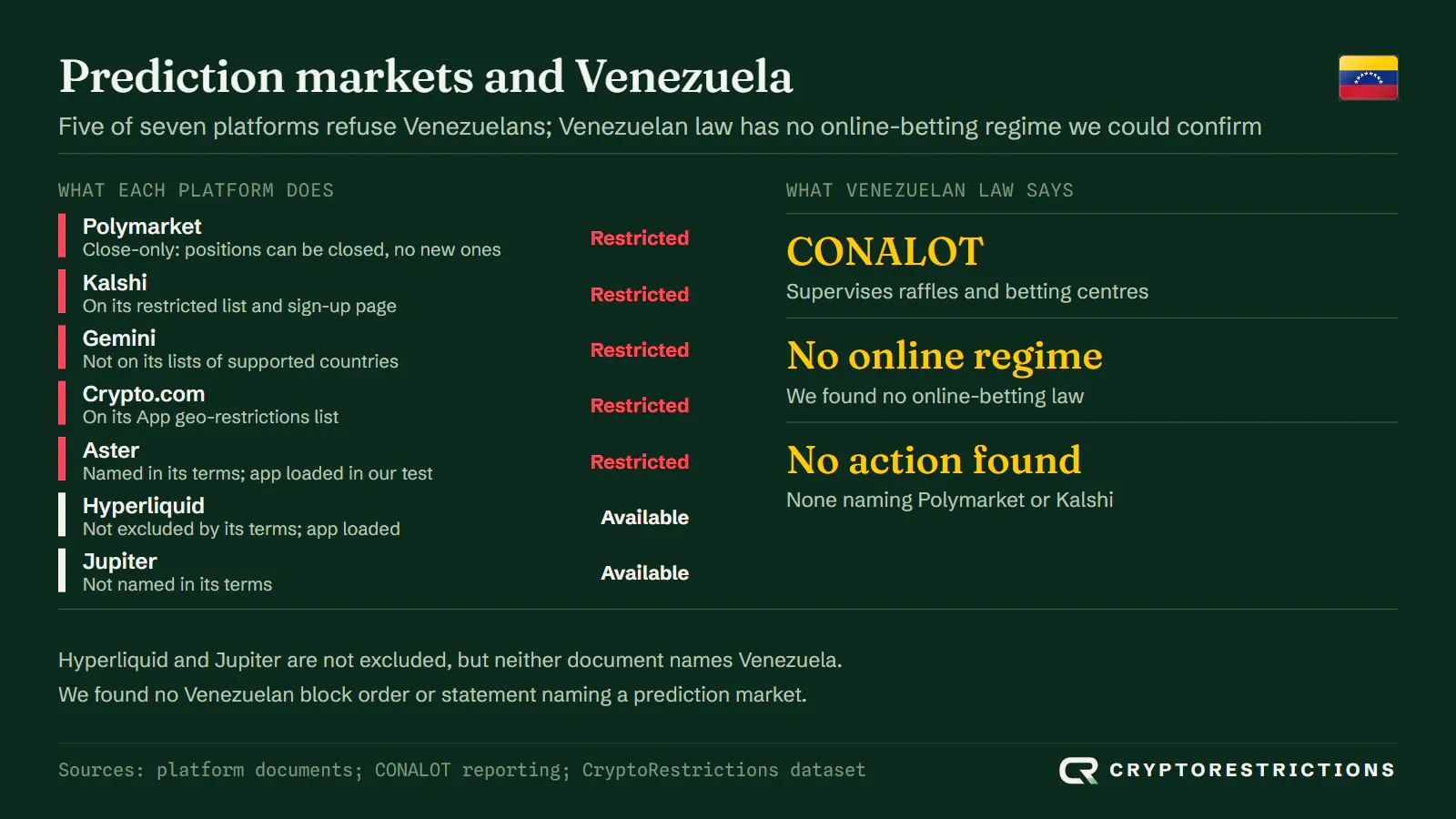
CONALOT is the regulator, and the reporting we found concerns physical and raffle operators: SCCG Management reports inspections in October 2026 that closed betting centres in Caracas. Sector analysts describe online gambling as neither prohibited nor authorised, which we could not confirm on a primary page. Polymarket lists Venezuela as close-only, and Kalshi lists it among the prohibited places.


How is crypto taxed in Venezuela?
We could not confirm a crypto tax rule on a primary page. Press reports say SENIAT expects crypto income in the income tax return, and a 3% tax on some crypto payments was reported in 2022; the current rate is unconfirmed.
El Diario reported in March 2026 that crypto income above about 40 USDT a month had to be declared in the 2025 income tax return, due 31 March 2026; other outlets cite a lower threshold, and we found no SENIAT providencia setting it. We found no crypto-specific rate, no holding-period rule and no reporting regime for exchanges, so we do not state a rate. On payments, CriptoNoticias reported in 2022 a 3% tax on large financial transactions, the IGTF, for payments in foreign currency or crypto not issued by the state outside the banking system. A cut to the IGTF for some payments in 2024 was reported, and we found no 2025 or 2026 decree, so treat the rate as unconfirmed. Mining has no tax we could find.




 Chile
 Peru
 Uruguay
 Colombia
 Argentina
 Brazil
 Ecuador
 Paraguay
 Bolivia
 Guyana
 Suriname