
Is crypto legal in Hungary?
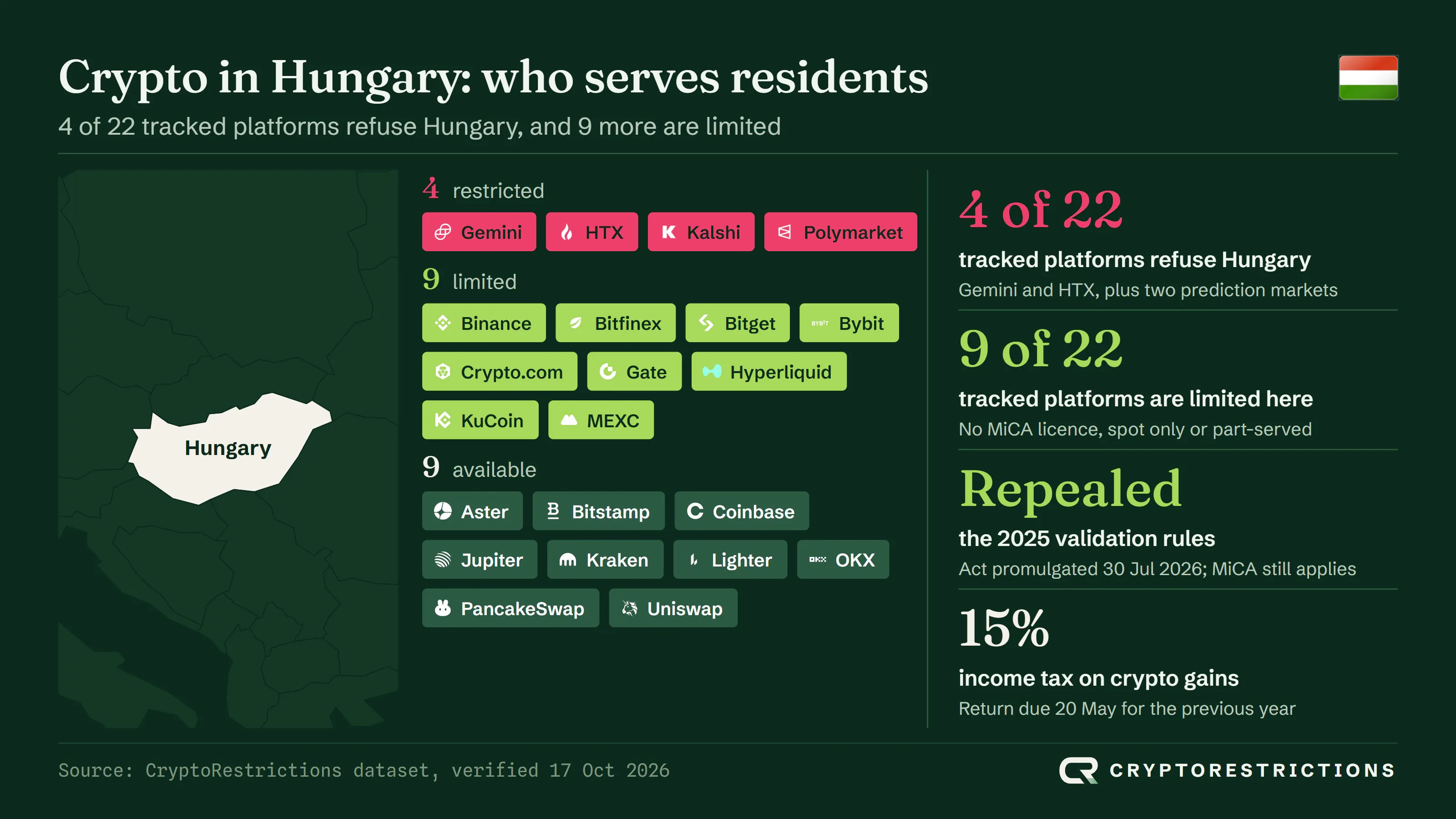
Yes. We found no Hungarian law that bans holding or trading crypto, and gains are taxed. Between July 2025 and August 2026 Hungary layered its own validation rules and criminal offences on top of the EU’s MiCA regulation, and it has since repealed them.
The EU’s Markets in Crypto-Assets Regulation (MiCA) applies in Hungary directly, and the Magyar Nemzeti Bank (MNB) is the competent authority for providers based there. The national crypto act, Act VII of 2024, sits beside it. From 1 July 2025 a 2025 amendment added two Criminal Code offences, misuse of crypto-assets and providing unauthorised crypto conversion services, and from 27 December 2025 every crypto-to-fiat or crypto-to-crypto conversion needed a certificate from a licensed validator, according to Wolf Theiss. A transaction without one was legally void.
Act XXXVIII of 2026 undid that. Parliament adopted it on 28 July 2026, it was promulgated on 30 July, and it takes effect on the eighth day after promulgation. It amends the Criminal Code, the act on the gambling authority and the crypto act. CMS reports that no validation is now required for any conversion, and that MiCA authorisation still applies.
The rules had a cost. Revolut withdrew its crypto service from Hungary in December 2025, and Strike stopped trading for Hungarians on 9 January 2026. Neither is a platform we track. We found no Hungary-specific exit notice from any platform we do track.
Which crypto exchanges work in Hungary?
Seven of the exchanges we track serve Hungarians under a MiCA licence from another EU country: Coinbase, Kraken, OKX, Bitstamp, Bybit, Crypto.com and Gate. Four are fully available; Bybit, Crypto.com and Gate are limited because they offer no derivatives here.
ESMA’s interim MiCA register lists Hungary as a passport country for each of the seven. It has no authorised provider with Hungary as its home state, but the MNB’s own institution register does hold Hungarian firms: on 20 July 2026 the MNB authorised CoinCash (Tiwala Solutions), reported by Cointelegraph as the first and so far only Hungary-based provider. It is not a platform we track. KuCoin EU and Gemini’s EU arm are also passported to Hungary on the register, but KuCoin EU’s trading is suspended and Gemini closed its EEA accounts, so both sit in the sections below.
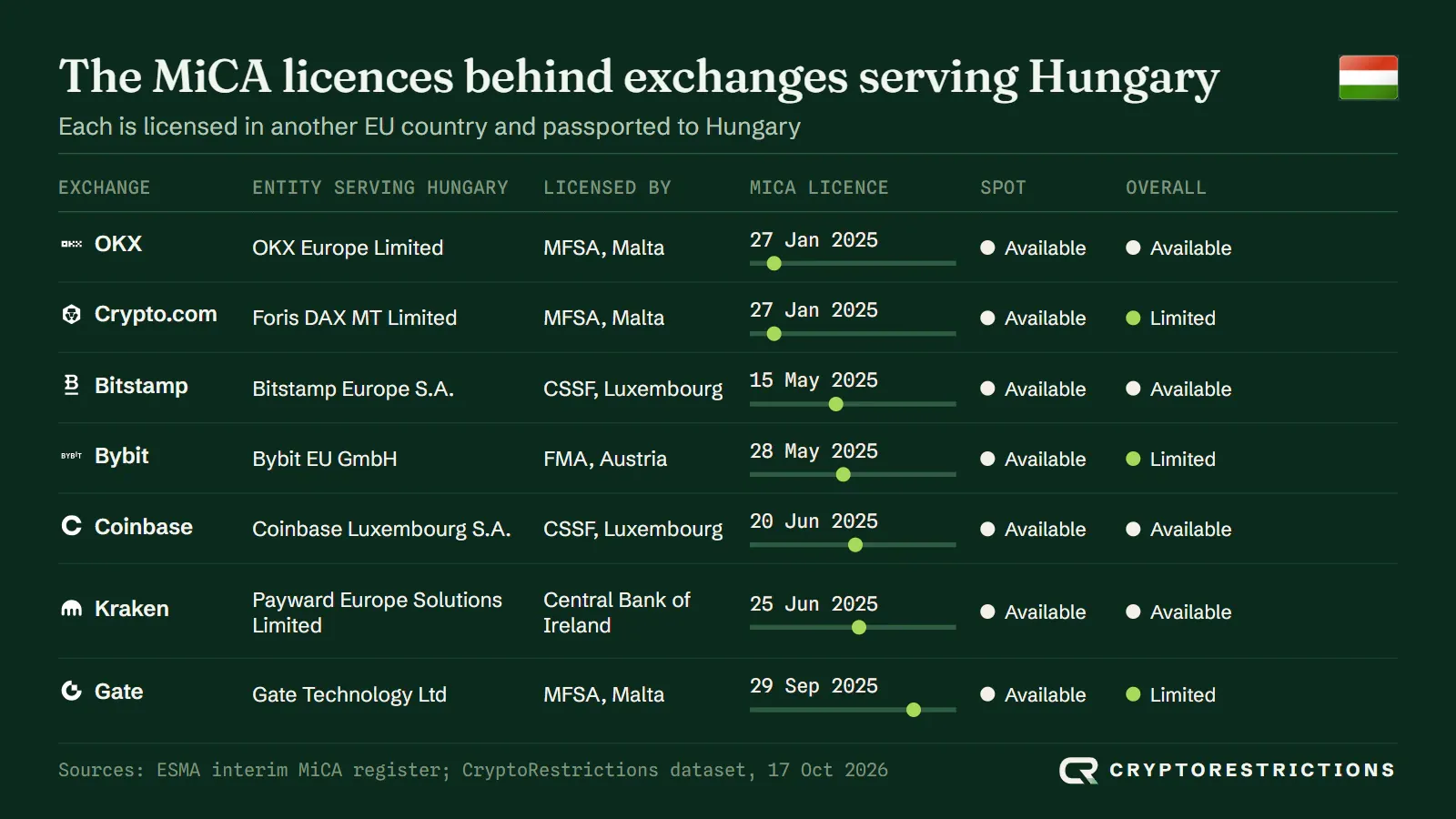
A passport is a notification, not a promise of service. The Block reported on 14 July 2025 that Bitstamp had halted trading for Hungarian residents under the new rules. We found no Bitstamp notice to confirm it, and Bitstamp’s sign-up page loaded in our October 2026 test with no barrier.
Best crypto platforms for Hungarian residents
By our access score, Bitstamp and Kraken (each 8.0 out of 10) are the most open exchanges for Hungarian users, with Coinbase and OKX (7.5) next. Aster, Lighter, Uniswap, Jupiter and PancakeSwap (8.0) are the most open on-chain platforms, and no prediction market is open.
The score rates how fully a Hungarian resident can use each platform, not its fees or safety. It is computed from our data and moves when a row changes: access status (4 points), the share of the platform’s products open here (3), the licences we hold on file for Hungary (2) and what our geo-access test saw from a Hungarian address (1). No platform earns the licence points, because we hold no licence booked to Hungary. Platforms that refuse Hungarian users are not scored. The full method is on our methodology page.
Exchanges

Bitstamp
Best for Spot trading from a long-running EU licence
8.0/10- Access
- 4/4
- Products
- 3/3
- Licences
- 0/2
- Our test
- 1/1
Read our Bitstamp reportPros
- Bitstamp Europe S.A. holds a CSSF MiCA licence from 15 May 2025, passported to Hungary
- Spot, staking and lending are open in our data
Cons
- No Hungarian entity: served from Luxembourg
- A July 2025 press report of a trading pause is unconfirmed

Kraken
Best for A wide product range from an Irish licence
8.0/10- Access
- 4/4
- Products
- 3/3
- Licences
- 0/2
- Our test
- 1/1
Read our Kraken reportPros
- Payward Europe Solutions holds a Central Bank of Ireland MiCA licence with a Hungarian passport
- Our test loaded sign-up from a Hungarian address with no barrier
Cons
- No Hungarian entity: served from Ireland

Coinbase
Best for A listed exchange passported from Luxembourg
7.5/10- Access
- 4/4
- Products
- 3/3
- Licences
- 0/2
- Our test
- 0.5/1
Read our Coinbase reportPros
- Coinbase Luxembourg S.A. holds a CSSF MiCA licence with a Hungarian passport
- The sign-up page loaded in our test
Cons
- No Hungarian entity: served from Luxembourg
- Our test showed a notice that stocks and prediction markets are unavailable

OKX
Best for A global brand with a local EU site
7.5/10- Access
- 4/4
- Products
- 3/3
- Licences
- 0/2
- Our test
- 0.5/1
Read our OKX reportPros
- OKX Europe Limited holds an MFSA MiCA licence from 27 January 2025, passported to Hungary
- okx.com sends Hungarian visitors to OKX Europe
Cons
- Served from Malta, not by a Hungarian entity

Bybit
Best for Spot trading on an Austrian licence
6.9/10- Access
- 3.5/4
- Products
- 2.4/3
- Licences
- 0/2
- Our test
- 1/1
Read our Bybit reportPros
- Bybit EU GmbH holds an Austrian MiCA licence with a Hungarian passport
- Sign-up loaded in our test with no barrier
Cons
- Bybit EU offers no derivatives
- EEA access to Bybit Global, which does, is being wound down

Crypto.com
Best for Spot trading in an app
6.3/10- Access
- 3.5/4
- Products
- 1.8/3
- Licences
- 0/2
- Our test
- 1/1
Read our Crypto.com reportPros
- Foris DAX MT Limited holds a Malta MiCA licence from 27 January 2025, passported to Hungary
- Spot trading and the app are offered
Cons
- Hungary is on its derivatives geo-restrictions list

Gate
Best for Spot trading on a licensed EU arm
5.5/10- Access
- 3.5/4
- Products
- 1.5/3
- Licences
- 0/2
- Our test
- 0.5/1
Read our Gate reportPros
- Gate Technology Ltd holds a Maltese MiCA licence with a Hungarian passport
- Spot trading is open to Hungarian users
Cons
- No derivatives: global Gate stopped taking EEA users in March 2025
- Our test showed an EU-region banner on the home page
Perpetuals

Aster
Best for Perpetual futures from your own wallet
8.0/10- Access
- 4/4
- Products
- 3/3
- Licences
- 0/2
- Our test
- 1/1
Read our Aster reportPros
- Hungary is not on its prohibited-jurisdictions list
- Its trading app loaded in our test
Cons
- No licence on file for Hungary

Lighter
Best for Perpetual futures from your own wallet
8.0/10- Access
- 4/4
- Products
- 3/3
- Licences
- 0/2
- Our test
- 1/1
Read our Lighter reportPros
- Hungary is not named in its terms
- Its trading app loaded in our test
Cons
- No licence on file for Hungary

Hyperliquid
Best for Perpetuals and spot on a decentralised exchange
5.9/10- Access
- 3/4
- Products
- 1.9/3
- Licences
- 0/2
- Our test
- 1/1
Read our Hyperliquid reportPros
- Perpetuals and spot loaded in our test
- Hungary is not excluded by its terms
Cons
- Its outcome markets tab is hidden from Hungarian addresses
DeFi

Jupiter
Best for Solana swaps
8.0/10- Access
- 4/4
- Products
- 3/3
- Licences
- 0/2
- Our test
- 1/1
Read our Jupiter reportPros
- Hungary is not in its terms
- Its app loaded in our test
Cons
- No licence on file for Hungary

PancakeSwap
Best for BNB Chain swaps and pools
8.0/10- Access
- 4/4
- Products
- 3/3
- Licences
- 0/2
- Our test
- 1/1
Read our PancakeSwap reportPros
- Not excluded by its terms
- The swap page loaded in our test
Cons
- No licence on file for Hungary

Uniswap
Best for Swapping tokens from your own wallet
8.0/10- Access
- 4/4
- Products
- 3/3
- Licences
- 0/2
- Our test
- 1/1
Read our Uniswap reportPros
- Its terms bar only places under comprehensive US sanctions
- Our test loaded the swap app from a Hungarian address
Cons
- No licence on file for Hungary
Which platforms block Hungarian users?
Four of the 22 platforms we track refuse Hungarian users: Gemini, HTX, Polymarket and Kalshi. Nine more are limited: five lack a working MiCA licence, three offer no derivatives and one hides its outcome markets.
Gemini closed every UK and EEA account on 6 April 2026. HTX’s user agreement bars the EU’s member states, and since 23 August 2026 EU sanctions on Russia-linked providers also ban dealings with HTX, under Regulation (EU) 2026/1848. Polymarket names Hungary in its terms of use of 11 August 2026, and Kalshi lists it in its member agreement.

The limited platforms are mostly MiCA casualties. Binance told European users about its licensing delay in June 2026 and has closed new sign-ups, deposits and trading across the EU while withdrawals stay open. KuCoin EU has had trading and deposits suspended since 4 February 2026, according to its June update. Bitget applied to Austria’s FMA on 2 July 2026 and says it will serve the EU once authorised.
What our geo-access test saw from Hungary
From a Hungarian address on 14 and 16 October 2026 we loaded 22 of the platforms we track: 2 refused us, 5 showed a notice or a redirect, and 15 loaded with no barrier.
An open page is not permission. Binance, HTX and MEXC all loaded their sign-up pages although their terms, notices or sanctions say Hungary should not be served, and Polymarket loaded because the January 2026 block works at Hungarian internet providers, which a VPN exit avoids. The two refusals were Gemini (“Gemini does not currently operate in Hungary”) and Kalshi (“Trading on Kalshi is not available in your country”). The five notices were a European regulatory information link at Binance, a Coinbase notice that stocks and prediction markets are unavailable, an EU-region banner at Gate, a KuCoin suggestion to switch to its EU site and OKX’s redirect to its European site. Swipe through the screenshots below; each card quotes what the page showed.
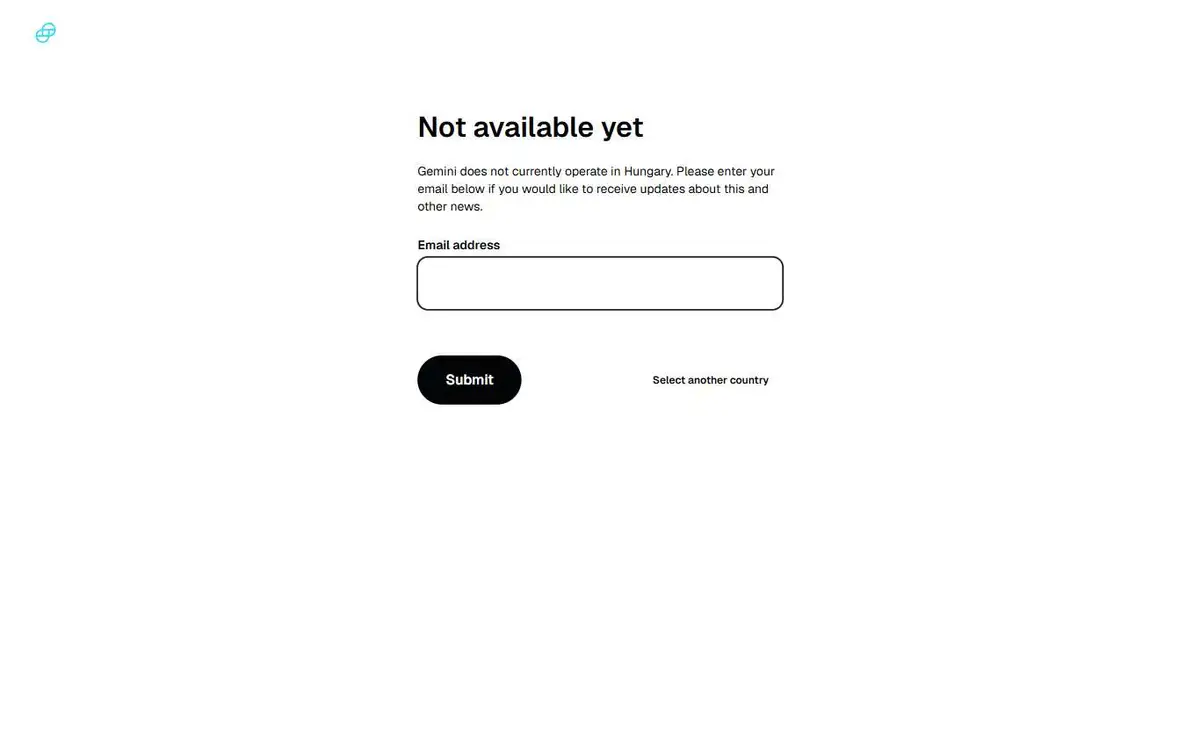
Blocked Gemini · Sign-up page
Hungary, one of the EEA countries Gemini left: the sign-up form is replaced by a refusal
“Gemini does not currently operate in Hungary.”
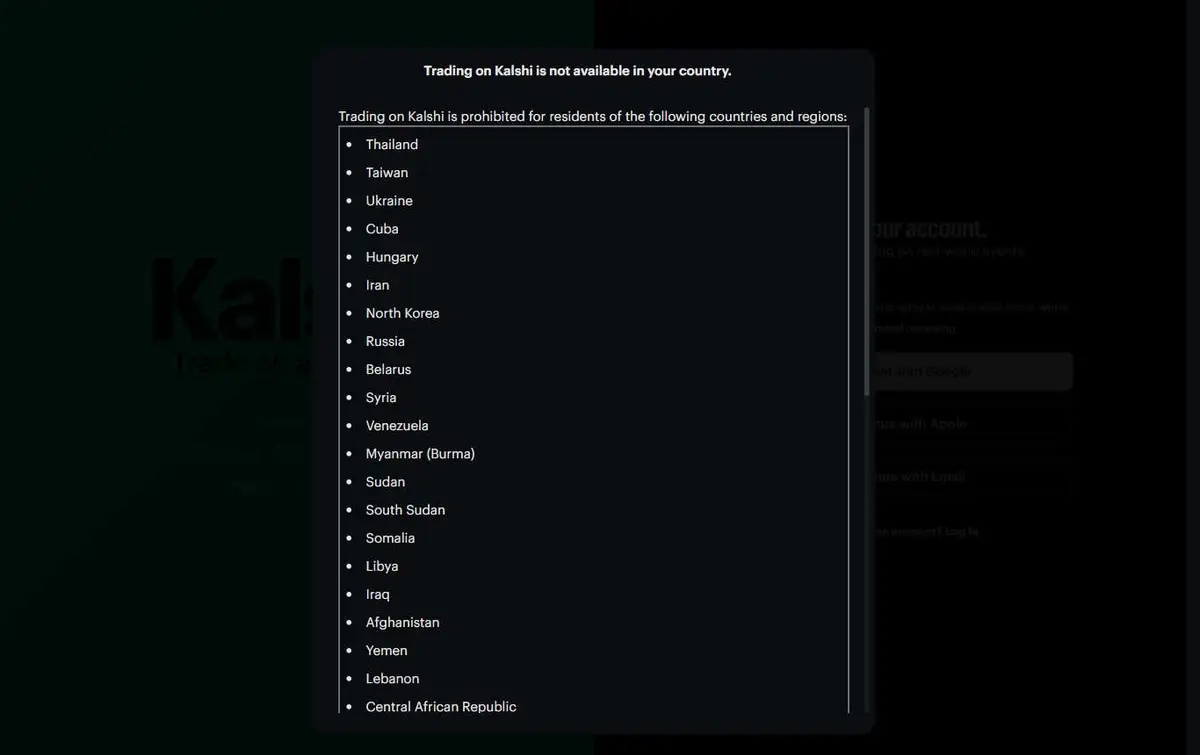
Blocked Kalshi · Sign-up page
Hungary, on Kalshi's list since March 2026: sign-up refuses trading and prints Kalshi's own list of prohibited places
“Trading on Kalshi is not available in your country.”
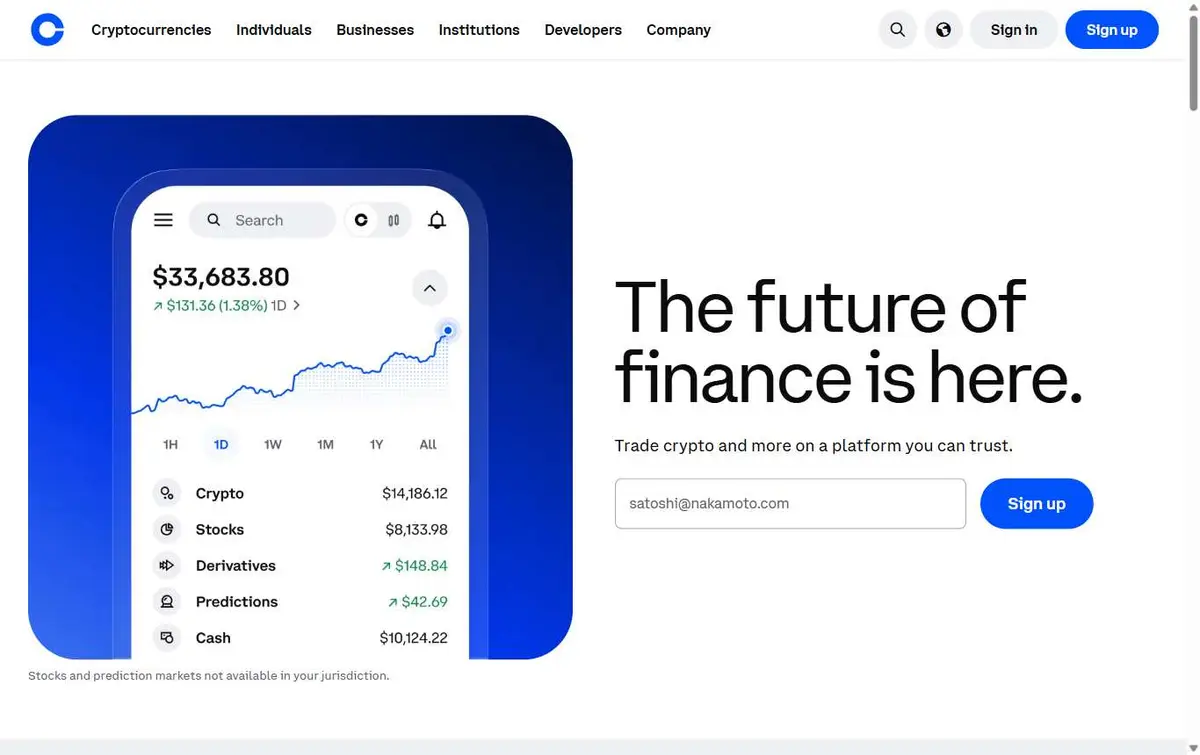
Notice shown Coinbase · Home page
Hungary: the home page loads, with a notice that stocks and prediction markets are unavailable
“Stocks and prediction markets not available in your jurisdiction.”
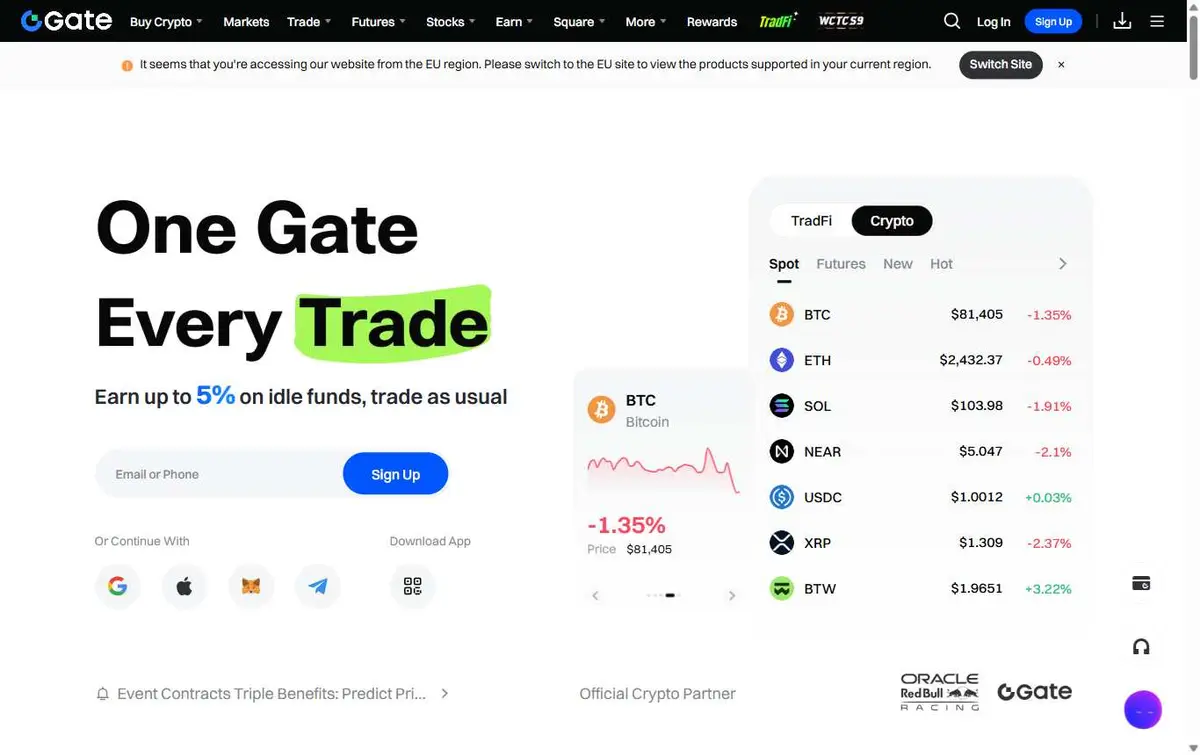
Notice shown Gate · Home page
Hungary: a banner asks visitors to switch to the EU site
“It seems that you're accessing our website from the EU region.”

Notice shown KuCoin · Home page
Hungary: a pop-up suggests switching to the KuCoin EU site
“Based on your location, we recommend switching to the KuCoin EU site for the best experience.”
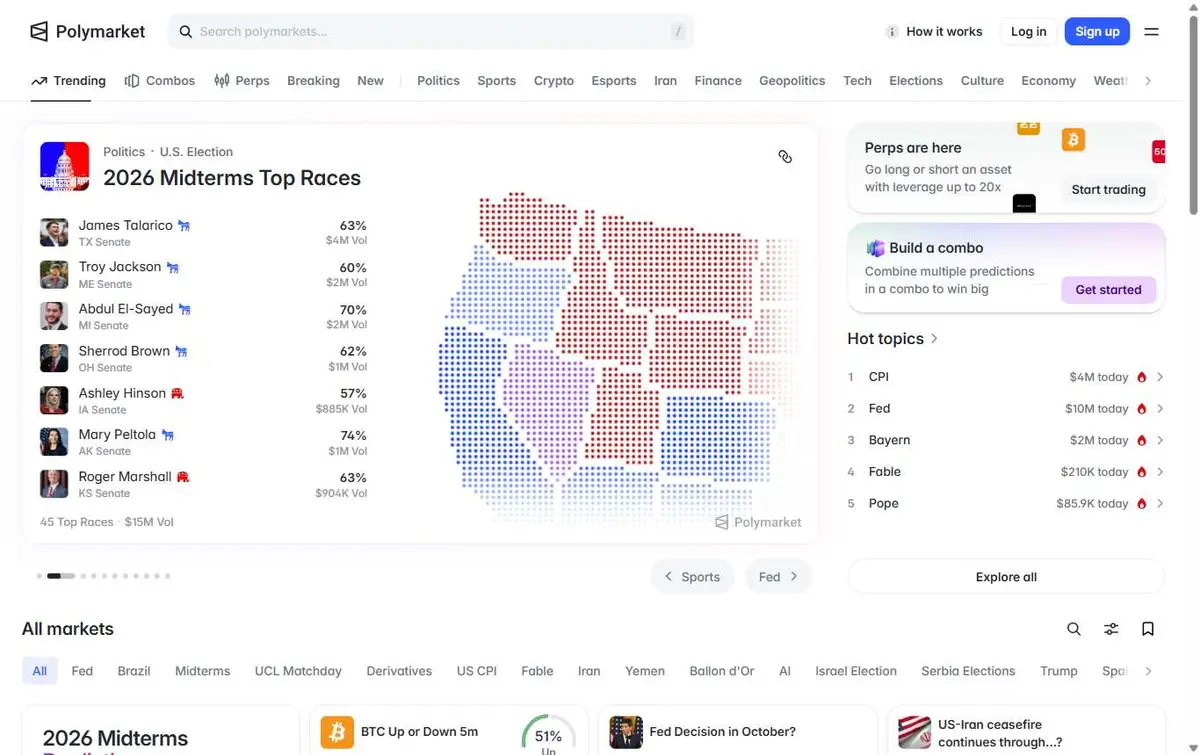
No barrier Polymarket · Home page
Hungary: the page loads from our VPN exit, although the regulator ordered Hungarian internet providers to block it in January 2026
 CRYPTORESTRICTIONS
Who regulates crypto in Hungary?
The MNB authorises crypto-asset service providers under MiCA, the gambling authority SZTFH blocks sites such as Polymarket, and NAV taxes the gains and takes the new EU reports. SZTFH also licensed validators until the August 2026 repeal.
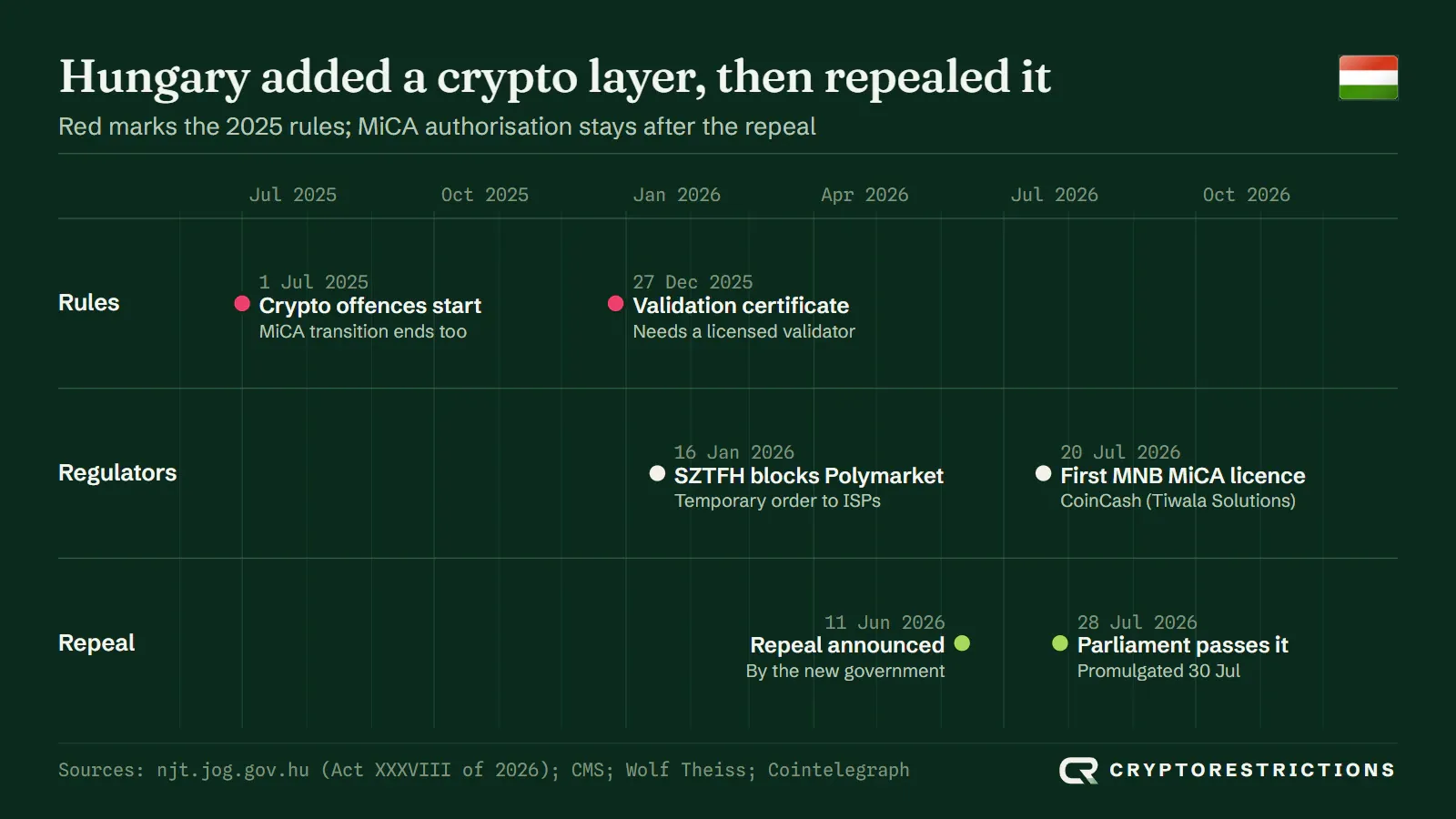
Hungary tightened first and loosened later. The 2025 amendment took effect on 1 July 2025, and Hungary used the earliest MiCA transition end date, 1 July 2025, rather than the EU maximum of 1 July 2026, according to Wolf Theiss. The validation certificate then applied from 27 December 2025. A new government announced the reversal on 11 June 2026, CMS reports, and the repeal act followed in July.
- MNB. The central bank authorises crypto-asset service providers based in Hungary and keeps the institution register. Its first MiCA licence came on 20 July 2026.
- SZTFH. The Supervisory Authority of Regulated Activities is the gambling regulator. Until the repeal it also licensed the validators, and the repeal act removes that power. It still issues blocking orders to internet providers, covered in the prediction-markets section.
- NAV. The tax administration collects the crypto income return and, since 1 January 2026, registers crypto-asset service providers for EU tax reporting, as covered in the tax section.
Which crypto products are limited in Hungary?
Spot trading is the open product. Derivatives are the narrowest: Bybit EU, Crypto.com and Gate offer none to Hungarians, and the outcome-market products we tested are closed to them.
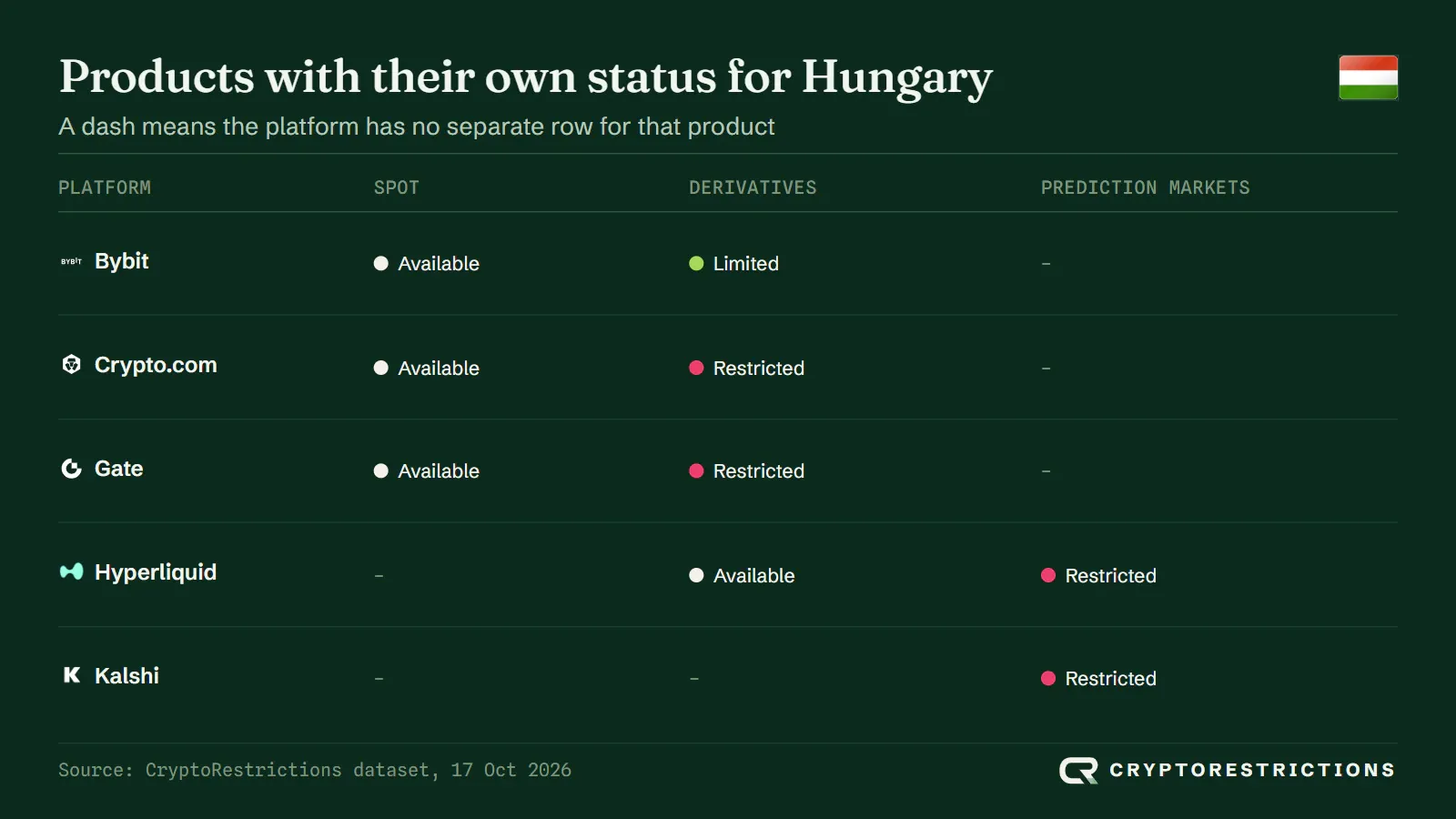
- Derivatives. Bybit EU offers no derivatives, and EEA access to Bybit Global is being wound down. Crypto.com lists Hungary on its derivatives geo-restrictions. Gate’s EU arm has no derivatives, and global Gate stopped taking EEA users in March 2025. Perpetuals on Aster, Hyperliquid and Lighter load from Hungary and are not excluded by their terms.
- Outcome markets. Hyperliquid’s app hides its outcome markets tab from Hungarian addresses, and Polymarket and Kalshi refuse Hungary outright.
Are prediction markets legal in Hungary?
No tracked platform offers them to Hungarians. We could not read a Hungarian prediction-market rule, but the gambling authority SZTFH ordered internet providers to block Polymarket in January 2026, and Hungary is not among the nine regulators that issued the June 2026 joint warning.
CMS reports that on 16 January 2026 SZTFH ordered Hungarian internet providers to block polymarket.com while it examined suspected illegal gambling. The order is temporary, in place until a final administrative decision, and applies to Hungarian addresses only: access from abroad or by VPN is unaffected. That fits our test, whose Hungarian VPN exit loaded Polymarket’s home page. We could not find whether a final decision has been issued. We also could not read the Hungarian gambling act itself, so we make no claim about whether it covers event contracts.
Nine gambling regulators from other countries issued a joint statement on prediction markets on 19 June 2026, according to Finance Magnates. Hungary was not one of them. We found no Hungarian enforcement action naming Kalshi, whose own terms already exclude Hungary.
How is crypto taxed in Hungary?
Gains are taxed at 15% personal income tax, but only when crypto is converted into real value, such as forints or goods. The return for 2025 income was due on 20 May 2026.
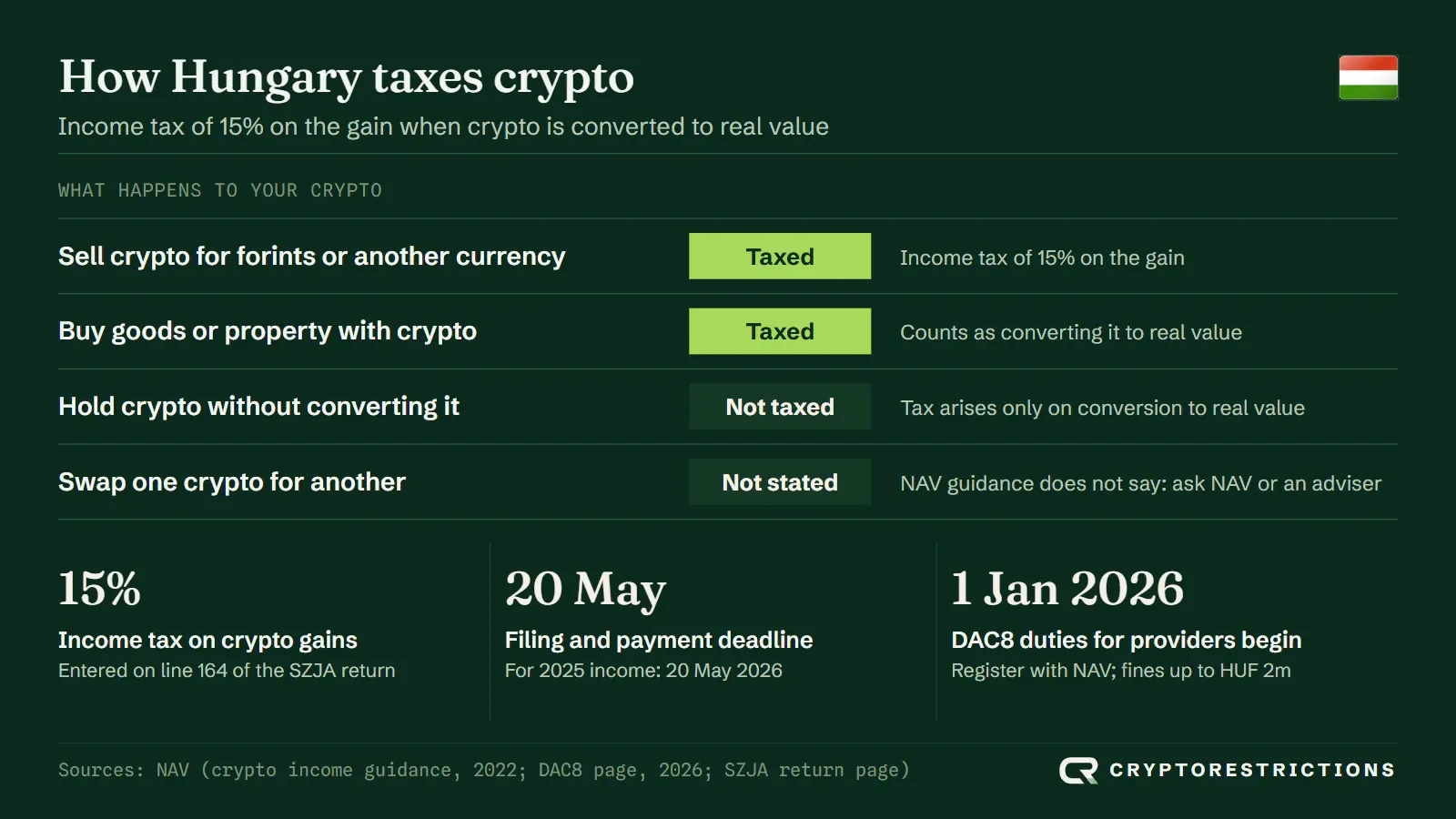
The rules come from NAV’s guidance page, which is dated 10 May 2022, so check the current figures before relying on it. It says tax arises when crypto is exchanged for legal tender or used to buy movable property or real estate. The gain goes on line 164 of the annual return, and a loss entered there can be offset against later crypto tax within two tax years. The page also exempts small sales, with limits tied to the minimum wage (HUF 20,000 per transaction and HUF 200,000 a year in 2022). It does not say how a swap of one crypto for another is treated.
NAV’s return page gives one filing and payment deadline for everyone: 20 May 2026 for income earned in 2025, on form 25SZJA.
Reporting is tightening. NAV’s DAC8 page says the EU’s tax-reporting duties for crypto-asset service providers apply from 1 January 2026. Providers must register in NAV’s DACentral portal, collect each customer’s tax residence by self-certification (for existing customers by 1 January 2027), and face fines of up to HUF 2 million for failures.






 Serbia
 Turkey
 Switzerland
 Iceland
 Liechtenstein
 Norway
 Croatia
 Estonia
 Finland
 Greece
 Latvia