
Is crypto legal in Poland?
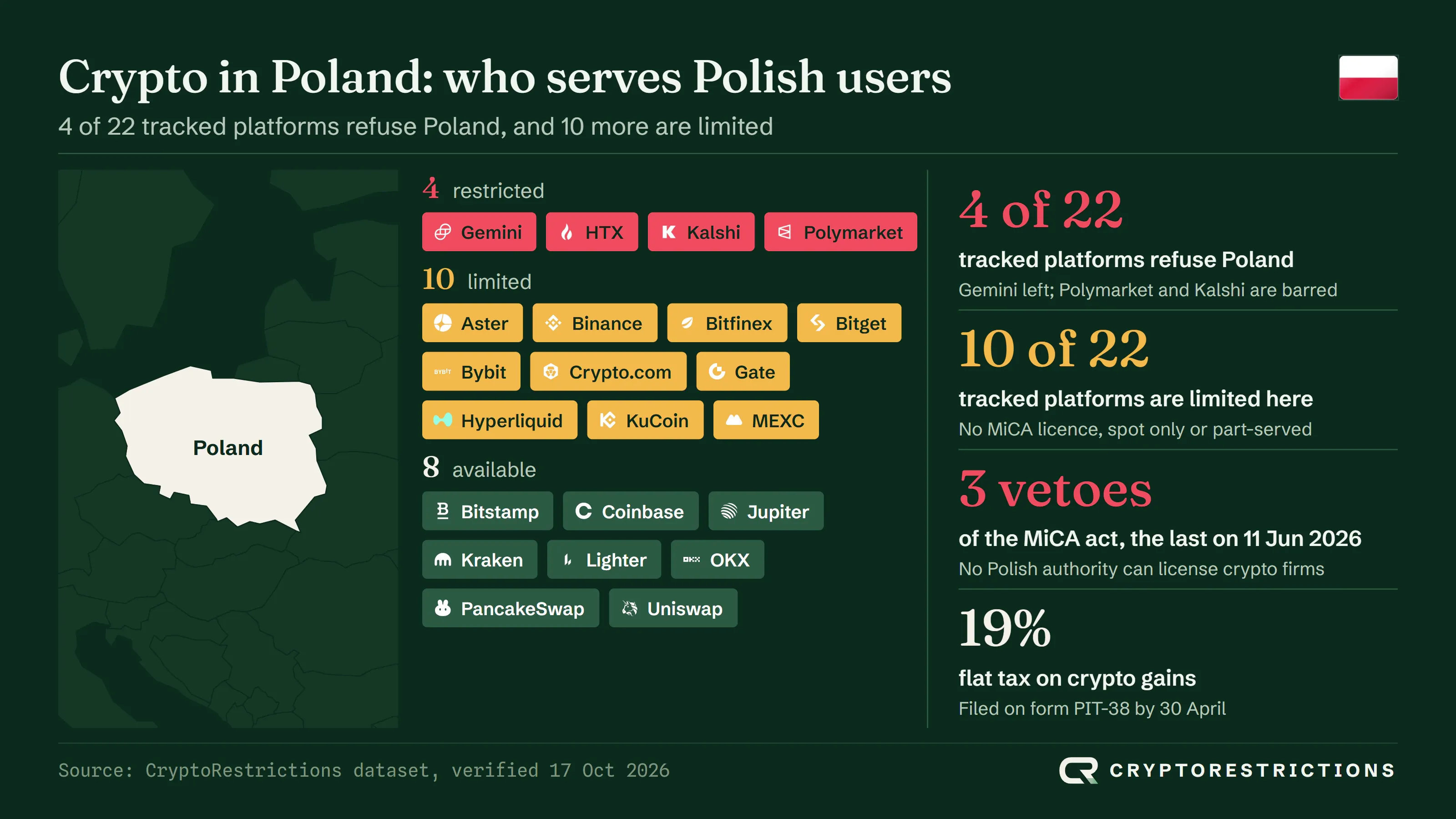
Yes. We found no Polish law that bans holding or trading crypto, and the Ministry of Finance taxes the gains. What Poland lacks is a licensing authority: it has never passed the law that would let a Polish regulator license crypto firms under MiCA.
The EU’s Markets in Crypto-Assets Regulation (MiCA) applies in Poland directly, but each country must name a regulator to authorise providers. Poland has not. The financial regulator’s office (UKNF) says in its position statement that no national authority has been designated for crypto-asset service providers, and that the KNF is competent only for issuers of e-money tokens. The EU-wide transition ended on 1 July 2026. According to the statement, Polish law cannot extend it: from that date domestic firms may not provide crypto services until authorised, and a Polish authorisation is possible only once a law designates the authority.
Providers licensed in another EU country are not blocked. The same statement says they may serve Poland on a passport notification. That is how every exchange in the next section reaches Polish users. Customers carry the risk: the tax administration’s notice to clients says crypto balances are not covered by state guarantees like bank deposits, and that firms without a MiCA authorisation after 1 July 2026 should be treated as high risk.
Which crypto exchanges work in Poland?
Seven of the exchanges we track serve Polish users under a MiCA licence from another EU country: Coinbase, Kraken, OKX, Bitstamp, Bybit, Crypto.com and Gate. Four are fully available; Bybit, Crypto.com and Gate are limited because they offer no derivatives here.
None of them holds a Polish licence, because none can be granted. ESMA’s interim MiCA register has no authorised provider with Poland as its home country, and it lists Poland as a passport country for each of the seven. KuCoin EU is on the register with a Polish passport too, but its trading has been suspended since February 2026, so it sits among the limited platforms below.
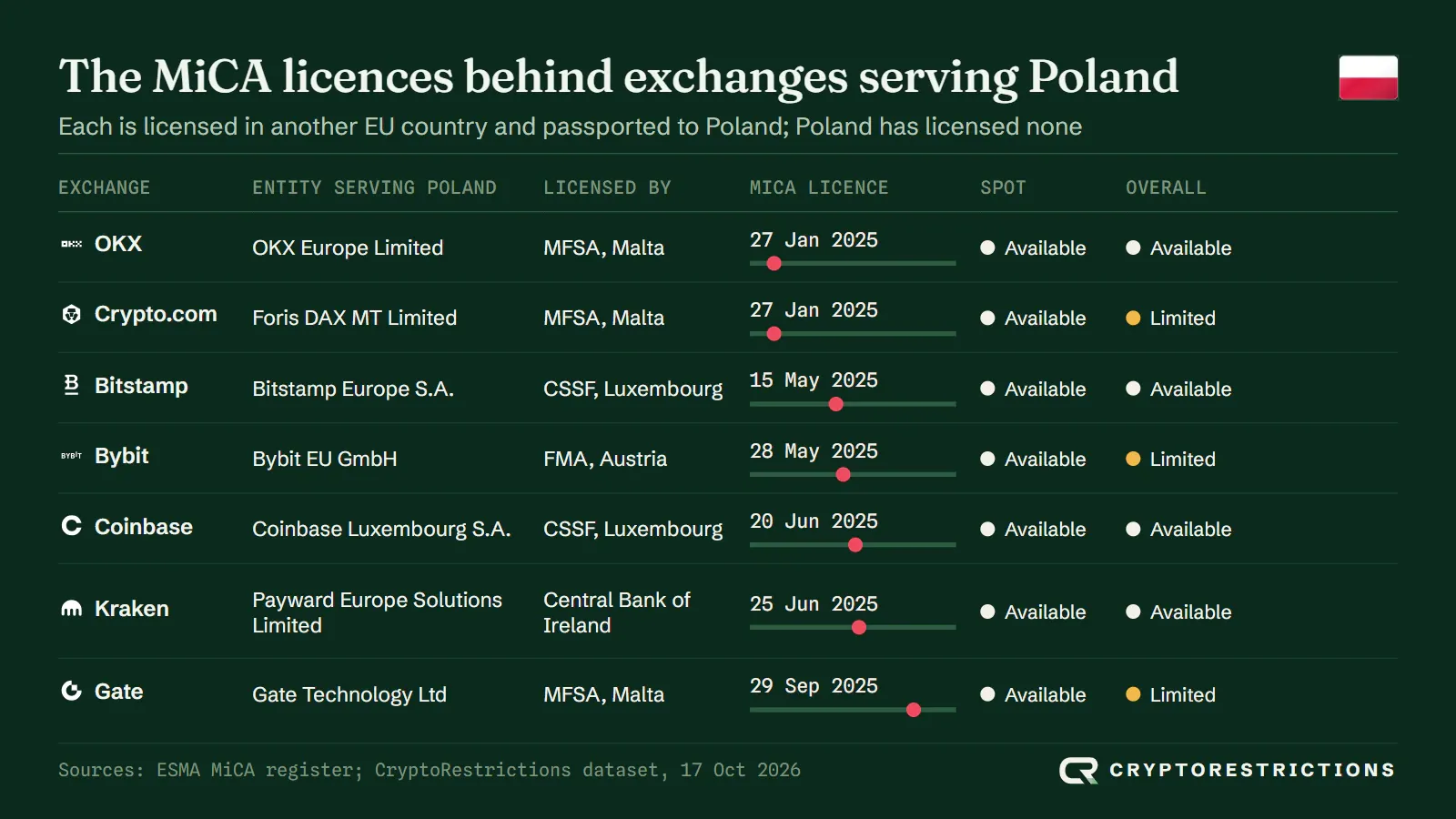
Two of the seven have added local payments. Coinbase launched BLIK and zloty purchases on 17 December 2025, and Bybit EU added zloty pairs and BLIK deposits on 21 April 2026.
Best crypto platforms for Polish residents
By our access score, Bitstamp and Kraken (each 8.0 out of 10) are the most open exchanges for Polish users, with Coinbase and OKX (7.5) next. Lighter, Uniswap, Jupiter and PancakeSwap (8.0) are the most open on-chain platforms, and no prediction market is open.
The score rates how fully a Polish resident can use each platform, not its fees or safety. It is computed from our data and moves when a row changes: access status (4 points), the share of the platform’s products open here (3), the licences we hold on file for Poland (2) and what our geo-access test saw from a Polish address (1). No platform earns the licence points, because no licence can be booked to Poland. Platforms that refuse Polish users are not scored. The full method is on our methodology page.
Exchanges

Bitstamp
Best for Spot trading from a long-running EU licence
8.0/10- Access
- 4/4
- Products
- 3/3
- Licences
- 0/2
- Our test
- 1/1
Read our Bitstamp reportPros
- Bitstamp Europe S.A. holds a CSSF MiCA licence from 15 May 2025, passported to Poland
- Spot, staking and lending are open in our data
Cons
- No Polish entity: served from Luxembourg

Kraken
Best for A MiCA-licensed exchange with a wide product range
8.0/10- Access
- 4/4
- Products
- 3/3
- Licences
- 0/2
- Our test
- 1/1
Read our Kraken reportPros
- Payward Europe Solutions holds a Central Bank of Ireland MiCA licence with a Polish passport
- Our test loaded sign-up from a Polish address with no barrier
Cons
- No Polish entity: served from Ireland

Coinbase
Best for A MiCA-licensed exchange with zloty and BLIK
7.5/10- Access
- 4/4
- Products
- 3/3
- Licences
- 0/2
- Our test
- 0.5/1
Read our Coinbase reportPros
- Coinbase Luxembourg S.A. holds a CSSF MiCA licence with a Polish passport
- BLIK and zloty purchases since 17 December 2025
Cons
- No Polish entity: served from Luxembourg
- Our test showed a notice that stocks and prediction markets are unavailable

OKX
Best for A global brand with a local EU site
7.5/10- Access
- 4/4
- Products
- 3/3
- Licences
- 0/2
- Our test
- 0.5/1
Read our OKX reportPros
- OKX Europe Limited holds an MFSA MiCA licence from 27 January 2025, passported to Poland
- okx.com sends Polish visitors to OKX Europe
Cons
- Served from Malta, not by a Polish entity

Bybit
Best for Spot trading with zloty pairs
6.9/10- Access
- 3.5/4
- Products
- 2.4/3
- Licences
- 0/2
- Our test
- 1/1
Read our Bybit reportPros
- Bybit EU GmbH holds an Austrian MiCA licence with a Polish passport
- Zloty pairs and BLIK deposits since 21 April 2026
Cons
- Bybit EU offers no derivatives
- EEA access to Bybit Global, which does, is being wound down

Crypto.com
Best for Spot trading in an app
6.3/10- Access
- 3.5/4
- Products
- 1.8/3
- Licences
- 0/2
- Our test
- 1/1
Read our Crypto.com reportPros
- Foris DAX MT Limited holds a Malta MiCA licence from 27 January 2025, passported to Poland
- Spot trading and the app are offered
Cons
- Derivatives are on its geo-restrictions list for Poland

Gate
Best for Spot trading on a licensed EU arm
5.5/10- Access
- 3.5/4
- Products
- 1.5/3
- Licences
- 0/2
- Our test
- 0.5/1
Read our Gate reportPros
- Gate Technology Ltd holds a Maltese MiCA licence with a Polish passport
- Spot trading is open to Polish users
Cons
- No derivatives: global Gate stopped taking EEA users in March 2025
- Our test showed an EU-region notice at sign-up
Perpetuals

Lighter
Best for Perpetual futures from your own wallet
8.0/10- Access
- 4/4
- Products
- 3/3
- Licences
- 0/2
- Our test
- 1/1
Read our Lighter reportPros
- Poland is not named in its terms
- Its trading app loaded in our test
Cons
- No licence on file for Poland

Hyperliquid
Best for Perpetuals and spot on a decentralised exchange
5.9/10- Access
- 3/4
- Products
- 1.9/3
- Licences
- 0/2
- Our test
- 1/1
Read our Hyperliquid reportPros
- Perpetuals and spot loaded in our test
- Poland is not excluded by its terms
Cons
- Its outcome markets tab is hidden from Polish addresses
DeFi

Jupiter
Best for Solana swaps
8.0/10- Access
- 4/4
- Products
- 3/3
- Licences
- 0/2
- Our test
- 1/1
Read our Jupiter reportPros
- Poland is not in its terms
- Its app loaded in our test
Cons
- No licence on file for Poland

PancakeSwap
Best for BNB Chain swaps and pools
8.0/10- Access
- 4/4
- Products
- 3/3
- Licences
- 0/2
- Our test
- 1/1
Read our PancakeSwap reportPros
- Not excluded by its terms
- The swap page loaded in our test
Cons
- No licence on file for Poland

Uniswap
Best for Swapping tokens from your own wallet
8.0/10- Access
- 4/4
- Products
- 3/3
- Licences
- 0/2
- Our test
- 1/1
Read our Uniswap reportPros
- Its terms bar only places under comprehensive US sanctions
- Our test loaded the swap app from a Polish address
Cons
- No licence on file for Poland
Which platforms block Polish users?
Four of the 22 platforms we track refuse Polish users: Gemini, Polymarket, Kalshi and HTX. Seven more are limited: five lack a working MiCA licence, and two bar outcome markets.
Gemini closed every UK and EEA account on 6 April 2026. Polymarket lists Poland in its geographic restrictions as close-only, Kalshi names Poland in section VI of its member agreement, and HTX’s user agreement bars all EU states. Since 23 August 2026 EU sanctions on Russia-linked providers also ban dealings with HTX, under Regulation (EU) 2026/1848.
The limited platforms are mostly MiCA casualties. Binance told European users about its licensing delay in June 2026, and its Polish notice, reported by money.pl, closes new users, new spot orders and Earn from 1 July while withdrawals stay open. Bitget applied to Austria’s FMA on 2 July 2026 and says it will serve the EU once authorised.
What our geo-access test saw from Poland
From a Polish address on 14 and 16 October 2026 we loaded 22 of the platforms we track: 2 refused us, 5 showed a notice or a redirect, and 15 loaded with no barrier.
An open page is not permission. Binance, HTX and MEXC all loaded their sign-up pages although their terms, notices or sanctions say Poland should not be served. The two refusals were Gemini (“Gemini does not currently operate in Poland”) and Polymarket, whose geoblock check answered blocked. The five notices were Kalshi’s “prediction markets are not available”, an EU-region prompt at Gate, a KuCoin suggestion to switch to its EU site, OKX’s redirect to its European site and a Coinbase notice that stocks and prediction markets are unavailable. Swipe through the screenshots below; each card quotes what the page showed.
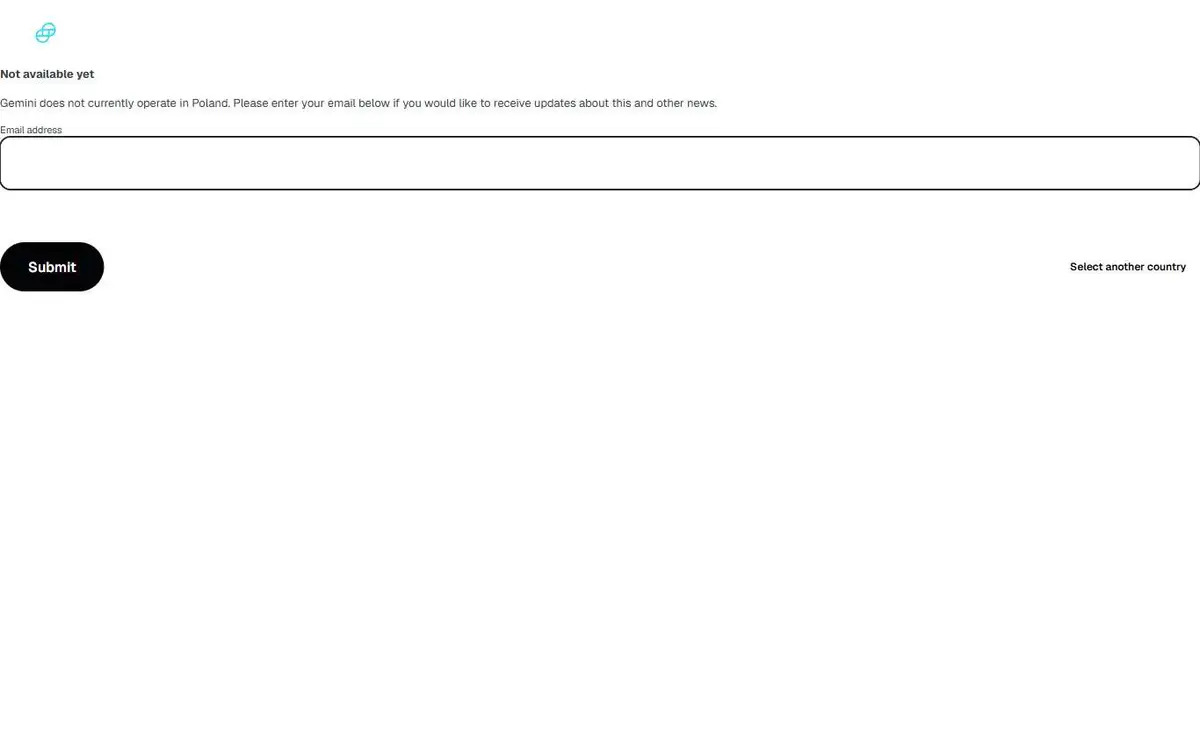
Blocked Gemini · Sign-up page
Poland, one of the EEA countries Gemini left, gets the same refusal
“Gemini does not currently operate in Poland.”
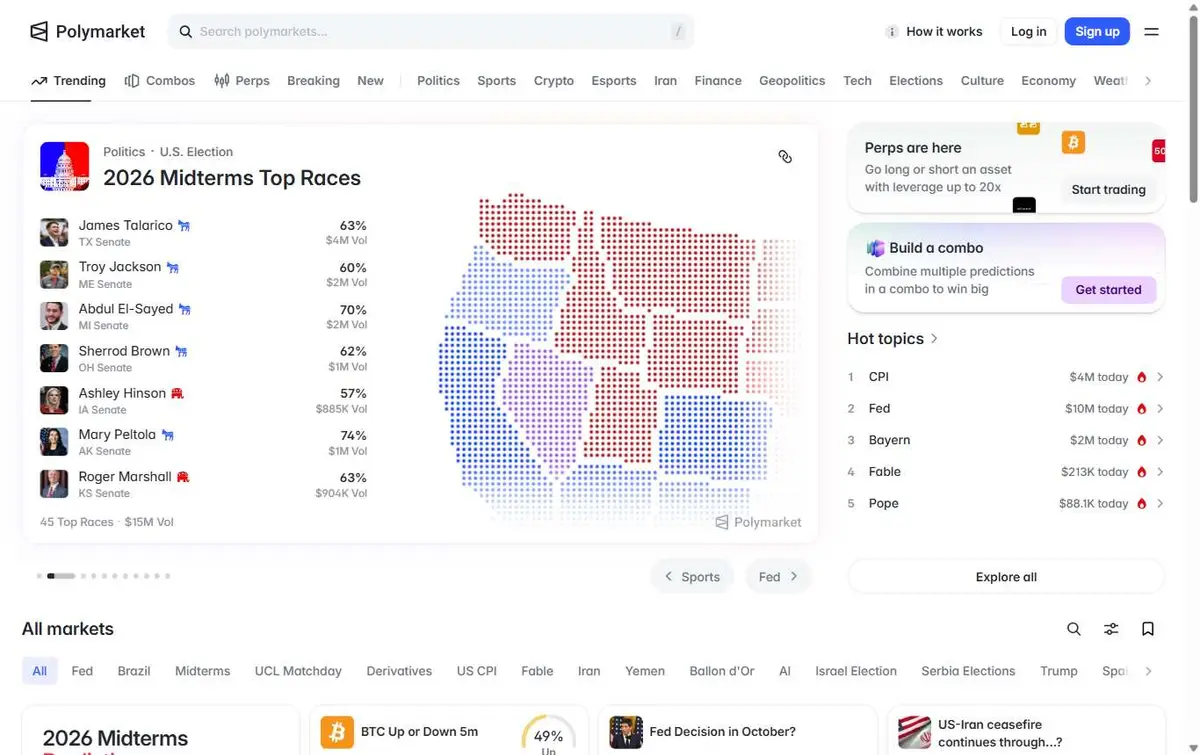
Blocked Polymarket · Home page
Poland, on Polymarket's close-only list: the geoblock check answered blocked
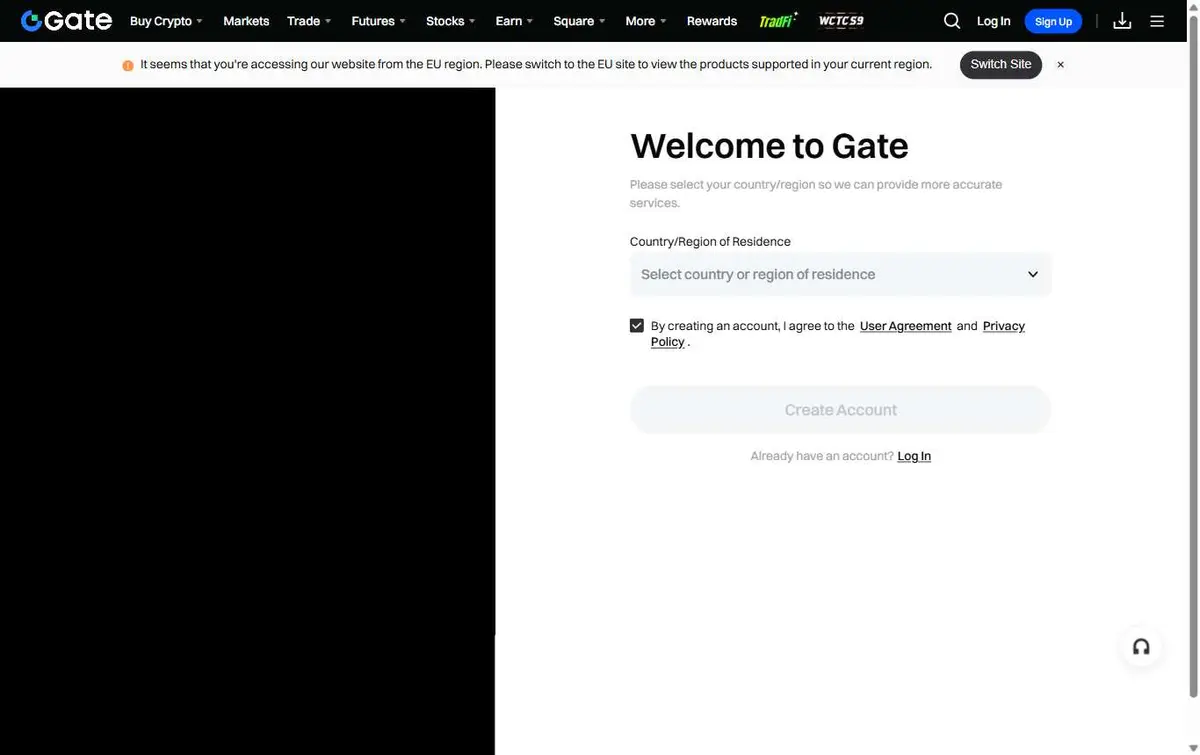
Notice shown Gate · Sign-up page
Poland gets an EU-region notice at sign-up
“It seems that you're accessing our website from the EU region.”
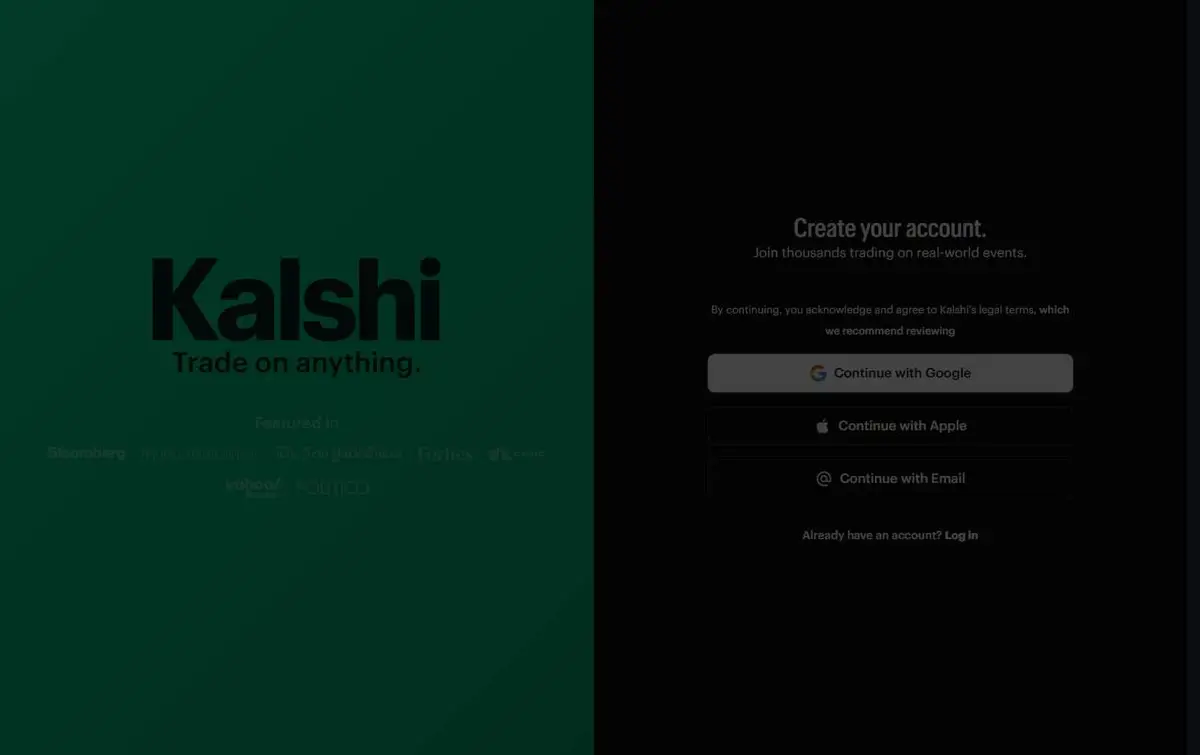
Notice shown Kalshi · Sign-up page
Poland, on Kalshi's restricted list: the sign-up page says prediction markets are not available
“Prediction markets are not available.”
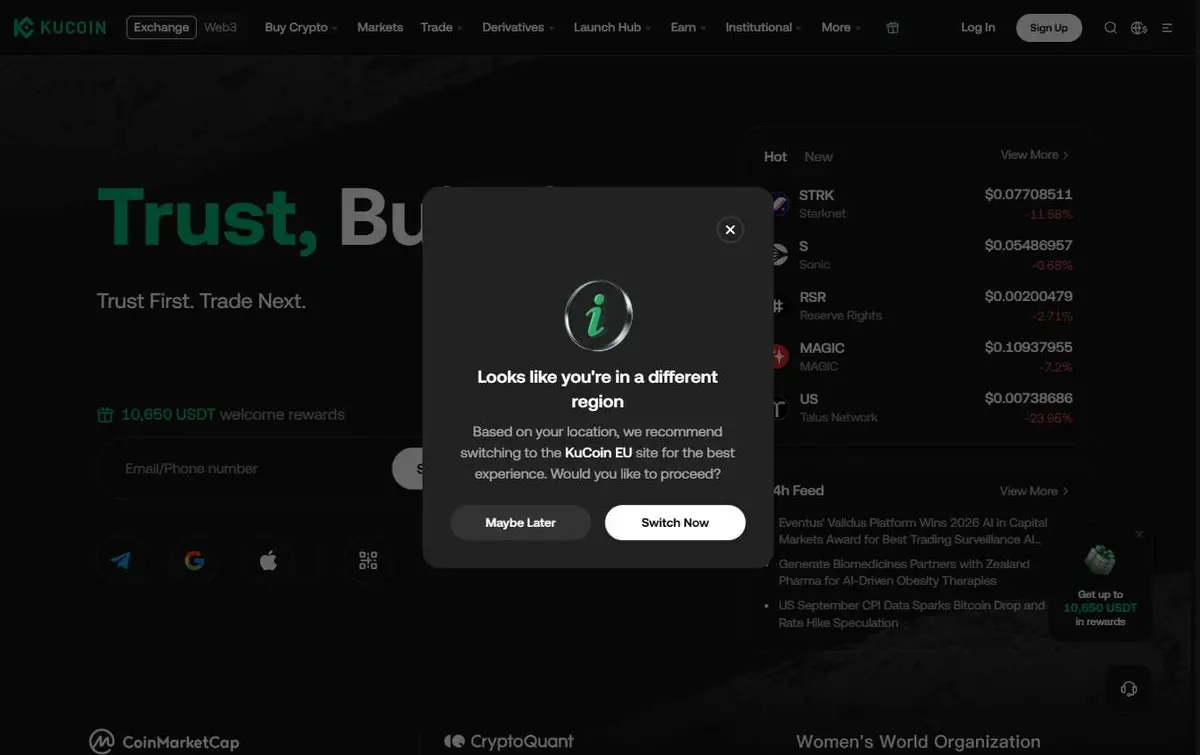
Notice shown KuCoin · Home page
Poland is pointed to the KuCoin EU site, which has had trading suspended since February 2026
“Based on your location, we recommend switching to the KuCoin EU site for the best experience.”
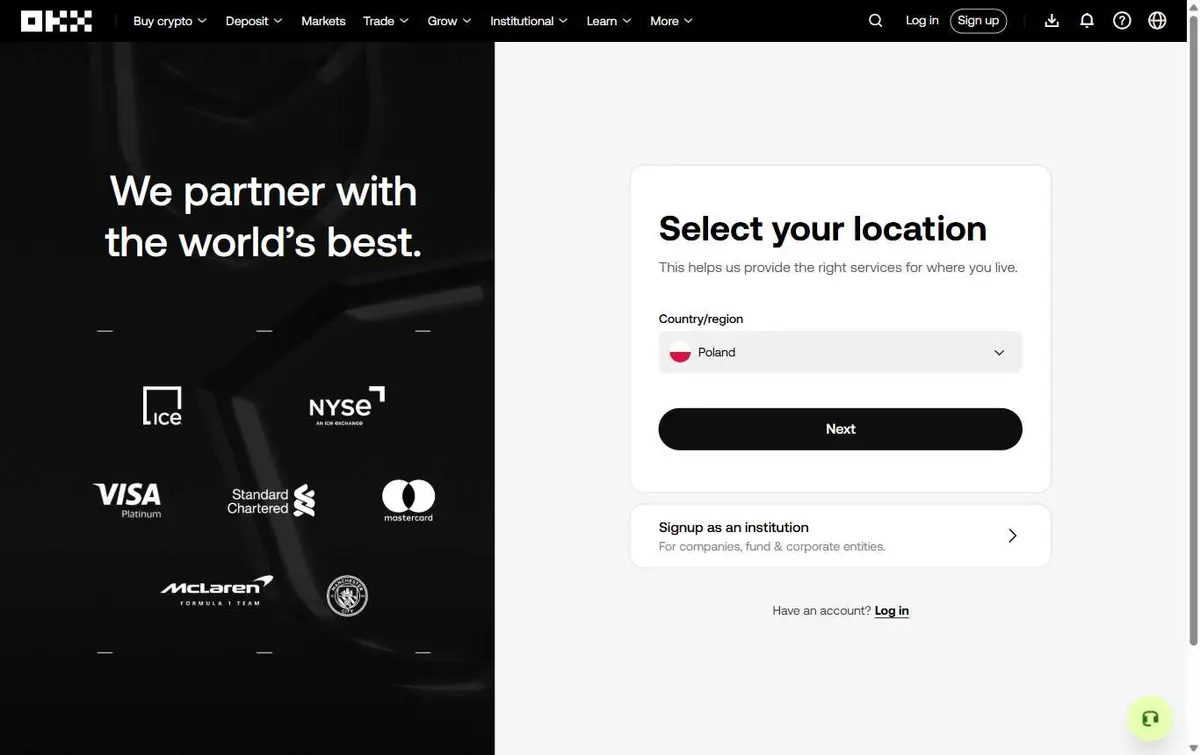
Notice shown OKX · Sign-up page
Poland: sign-up is served by OKX Europe
 CRYPTORESTRICTIONS
Who regulates crypto in Poland?
Nobody yet licenses crypto firms. The KNF is competent for e-money token issuers only, the tax administration in Katowice keeps an old register that grants no permit, and the Ministry of Finance runs the gambling blocklist.
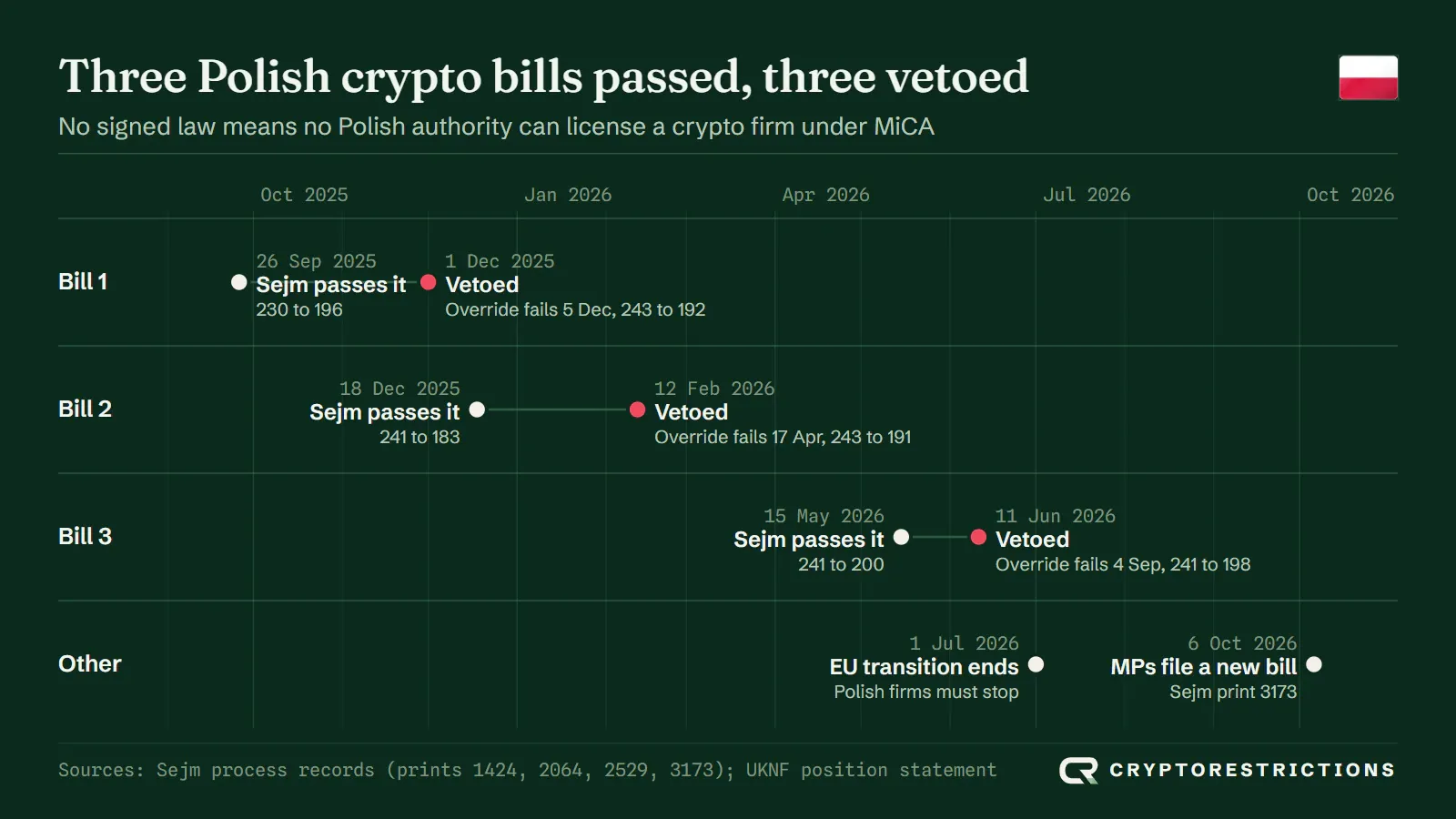
Parliament has tried three times to fix this. The Sejm passed the government’s first bill on 26 September 2025, and President Nawrocki vetoed it on 1 December. The Sejm needs a three-fifths majority to override a veto and fell short on 5 December, 243 to 192. The government filed a second bill; it passed on 18 December, was vetoed on 12 February 2026, and the override failed on 17 April (243 to 191). A third bill passed on 15 May and was vetoed on 11 June, reportedly over website blocking and supervisory fees, according to Polsat News. The override failed again on 4 September (241 to 198). The Sejm has never re-passed a bill after a veto; each retry was a new bill. On 6 October a group of MPs filed another, print 3173.
- KNF and UKNF. All three bills named the KNF as the competent authority for crypto-asset service providers. Today it supervises issuers of e-money tokens, the single MiCA role Poland has assigned. It publishes a public warnings list; none of the platforms we track was on it when we read it on 17 October 2026.
- KAS in Katowice. The Director of the Tax Administration Chamber in Katowice runs the virtual currency register, set up under the anti-money-laundering law. The register page says an entry is not a permit and that crypto services in the EU may only be provided by MiCA-authorised firms. An April 2026 interpellation says the office stopped accepting new entries.
- Ministry of Finance. It keeps the register of domains offering gambling in breach of the Hazard Act, covered in the prediction-markets section, and sets tax rules.
Which crypto products are limited in Poland?
Spot trading is the open product. Derivatives are the narrowest: Bybit EU, Crypto.com and Gate offer none to Polish users, and every outcome-market product we track is closed to them.
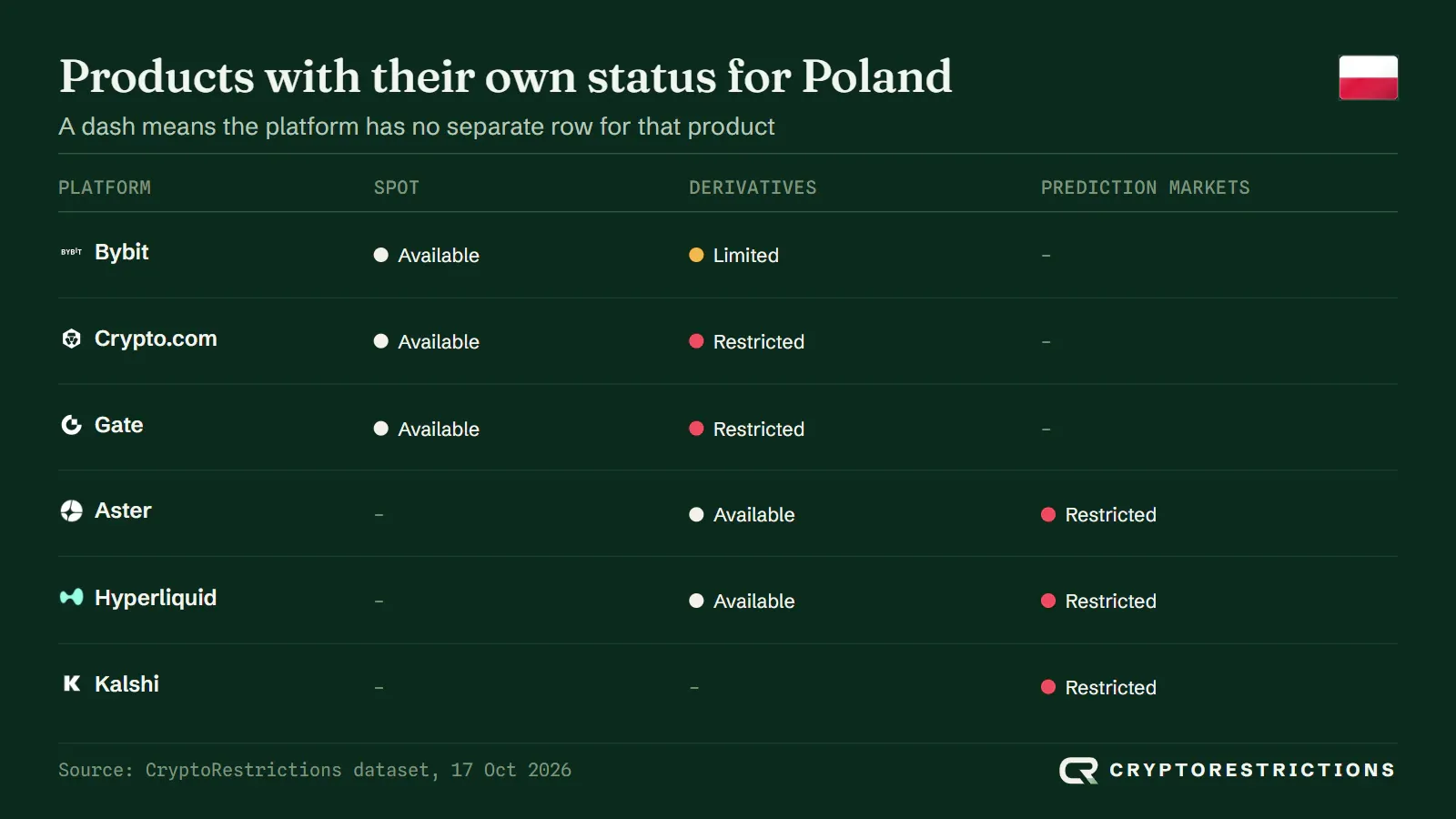
- Derivatives. Bybit EU offers no derivatives, and EEA access to Bybit Global is being wound down. Crypto.com lists Poland on its derivatives geo-restrictions. Gate’s EU arm has no derivatives, and global Gate stopped taking EEA users in March 2025. Perpetuals on Aster, Hyperliquid and Lighter load from Poland and are not excluded by their terms.
- Outcome markets. Aster bars prediction trading here, and Hyperliquid’s app hides its outcome markets tab from Polish addresses.
- Stablecoins. E-money tokens, the MiCA category covering single-currency stablecoins, are the one area where Poland has an authority: the UKNF says the KNF supervises their issuers.
Are prediction markets legal in Poland?
No tracked platform offers them to Polish residents. We found no Polish prediction-market law, but the Ministry of Finance blocklist for illegal gambling reportedly includes Polymarket, and Polish regulators joined a June 2026 European warning.
Polymarket, Kalshi, Aster and Hyperliquid all restrict Poland in our data, as covered above. The Ministry of Finance’s domain register lists sites offering gambling in breach of the Hazard Act. Press reports say Polymarket was added in January 2025, and that internet providers must block listed domains, according to bitcoin.pl. We could not confirm this ourselves: the register’s search sits behind bot protection, which we did not try to bypass.
In June 2026 regulators from nine European countries, Poland among them, issued a joint statement on prediction markets, reported by European Gaming. It commits them to share information, monitor advertising and act against platforms that break local rules. We found no Polish enforcement action that names Kalshi.
How is crypto taxed in Poland?
Income from selling crypto is taxed at a flat 19%, with no holding-period exemption. You file form PIT-38 between 15 February and 30 April for the previous year, and swapping one crypto for another is not taxed until you sell for cash or spend it.
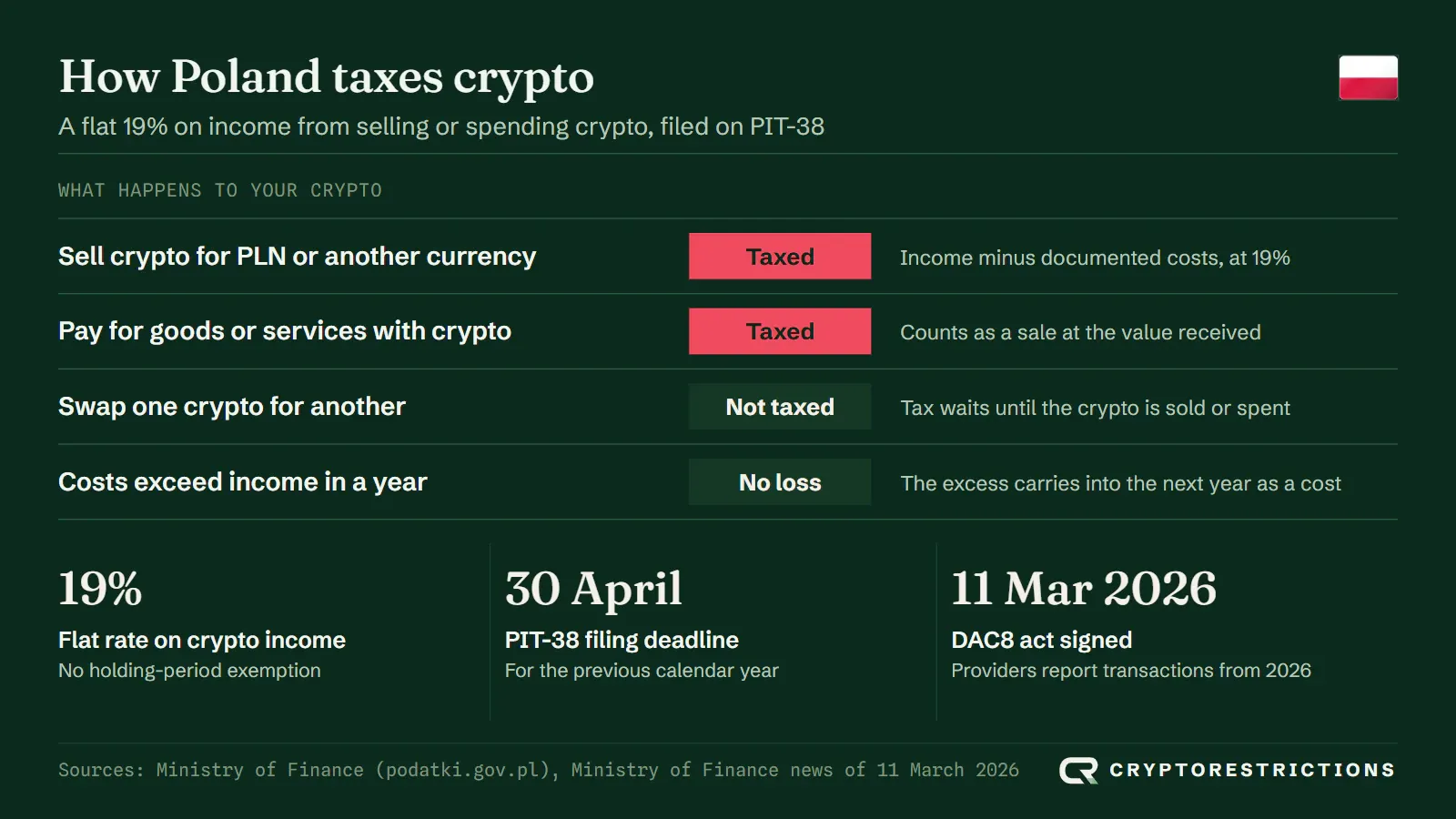
The rules come from the Ministry of Finance’s crypto guidance page, updated 24 June 2026. The taxable events are selling crypto for money and exchanging it for goods or services. Documented purchase costs and selling fees are deductible; mining equipment and electricity are not. If costs exceed income in a year, the excess carries into the next year instead of becoming a loss, and exchanges have no duty to send you a PIT-8C or PIT-11.
Two points are unsettled. The tax offices treat staking rewards as income when received, while several administrative courts say tax arises only on sale, and no supreme court ruling has settled it, as Bankier reported in April 2025. The vetoed crypto act would have written the court view into the tax law: a staking reward is not income until sold, and a crypto-to-crypto swap is not a disposal. It is not law.
Reporting is tightening. The act carrying the EU’s DAC8 rules into Polish law was signed on 11 March 2026, and crypto-asset service providers must report transactions from the start of 2026.







 Serbia
 Turkey
 Switzerland
 Iceland
 Liechtenstein
 Norway
 Croatia
 Estonia
 Finland
 Greece
 Latvia