Binance is hard to replace with one platform. Its international business combines spot markets, perpetual contracts, options, earn products, fiat services and a large asset list in one account. Alternatives each cover part of that, and which of them you can use depends on where you live.
This guide compares centralized exchanges, regional platforms, spot decentralized exchanges (DEXs) and perpetual DEXs. We treat regulatory authorisation, residency rules, liquidity, asset selection and product availability as separate questions, not a single yes-or-no on access. It is an availability and regulatory comparison, not a recommendation. For one platform in one country, use the restriction explorer.
Why availability comes first
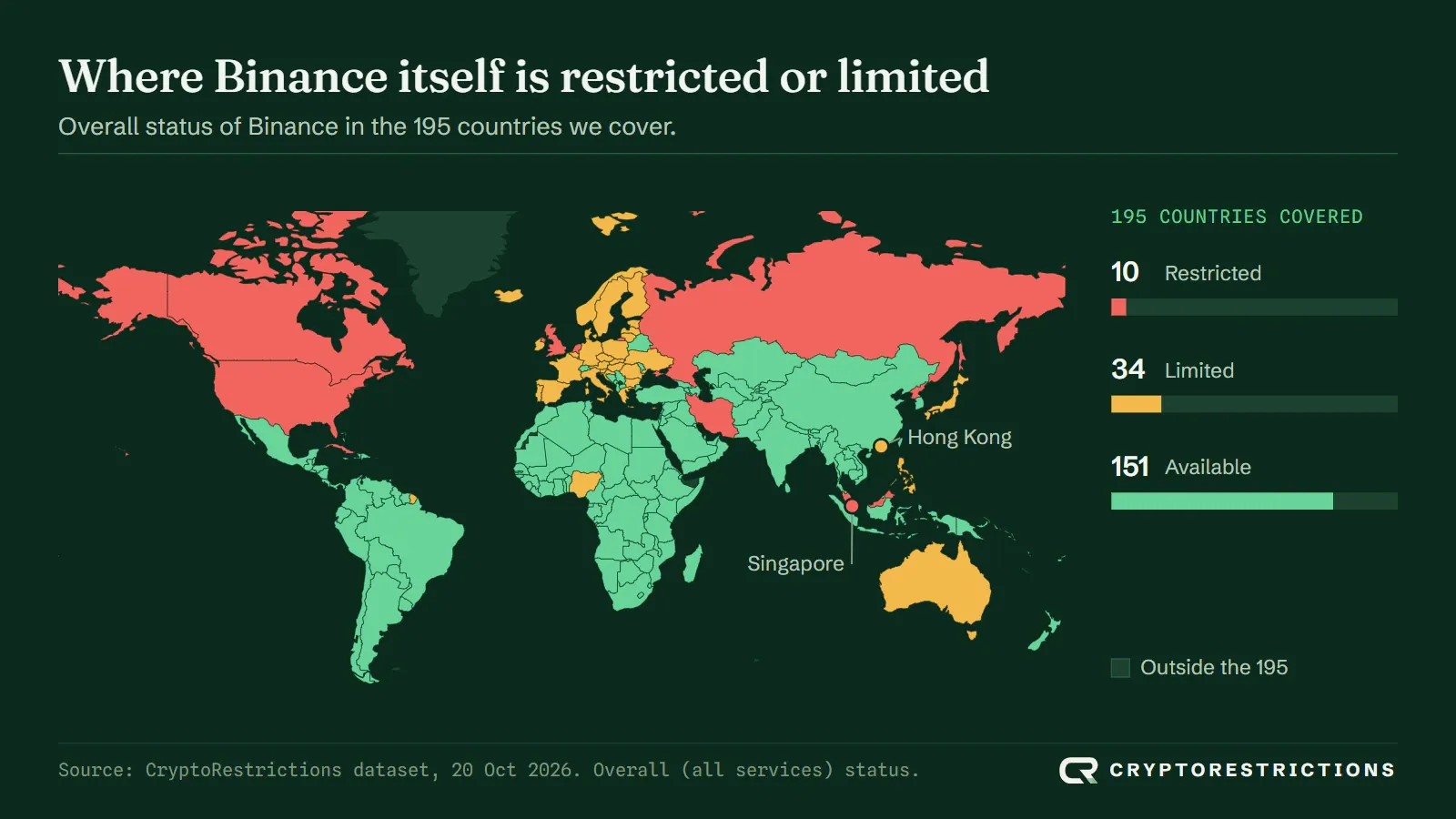
Binance itself is restricted or limited in several large markets. In our dataset, Binance is restricted in the United States, Canada, the United Kingdom, Singapore and the Netherlands. It is limited in Germany, France and the rest of the EEA, where it has no MiCA authorization: new sign-ups, deposits and trading are closed, while existing users can still withdraw. It is also limited in Hong Kong and Japan. US residents are directed to the separate Binance.US platform. Across the 195 countries we cover, Binance is restricted in 10, limited in 34 and available in 151 (verified 20 October 2026).
Access can also change overnight. On 29 October 2026 about $6.3 billion was taken from Binance’s hot wallets, and Binance suspended withdrawals while it checked its systems. The FBI attributed the theft to North Korea. Binance says its SAFU fund and corporate treasury will cover the loss. It restarted withdrawals in phases on 1 November, with all 15 networks and assets in the first phase back by 12:36 UTC and the rest still being tested. The halt did not change where Binance operates, so the statuses in this guide stand.
So the useful question is not which exchange ranks highest. It is which alternatives accept a user in a given country, for a given product. Market size still matters for context. CoinGecko’s research on centralized exchange market share (updated May 2026) ranks the ten largest by 2025 spot volume.
Competition has continued. CoinGecko’s Q2 2026 industry report found Bybit held 10.0% of top-ten spot CEX volume in the quarter, the only exchange besides Binance (38.7%) with a double-digit share.
Which centralized exchanges rival Binance?
For users who want the international Binance experience, locally focused exchanges are only part of the answer. Bybit, OKX, MEXC, Gate, Bitget, KuCoin, Crypto.com and HTX are the nearest comparisons on scale and product range. Asset depth, perpetual contracts, leverage, fiat connectivity, listing policy and residency rules differ between them.
The table shows the status our dataset records for each in six jurisdictions, next to the DeFi platforms we track.
Bybit
Bybit combines spot markets with derivatives and advanced trading tools. CoinGecko ranked it second by 2025 spot volume, with an 8.1% share of the top ten.
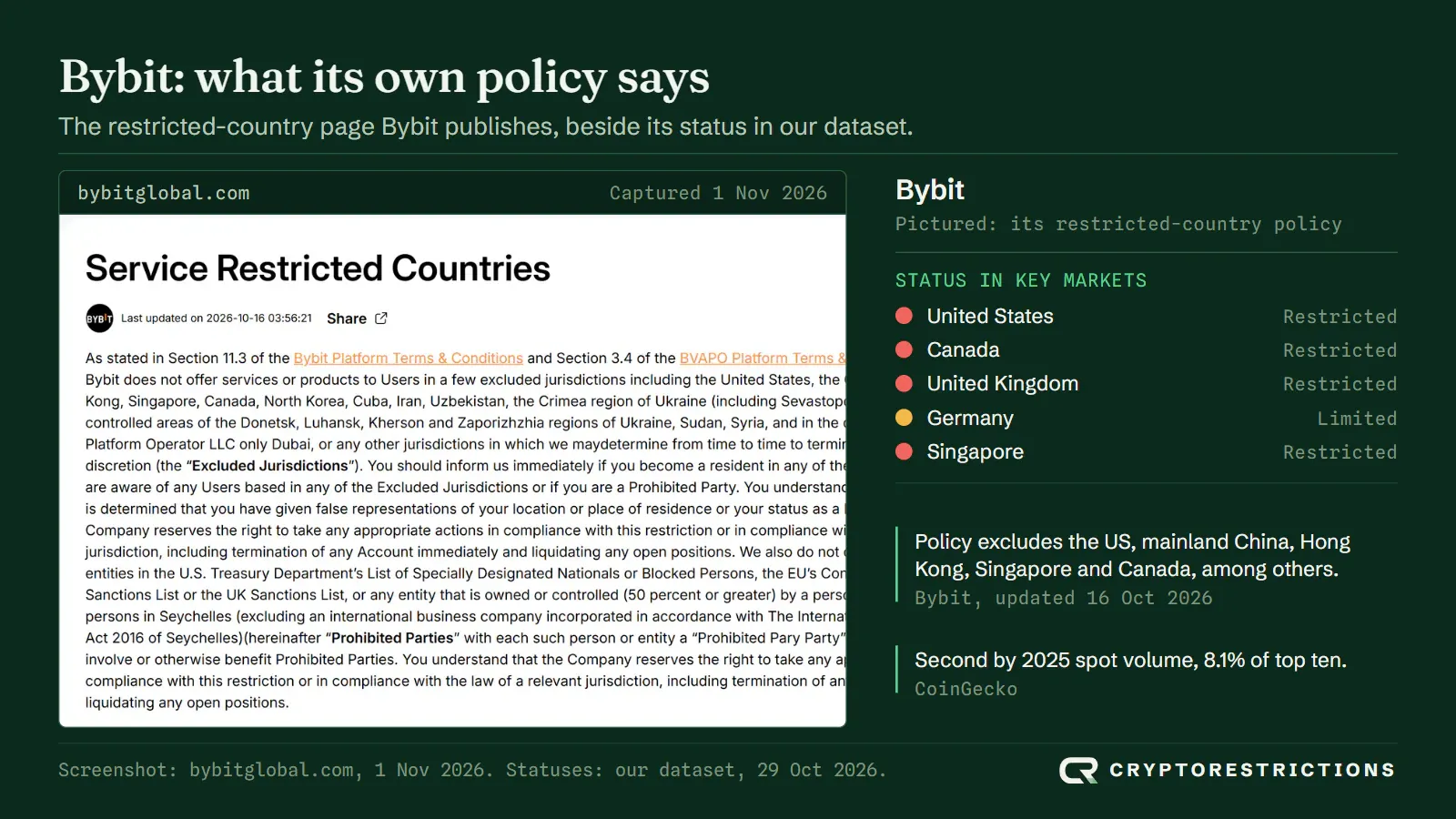
Availability is the main limit. Bybit’s restricted-country policy, updated 16 October 2026, excludes the United States, mainland China, Hong Kong, Singapore and Canada, along with Uzbekistan, Cuba, Iran, North Korea, Sudan, Syria and the Russian-controlled regions of Ukraine. Our dataset lists the UK as restricted: Bybit has taken no new UK registrations since 21 September 2026 and, from 21 October 2026, existing UK accounts cannot place orders, according to its UK notice. It also records Japan, where Bybit finished closing its services on 22 July 2026, as restricted. In Europe, Bybit’s global terms now exclude France, which is served only by Bybit EU, and Germany is limited because Bybit EU offers no derivatives.
OKX
OKX offers spot, derivatives and advanced order types, and has segmented its international business into locally regulated entities. In Europe, OKX’s regulatory disclosure states that OKX Europe Limited received its MiCA licence from Malta’s Financial Services Authority (MFSA) on 27 January 2025.
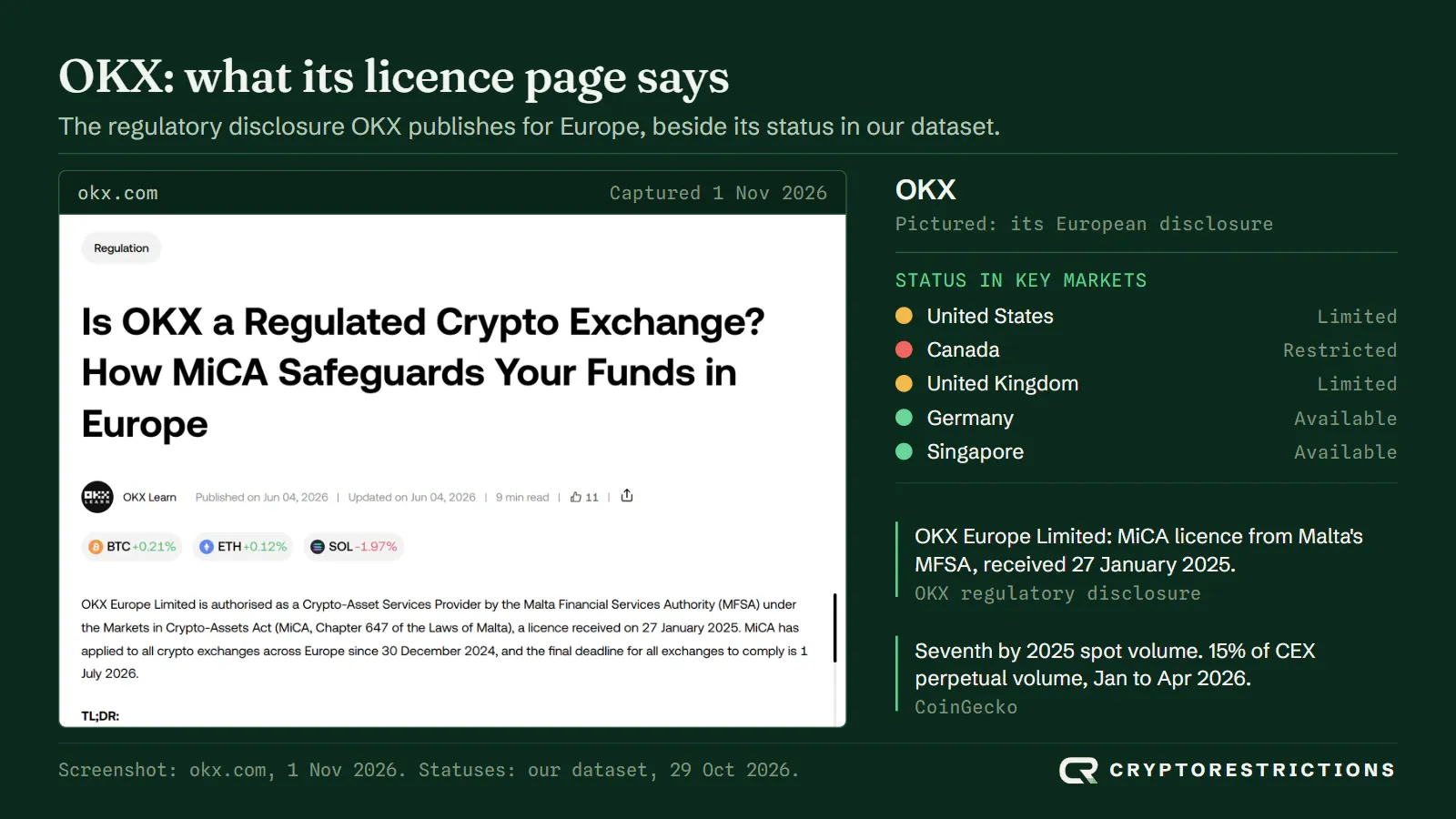
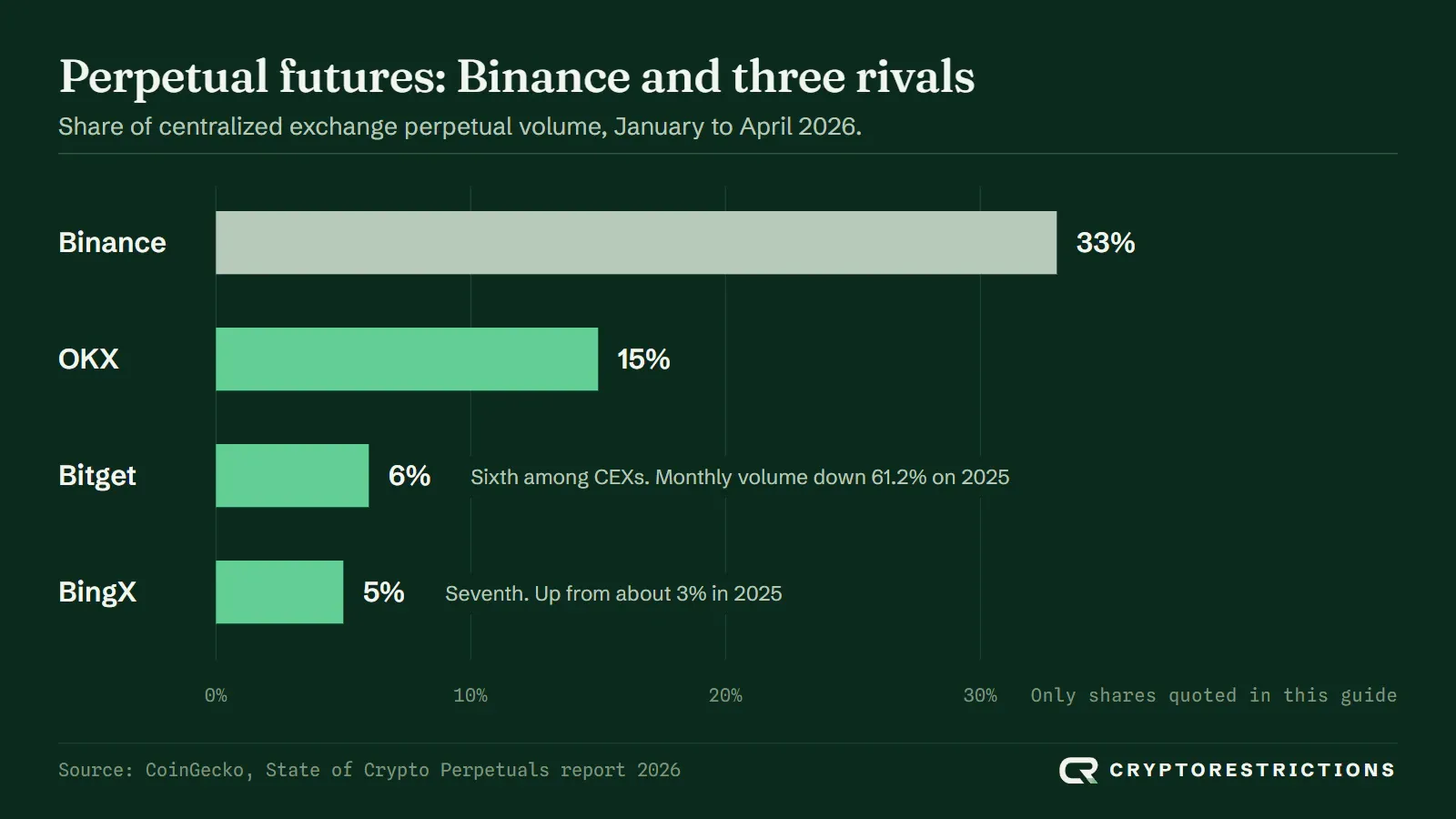
CoinGecko ranked OKX seventh by 2025 spot volume. In perpetuals, it estimated OKX at a 15% share of the CEX market in the first four months of 2026, against Binance’s 33%.
MEXC
MEXC is known for market breadth, particularly smaller tokens. CoinGecko ranked it third by 2025 spot volume and found it grew fastest in the top ten, up 90.9% on 2024. Its perpetual markets research counted 879 new perpetual contracts listed on MEXC between January 2025 and April 2026, more than any other exchange studied.
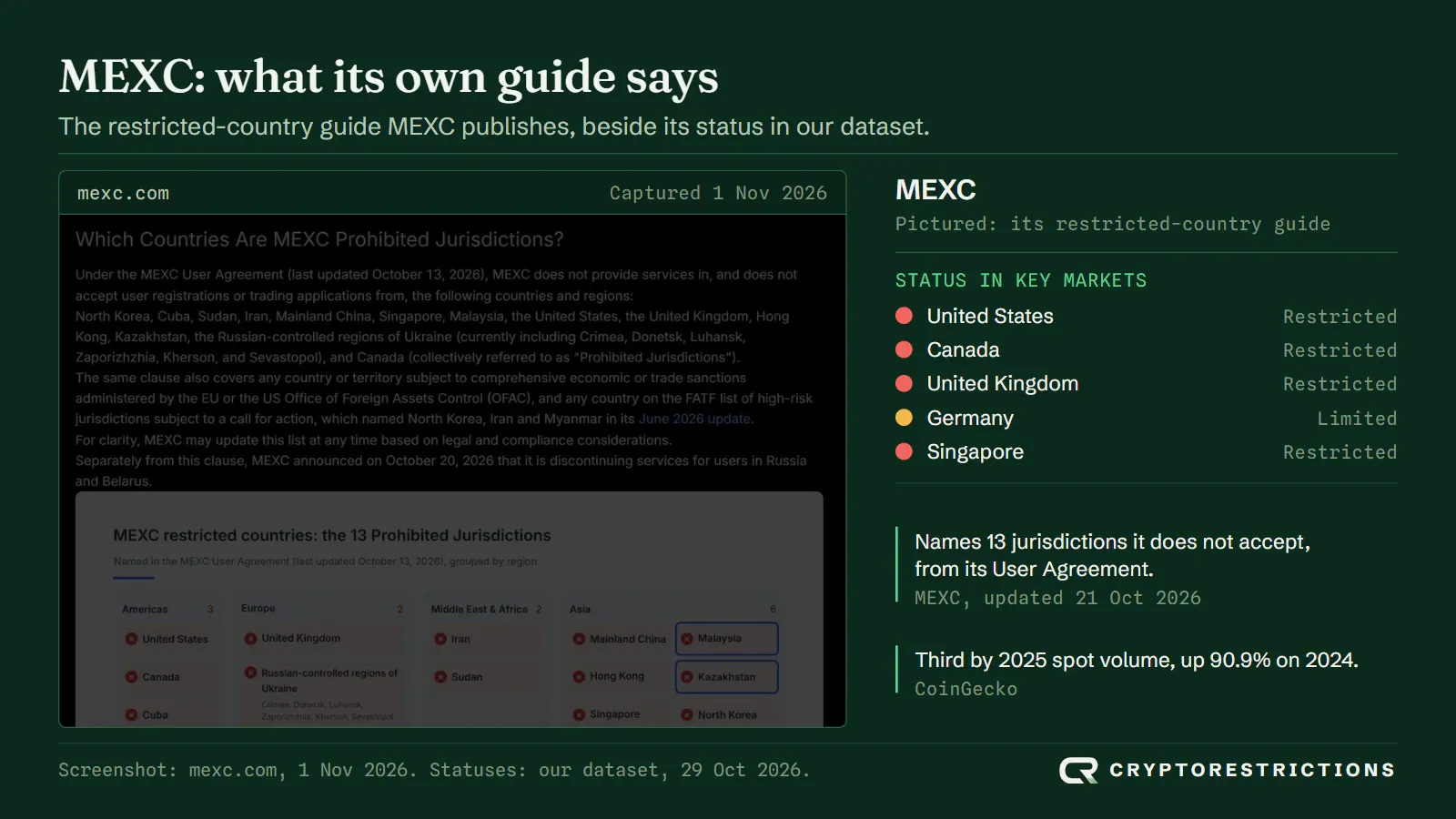
Availability is narrow. MEXC’s restricted-country guide, updated 21 October 2026, names 13 jurisdictions it does not accept from its User Agreement, including the United States, Canada, the United Kingdom, Singapore, Hong Kong, Malaysia, Kazakhstan and mainland China. It also covers countries under comprehensive EU or OFAC sanctions and on the FATF call-for-action list.
A large catalogue also means more small, thinly traded assets. Listing count is a feature of the exchange, not evidence that an asset is suitable for anyone.
Gate
Gate competes on breadth. CoinGecko ranked it fourth by 2025 spot volume, with a 7.5% share and annual growth of 39.7%.
Gate runs separate regional entities. Gate Europe’s overview says Gate Technology Ltd holds MiCA authorisation as a crypto-asset service provider and a PSD2 payment institution licence, both from the MFSA, and that it has initiated passporting across the EEA. The global exchange restricts the US, and our dataset records Gate US, Inc. as a separate service offering spot, convert and staking only.
Bitget
Bitget is a derivatives-focused exchange. CoinGecko ranked it sixth by 2025 spot volume, with growth of 45.5%. In perpetuals it held a 6% share in the first four months of 2026, sixth among CEXs, after its average monthly perpetual volume fell 61.2% from 2025.
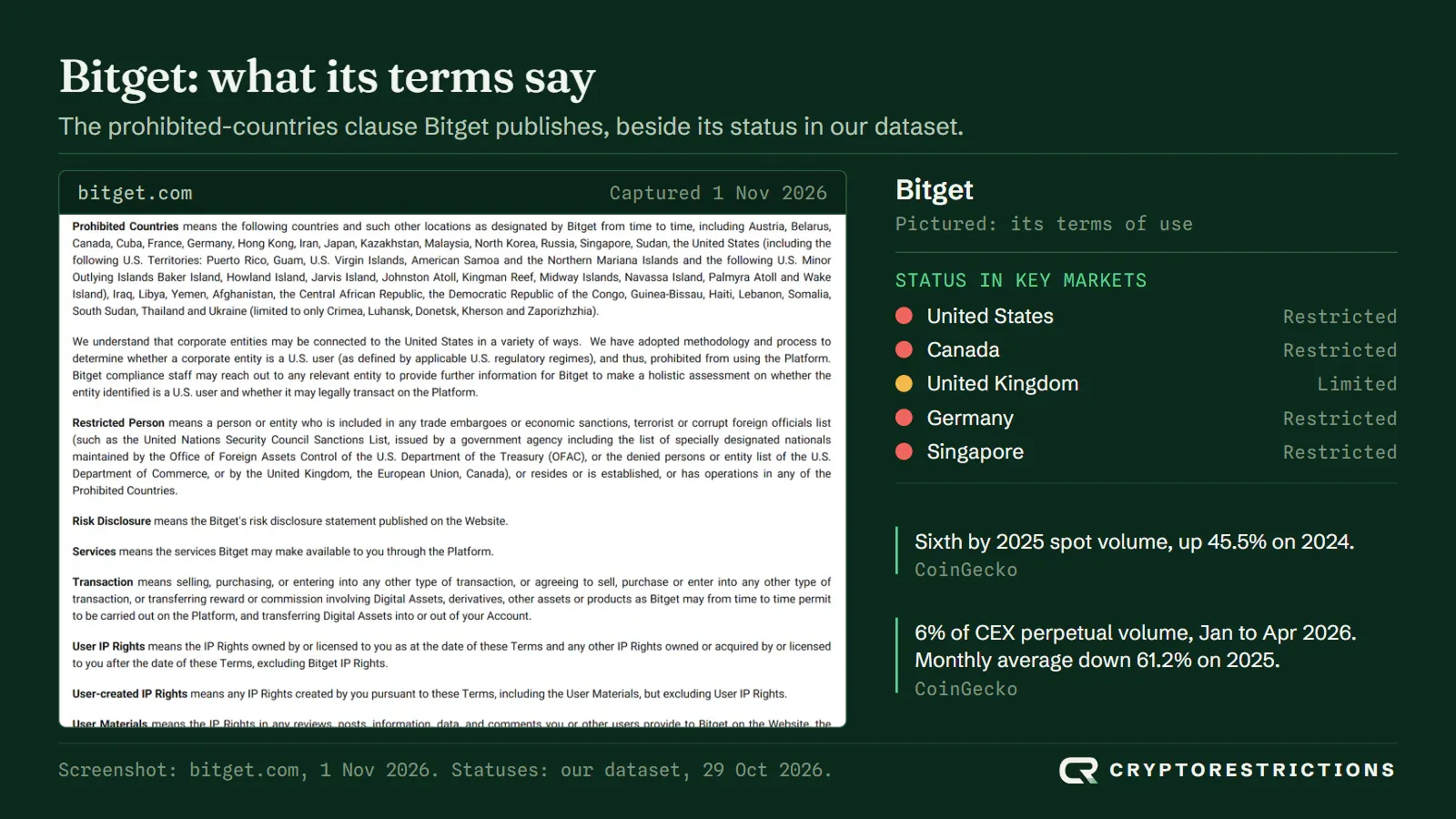
Our dataset lists Bitget as restricted in the United States, Canada, Singapore, Hong Kong, Germany, France and Japan, and limited in the United Kingdom and Australia. The prohibited countries are defined in Bitget’s terms of use, updated 20 October 2026, which also name Austria, Russia and Belarus.
KuCoin
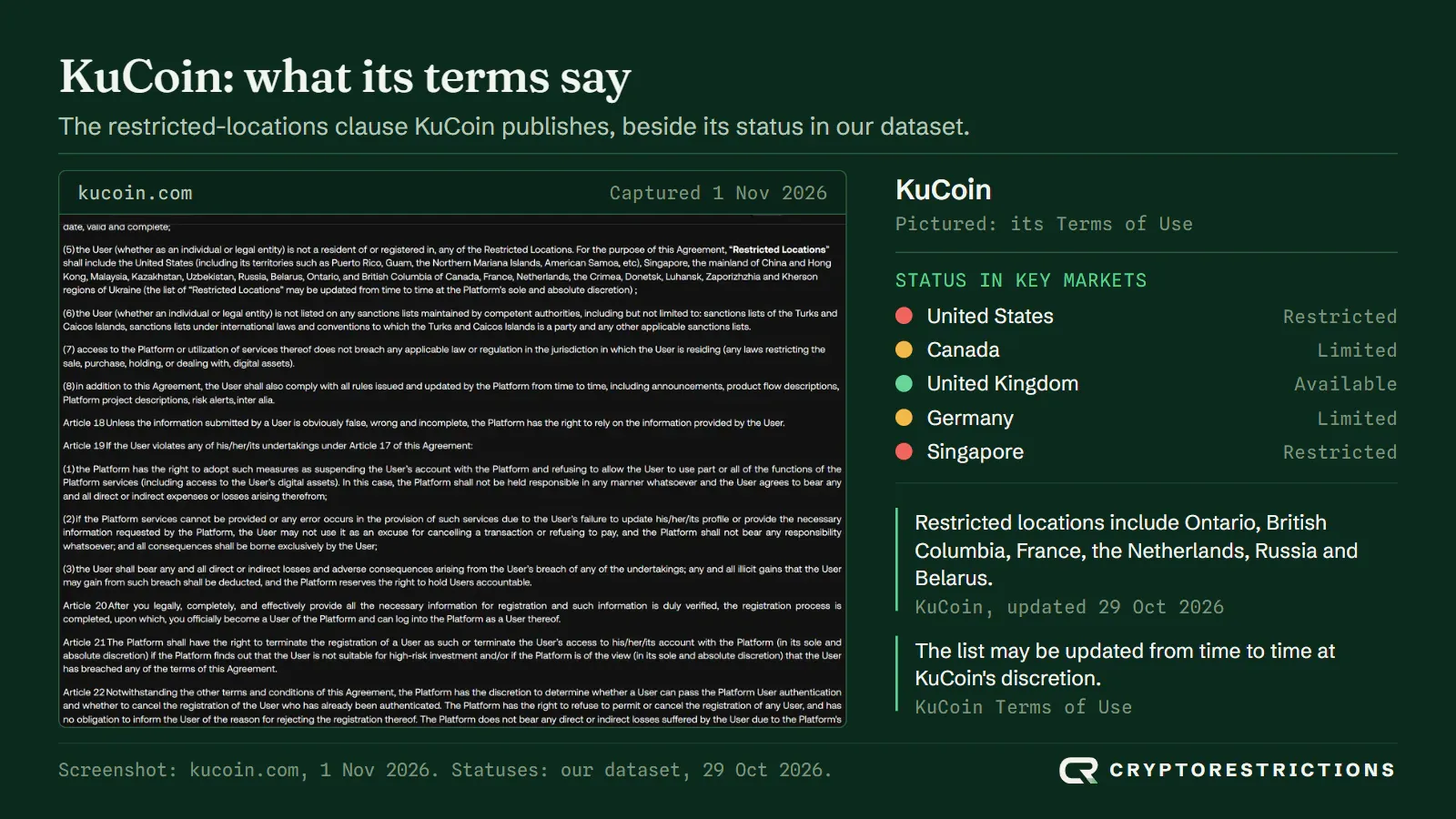
KuCoin lists many altcoins and has a broad product range. Its Terms of Use, last updated 29 October 2026, list as restricted locations the United States, Singapore, mainland China, Hong Kong, Malaysia, Kazakhstan, Uzbekistan, Russia, Belarus, Ontario, British Columbia, France and the Netherlands, plus four Ukrainian regions. Russia and Belarus were added on 29 October 2026, when KuCoin ended services for users there. The list “may be updated from time to time” at KuCoin’s discretion.
Other large exchanges
Crypto.com and HTX also appear in CoinGecko’s top ten. Crypto.com is limited in all six jurisdictions in the table above in our dataset, because it offers no derivatives in any of them. HTX is restricted in all six. EU persons have also been barred from dealing with it since 23 August 2026, which our sanctions guide explains. In the UK, HTX has settled the FCA’s High Court case over illegal promotions: under a court order of 27 October 2026 it undertakes until 2031 not to promote its services to UK consumers unlawfully, and it takes no UK deposits or sign-ups.
BingX rose from about 3% to 5% of perpetual CEX volume between 2025 and the first four months of 2026, placing seventh in CoinGecko’s ranking. We do not track it, so it has no dataset status. BingX’s own disclaimer, last updated 11 December 2023, says it does not accept customers from a list of jurisdictions that includes Canada, Hong Kong, Singapore, the Netherlands, the United Kingdom and the United States, and that the list can vary by service. We have not confirmed BingX’s operating entity or home regulator, so we make no claim about its regulatory status.
Regional exchanges at a glance
Local exchanges serve one market and do not match Binance on product range, but they are often the platforms a regulator or a bank recognises. The table lists the ones covered in this guide. These platforms are not in our dataset and carry no availability status. The last column says where the regulatory fact was read, and the regional sections below give the sources and dates. “States” means the exchange’s own pages say it, because the register could not be opened or does not exist.
Alternatives in Europe
Several large international exchanges have created entities under the EU Markets in Crypto-Assets Regulation (MiCA), so European residents have a wider regulated choice than most regions. Which entity serves you matters more than the brand name.
In our dataset, Coinbase, Kraken and OKX are available in Germany, France and the Netherlands. Bybit, Gate and Crypto.com are limited in all three, because their European entities offer no derivatives or, for Gate, serve spot only. HTX is restricted in all three, and KuCoin is restricted in France and the Netherlands and limited in Germany, where KuCoin EU has had trading suspended since 4 February 2026.
Bitvavo and Bitpanda
Two European platforms sit outside our dataset. We checked each against ESMA’s interim MiCA register of crypto-asset service providers, which we read on 10 October 2026 (the file was last modified on 7 October 2026). We re-read the Bitpanda GmbH and Bybit EU GmbH entries on 1 November 2026: the authorisation dates are unchanged. We re-read the Bitpanda GmbH and Bybit EU GmbH entries on 1 November 2026: the authorisation dates are unchanged.
Bitvavo B.V. of Amsterdam is listed as authorised by the Dutch Authority for the Financial Markets (AFM) on 26 June 2025. The services named are custody and administration of crypto-assets, operation of a trading platform, and transfer services. Bitvavo’s countries page lists 25 countries with euro trading pairs and payment methods such as SEPA transfer, iDEAL | Wero and cards, and points Belgian and Spanish customers to bitvavo.be and bitvavo.es. Its help centre article, updated 12 September 2026, describes the same three services. Bitvavo fits euro-funded spot trading. We did not assess its product range beyond those pages.
Bitpanda appears three times in the register. Bitpanda GmbH of Vienna was authorised by the Austrian Financial Market Authority (FMA) on 9 April 2025. Its listed services are custody, exchange of crypto-assets for funds and for other crypto-assets, execution of orders, placing, reception and transmission of orders, and transfer services. Bitpanda Asset Management GmbH is listed under BaFin (24 January 2025) and BP23 CA Limited under Malta’s MFSA (27 January 2025). Bitpanda GmbH’s entry includes execution and exchange services but not the operation of a trading platform, which is the difference from Bitvavo’s entry: it describes a broker, not an order-book exchange. Bitpanda’s verification page lists more than 40 supported countries, including the United Kingdom through a separate entity, Bitpanda Broker UK Ltd, which we did not check against the FCA register.
Both are options for regulated euro access. This guide makes no claim that either covers Binance’s derivatives or its full asset list.
Checking Bybit EU and Kraken
The dataset-based rows in the table above can be checked against the same ESMA register. It lists Bybit EU GmbH, authorised by the FMA on 28 May 2025 for custody, exchange of crypto-assets for funds and for other crypto-assets, placing, and transfer services, with no trading-platform or order-execution service named. For Kraken it lists two Irish entities, both authorised by the Central Bank of Ireland on 25 June 2025: Payward Europe Solutions Limited (custody, exchange, order execution, placing, reception and transmission of orders, portfolio management and transfers) and Payward Global Solutions Limited (operation of a trading platform).
Product limits still apply
A MiCA authorisation does not mean every international product is offered in Europe. OKX’s European stablecoin guidance says USDT cannot be traded by European users because Tether has not obtained authorisation under MiCA. Deposited USDT arrives but stays frozen until it is returned. That is a product restriction, not a restriction on OKX itself. Coinbase has said it would convert EEA retail balances in 14 stablecoins without MiCA-authorised issuers, USDT among them, into USDC on 30 October 2026. Coinbase has said it would convert EEA retail balances in 14 stablecoins without MiCA-authorised issuers, USDT among them, into USDC on 30 October 2026. Our stablecoin regulation guide covers the rule in detail.
An exchange can be available in a country while a particular token or product is not. Check platform access and product access separately.
Alternatives in North America
North America shows why one global ranking misleads. Several of the largest Binance rivals exclude both US and Canadian residents, so the practical set is smaller and different from the one available to a European or Singapore user.
United States
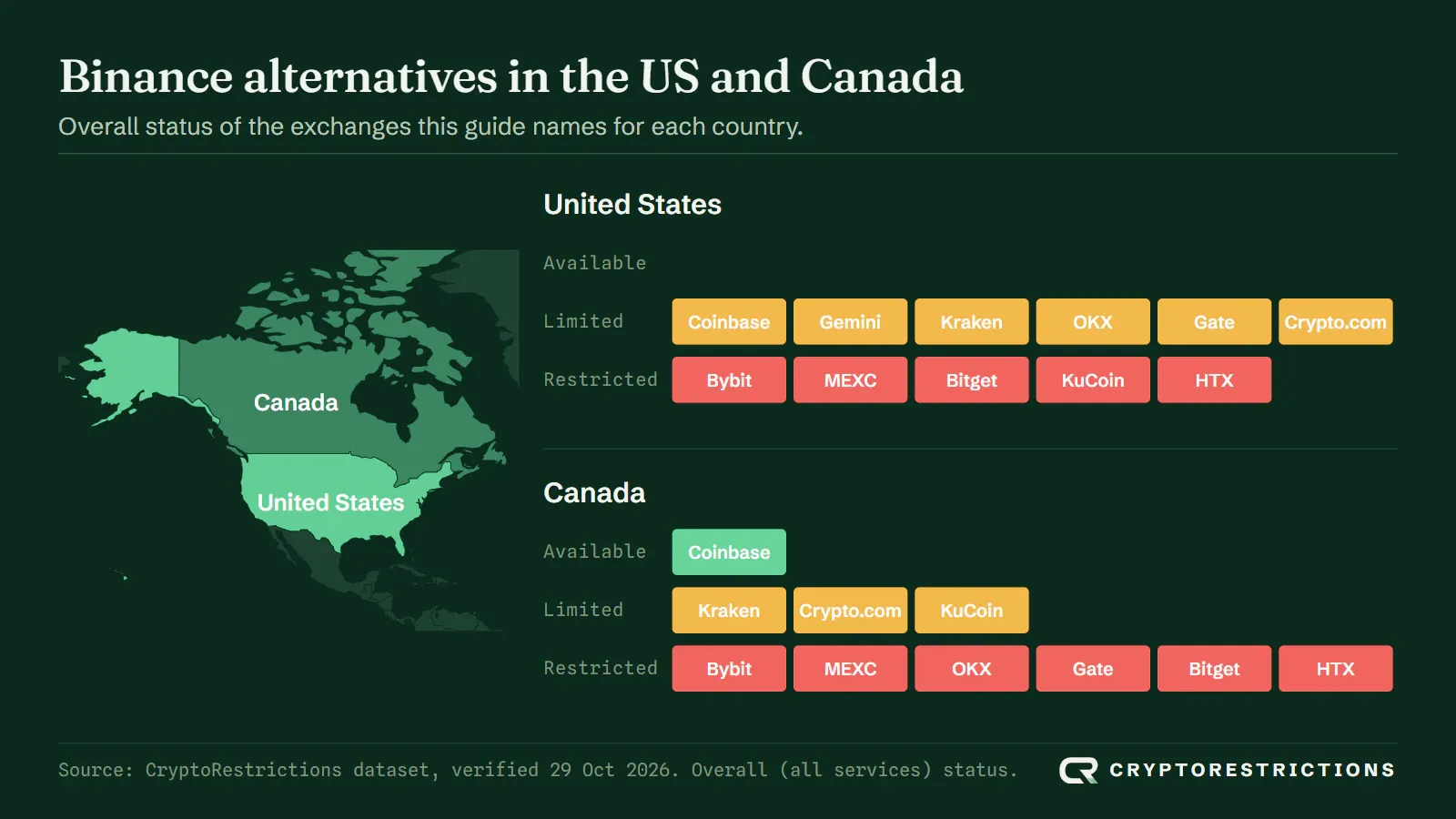
In our dataset, Coinbase, Gemini, Kraken, OKX, Gate and Crypto.com are limited in the United States, mostly by excluded states or derivatives: Coinbase cuts staking, lending or prediction markets in some states, and Gemini’s derivatives exclude US persons. Bybit, MEXC, Bitget, KuCoin and HTX are restricted.
Those services do not reproduce Binance.com’s derivatives and altcoin catalogue. US users should compare state availability, supported assets, staking eligibility and any limits on leveraged products. Offshore-style perpetual futures from centralized exchanges are largely closed to US residents.
Two US platforms are outside our dataset. Binance.US is run by BAM Trading Services, Inc., not by the company behind Binance.com. Its About page says BAM registered with FinCEN as a money services business on 11 June 2019, holds money transmitter licences in 32 states and territories as of June 2026 (NMLS ID 1906829; page re-read on 1 November 2026), supports USD deposits and operates only in the United States and its authorised territories. It also says BAM and Binance Holdings Limited share common majority ownership but keep separate corporate and management structures. We could not query the FinCEN or NMLS registers directly, so these are Binance.US’s statements. State availability can change with approvals.
Gate US, Inc. is a separate company from the international Gate exchange. Its licence disclosure page, read on 1 November 2026, lists money transmitter or equivalent licences in 37 US jurisdictions, including the District of Columbia and Puerto Rico (NMLS ID 2272810), and says its services may be restricted in some jurisdictions. Our dataset records its product scope as spot, convert and staking only.
Canada
Canada is assessed by province as well as country. Coinbase is available in our dataset. Kraken and Crypto.com are limited, because Canadian clients cannot use derivatives on either. KuCoin is limited because Ontario and British Columbia are named restricted locations. Bybit, MEXC, OKX, Gate, Bitget and HTX are restricted.
Canadian domestic exchanges are outside the platforms we track, so none has a dataset status. The Canadian Securities Administrators (CSA) publish a list of crypto platforms authorized to do business with Canadians, last updated 18 September 2026 and read on 10 October 2026. Each entry links to the regulatory decisions that apply to the platform. The list includes:
- NDAX: Ndax Canada Inc., decision of 19 December 2024.
- Coinsquare: Coinsquare Capital Markets Limited, decision of 11 October 2024.
- Newton: Newton Crypto Ltd., latest amended decision of 25 March 2026.
- Shakepay: Shakepay Inc., decision of 8 January 2025.
Bitbuy is a different case. The CSA’s expired decisions page lists a decision for Bitbuy Technologies Inc. as expired, and the authorized list has no Bitbuy entry. Bitbuy’s own FAQ explains why: it says its trading platform is now operated by Coinsquare Capital Markets Ltd. (CCML), a dealer member of the Canadian Investment Regulatory Organization (CIRO), and that clients signed new agreements with CCML. CIRO’s member bulletin records CCML’s admission to membership, then under the name IIROC, on 12 October 2022. Coinsquare and Bitbuy therefore share one regulated entity.
Two other platforms describe their own status. Newton states that it is registered as a money services business with FINTRAC and is a CIRO dealer member. Shakepay states that it is a CIRO member and registered as an investment dealer with the AMF and the provincial securities regulators. We did not check those statements against the CIRO directory. Bitbuy’s FAQ adds that investor protection through the Canadian Investor Protection Fund covers cash balances but not crypto assets. On currency, Newton’s site describes funding in Canadian dollars by e-transfer, and NDAX’s site quotes prices in Canadian dollars.
None of the five is on the CSA’s separate list of pre-registration undertakings, which names only DigiFinex and Uphold (page updated 17 July 2026). Binance is a different situation. Our dataset records Binance as restricted in Canada, based on Binance’s list of prohibited countries. Binance’s own 2022 undertaking to the Ontario Securities Commission covers Ontario only, and we did not find a dated Binance notice of a national withdrawal, so this guide does not describe one.
Shortlist for US and Canadian residents
The table groups the platforms in this section by what could be verified. It is not a ranking.
| What was verified | US platforms | Canadian platforms |
|---|---|---|
| Status in our dataset | Coinbase, Gemini, Kraken (limited by state or product) | Coinbase (available); Kraken, Crypto.com (limited) |
| Listed by a securities regulator | Not applicable | NDAX, Coinsquare, Newton, Shakepay |
| State money transmitter licences, as stated by the company | Binance.US (32 states and territories), Gate US (37 jurisdictions) | Not applicable |
| CIRO dealer membership | Not applicable | Coinsquare and Bitbuy (through CCML); Newton and Shakepay (as stated) |
| Binance-branded service | Binance.US, a separate company | Binance is restricted in our dataset |
| Offshore-style CEX perpetuals | Largely closed | Largely closed |
| DeFi trading | Depends on protocol and state | Depends on protocol and province |
Alternatives in Asia-Pacific
Asia-Pacific has several separate markets, not one rulebook. Japan registers its providers, Hong Kong licenses its trading platforms, and Singapore and Australia have their own regimes.
South Korea
CoinGecko ranked Upbit tenth among the largest CEXs by 2025 spot volume, with 5.5% of the group’s total and an 18.9% fall in volume from 2024. Our dataset shows Bybit, Bitget, Coinbase, Kraken and HTX as available in South Korea, OKX as limited because its derivatives are restricted there, and MEXC, KuCoin and Gate as restricted. South Korea’s FIU blocked the MEXC and KuCoin websites in October 2026, after blocking their apps in 2025.
Upbit is run by Dunamu Inc. In South Korea a virtual asset service provider files a report with the Financial Intelligence Unit (FIU), and the FIU’s list records whether the report was accepted. The FIU’s notice of 30 September 2026 lists Upbit among 28 providers whose report was accepted, and Upbit’s site footer gives Dunamu’s virtual asset service provider registration number as 2021-01. In February 2025 the Financial Services Commission announced that the FIU had partially suspended Dunamu for three months, from 7 March to 6 June 2025, for dealing with unreported overseas providers. The suspension barred new customers from transferring crypto in and out. It did not stop existing customers, nor trading or Korean won deposits and withdrawals for new ones. We have not checked Upbit’s current terms for who may open an account.
Japan
Japan requires crypto-asset exchange service providers to register. The Financial Services Agency’s register, as of 1 September 2026, lists bitFlyer and Coincheck among its registered providers, with the crypto-assets each handles. bitFlyer, Inc. is registered with the Director of the Kanto Local Finance Bureau as No. 00003 (registered 29 September 2017). Coincheck, Inc. is No. 00014 (registered 11 January 2019). The FSA notes that it does not guarantee or endorse the value of the listed crypto-assets. In our dataset, Bybit, OKX, Bitget, Coinbase, Kraken and HTX are restricted in Japan, MEXC, KuCoin and Crypto.com are limited, and Gate is available through Gate Japan K.K. Registration status and asset selection are separate questions.
Hong Kong and Singapore
Hong Kong’s Securities and Futures Commission (SFC) maintains a list of licensed virtual asset trading platforms. The list, last updated 16 October 2026 and read on 1 November 2026, names 13 platforms, among them OSL Digital Securities Limited, which runs OSL Exchange (licensed 15 December 2020), and Hash Blockchain Limited, which runs HashKey Exchange (licensed 9 November 2022). The SFC says the list is not a guarantee of performance or creditworthiness. HashKey’s introduction page states that it serves professional investors and retail customers and holds Type 1 and Type 7 licences plus a virtual asset trading platform licence under the anti-money laundering ordinance. Its fiat deposit guidelines list HKD, USD, EUR, CNH, SGD and JPY deposits. We could not read OSL’s own legal pages, so we make no further statement about its customers or currencies. In Hong Kong, our dataset lists Coinbase and Kraken as available, Crypto.com as limited, and Bybit, OKX, MEXC, Gate, Bitget, KuCoin, HTX and Gemini as restricted.
Singapore gives a similar split. OKX, Coinbase, Kraken and Gemini are available, and Crypto.com is limited. Bybit, MEXC, Gate, Bitget, KuCoin and HTX are restricted.
Two local platforms are outside our dataset. The Monetary Authority of Singapore (MAS) Financial Institutions Directory, read on 10 October 2026, lists SBI Coinhako Technology Pte. Ltd., which operates Coinhako, as a major payment institution providing cross-border money transfer and digital payment token services. It lists Independent Reserve SG Pte. Ltd. as a major payment institution providing account issuance, domestic and cross-border money transfer and digital payment token services. Independent Reserve’s Singapore page states the licence number as PS20200517 under the Payment Services Act 2019. These are payment services licences that cover digital payment tokens. We have not confirmed which residents either platform serves or in which currencies, so we make no claim on those points.
Australia
In Australia, MEXC, Gate, KuCoin, HTX and Coinbase are available in our dataset. OKX, Kraken, Crypto.com and Bitget are limited, mostly by restricted derivatives, as is Binance. Bybit, which added Australia to its excluded jurisdictions in terms effective 16 October 2026, and Gemini are restricted. The choice between a domestic exchange and an international one turns on which Binance feature you need to replace.
Four domestic exchanges are outside the dataset. AUSTRAC’s registration guidance says a virtual asset service provider cannot start providing services until AUSTRAC approves its registration, and registration is tied to managing money laundering and terrorism financing risk. AUSTRAC’s public register sits behind its online portal, which we could not open, so the entries below are each company’s own statement. They are not a register check.
- CoinSpot: its terms name Casey Block Services Pty Ltd (ABN 19 619 574 186) as operator and say the platform is designed for Australian residents. Its AML page says CoinSpot has been a registered virtual asset service provider since 4 April 2018.
- BTC Markets: BTC Markets Pty Ltd (ACN 164 093 887) states in terms dated 16 July 2026 that it is registered with AUSTRAC as a virtual asset service provider. The terms require account holders to be Australian residents, with exceptions at its discretion, and say the fiat wallet supports AUD only.
- Independent Reserve: the Australian site states that Independent Reserve Pty. Ltd. (ABN 46 164 257 069) is registered with AUSTRAC as a digital currency exchange. The same group’s Singapore entity is covered above.
- CoinJar: CoinJar Australia Pty Ltd (ACN 648 570 807) states that it is a registered virtual asset service provider with AUSTRAC.
AUSTRAC registration concerns anti-money laundering and counter-terrorism financing obligations. We did not check whether any of the four holds other Australian authorisations, such as an Australian financial services licence.
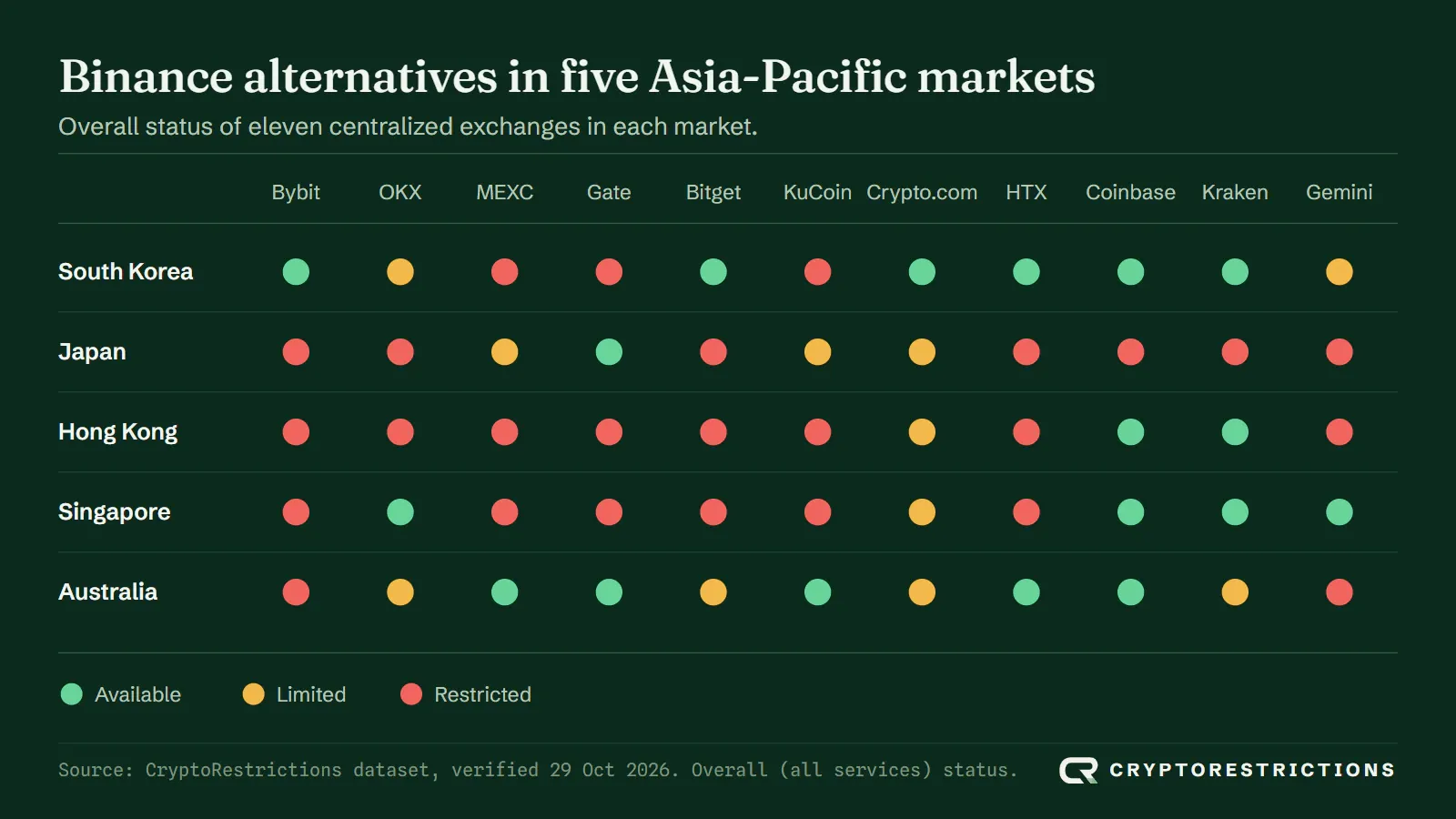
The grid reads every pair from the live dataset, so it also shows a few not discussed above: Crypto.com is available in South Korea through a local site, and Gemini serves South Korea for perpetuals only.
Which DEXs replace spot trading?
A decentralized exchange can replace part of Binance without a custodial account. That suits on-chain tokens and self-custody users. It does not provide fiat banking, account recovery, centralized support or tax exports, and the details vary by protocol and blockchain.
CoinGecko’s CEX and DEX trading report found PancakeSwap and Uniswap in the top ten spot exchanges between August 2025 and January 2026, with cumulative spot volume of about $0.55 trillion and $0.54 trillion. Both placed ahead of CEXs such as Bitget, OKX, Coinbase and Upbit.
Uniswap
Uniswap is the largest DEX on Ethereum and other networks, run through a wallet and on-chain liquidity. Its web app is operated by Uniswap Labs, which bars people under US sanctions rather than listing countries. Our dataset records it as available in 191 of the 195 countries we cover, limited in one and restricted in three.
Trading this way changes the risk profile.
- You keep wallet control, and transactions settle on-chain.
- Network fees affect cost.
- Illiquid or malicious tokens can be tradeable.
- Smart-contract risk remains.
- A mistaken transaction can be irreversible.
Jupiter and PancakeSwap
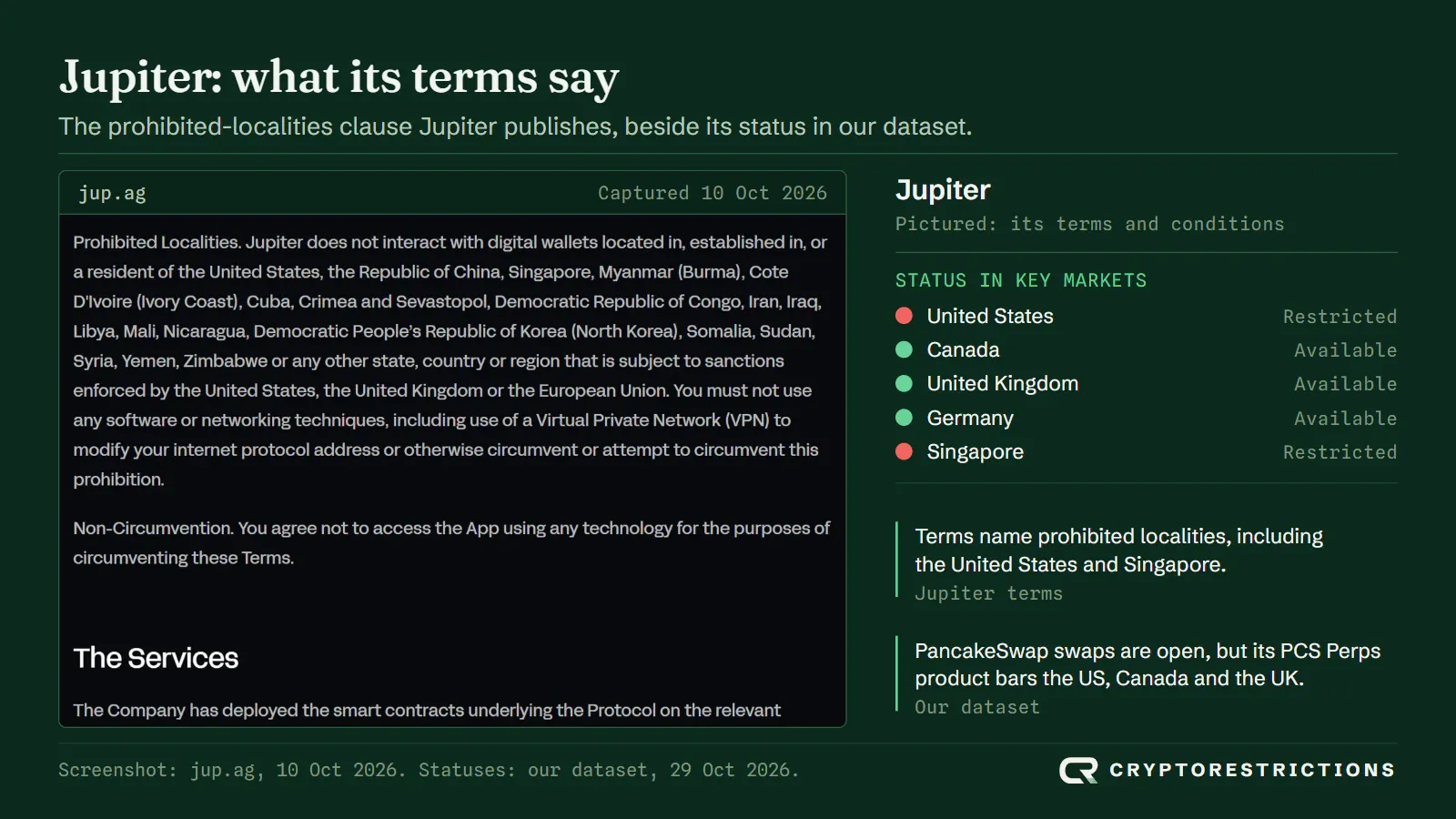
Jupiter is Solana’s main swap aggregator, with perpetuals and lending in the same app. Its terms name prohibited localities, including the United States and Singapore, so it is restricted there in our dataset. PancakeSwap runs on BNB Chain and other networks. Its swaps are not excluded by its terms, but its PCS Perps product bars the United States, Canada, the United Kingdom and South Korea among others, so PancakeSwap is limited there.
Which DeFi perpetuals replace futures?
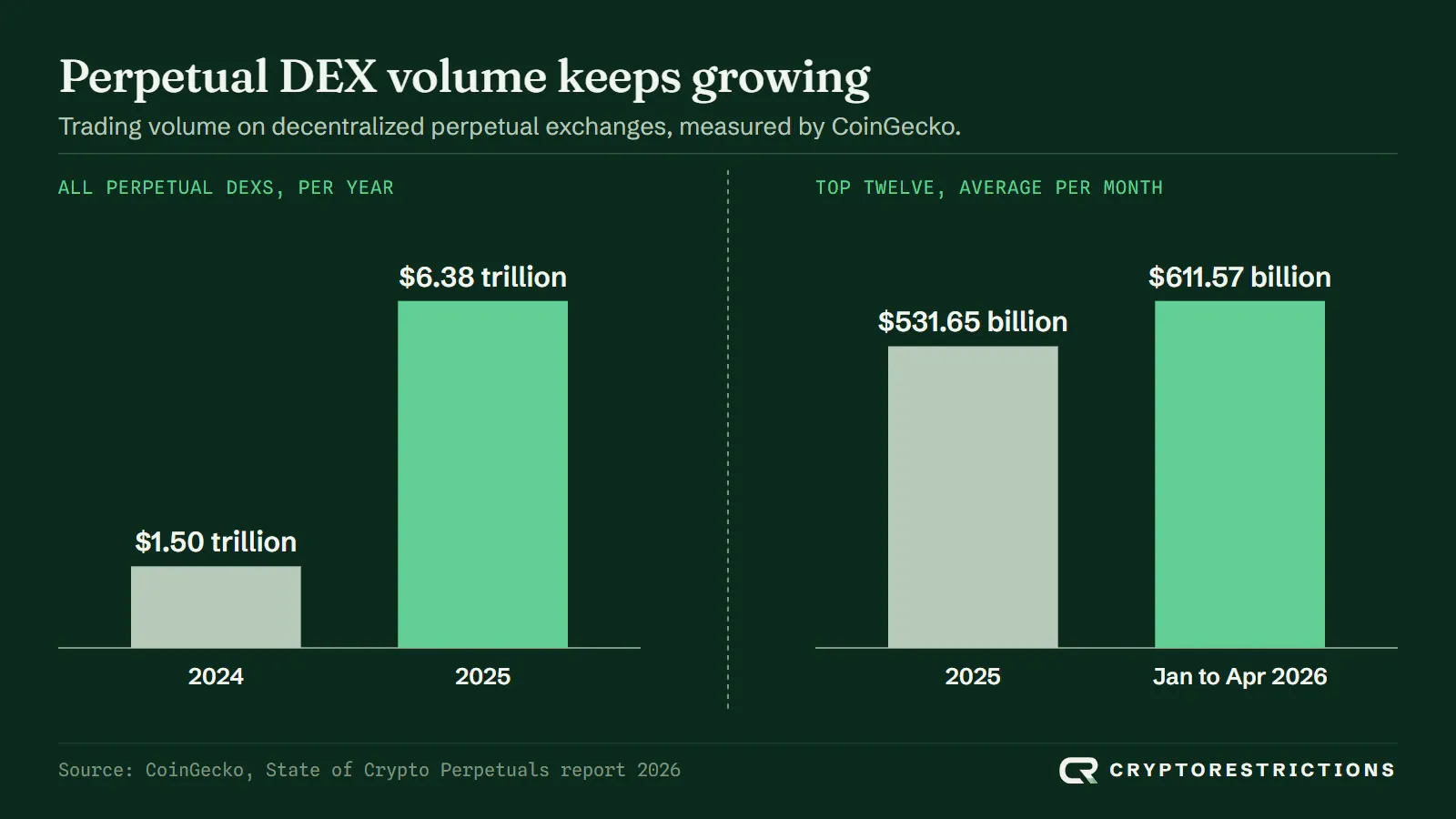
Perpetual DEXs now compete directly with centralized derivatives exchanges. CoinGecko’s State of Crypto Perpetuals report found the top twelve perpetual DEXs averaged $611.57 billion a month in the first four months of 2026, up from $531.65 billion in 2025. Perpetual DEX volume totalled $6.38 trillion in 2025 against $1.50 trillion in 2024.
Hyperliquid
Hyperliquid runs order-book perpetuals on its own chain. CoinGecko put its April 2026 perpetual volume at $190.28 billion, about 3.9% of all perpetual exchange volume. That ranked it ninth, just behind BingX and ahead of KuCoin. The report also credits Hyperliquid with leading perpetual DEX open-interest growth.
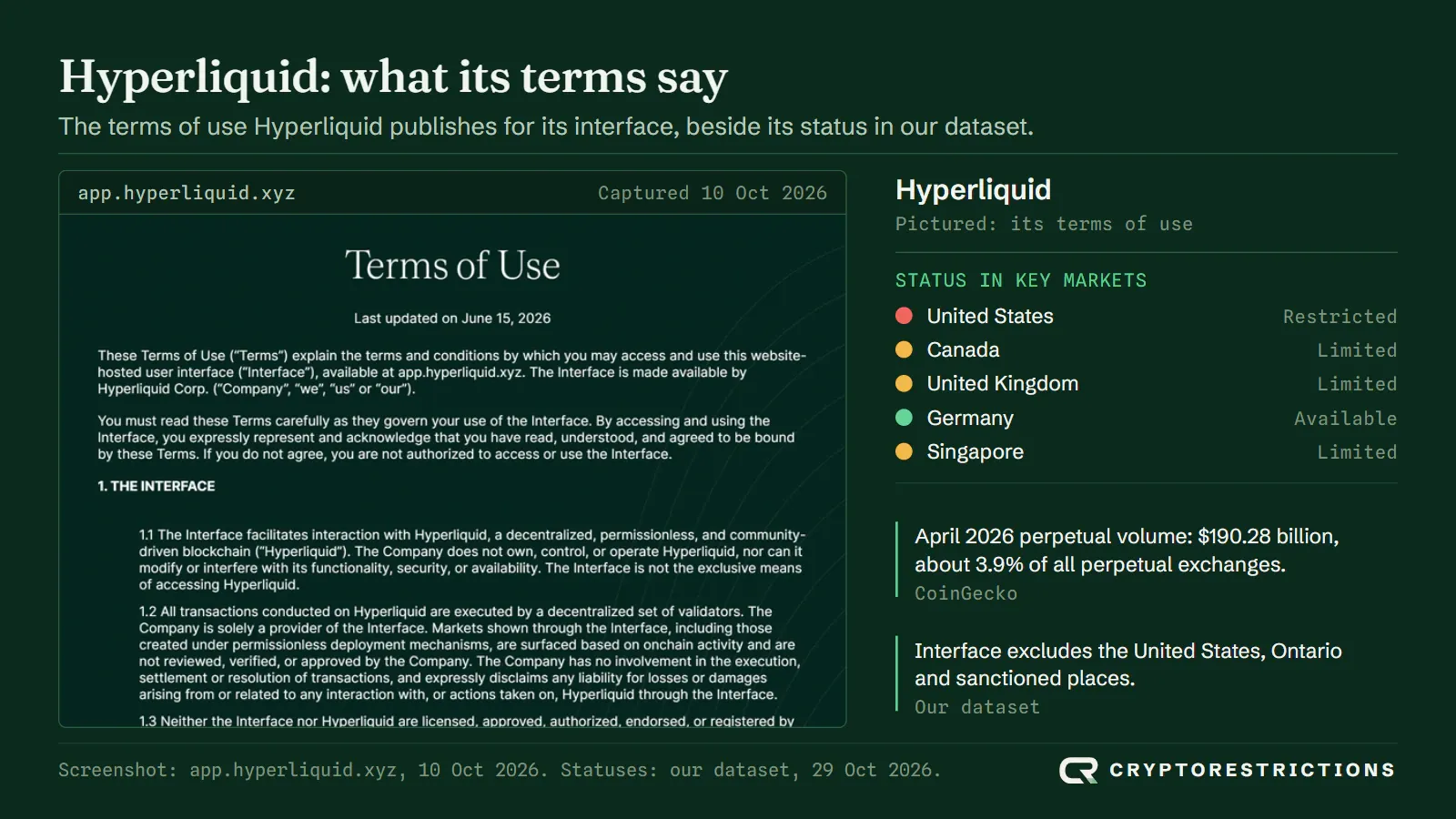
Its web interface excludes the United States, Ontario and sanctioned places. Our dataset records it as restricted in the US and limited in Canada, the UK and Singapore, where Ontario is excluded or its outcome markets are hidden.
Aster and Lighter
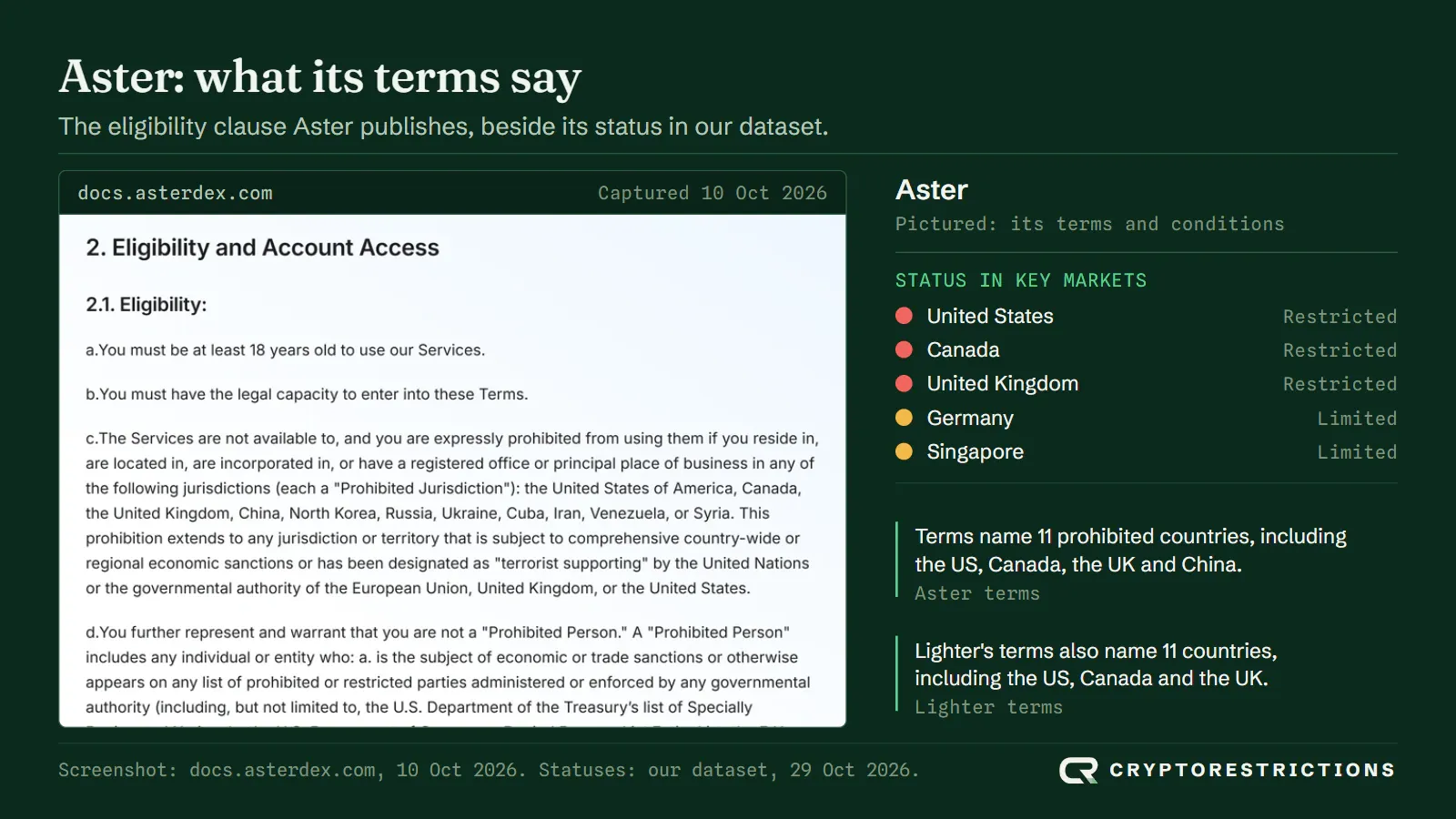
Aster offers leveraged perpetual markets and a CEX-style interface. Its terms name 11 prohibited countries, including the United States, Canada, the United Kingdom and China. Lighter is an order-book perpetuals and spot exchange on an Ethereum layer 2. Its terms name 11 countries, including the US, Canada and the UK, and its Singapore status is limited because Singapore is barred from its Robinhood Chain integration and points program. Aster is limited in Singapore, Germany and Japan because its prediction trading is barred there, while perpetuals and spot are not. Aster is limited in Singapore, Germany and Japan because its prediction trading is barred there, while perpetuals and spot are not.
Variational and other perpetual DEXs
Variational’s Omni product runs on Arbitrum and requires an EVM wallet with USDC to create a portfolio, according to its getting started documentation. Its restricted persons policy excludes US persons, Canadian persons, residents of Taiwan, several US-associated territories, and places under sanctions including Crimea, Donetsk, Luhansk, Sevastopol, Cuba, Iran, North Korea, Sudan and Syria.
CoinGecko reported that Pacifica, Extended and Variational reached roughly 4%, 4% and 3% of perpetual DEX volume in April 2026, overtaking Jupiter and dYdX. No ranking here is permanent.
DeFi does not mean unrestricted. A protocol can exist on a public blockchain while the company running its main interface restricts residents, IP locations, products or wallet addresses.
How to choose
Start with residency and product eligibility. Low fees and a large asset list do not matter if a platform’s terms exclude your jurisdiction or the product you need.
Of the 17 alternatives this guide names from our dataset, the number with an overall status of available is 1 in the United States, 3 in Canada, 4 in the United Kingdom, 8 in Germany and Hong Kong, 7 in France, 9 in the Netherlands and Australia, 10 in South Korea, 6 in Singapore and 5 in Japan.
Then identify the function being replaced. Leaving Binance Spot, trading perpetuals, buying by bank transfer and trading new on-chain tokens call for different tools.
Four types of restriction
We treat these separately because each describes a different situation:
These should not be merged into the word “banned”. Bybit declining Canadian residents under its terms is different from a regulator prohibiting exchange activity in Canada. The travel rule guide covers a further layer, the identity data an exchange must collect and share for transfers.
Compare liquidity separately from listings
Large token counts help only when markets have depth for the intended order size. CoinGecko’s 2026 CEX liquidity research, updated 30 September 2026, found Binance led BTC liquidity among the eight exchanges studied, with 25.3% of the total. Bitget and OKX followed, each with roughly $4 to $5 million. MEXC showed about $450,000 of ETH liquidity in the measured range, where the other seven exchanges each had over $1 million per side.
That is why listing breadth and liquidity are different measures.
Match platforms to priorities
The table groups the platforms in this guide by the need they address, using only entries sourced above. Order within a row is not a ranking, and nothing here is investment advice. Check residency and product eligibility on each platform’s own terms.
| If you need | Platforms with a sourced entry in this guide |
|---|---|
| Large international CEXs (residency rules apply) | Bybit, OKX, Gate, Bitget, MEXC, KuCoin |
| Regulated euro access under MiCA | OKX Europe, Gate Europe, Bybit EU, Kraken, Bitvavo, Bitpanda |
| US service with state money transmitter licences | Binance.US, Gate US (as stated by each); Coinbase, Gemini, Kraken (dataset status) |
| Canadian securities regulator listing | NDAX, Coinsquare, Newton, Shakepay; Bitbuy through Coinsquare Capital Markets |
| Australian dollar accounts | CoinSpot, BTC Markets, Independent Reserve, CoinJar (AUSTRAC registration as stated) |
| South Korean market | Upbit (report accepted by the FIU) |
| Japanese registered provider | bitFlyer, Coincheck (FSA register) |
| Hong Kong SFC-licensed platform | HashKey Exchange, OSL Exchange |
| Singapore MAS-licensed platform | Coinhako, Independent Reserve |
| On-chain perpetuals | Hyperliquid, Aster, Lighter, Variational |
| Wallet-based spot swaps | Uniswap, PancakeSwap, Jupiter |
Using more than one platform
Some users split roles: a locally available exchange for fiat transfers, a larger exchange for liquid markets and a DEX for tokens that trade mainly on-chain. That adds wallet, security, tax-record and operational complexity. It should be a deliberate choice.
Common questions
What is closest to Binance?
By volume and product range, the nearest centralized rivals are Bybit, OKX, Gate, Bitget and MEXC. MEXC and Gate stand out for asset breadth, while Bybit and OKX offer a fuller trading interface. All five exclude some major jurisdictions, so check residency first.
Is Bybit a Binance alternative?
For users in supported countries, it competes closely on spot and derivatives. CoinGecko ranked it second by 2025 spot volume and measured a 10.0% share in Q2 2026. Its restricted-country policy excludes the United States, Canada, Singapore, Hong Kong and mainland China.
Is MEXC better for altcoins?
MEXC lists many assets and added 879 perpetual contracts between January 2025 and April 2026, the most of any CEX in CoinGecko’s study. It also prohibits users in the United States, Canada, the United Kingdom, Singapore and Hong Kong.
Is Gate a Binance alternative?
Gate combines broad asset coverage with spot and derivatives products, and ranked fourth in CoinGecko’s 2025 spot volume. Its European entity holds MiCA authorisation from the MFSA. Users elsewhere may be served by a different entity with a different product set.
What is the main DeFi alternative for perpetuals?
Hyperliquid is the largest in CoinGecko’s data, by volume and by open-interest growth. Aster, Lighter and Variational are other options. Platform, blockchain, collateral, liquidity and residency all affect the choice.
Can a DEX replace Binance?
Partly. Spot DEXs handle wallet-based swaps and perpetual DEXs provide leveraged derivatives. Fiat deposits, account recovery, centralized custody and some payment services still need other infrastructure.
Are DEXs available everywhere?
No. Interface operators can restrict countries, products or addresses even when the smart contracts remain on-chain. Variational maintains a restricted-person list, and Hyperliquid, Aster, Lighter and Jupiter name excluded locations in their terms. Local derivatives and financial-services rules also apply independently of what software permits.
Does a VPN change eligibility?
No. A VPN changes the apparent location of a connection, not residence, nationality, sanctions status or the terms a user accepted. KuCoin’s Terms of Use, for example, allow it to enforce IP-based restrictions and prohibit attempts to bypass them using proxies or VPNs. Choose a platform that officially supports your residence and the product you want.