Stablecoin regulation decides who may issue fiat-linked tokens, what reserves back them, whether holders can redeem them, and which exchanges and payment firms may offer them. The rules differ sharply between the US, the EU, the UK, Hong Kong, Singapore, Japan and the UAE.
For users, the key distinction is between a stablecoin existing on a blockchain and being legally available through a particular exchange or regulated intermediary. A token can be transferable between wallets everywhere and still be restricted on regulated platforms in one jurisdiction. This guide covers the regimes as they stood on 1 November 2026. For the current status of a platform in a country, use the restriction explorer.
What is stablecoin regulation?
Stablecoins are digital assets designed to hold a stable value, usually against a currency such as the US dollar or the euro. Regulators focus on the issuer, the reserve assets, redemption arrangements, custody, disclosure, anti-money-laundering controls and the services provided around the token.
There is no single international stablecoin licence. A token accepted under one framework can face restrictions elsewhere because its issuer lacks local authorization, its reserves differ from local requirements, or an intermediary is barred from offering a particular service involving it.
The Financial Stability Board’s 2023 recommendations set the international baseline. They call for robust redemption rights, clear governance, risk management and cross-border cooperation. Recommendation 10 says an arrangement should meet all applicable requirements of a jurisdiction before it starts operating there.
Implementation is uneven. The FSB’s October 2025 peer review found that “few have finalised their regulatory frameworks for GSCs”, the FSB’s term for global stablecoin arrangements, and that inconsistent implementation leaves room for regulatory arbitrage.
The FATF has also turned to stablecoins. Its targeted report on stablecoins and unhosted wallets, published on 3 March 2026, highlights illicit-finance risks from criminal misuse of stablecoins, particularly through peer-to-peer transactions via unhosted wallets. It notes that only a limited number of jurisdictions have targeted frameworks for stablecoin arrangements, and urges countries to fully implement Recommendation 15 so that issuers and intermediaries carry clear anti-money-laundering obligations. Its July 2026 update on virtual assets points to the same rising risks. For how transfer information travels between regulated firms and unhosted wallets, see our crypto travel rule guide.
How does the US regulate stablecoins?
The US enacted its first federal payment-stablecoin framework when the GENIUS Act was approved as Public Law 119-27 on 18 July 2025. It sets up federal and state routes for permitted payment-stablecoin issuers.
The main restriction falls on issuers: once it takes effect, issuing a payment stablecoin in the US requires qualifying under the framework. Treasury describes 18 January 2027 as the expected effective date of the Act. It adds that from 18 July 2028 digital asset service providers generally may not offer or sell a payment stablecoin to people in the US unless its issuer is licensed.
Reserves and yield
Under 12 U.S.C. 5903, permitted issuers must hold identifiable reserves backing outstanding stablecoins on an at least 1 to 1 basis. Permitted reserve assets include US coins and currency, insured bank deposits, Treasury bills, notes and bonds with 93 days or less remaining, overnight repurchase agreements backed by such Treasuries, and registered government money market funds invested in those assets. Issuers must publish reserve composition monthly and have it examined by a registered public accounting firm.
The same section bars permitted issuers and foreign payment-stablecoin issuers from paying holders interest or yield solely for holding, using or retaining the stablecoin. That rule concerns issuer-paid yield. It does not by itself settle how third-party rewards, lending or investment products are treated.
Rules still being written
Implementation is under way. On 17 August 2026 Treasury issued a proposed rule on how it will implement section 3 of the Act, defining what it means to issue a payment stablecoin in the US and to offer or sell one to people there. On 24 September 2026 the Federal Reserve Board requested comment on two proposals for Board-supervised issuers: one on reserves, capital and risk management, and one on an application process for Board-supervised banks. On 21 October 2026 the OCC issued the first final rule, covering issuers under its jurisdiction, with an effective date of 18 January 2027. It leaves Bank Secrecy Act, anti-money-laundering and sanctions requirements to a separate rulemaking with Treasury.
Existing US examples
Some stablecoins were already under prudential supervision before the Act. Paxos received approval from the OCC on 12 December 2025 to convert its New York trust charter into a national trust charter, and says that all of its US activity then falls under OCC supervision. It issues PYUSD and publishes monthly reserve reports. Ripple’s RLUSD is issued by Standard Custody & Trust Company, which Ripple says is chartered and supervised by the New York Department of Financial Services as a limited purpose trust company.
The GENIUS Act therefore does not start from zero. It puts a national framework over a market that previously relied on state trust charters, money-transmission licences and agency-specific rules. For where US users can access specific platforms, see our United States page.
How does MiCA regulate stablecoins?
The EU regulates stablecoins under the Markets in Crypto-Assets Regulation (MiCA). Stablecoins fall into two categories: e-money tokens, which reference a single official currency, and asset-referenced tokens, which reference other assets or a mix.
Under Article 48, an e-money token can generally be offered to the public or admitted to trading in the EU only by its issuer, and only if the issuer is authorized as a credit institution or an electronic money institution and has published a crypto-asset white paper. MiCA’s stablecoin rules have applied since 30 June 2024.
Holding differs from regulated servicing
The expectations are addressed to issuers, to crypto-asset service providers (CASPs) and to the national authorities that supervise them. They concern the services offered to EU clients.
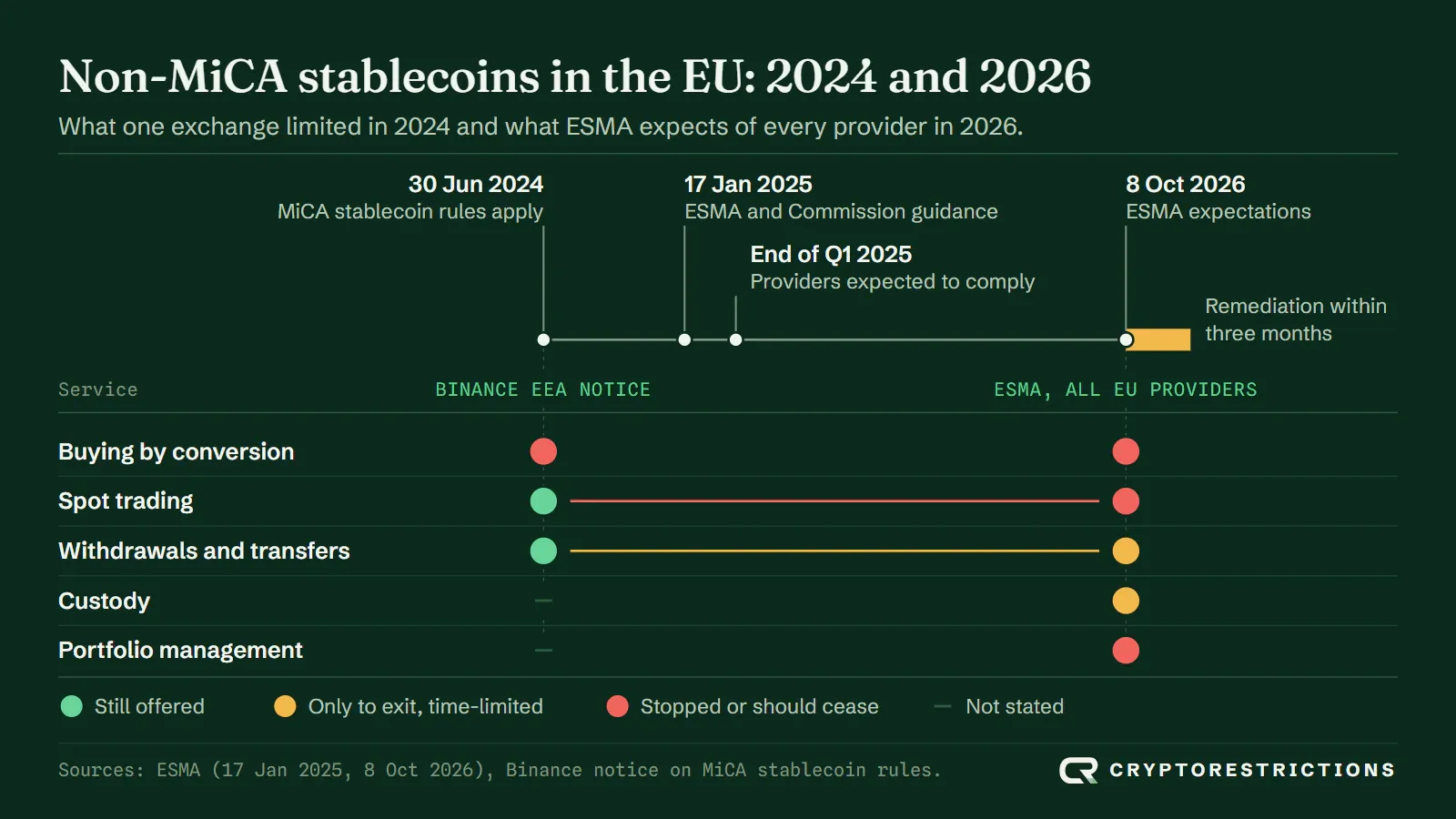
On 17 January 2025, ESMA and the European Commission published guidance expecting national authorities to ensure that CASPs complied regarding non-compliant asset-referenced and e-money tokens no later than the end of the first quarter of 2025.
On 8 October 2026 ESMA went further. Its supervisory expectations say CASPs should cease providing services related to non-MiCA-compliant stablecoins to clients in the EU, across all MiCA crypto-asset services including trading platforms, exchange, custody and portfolio management. They should also put controls in place to stop clients acquiring or increasing exposure to those tokens. National authorities should require remediation of remaining exposures no later than three months after publication. Any continued service should be strictly limited to what is needed to liquidate, convert, withdraw, transfer or safekeep the assets, and be time-limited and closely supervised.
So the question is wider than whether a trading pair is listed. It covers custody, transfers and every other regulated service.
What exchanges did
Binance’s notice on MiCA stablecoin rules shows an early, partial approach. From 30 June 2024 it limited what it called unauthorized stablecoins for EEA users: buying them through Convert became impossible, spot pairs stayed available until further notice, and deposits and withdrawals continued.
Tether’s USDT shows the other side. OKX Europe, which holds a MiCA licence from the Malta Financial Services Authority, says in its guide to USDT that European users cannot trade USDT on OKX because Tether has not obtained authorization under MiCA. It names USDC and USDG as the MiCA-compliant dollar stablecoins it supports instead.
Binance’s position in the EU has since changed. Our dataset records it as limited in Germany and France, as in most of the EEA: it had no MiCA authorization at the 1 July 2026 deadline, and new sign-ups, deposits and trading are closed, with existing users still able to withdraw. See the Binance page for the sources and the current status.
Coinbase has followed the same direction. Its help page for Coinbase Luxembourg S.A. lists 14 assets without a MiCA-authorised issuer, USDT and PYUSD among them, that EEA retail customers could only withdraw, and says balances left on 30 October 2026 are converted into USDC (page last read 1 November 2026).
The vocabulary matters:
- Restricted can mean regulated intermediaries cannot provide particular services involving a token.
- Unavailable can result from an exchange’s own policy.
- Unauthorized issuer describes the issuer’s position under the framework.
- Prohibited applies only to what the law or a regulator actually forbids.
Which stablecoins comply with MiCA?
Circle announced on 1 July 2024 that its French entity had obtained an electronic money institution (EMI) licence from the ACPR, allowing USDC and EURC to be issued in the EU under MiCA. Circle’s redemption policy names Circle Internet Financial Europe SAS as the French entity handling EURC redemptions. On 14 October 2026 the EBA classified USDC as the first significant e-money token under MiCA. From 12 November 2026 the EBA takes over supervision of its own funds, reserves, liquidity and recovery and redemption plans, while the ACPR keeps governance and the other tasks.
Banking Circle’s EURI white paper page classifies EURI as an e-money token under MiCA, issued by Banking Circle S.A. in Luxembourg. Banking Circle’s regulatory information page says it is authorized as a credit institution in Luxembourg and supervised by the Luxembourg Commission for the Financial Sector (CSSF). Societe Generale-FORGE says it restructured EURCV as an e-money token in compliance with MiCA, effective 1 July 2024, and that it holds an electronic money institution licence from the ACPR.
MiCA therefore separates stablecoins issued through authorized European entities from globally traded tokens whose issuers have not entered the EU framework.
How does the UK regulate stablecoins?
The UK has finalized its core crypto rules, but the regime does not apply until 25 October 2027. On 30 June 2026 the FCA published final crypto rules covering firms that include trading platforms, custodians and stablecoin issuers. Firms can apply for authorization between 30 September 2026 and 28 February 2027. Until the regime starts, the FCA’s oversight of crypto is limited to financial promotions and anti-money-laundering controls.
Qualifying stablecoins
The FCA’s framework uses the term qualifying stablecoin: a cryptoasset that aims to maintain a stable value by referencing one or more fiat currencies. Its consultation CP25/14 on stablecoin issuance and cryptoasset custody covers issuing a qualifying stablecoin and safeguarding qualifying cryptoassets. The FCA and the Bank of England plan a further consultation later in 2026 on stablecoin issuers that HM Treasury recognizes as systemic.
A stablecoin accessible to a UK resident today has not necessarily been authorized under the incoming regime. Equally, final rules do not mean every provision already applies. The UK sits between the EU and Singapore: the rulebook is largely written, and the main authorization regime starts in 2027. See the United Kingdom page for platform access today.
How do Asian markets regulate stablecoins?
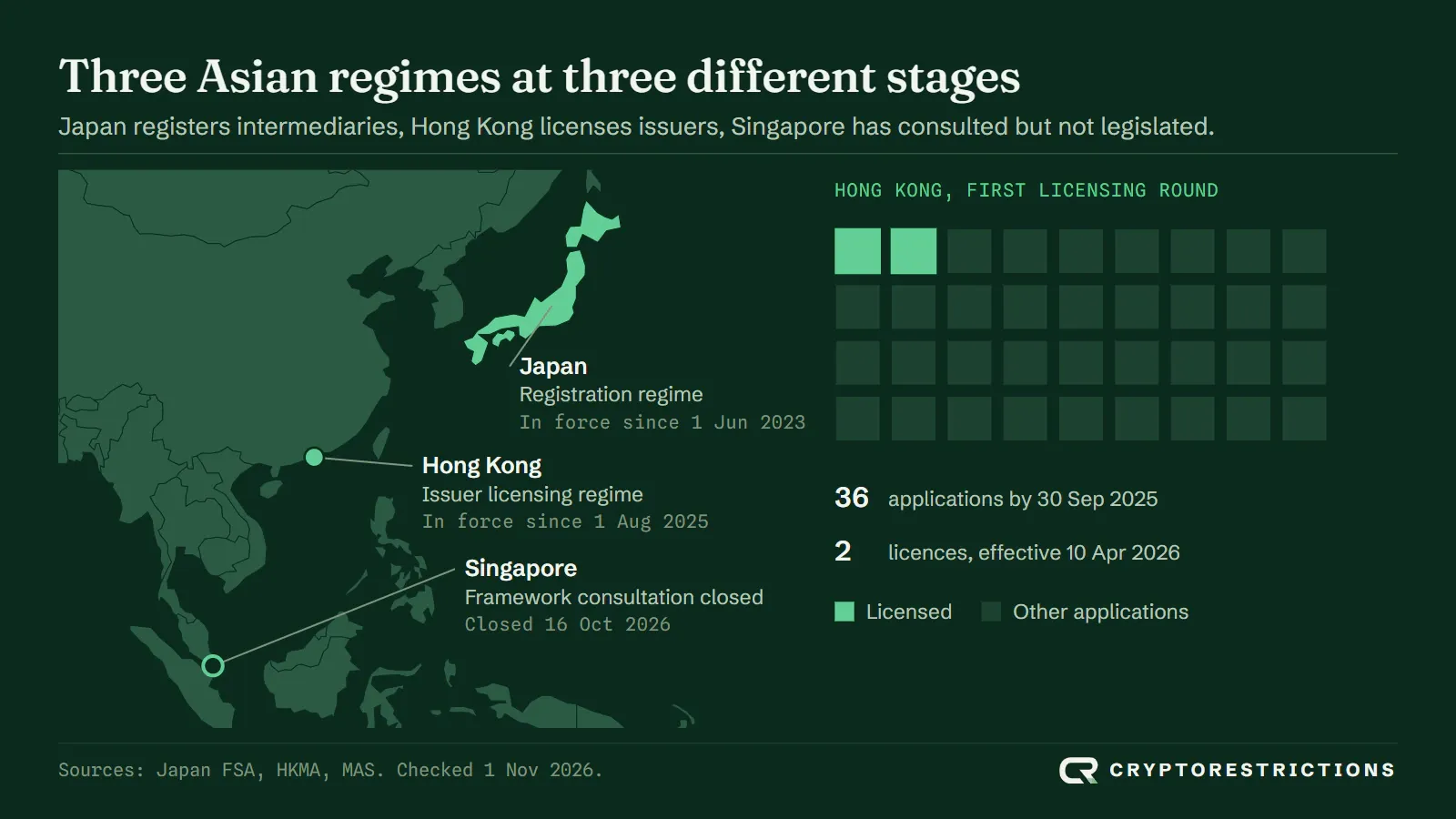
Asia has no unified system. Hong Kong, Singapore and Japan take different approaches to issuance, intermediaries and recognition.
Hong Kong
Hong Kong’s stablecoin regime came into effect on 1 August 2025. The HKMA states that issuing fiat-referenced stablecoins is a regulated activity requiring a licence.
On 10 April 2026 the HKMA granted its first licences. The register of licensed stablecoin issuers lists two licensees, both effective 10 April 2026:
- Anchorpoint Financial Limited
- The Hongkong and Shanghai Banking Corporation Limited
The HKMA received 36 applications in the first batch, which closed on 30 September 2025. In its account of the decision it says both licensees plan to issue Hong Kong dollar (HKD)-referenced stablecoins in the initial phase, and that they expect to launch business in the coming few months.
The Stablecoins Ordinance reaches beyond issuers based in Hong Kong. Section 5 treats issuing a stablecoin outside Hong Kong as a regulated activity if it purports to keep a stable value by reference to the Hong Kong dollar. It also treats a person as holding out as carrying on a regulated activity if they actively market it to the public, in Hong Kong or elsewhere. Section 9 bars offering a specified stablecoin unless the person is a permitted offeror, such as a licensee, and the issue is authorized by a licence, or an exception applies.
Licensing the issuer is a separate question from which stablecoins a regulated intermediary may offer. Check Hong Kong for platform status.
Singapore
Singapore’s dedicated framework for single-currency stablecoins is still in the legislative process. On 1 September 2026 MAS opened a consultation on amendments to the Payment Services Act. It closed on 16 October 2026, and MAS had not published a response when we checked on 1 November 2026.
According to MAS’s announcement, the proposed framework would cover single-currency stablecoins issued in Singapore and pegged to the Singapore dollar or a G10 currency, with requirements on value stability, capital, redemption at par and disclosure. Only issuers licensed under the framework could describe themselves as MAS-regulated stablecoin issuers and represent their tokens as “MAS-regulated stablecoins”. Other stablecoins would be treated as digital payment tokens (DPTs) and subject to the consumer protection safeguards that apply to DPTs. MAS also proposed to:
- allow jointly issued stablecoins from a Singapore and a foreign issuer, if risks are sufficiently mitigated;
- recognize a limited number of foreign-issued stablecoins regulated under a comparable framework, mainly for wholesale cross-border use;
- prohibit interest on MAS-regulated stablecoins;
- require issuer stress testing, and recovery and orderly wind-down plans.
Paxos says USDG is issued by Paxos Digital Singapore, which the MAS directory lists as a Major Payment Institution providing digital payment token services. In its launch announcement of 1 November 2024, Paxos described USDG as substantively compliant with MAS’s upcoming stablecoin framework. A payment institution licence is not the same as being a regulated stablecoin issuer under a framework that has not yet become law. See Singapore.
Japan
Japan’s registration system for electronic payment instruments exchange service providers, which covers intermediaries in yen-linked and other legal-tender-linked stablecoins, took effect on 1 June 2023. Operating in Japan requires registration under the Payment Services Act or, for handling providers, the Banking Act.
On 4 March 2025 SBI VC Trade announced that it had completed registration to process USDC, the first Japanese firm to do so. Japan therefore did not approve a stablecoin in general: it created a regulated category and registered a specific intermediary to handle one. See Japan.
How does the UAE regulate stablecoins?
The UAE has more than one regulator, and the answer depends on the zone and the activity.
Central Bank payment tokens
The Central Bank of the UAE (CBUAE) issued its Payment Token Services Regulation as C 2/2024, effective from 31 August 2024. It covers three payment token services: issuance, conversion, and custody and transfer. No person may perform any of them in the UAE, or direct them at people in the UAE, without a CBUAE licence or registration. A UAE licence applicant must be a company incorporated in the UAE, excluding Financial Free Zones.
The regulation separates two kinds of token:
- Dirham payment tokens are issued by CBUAE-licensed issuers, and only to people resident in the UAE. A bank may not act as an issuer itself, though it can set up a subsidiary to do so.
- Foreign payment tokens are tokens denominated in a foreign currency. Their issuers can apply for a CBUAE registration, and licensed and registered firms may transfer them only when they are used as a means of payment to buy virtual assets or virtual asset derivatives.
Merchants in the UAE may accept only those two kinds of token as payment, with the same limit on foreign tokens. The regulation also bars anyone from issuing algorithmic stablecoins or privacy tokens, or performing or promoting services relating to them, in the UAE or directed at people there. That ban applies to firms licensed by other UAE regulators too.
The CBUAE’s licensing register lists three entities under Dirham Payment Token Issuance: AED StableCoin L.L.C - S.P.C, Zand Trust L.L.C S.O.C and AEDC Stable Coin-L.L.C. It also lists AEDC Stable Coin Network And Distribution - L.L.C for payment token conversion and for payment token custody and transfer.
Dubai regimes
Elsewhere in Dubai, VARA’s rulebook carries fiat-referenced virtual asset issuance rules covering approval, disclosure, reserve assets, redemption, audits and capital. Those rules state that an issuance of a token that purports to keep a stable value against the dirham is not approved under them and stays under the sole and exclusive purview of the CBUAE.
In the Dubai International Financial Centre (DIFC), the Dubai Financial Services Authority (DFSA) published a notice on 3 June 2025 recognizing Ripple (RLUSD) as a Crypto Token. The recognition took effect on the date of the notice and stays in effect until further notice.
A label such as “UAE approved” can therefore hide which regulator approved what, and for which zone. See United Arab Emirates.
How do the regimes compare?
Which stablecoins face different rules?
A stablecoin’s position depends on its issuer, reserve model, home jurisdiction, local authorization and the service through which a user reaches it. The comparison shows why a single label such as “regulated” or “unregulated” rarely fits.
Scale does not substitute for authorization. Tether’s second-quarter 2026 report cites approximately $184.6 billion in tokens issued, yet the EU expectations of 8 October 2026 turn on MiCA compliance, not market size. Reserve backing alone does not decide access either. Whether a token can be served depends on its issuer’s authorization in the relevant jurisdiction.
What do stablecoin rules mean for users?
The token is only the first part of the analysis. An exchange can restrict a product even when owning the token is not prohibited. A blockchain can allow transfers while locally regulated intermediaries cannot trade, hold, convert or transfer the token for clients.
Five questions help separate the layers:
- Issuer status: Is the issuer licensed, authorized or registered under the local framework?
- Residency: Does the platform restrict access by the user’s country or region?
- Service type: Does the restriction cover only trading, or also custody, transfers, staking, lending, payments or conversion?
- Customer category: Is access limited to professional or institutional clients?
- Exchange policy: Has the platform gone beyond what the law requires?
Exchange restrictions change quickly
Binance’s 2024 EEA notice allowed deposits and withdrawals and kept spot pairs open. Since then Binance has stopped EU sign-ups, Coinbase has moved EEA retail balances in 14 tokens into USDC and ESMA has issued broader expectations for EU providers. An older article saying a token can still be deposited, withdrawn or held on a European platform may no longer describe the position. Every status on this site carries a source and a verification date, explained in our methodology.
Regulation is issuer-specific
Regulators increasingly assess the organization behind a token, not the category. Reserve assets, segregation, redemption rights, governance, audits, capital, anti-money-laundering controls and recovery planning all feed into authorization. That direction runs through the GENIUS Act, MiCA, the FCA framework, Hong Kong’s licensing regime and Singapore’s proposed rules.
What happens next?
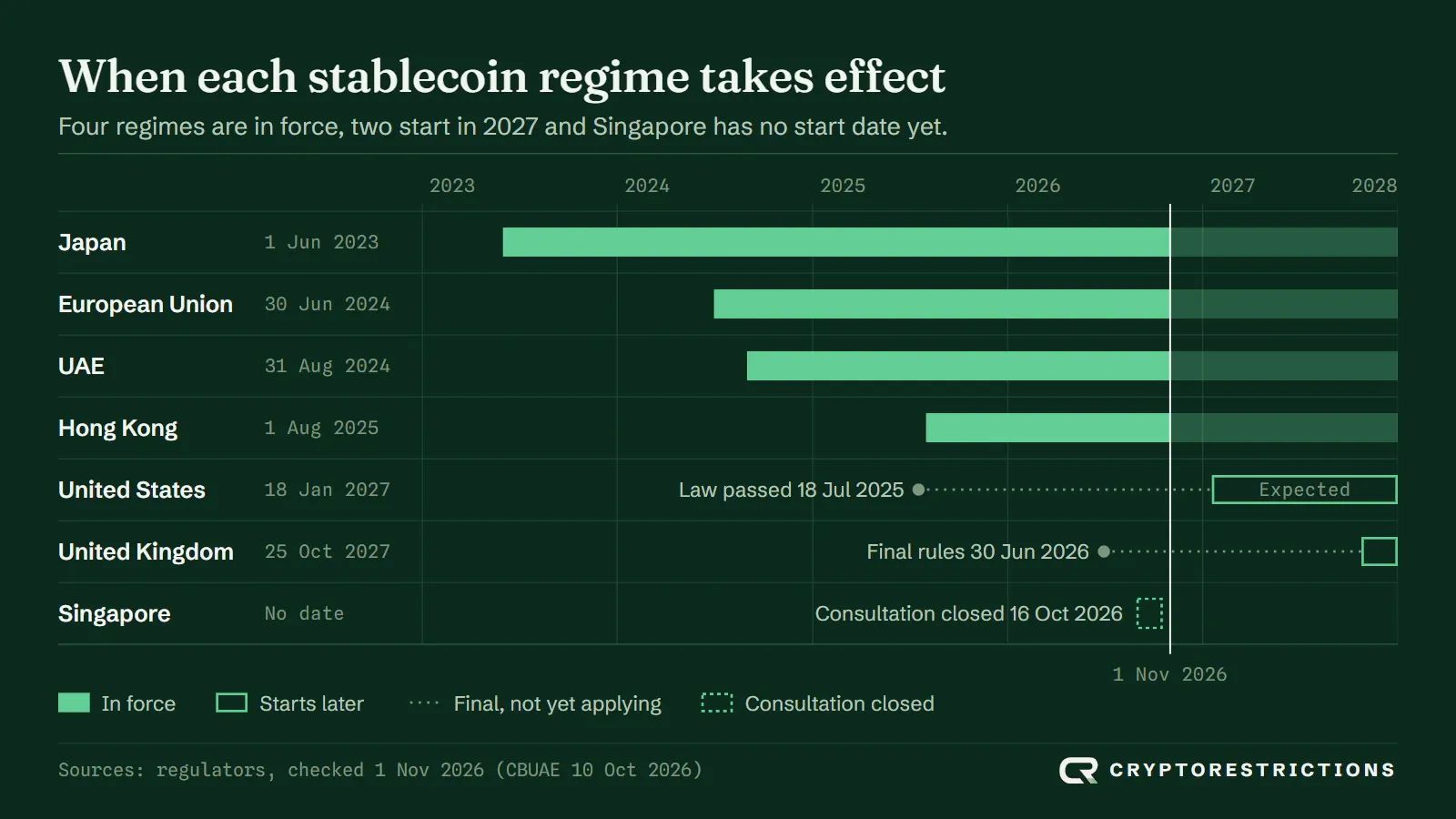
The trend is from broad crypto rules toward specific rules for stablecoin issuance and distribution. The dated milestones below run from 2023 to the next scheduled dates.
The US is working toward the expected January 2027 date: the OCC has finalized its rule, while Treasury and the Federal Reserve have yet to finalize theirs. In the EU the focus has shifted to what providers may do with unauthorized tokens. The UK has most of its rulebook but starts in 2027. Singapore is still consulting, and Hong Kong has begun licensing issuers.
For issuers, this means jurisdiction-specific entities, licences, reserve structures and distribution. For users, the conclusion is simpler: a stablecoin can remain technically transferable while being restricted through regulated exchanges in a particular jurisdiction. Where the user lives, which entity issued the token, which intermediary provides the service and which activity the local rules regulate decide the outcome.