
A central bank digital currency (CBDC) is money issued by a central bank in digital form. Most countries that talk about one are still researching it. A few have launched, one has banned it, and several have paired a CBDC with limits on private crypto. This guide tracks fourteen countries and currency areas by stage and says what each row rests on.
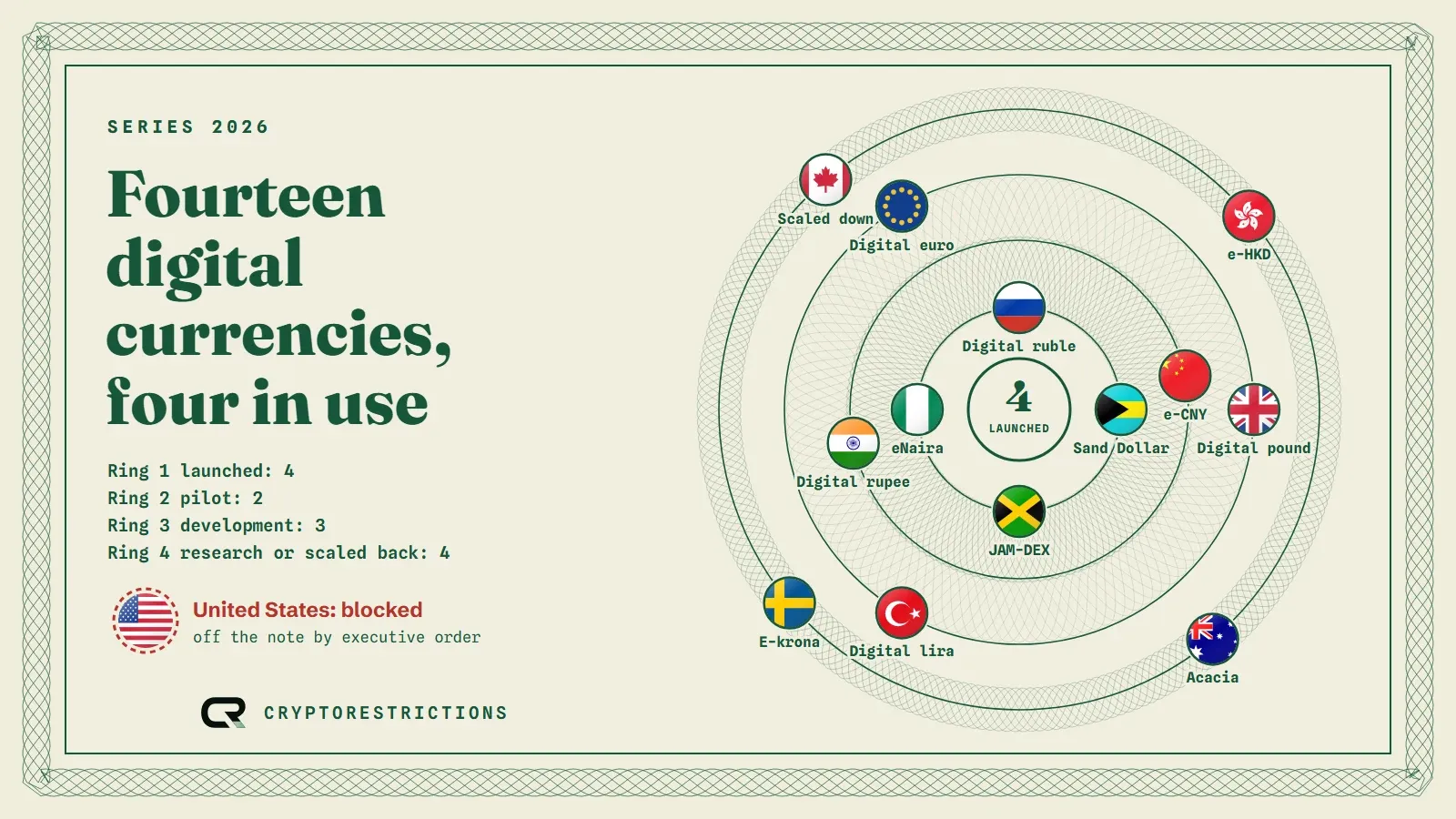
Every stage below comes from a page published by the central bank, a regulator or a government. Where a page carries no date, the row shows the date we read it, 2 November 2026. For how crypto itself is treated in each country, see the restriction explorer.
What is a CBDC?
A CBDC is a digital form of a country’s own currency, issued by its central bank. The central banks that have launched one describe it in the same terms as cash. The Central Bank of Nigeria says its eNaira is issued by the Bank as legal tender. The Reserve Bank of India describes its retail pilot token as a digital token that represents legal tender, issued in the same denominations as paper currency and coins, handed out through banks, and paying no interest.
Two things follow. A CBDC has one issuer, the central bank. And its value is the currency’s value, not a market price.
How is a CBDC different from a stablecoin or crypto?
The difference is the issuer and the legal status.
China’s 2021 notice shows the legal line. It says virtual currencies such as bitcoin, ether and tether lack legal tender status and cannot be used as money in the market, while the same central bank runs a pilot of its own digital currency. A CBDC and a private token can therefore be treated in opposite ways by one authority.
Where does each CBDC stand?
The map shows the stage of thirteen projects. The euro area is in the table but not on the map, because the digital euro belongs to the euro area rather than to the 27 EU members the map would shade.
The full tracker follows. It is sortable, and each country links to its guide where we have one.
Which countries have launched a CBDC?
Four places on our list have a live CBDC.
The Bahamas. The Central Bank of The Bahamas published a notice on 20 October 2020 stating that the digital dollar is available nationwide. The notice is a single line, so it confirms the launch and says nothing about use.
Jamaica. The Bank of Jamaica described JAM-DEX in a May 2022 release as issued and backed by the Bank, with a rollout underway through one bank’s Lynk wallet. The same release said amendments to the Bank of Jamaica Act, meant to make it legal tender, were still to come. We did not read a later Bank page that confirms those amendments, so the row stays at its 2022 date.
Nigeria. The CBN’s page presents the eNaira as legal tender. The page has no date, and the launch guidelines it links are an image scan we could not read as text, so we do not state a launch date here.
Russia. On 31 August 2026 the Bank of Russia announced that the digital ruble had launched. From 1 September 2026, major banks and large retail companies must make their infrastructure available for it. Other banks may offer it but are not obliged to this autumn. Individuals may open one account if they choose, and top-ups from bank accounts are limited to 300,000 rubles a month.
Which countries are testing or building one?
China. A November 2024 action plan, which we read in its English version on the People’s Bank of China site, says prudent steps will be taken to advance the e-CNY pilot. We read no newer central bank statement that changes the label.
India. The Reserve Bank announced a retail pilot starting on 1 December 2022 in a closed user group of customers and merchants. That is the latest RBI release we read, so the row is dated 29 November 2022 and may be behind the current position.
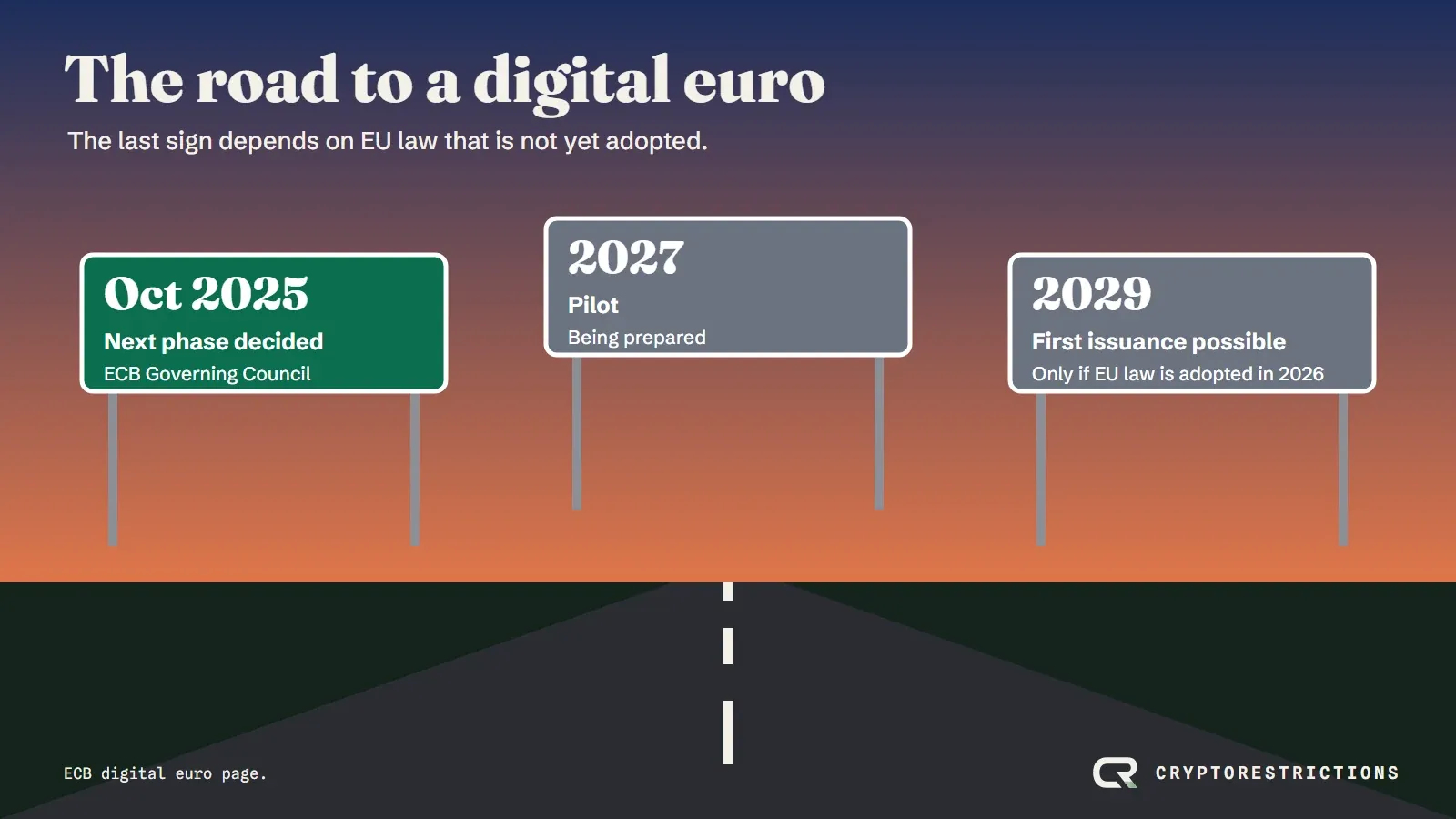
Euro area. The ECB’s digital euro page says the Governing Council decided in October 2025 to move to the next phase. The Eurosystem is preparing a pilot for 2027, and a first issuance is possible in 2029 only if the necessary EU legislation is adopted in the course of 2026. The page does not say the legislation has been adopted.
United Kingdom. The Bank of England’s March 2026 update says the design phase ends in 2026 and that the Bank and HM Treasury will set out their decision on next steps later in the year. That decision will weigh a digital pound against other payment modernisation work. We found no decision on the pages we read.
Turkey. A 3 August 2026 release says 23 projects were selected for development work and sandbox testing in the digital Turkish lira ecosystem. It does not mention a decision to issue.
Which countries are researching, shelving or blocking a CBDC?
United States. The executive order of 23 January 2025 states a policy of prohibiting the establishment, issuance, circulation and use of a CBDC in the United States. Section 5 bars agencies from acting to establish, issue or promote one, at home or abroad, and ends ongoing CBDC plans. This is an executive order, not a statute. We could not read the congressional record, so we do not report the status of any bill.
Canada. The Bank of Canada says it is scaling down its work on a retail CBDC. The page is undated.
Hong Kong. In the October 2025 release on the e-HKD pilot, the HKMA said it had not decided whether or when to issue a retail e-HKD and would put future work into wholesale payments.
Australia. The Reserve Bank’s Project Acacia page says continued exploration of wholesale CBDC is warranted. It does not say a CBDC will be issued.
Sweden. In its Payments Report 2026 the Riksbank recommended an inquiry into the legal changes needed for an e-krona, to be set up once the digital euro regulation is final. An e-krona needs a decision by the Riksdag.
Which countries paired a CBDC with limits on crypto?
Four rows combine a CBDC with a restriction on private crypto. In each case the restriction is a separate legal instrument from the CBDC, and the two were not issued together.
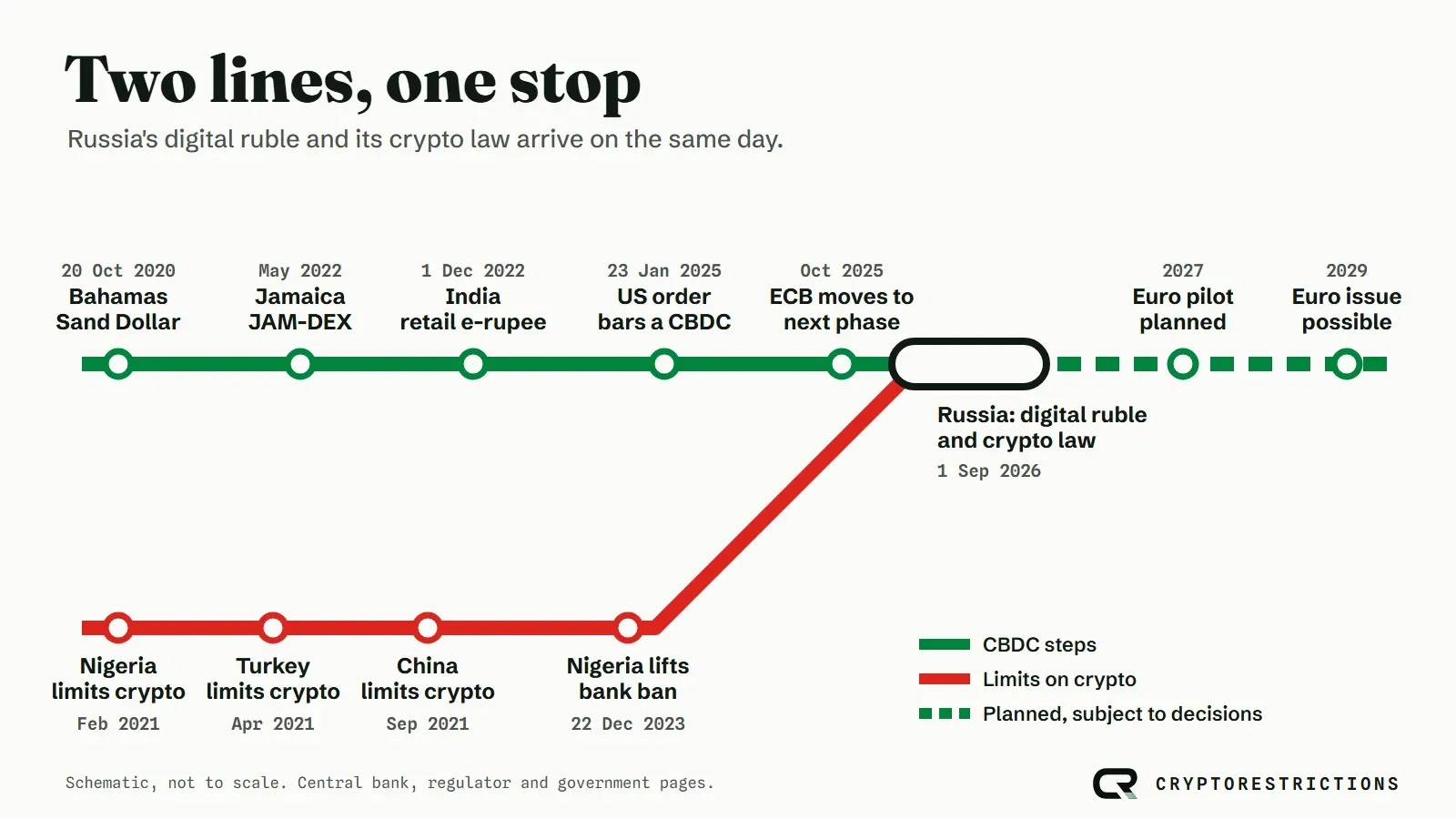
Two of the four rest on secondary sources. The Chinese and Turkish rows rest on the legal texts themselves. The Russian row rests on a legal database summary, and the Nigerian row on a news report of the CBN circulars, so both should be checked against the circulars before anyone relies on them.
The pairing is worth noting but should not be read as a rule. The other ten rows on the list are not tied here to any crypto limit, and we make no claim about the crypto rules of those countries on this page.
What does this list leave out?
It is a selection, not a census. We covered fewer countries on purpose and kept only those where we could read the stage on a central bank, regulator or government page.
- Projects we could not confirm at the source. The Eastern Caribbean Currency Union, the United Arab Emirates, Brazil, Saudi Arabia and Qatar all have CBDC pages or reports. We could not read a current official statement of their stage, so they are not in the tracker.
- Cross-border projects. Multi-country wholesale projects are not tracked here.
- Legislative status. We report orders and central bank positions, not the progress of bills.
- Stale rows. The Bahamas, Jamaica and India rows rest on pages from 2020 to 2022. They show the last date we could read, not a current position.
Surveys by the Bank for International Settlements and the Atlantic Council’s tracker are useful for finding projects. We did not use either as a source, and no row here rests on them.
Common questions about CBDCs
Is a CBDC the same as crypto?
No. A CBDC has a central bank as its issuer and is the national currency in digital form. Crypto assets are not issued by central banks. The rules also differ, as the table above shows.
Which country has banned a CBDC?
On our list, the United States, through the executive order of 23 January 2025. It restricts federal agencies and states a policy against a CBDC. It is an order, and the order itself is the source.
Does having a CBDC mean crypto is banned?
Not by itself. China, Turkey and Russia limit crypto while running a CBDC, and Nigeria did until December 2023. The rest of the list is not tied here to such a limit.
How do I check what applies to me?
Look up your country on the restriction explorer and read the country guide. Our methodology explains how each status is sourced and dated.