Kalshi and Polymarket both sell contracts that pay out on the outcome of an event, but they are built differently. Kalshi is a single US-regulated exchange. Polymarket is two products: an international site, polymarket.com, and a separate US exchange, Polymarket US. Most questions about which one “works” or “is legal” turn on that split.
This guide compares who can use each, which regulator and licence sits behind each, where each is blocked, how money moves, and what states and countries have done against them. It does not compare fees, which we do not track, and it does not say which is better. For how event contracts work, see what a prediction market is. For one platform in full, use the Kalshi and Polymarket pages.
Are Kalshi and Polymarket the same kind of company?
No. The legal entity you deal with differs, and so does the regulator.
Kalshi’s exchange, KalshiEX LLC, was designated as a contract market by the Commodity Futures Trading Commission (CFTC) on 4 November 2020. Its clearing house, Kalshi Klear LLC, received a CFTC registration order as a derivatives clearing organization on 29 August 2024. Kalshi’s help centre says its perpetual futures are carried by Kalshi Prime, a registered futures commission merchant that keeps customer funds in a segregated account. Members outside the US trade on the same exchange: Kalshi’s member agreement is governed by New York law.
Polymarket has three names in the record. The CFTC’s January 2022 order fined Blockratize, Inc., doing business as Polymarket, $1.4 million and required it to wind down markets on polymarket.com that did not comply with US law. Polymarket US is a different company: its participant agreement names QCX LLC, doing business as Polymarket US, and QC Clearing LLC, doing business as Polymarket Clearing. QC Clearing was registered as a derivatives clearing organization on 17 December 2024, and QCX operates as a CFTC-designated contract market under an order of designation. The international site is operated by Adventure One QSS Inc. That is the entity the Dutch gambling regulator, the Kansspelautoriteit (Ksa), named in its January 2026 decision, after finding it listed in the site’s footer and terms as the owner and organiser. Nevada’s gaming regulator sued all three entities together in January 2026.
Where is Kalshi available, and where is Polymarket?
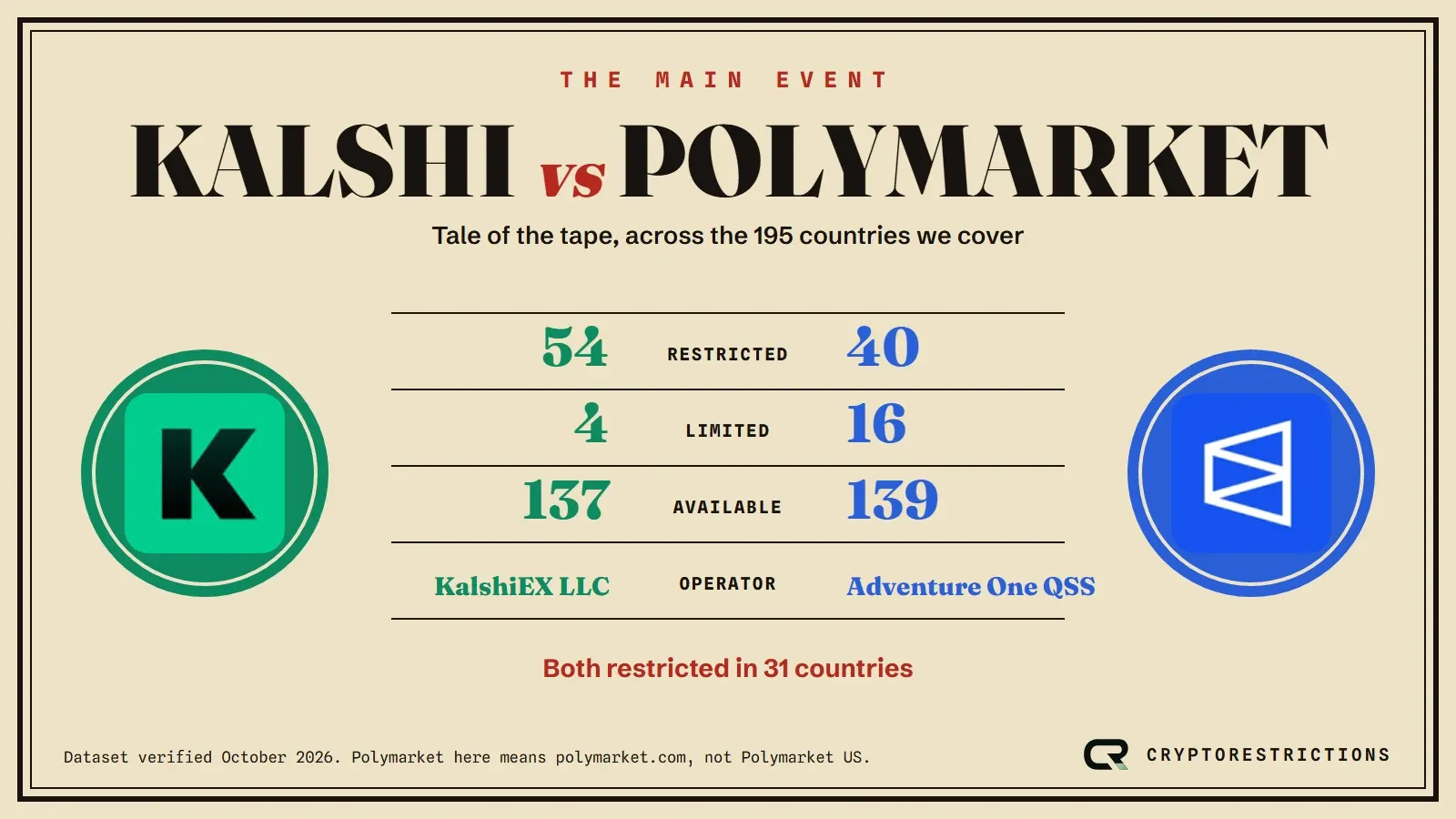
The member agreement names 55 restricted jurisdictions, and our dataset adds the government blocks that sit outside it. Kalshi is restricted in 54 of the 195 countries we cover, limited in 4 and available in the other 137. The 55th jurisdiction on the list, Taiwan, is outside our 195. The agreement says the ban applies to trading event contracts, and that people in those places may still hold a membership.
Polymarket is restricted in 40 countries, limited in 16 and available in 139. Its restricted list is mostly its own, and the US is limited because polymarket.com refuses US users while Polymarket US serves them. The two platforms are restricted together in 31 countries.
The differences matter more than the overlap. Kalshi is available and Polymarket restricted in eight countries: Burundi, Germany, Indonesia, Japan, the Netherlands, Slovakia, Slovenia and South Korea. Polymarket is available and Kalshi restricted in 18, among them Bulgaria, China, Kenya and the United Arab Emirates. Brazil is the one country where Kalshi is limited and Polymarket restricted.
“Available” means the platform itself lets you in. It does not mean local law allows betting on events. Many countries treat these products as gambling, and a new national order can move a country to limited, as it did for Spain on 26 May 2026, when the DGOJ opened a sanction case and ordered both websites blocked.
How do the two check where you are?
Kalshi is the more explicit. Its member agreement has you promise you are not domiciled in, organised in or located in a restricted place, and our test found its sign-up page names the reason when it refuses. Polymarket’s check is silent: markets load everywhere and the block shows when an order fails. Both results are in the Kalshi and Polymarket reports. A VPN does not change eligibility on either.
Can you use Kalshi or Polymarket in the United States?
Both are limited in the US, for different reasons.
Polymarket’s split dates from the 2022 CFTC order. polymarket.com refuses US users, and Americans use Polymarket US, which asks for a legal name, address, date of birth and Social Security number and requires identity verification before you can deposit or trade. Kalshi serves the US from one exchange, and its limit comes from state courts.
What have US courts said about Kalshi?
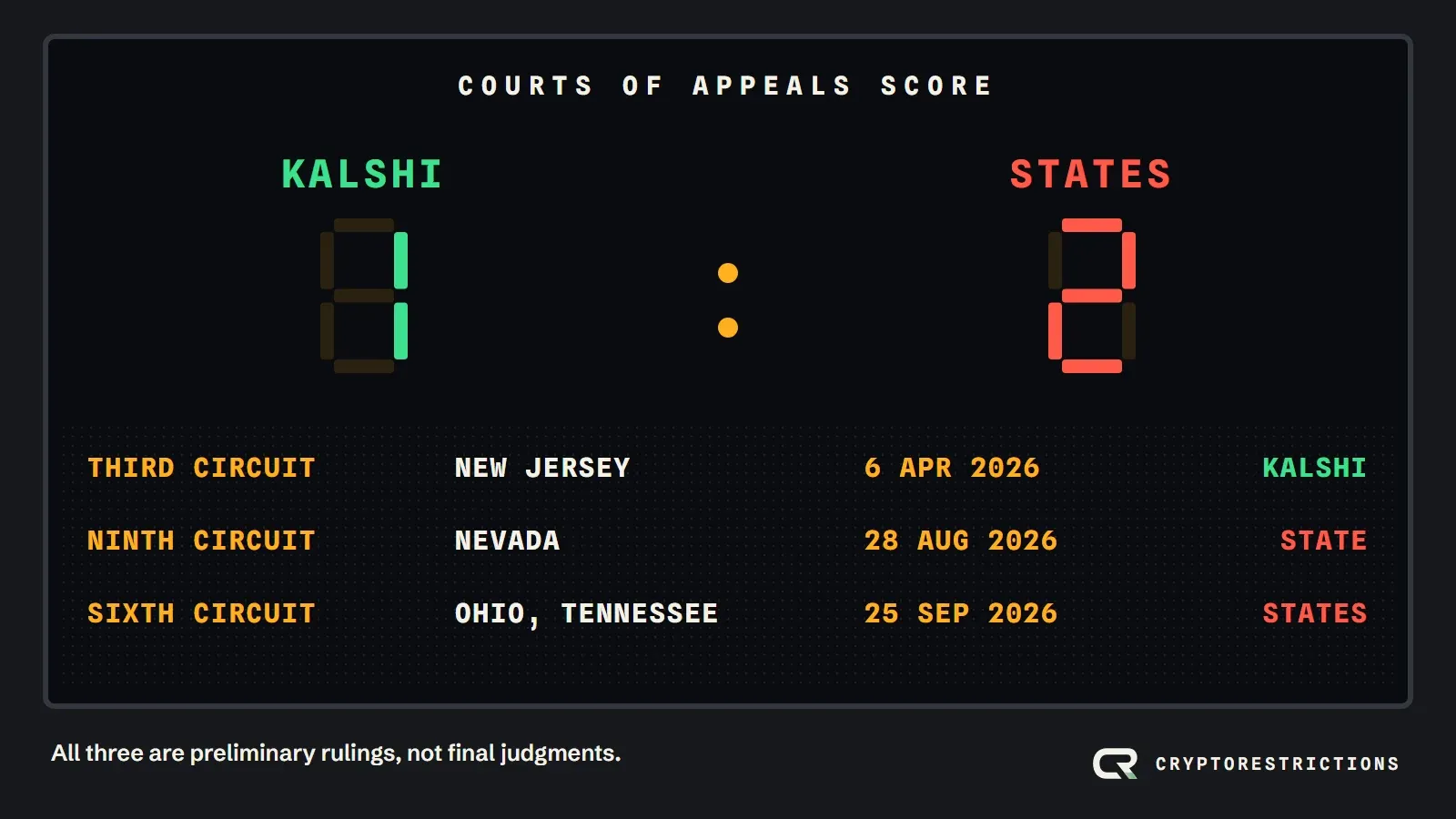
The central question is whether federal commodities law overrides state gambling law for sports contracts. Appeals courts have split, and all three rulings below concern preliminary injunctions rather than final judgments.
- Third Circuit, 6 April 2026: in the case against New Jersey it affirmed an injunction for Kalshi because Kalshi showed a reasonable chance of success on its argument that the Commodity Exchange Act preempts state law.
- Ninth Circuit, 28 August 2026: in the Nevada case it held that the district court did not abuse its discretion in dissolving the injunction, because Kalshi did not show a likelihood of preemption.
- Sixth Circuit, 25 September 2026: it affirmed the denial of an injunction in Ohio and vacated one granted in Tennessee, holding that Kalshi’s sports contracts are not shown to be swaps and that the Act does not preempt either state’s law.
Which states have acted against each?
Our dataset records a state only when an order says what the platform must stop. Kalshi is limited in Connecticut, Michigan, Missouri, Nevada and Washington. Polymarket, meaning Polymarket US, is limited in Connecticut, Michigan, Missouri and Nevada.
The Nevada Gaming Control Board said on 24 July 2026 that a court injunction of 18 May barred Kalshi’s sports, election and entertainment contracts, and that Kalshi had agreed to a third-party geofence by 12 August or a $120,000 daily penalty. Washington’s order and Michigan’s injunction came in August and September. Polymarket US’s Michigan change is described in a Michigan Gaming Control Board notice.
Connecticut’s September 2026 cease-and-desist letters went to nine prediction markets including Polymarket, not Kalshi, which the state had sued about two weeks earlier. Missouri’s attorney general sent letters on 18 September to six companies, Polymarket and Kalshi among them. New York has sued both: the attorney general sued Kalshi on 31 July 2026 and sued Polymarket US on 24 September, each as an unlicensed gambling operation. Those suits are allegations, and New York has no recorded cut in our dataset yet. For one state in detail, use its state page.
How does the foreign regulatory picture differ?
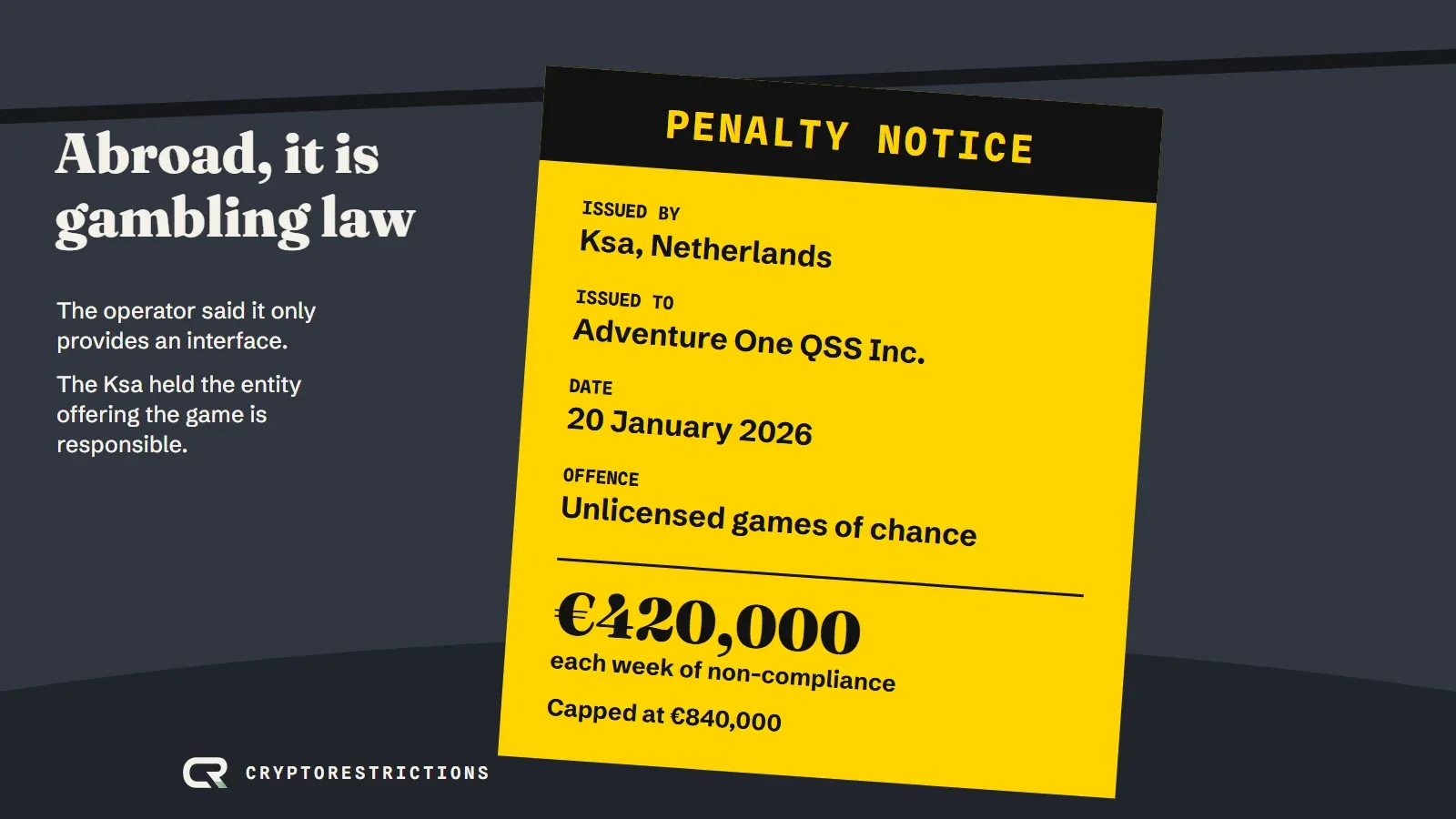
Outside the US the question is gambling law, not commodities law, and the two platforms are treated alike more often than not. The Ksa’s decision against Adventure One QSS Inc., dated 20 January 2026, orders it to stop offering unlicensed games of chance to the Netherlands and sets a penalty of 420,000 euros for each week of non-compliance, up to 840,000 euros. The operator argued it only provides an interface and does not control wallets or settlement, which runs through an automated oracle. The Ksa held that responsibility lies with the entity that offers the game, whoever performs the technical settlement.
We found no gambling licence for Kalshi either, and the DGOJ block above covers both. The European Securities and Markets Authority (ESMA) said on 3 July 2026 that event contracts which are financial instruments fall within national binary option measures, which prohibit offering them to retail clients, and that distributing them in the EU needs an investment firm authorisation. Whether a given contract is a financial instrument depends on its underlying question. For the country view, see Germany, the Netherlands and Spain.
How does money get in and settle?
The two differ most here, and only partly by regulator.
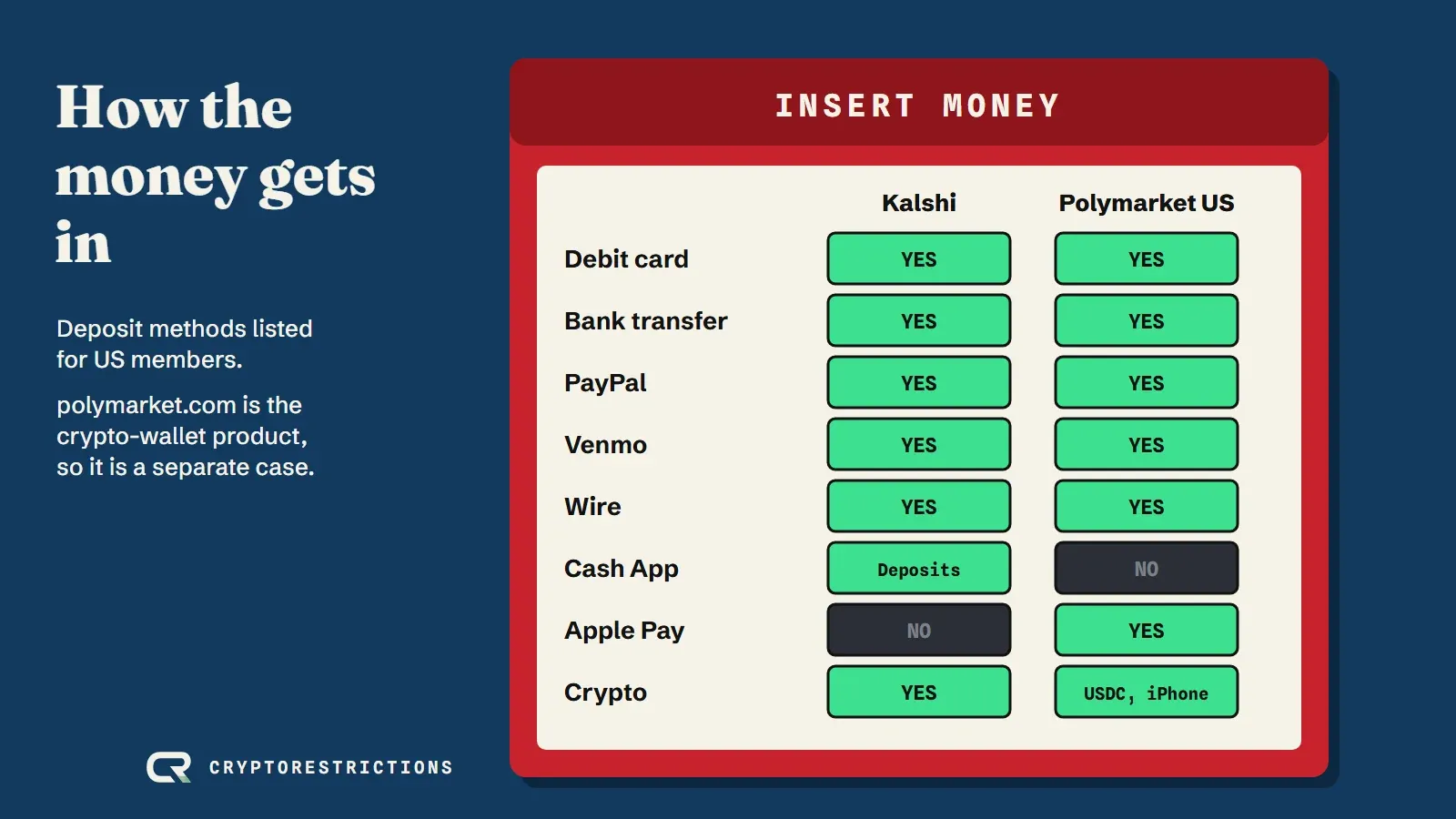
Kalshi’s transfers FAQ lists debit card, bank transfer, PayPal, Venmo, Cash App (deposits only), crypto and wire for US members. Members abroad can deposit by debit card, crypto or wire, with wires starting at $1,000, and can withdraw to a card or in crypto. Crypto for US members is processed through Zero Hash. Contracts settle in dollars: each winning contract pays out $1.
Polymarket US lists debit card, bank transfer, Apple Pay, PayPal, Venmo, USDC (iPhone only, where available) and wire as deposit methods. Its participant agreement has users consent to electronic delivery of IRS Form 1099-B and is governed by New York law. polymarket.com is the crypto-wallet product, and the operator’s own account to the Dutch regulator is that it provides an interface rather than custody. We could not reopen its terms of use for this guide, so the Polymarket page is the place for its custody and governing-law terms.
“Dollars versus crypto” is therefore not a clean split between the two companies. It is a split between Kalshi and Polymarket US on one side, which take regulated-exchange deposits with crypto as an option, and polymarket.com on the other.
Common questions about Kalshi vs Polymarket
Is Polymarket the same as Polymarket US?
No. They have different operators, regulators and user bases. polymarket.com refuses US users. Polymarket US is a CFTC-regulated exchange that serves them.
Is Kalshi regulated and Polymarket not?
Kalshi’s exchange and clearing house are both CFTC-licensed. Polymarket US also has a CFTC-designated exchange and a registered clearing house. We found no licence for polymarket.com. A licence in the US says nothing about whether a state or a foreign regulator accepts the product.
Which is blocked in more countries?
In our dataset, Kalshi is restricted in 54 countries and Polymarket in 40, but Polymarket is limited in 16 against Kalshi’s 4. Add restricted and limited and the totals are 58 and 56.
Does either company hold a gambling licence?
We found none for either. Their authorisations are CFTC licences, which are financial-market licences.
How to read this comparison
A status here describes what the platform and local orders allow, not whether a contract is legal in your country or state. Our methodology explains how each status is sourced and dated, and the restriction explorer shows the current state of any platform in any country.