
A prediction market is a marketplace where people trade contracts whose value depends on whether a stated event happens. The price of a contract moves as buyers and sellers change their minds, and it is commonly read as the crowd’s estimate of the probability.
Whether that activity is legal depends on who runs the market, what the contracts are about and where the user sits. This guide explains the mechanics, then the legal models, the US dispute between federal and state law, and how the rules differ by country. It does not recommend any platform or any trade. For the current status of a platform in a country, use the prediction markets section and the restriction explorer.
What is a prediction market?
The usual unit is the event contract. A Third Circuit opinion describes it as a contract that identifies an event with several possible outcomes, a payment schedule for those outcomes and an expiration date, with a price that moves with perceptions of how likely the event is. The events can be elections, economic figures, weather, entertainment or sports.
Most contracts are yes or no questions. A “yes” position pays if the event happens and a “no” position pays if it does not. Because the payoff is fixed and the price is not, the price carries the information. Kalshi’s explainer ties a 40 percent chance of “yes” to an expected value of 40 cents for a contract that pays $1. That is the platform’s own description of how price relates to probability.
How does an event contract work?
Two details matter for the legal questions later. First, the payoff depends on an event, not on a price. Second, whether the platform is the other side of the trade or only a matching service is one of the main arguments in the sportsbook debate below.
How is an event contract priced?
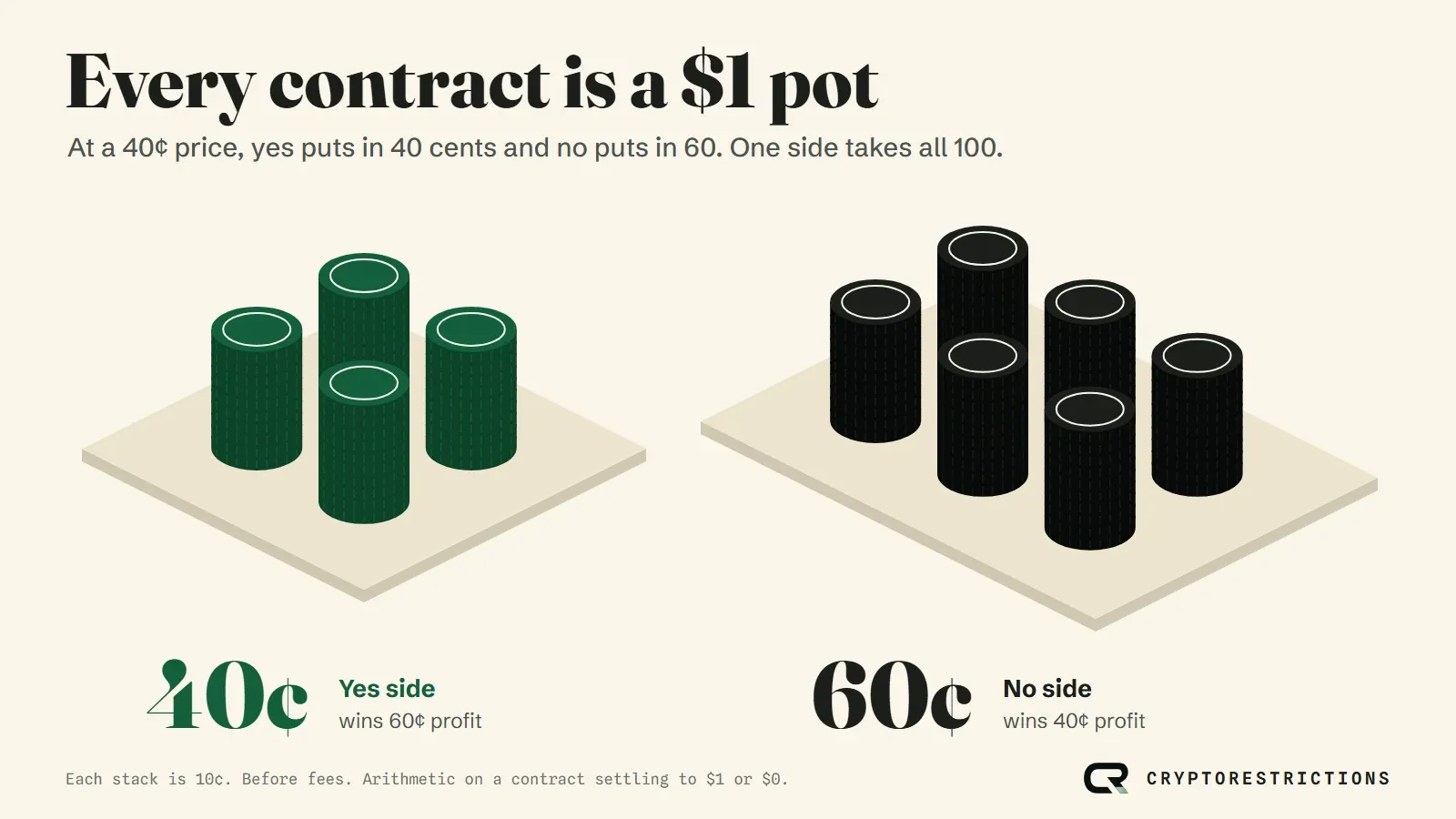
The price is what a buyer pays for one contract, and the contract settles to $1 or $0. That fixes the arithmetic. A buyer who pays 40 cents gains 60 cents if the answer is right and loses 40 cents if it is wrong, so a 40 cent price breaks even only if the event happens 40 percent of the time. A cheaper contract pays more when it is right and is right less often: at 10 cents the gain is 90 cents and the loss 10 cents, and at 90 cents the gain is 10 cents and the loss 90 cents. Fees are not included.
How is a prediction market different from a sportsbook?
A sportsbook is a licensed gambling business that offers bets on sports at odds it sets. Online sportsbooks are regulated by states, a point the dissenting judge made in the Third Circuit case.
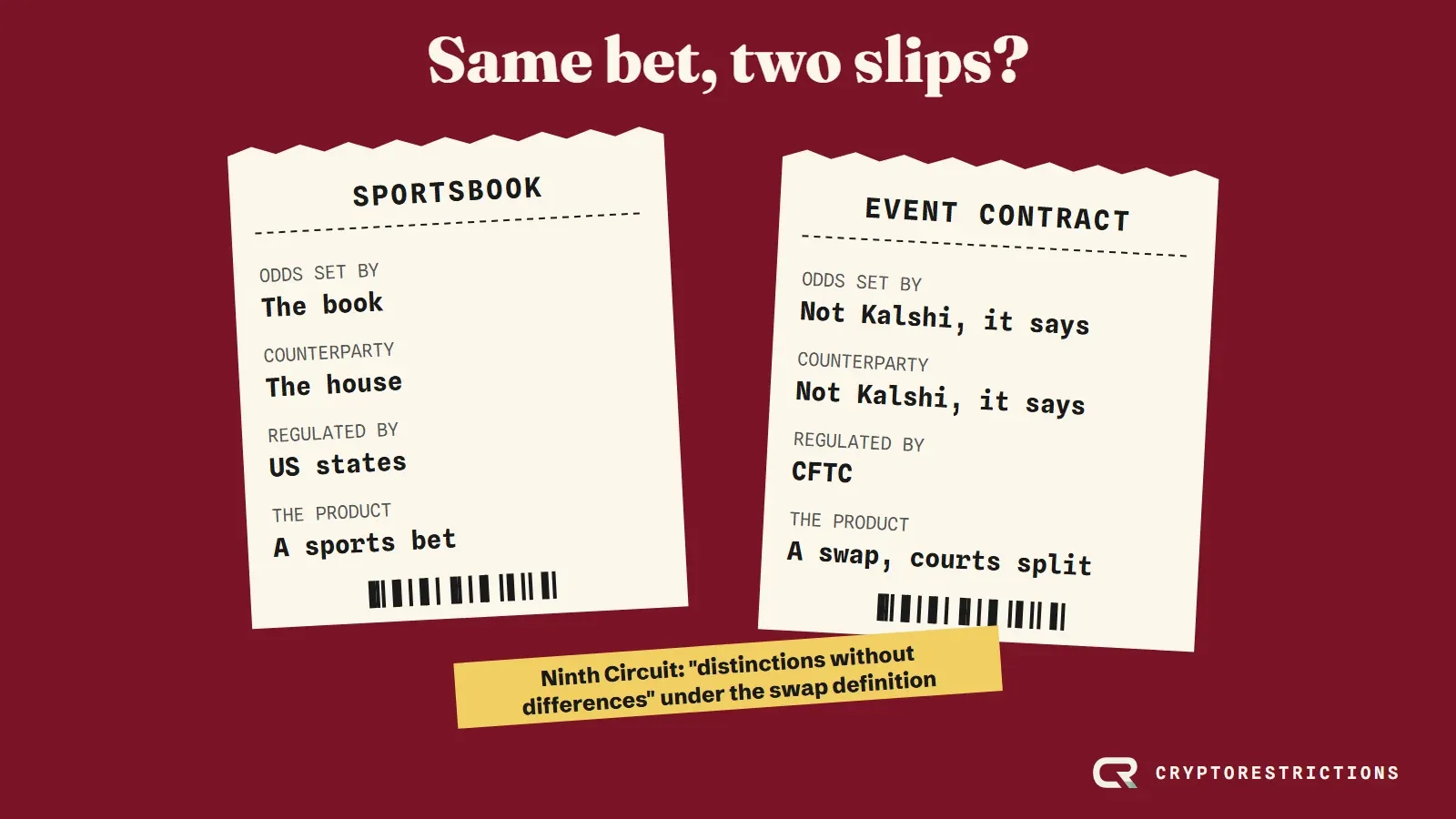
Kalshi argues its exchange is different. In the Ninth Circuit case it said that, unlike a traditional casino or house, it is not the counterparty to any trade, does not set betting odds, does not profit when customers lose and has no incentive to favour itself at customers’ expense. The Ninth Circuit called these distinctions without differences, because none of them appears in the statutory definition of a swap. The same opinion notes that Kalshi’s affiliate, Kalshi Trading, acts largely as a market maker on the exchange.
The product looks similar to the user, which is why the dispute exists. The dissent in the Third Circuit said Kalshi’s sports offerings are virtually indistinguishable from the products of online sportsbooks such as DraftKings and FanDuel. The majority took the opposite view, that the contracts are swaps traded on a federally designated market.
How is it different from a derivatives exchange?
A conventional futures or swaps exchange is built for hedging financial risk and discovering prices, which the Sixth Circuit describes as the critical functions of derivatives markets. The Commodity Exchange Act (CEA) defines a swap to include a contract whose payment depends on the occurrence of an event “associated with a potential financial, economic, or commercial consequence”. The Third Circuit read that wording broadly and concluded that “swap” includes event contracts.
The Ninth and Sixth Circuits read it more narrowly. The Ninth Circuit said sports contracts do not help institutions hedge risk but create risk where none existed. The Sixth Circuit held that an event must be intrinsically tied to a financial consequence, such that hedging or price discovery on it would be understandable, with a change in interest rates as its example. On that reading, Kalshi had not shown its sports contracts are swaps.
What are the legal models?
There are two, and the difference between them explains most of the news.
What is the regulated model?
In the US, an exchange that wants to list event contracts for the public can apply to the Commodity Futures Trading Commission (CFTC) to become a designated contract market (DCM). The CFTC designated KalshiEX LLC on 4 November 2020 under section 5 of the CEA, after concluding it could comply with the Act and the rules that apply to DCMs. Polymarket’s US arm, QCX LLC, which trades as Polymarket US, was designated by a CFTC order dated 9 July 2025.
A DCM does not need approval before listing each contract. It self-certifies that the contract complies with the law, as the Third Circuit describes the process. The CFTC keeps a power to step in. Under the CEA’s special rule for event contracts, 7 U.S.C. § 7a-2(c)(5)(C), the Commission may determine that an event contract is contrary to the public interest if it involves activity unlawful under federal or state law, terrorism, assassination, war, gaming, or other similar activity it identifies by rule. A contract so determined may not be listed. CFTC regulation 17 CFR 40.11 sets out the process, including a 90-day review during which the Commission can ask the exchange to suspend the contract.
Users of a DCM go through identity checks. Polymarket US says it is a CFTC-regulated exchange and requires know-your-customer verification, including a Social Security number, before anyone can deposit or trade.
What is the crypto-native model?
Before it had a US licence, Polymarket ran event markets on a blockchain without CFTC designation. On 3 January 2022 the CFTC said Polymarket had operated an unregistered facility for event-based binary options, offering more than 900 event markets through smart contracts. It treated each market contract as a swap, ordered a $1.4 million civil penalty, reduced for cooperation, and required Polymarket to wind down the non-compliant markets.
Polymarket also runs an international site separate from its US exchange. A Dutch regulator tested polymarket.com in July and November 2025 and found a player account could be created, a deposit made by card through a payment provider and a “Buy Yes” position placed from the Netherlands, with no technical measure blocking access. Our Polymarket page records which countries the platform restricts itself and which have ordered it blocked.
The two models are not a ranking. They differ in who supervises the market, who verifies users and which court or regulator can act against the operator.
Why are US states challenging federal preemption?
Federal law can override state law on the same subject. That is preemption. The CEA gives the CFTC “exclusive jurisdiction” over swaps traded on a DCM, and Kalshi argues this stops states from applying gambling law to its contracts. States regulate sports betting, and several say Kalshi’s sports contracts are sports bets that state law prohibits or licenses.
The CEA also contains two savings clauses that preserve some state and court authority. Both sides read the text differently, and the Third Circuit and the Sixth Circuit reached opposite results on it. The opinions we read concern sports contracts. They do not settle contracts on other subjects, so a state page is the place to check what applies where.
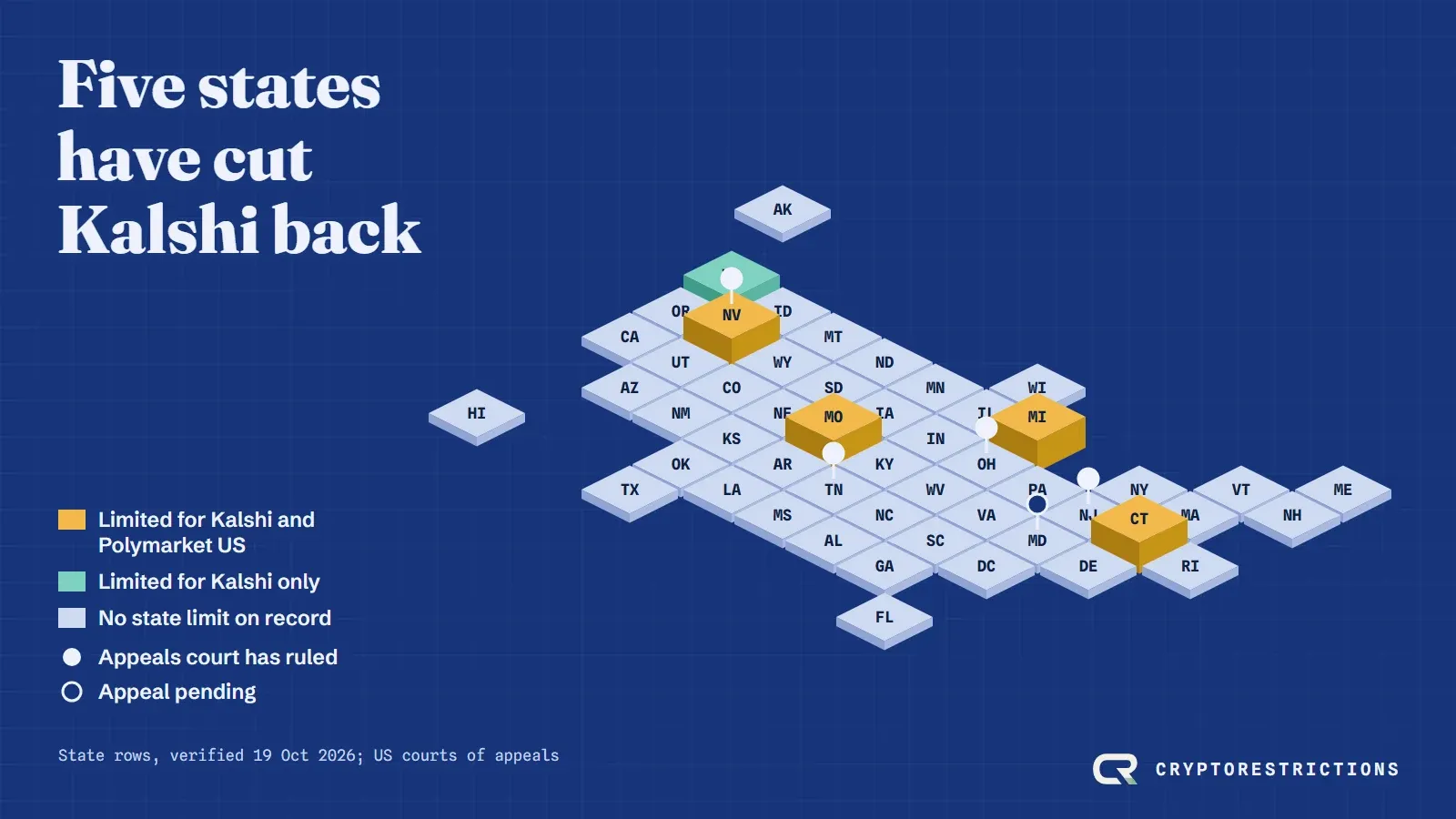
Our state rows record a state limit on Kalshi in five states (Connecticut, Michigan, Missouri, Nevada and Washington) and on Polymarket US in four (Connecticut, Michigan, Missouri and Nevada), as verified on 19 October 2026. Every other state shows no limit on record. That is not a finding that the contracts are lawful there. The Kalshi page lists each order.
What is still undecided?
As of 2 November 2026, the Supreme Court docket for No. 26-299, Flaherty v. KalshiEX, LLC, shows the petition filed on 2 September 2026 and the response due on 7 December 2026. It shows no order on whether the Court will hear the case. The CFTC has also entered the fight. On 9 October 2026 it announced an interim final rule stating that casino-style gambling products are excluded from the definition of swap, and a proposed rule that would add event contracts on sports, politics, culture and weather to the definition. The proposal is not final, and courts, not the agency, decide what the statute means.
On 27 October 2026 the CFTC sued Utah to stop it from using state law against CFTC-registered markets, saying it has started proceedings against nine other states. We do not follow each filing here. The state guides do, for example Nevada, New Jersey, Ohio and Utah.
The CFTC had not itself restricted sports event contracts when the Third Circuit ruled. The court noted that the Commission had not reviewed or prohibited any, and that in March 2026 it had invited comment on the scope and public interest implications of “gaming” and “sports competition”.
Are prediction markets legal in other countries?
The CFTC designation is a US status. The three regulators below applied their own gambling laws.
- Netherlands. On 20 January 2026 the Kansspelautoriteit found that the operator of polymarket.com, Adventure One QSS Inc., was offering a game of chance without the licence the Betting and Gaming Act requires, and ordered it to stop under a penalty. The authority described the market it tested as a virtual version of betting on events. See the Netherlands page.
- Spain. On 26 May 2026 the gambling regulator, the DGOJ, opened a sanctioning case against Polymarket and Kalshi and ordered both websites blocked nationwide while the case runs. It said Spain, like other European jurisdictions, treats prediction markets as gambling that needs a specific licence. See the Spain page.
- France. On 25 February 2026 the ANJ said prediction market platforms are not authorised in France and are considered illegal gambling services. It said Polymarket and Kalshi had geoblocked France. See the France page.
Read the matrix with care. “Available” means the platform does not list the country as restricted and no blocking order is on record. It is not a statement that the activity is legal there, and a regulator can act at any time, as the Netherlands did against Polymarket’s operator. The country pages carry the dated sources.
Is it legal for me?
The honest answer has three parts. In the US, a CFTC-designated exchange operates under federal rules, and sports contracts in particular face unresolved challenges from states. Outside the US, the likely framework is gambling law, which varies widely, and several regulators say the platforms lack the licence their gambling law requires. And in both cases, the position can change on a court ruling or a regulator’s order, which is why each claim above carries a date.
This guide does not say whether a given person may trade. The platform’s rules, the user’s location and local law decide that, and a lawyer who knows the jurisdiction can advise. For the platforms themselves, see our Kalshi and Polymarket pages. A direct comparison of the two is covered in a separate guide.
Common questions about prediction markets
Are prediction markets gambling?
It depends on the jurisdiction. Regulators in the Netherlands, Spain and France call them gambling. In the US, the CFTC says event contracts on designated markets are commodity derivatives, and the Ninth and Sixth Circuits have ruled for states on sports contracts at the preliminary stage. The question is open.
Who regulates prediction markets in the US?
The CFTC regulates exchanges it has designated, and states regulate gambling. The overlap on sports contracts is the subject of the court cases.
Can a prediction market price be wrong?
Yes. A price reflects what traders were willing to pay at that moment, not a guarantee of the outcome. We do not advise on trades.
Does a country page tell me if a platform is legal?
No. It tells you the access status we verified from the platform’s own terms, regulator orders and our geo-access test. Our methodology explains how each status is sourced and dated.