Is crypto legal in Nigeria?
Yes. We found no Nigerian law that bans holding or trading crypto, and the Investments and Securities Act 2025 puts digital assets under the SEC as securities. Banks have been allowed to serve licensed crypto businesses since December 2023.
The Act was assented on 25 March 2025. Its text counts “virtual and digital assets” as securities and tells the SEC to register digital asset exchanges, virtual asset service providers and digital asset operators. It sets no minimum capital; the SEC does that by circular. The Act’s general penalty for capital market breaches is an administrative fine of at least 20 million naira, and promoters of pyramid and Ponzi schemes face at least 20 million naira, 10 years in prison or both.
The banking side moved the other way twice. In February 2021 the Central Bank of Nigeria (CBN) told banks to close the accounts of people and firms dealing in crypto, which did not ban crypto itself. On 22 December 2023 a CBN circular reversed it: banks may open designated accounts for virtual asset service providers that hold an SEC licence, though banks still may not hold or trade crypto themselves. We read the circular through a news report, because the CBN site did not load for us.
Nigeria was removed from the Financial Action Task Force grey list at its October 2025 plenary. The sections below cover who holds approval, who refuses Nigerians, the products that are cut, enforcement, betting law and tax.
Which crypto exchanges work in Nigeria?
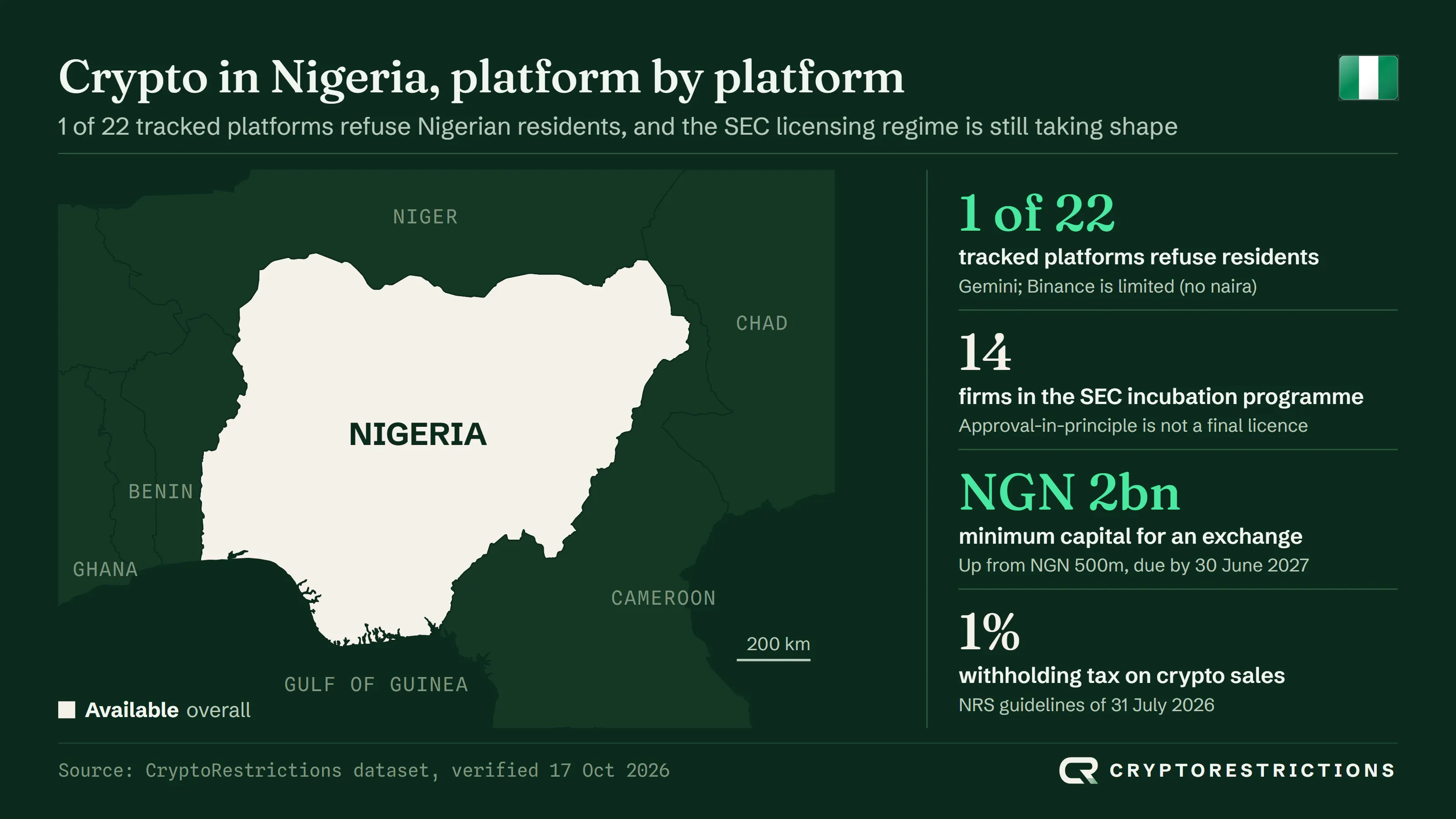
Most of the exchanges we track serve Nigeria, but none shows a final Nigerian licence. SEC Nigeria’s incubation programme admits firms on approval-in-principle, which the SEC says is not a licence.
The SEC’s register page (published 25 May 2025) lists Busha and Quidax as participants in the Accelerated Regulatory Incubation Programme (ARIP) for digital asset exchange, and gives no licence type for either. A circular of 2 July 2026 admitted seven more firms, including Luno Nigeria, and says approval-in-principle “is not a final licence”. Nairametrics counted 14 participants on 15 August 2026. We found no source naming a fully licensed exchange, and no register page that lists one.
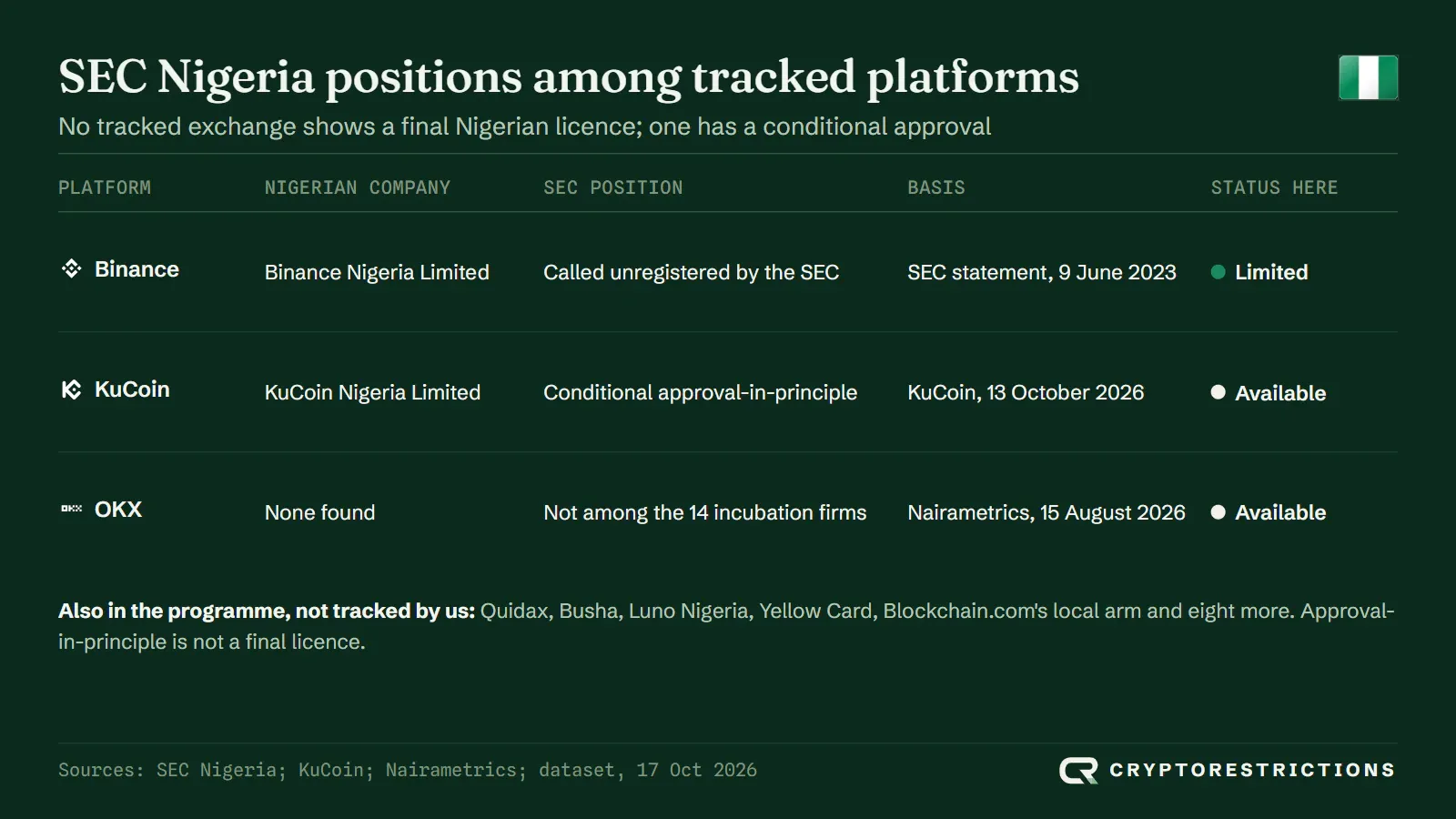
KuCoin says in a post of 13 October 2026 that KuCoin Nigeria Limited received conditional approval-in-principle, that this does not let it onboard clients or offer services to the Nigerian public yet, and that KuCoin’s global products will not be available through it unless the SEC separately clears them. Binance was called unregistered by the SEC in June 2023, and we found no Nigerian licence or incubation entry for it. We found no Nigerian company for OKX.
Best crypto platforms for Nigerian residents
By our access score, eleven exchanges tie at 8.0 out of 10 for Nigerian residents, with Coinbase (6.9) and Binance (6.3) behind because of a product cut and the end of naira trading. Polymarket, Kalshi and every DeFi pick also score 8.0, because no platform has a Nigerian licence on file.
The score rates how fully a Nigerian resident can use each platform, not its fees or safety. It is computed from our data and moves when a row changes: access status (4 points), the share of the platform’s products open here (3), the Nigerian licences we hold on file (2) and what our geo-access test saw from a Nigerian address (1). We hold no licence row for Nigeria, so every platform scores 0 on licences. Platforms that refuse Nigerian residents are not scored. The full method is on our methodology page.
Exchanges

Bitfinex
Best for Spot access under global terms
8.0/10- Access
- 4/4
- Products
- 3/3
- Licences
- 0/2
- Our test
- 1/1
Read our Bitfinex reportPros
- Nigeria is not a prohibited jurisdiction in its terms
Cons
- No Nigerian licence on file

Bitget
Best for Spot and derivatives under global terms
8.0/10- Access
- 4/4
- Products
- 3/3
- Licences
- 0/2
- Our test
- 1/1
Read our Bitget reportPros
- Not on its prohibited-countries list of 16 October 2026
Cons
- No Nigerian licence on file

Bitstamp
Best for Plain spot trading
8.0/10- Access
- 4/4
- Products
- 3/3
- Licences
- 0/2
- Our test
- 1/1
Read our Bitstamp reportPros
- No Bitstamp document excludes Nigeria
Cons
- No Nigerian licence on file

Bybit
Best for Spot and derivatives under global terms
8.0/10- Access
- 4/4
- Products
- 3/3
- Licences
- 0/2
- Our test
- 1/1
Read our Bybit reportPros
- Nigeria is not on its excluded-jurisdictions list
Cons
- No Nigerian licence on file

Crypto.com
Best for Spot trading in the app
8.0/10- Access
- 4/4
- Products
- 3/3
- Licences
- 0/2
- Our test
- 1/1
Read our Crypto.com reportPros
- Nigeria is not on its App geo-restriction list
Cons
- No Nigerian licence on file

Gate
Best for Spot and derivatives under global terms
8.0/10- Access
- 4/4
- Products
- 3/3
- Licences
- 0/2
- Our test
- 1/1
Read our Gate reportPros
- Not named in its restricted locations
Cons
- Its list is non-exhaustive
- No Nigerian licence on file

HTX
Best for Spot and derivatives under global terms
8.0/10- Access
- 4/4
- Products
- 3/3
- Licences
- 0/2
- Our test
- 1/1
Read our HTX reportPros
- Not on the restricted lists in its user agreement
Cons
- No Nigerian licence on file

Kraken
Best for Spot trading outside the Nigerian regime
8.0/10- Access
- 4/4
- Products
- 3/3
- Licences
- 0/2
- Our test
- 1/1
Read our Kraken reportPros
- Nigeria is not on its do-not-serve list
Cons
- Its site was briefly blocked in Nigeria in February 2024

KuCoin
Best for A global exchange with a local entity in progress
8.0/10- Access
- 4/4
- Products
- 3/3
- Licences
- 0/2
- Our test
- 1/1
Read our KuCoin reportPros
- KuCoin Nigeria has SEC conditional approval-in-principle
- Not a restricted location in its terms
Cons
- That approval does not yet let KuCoin Nigeria onboard clients

MEXC
Best for Spot and derivatives under global terms
8.0/10- Access
- 4/4
- Products
- 3/3
- Licences
- 0/2
- Our test
- 1/1
Read our MEXC reportPros
- Not on its prohibited list of 13 October 2026
Cons
- No Nigerian licence on file

OKX
Best for A global exchange that has returned
8.0/10- Access
- 4/4
- Products
- 3/3
- Licences
- 0/2
- Our test
- 1/1
Read our OKX reportPros
- Nigeria is not on its restricted list of 8 July 2026
Cons
- Ended Nigerian service in August 2024
- Access reported restored in July 2026 with no stated legal basis

Coinbase
Best for Spot trading with a US-listed brand
6.9/10- Access
- 4/4
- Products
- 2.4/3
- Licences
- 0/2
- Our test
- 0.5/1
Read our Coinbase reportPros
- Nigeria is a listed sign-up country in its identity verification guide
Cons
- Our test saw stocks and prediction markets marked unavailable

Binance
Best for Trading with crypto you already hold
6.3/10- Access
- 3/4
- Products
- 2.3/3
- Licences
- 0/2
- Our test
- 1/1
Read our Binance reportPros
- Nigeria is not on its prohibited list
Cons
- Naira deposits, withdrawals and pairs ended in March 2024
- The SEC called Binance Nigeria unregistered in June 2023
Prediction markets
Kalshi
Best for US-regulated event contracts
8.0/10- Access
- 4/4
- Products
- 3/3
- Licences
- 0/2
- Our test
- 1/1
Read our Kalshi reportPros
- Nigeria is not on its restricted-jurisdictions list
Cons
- No Nigerian regulator position found

Polymarket
Best for Global event markets from a wallet
8.0/10- Access
- 4/4
- Products
- 3/3
- Licences
- 0/2
- Our test
- 1/1
Read our Polymarket reportPros
- Nigeria is not on its blocked-countries list
Cons
- No Nigerian regulator position found
DeFi
Aster
Best for Perpetuals and spot trading
8.0/10- Access
- 4/4
- Products
- 3/3
- Licences
- 0/2
- Our test
- 1/1
Read our Aster reportPros
- Perpetuals load in the trading app in our test
Cons
- Prediction trading is barred under its prediction rules

Hyperliquid
Best for Perpetuals from your own wallet
8.0/10- Access
- 4/4
- Products
- 3/3
- Licences
- 0/2
- Our test
- 1/1
Read our Hyperliquid reportPros
- Not blocked in our geo-access test
Cons
- No Nigerian licence on file

Jupiter
Best for Solana swaps
8.0/10- Access
- 4/4
- Products
- 3/3
- Licences
- 0/2
- Our test
- 1/1
Read our Jupiter reportPros
- Nigeria is not named in its terms
Cons
- No Nigerian licence on file

Lighter
Best for Perpetuals on its trading app
8.0/10- Access
- 4/4
- Products
- 3/3
- Licences
- 0/2
- Our test
- 1/1
Read our Lighter reportPros
- Not named in its terms
- The trading app loaded in our test
Cons
- No Nigerian licence on file

PancakeSwap
Best for BNB Chain swaps and pools
8.0/10- Access
- 4/4
- Products
- 3/3
- Licences
- 0/2
- Our test
- 1/1
Read our PancakeSwap reportPros
- Its terms bar only people and places under US sanctions
Cons
- No Nigerian licence on file

Uniswap
Best for Swapping tokens from your own wallet
8.0/10- Access
- 4/4
- Products
- 3/3
- Licences
- 0/2
- Our test
- 1/1
Read our Uniswap reportPros
- Its terms bar only places under comprehensive US sanctions
Cons
- No Nigerian licence on file
Which platforms block Nigerian users?
Gemini is the only tracked platform that refuses Nigerian residents outright, because Nigeria is not on its list of supported countries. Binance is limited, and Coinbase withholds one product.
Gemini’s areas of availability list only Egypt, Ghana and South Africa in Africa, so Nigerian residents cannot open an account. Binance ended all naira services in March 2024: naira deposits stopped on 5 March, withdrawals on 8 March, and remaining balances were converted to USDT. It still lists no restriction on Nigeria itself.
State action has been indirect. In February 2024 Nigerian users briefly lost access to Binance, Kraken and Coinbase, and the sites came back. We found no standing order that blocks a tracked platform today.
What our geo-access test saw from Nigeria
From a Nigerian address on 14 and 16 October 2026 we loaded 21 of the 22 platforms we track: 20 with no barrier, and Coinbase with a notice about stocks and prediction markets. We did not test Gemini.
An open page is not permission, and most platforms enforce at identity verification, so a loading home page does not mean an account will pass checks. OKX loaded cleanly even though it left the country in 2024, and Binance loaded even though its naira services have ended. Swipe through the screenshots below; each card says what the page showed.
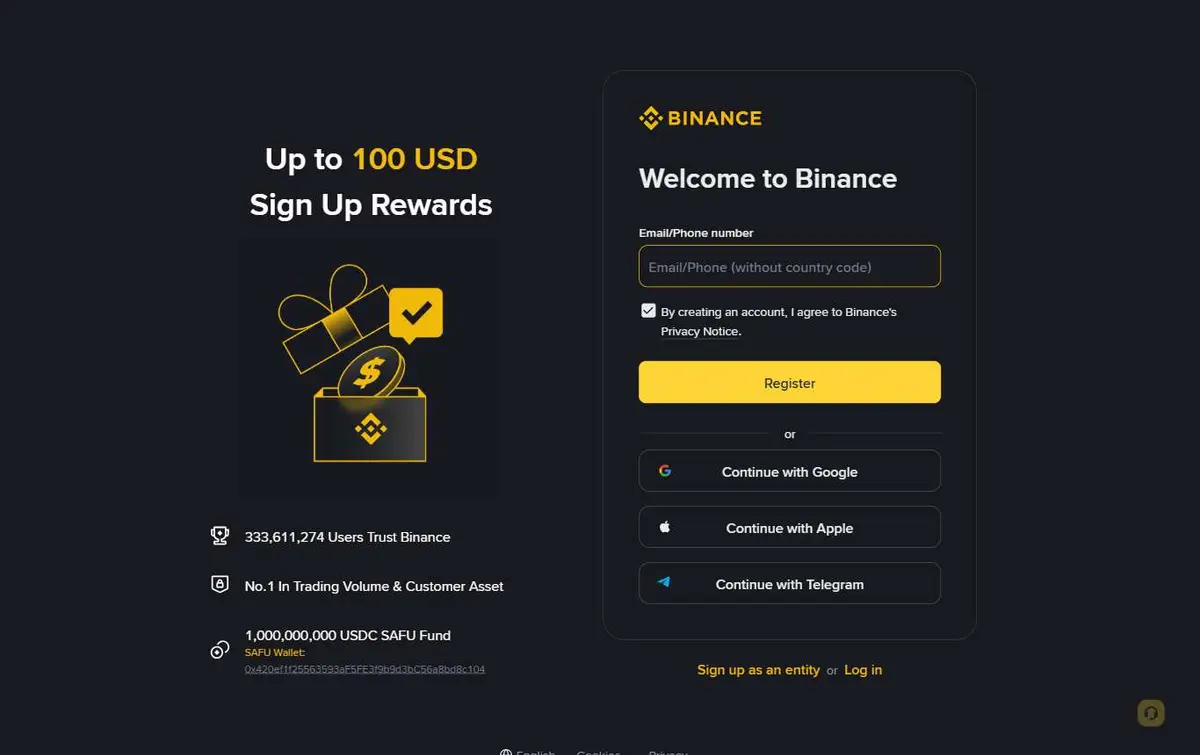
No barrier Binance · Sign-up page
Nigeria: the sign-up form opens, although naira trading ended in March 2024
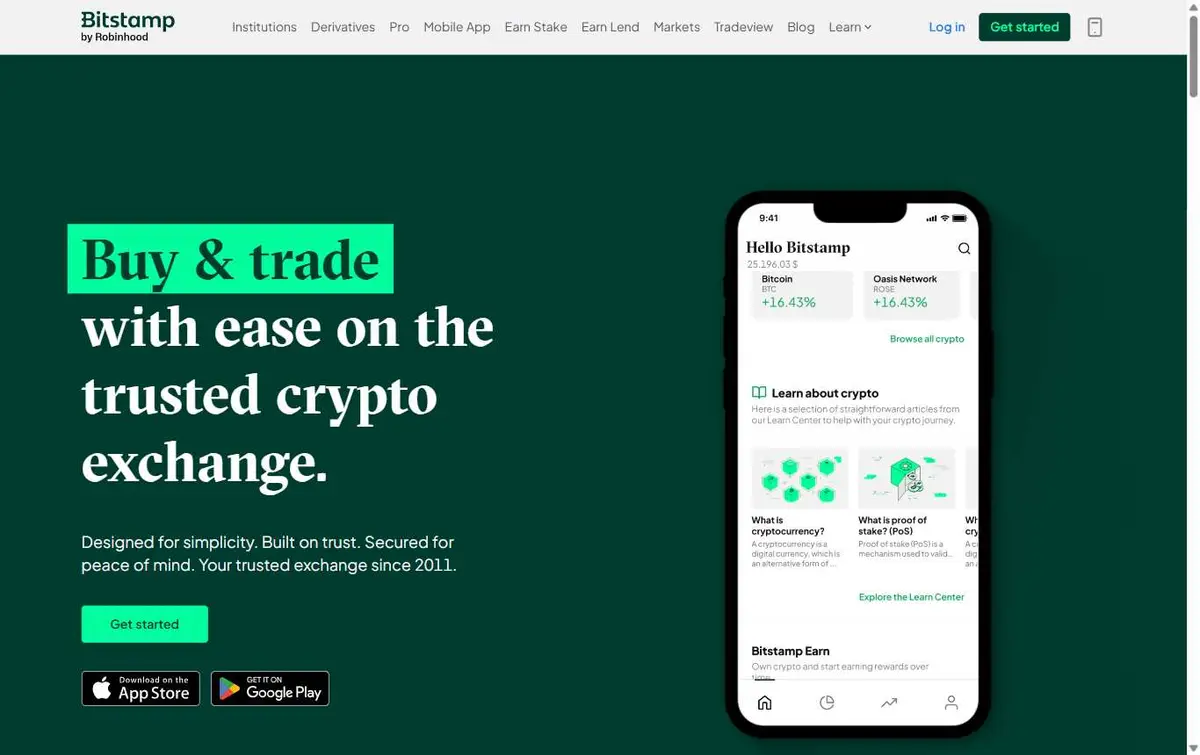
No barrier Bitstamp · Home page
Nigeria, one of the countries no Bitstamp document excludes
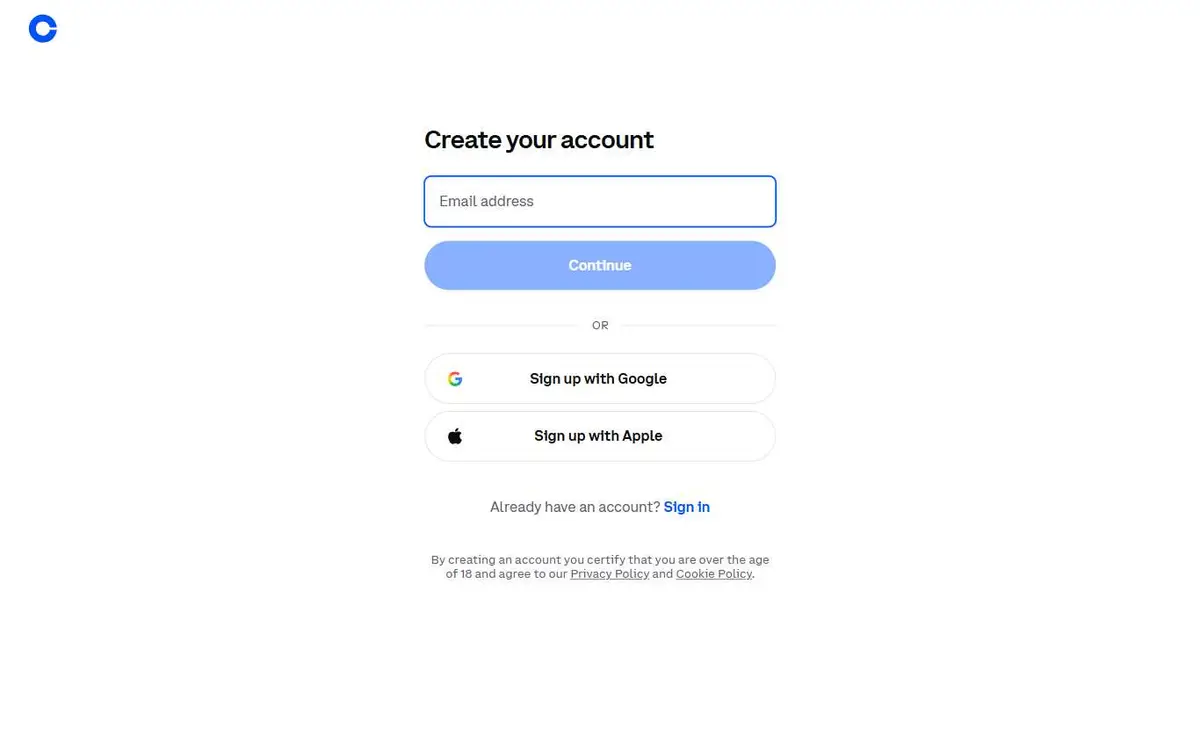
No barrier Coinbase · Sign-up page
Nigeria: the sign-up form opens as it does everywhere we tested
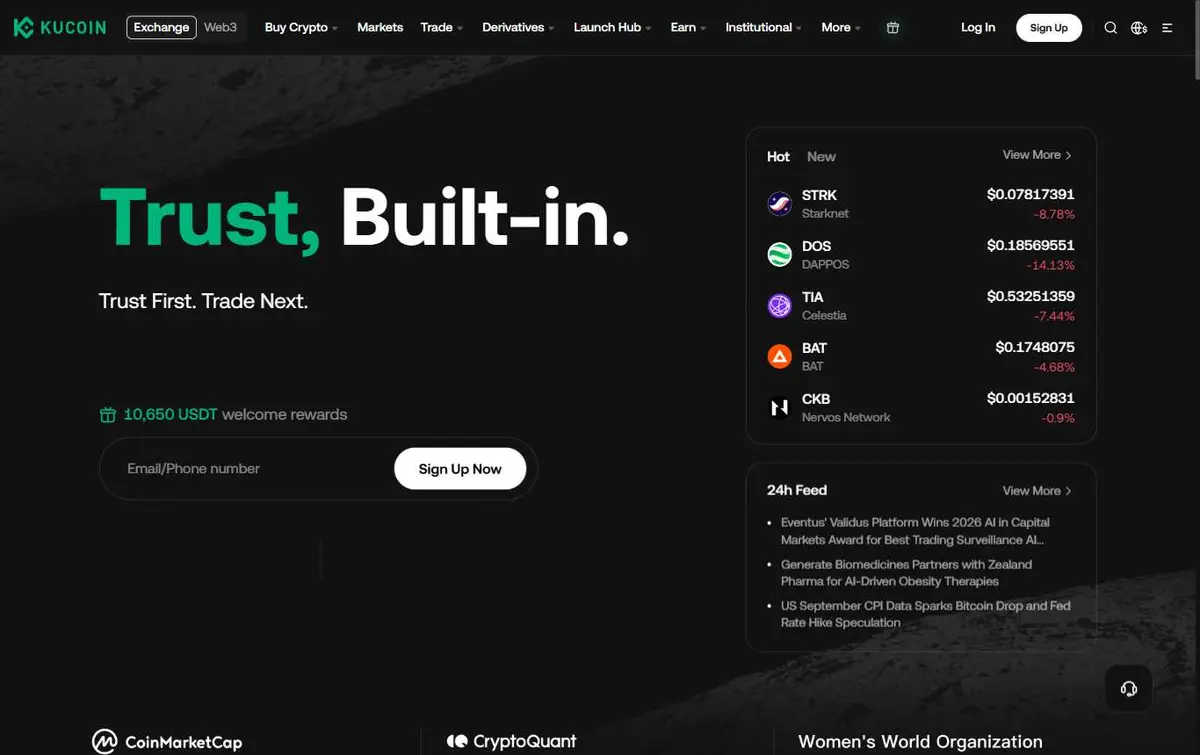
No barrier KuCoin · Home page
Nigeria: KuCoin loads, though its Nigerian entity may not yet onboard clients
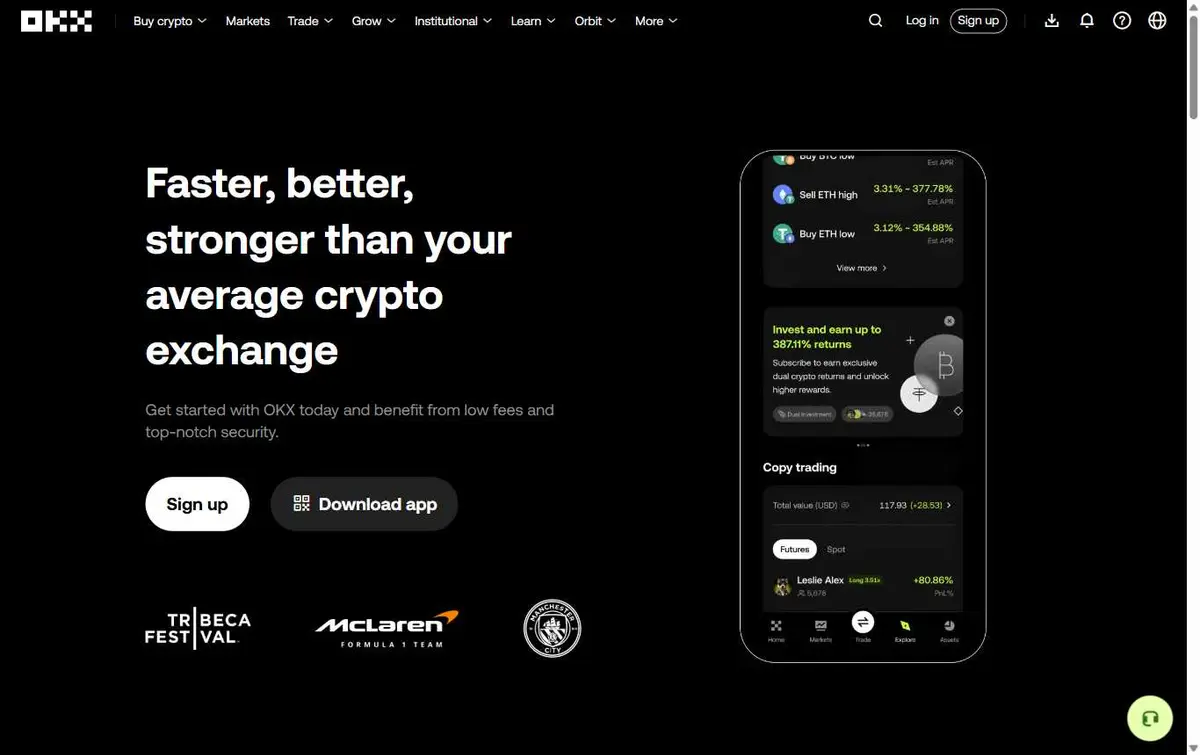
No barrier OKX · Home page
Nigeria: the OKX home page loads with no notice
 CRYPTORESTRICTIONS
Who regulates crypto in Nigeria?
The SEC licenses and supervises digital asset businesses, the CBN governs how banks deal with them, the Nigeria Revenue Service taxes them, and the courts and the anti-corruption agency handle enforcement.
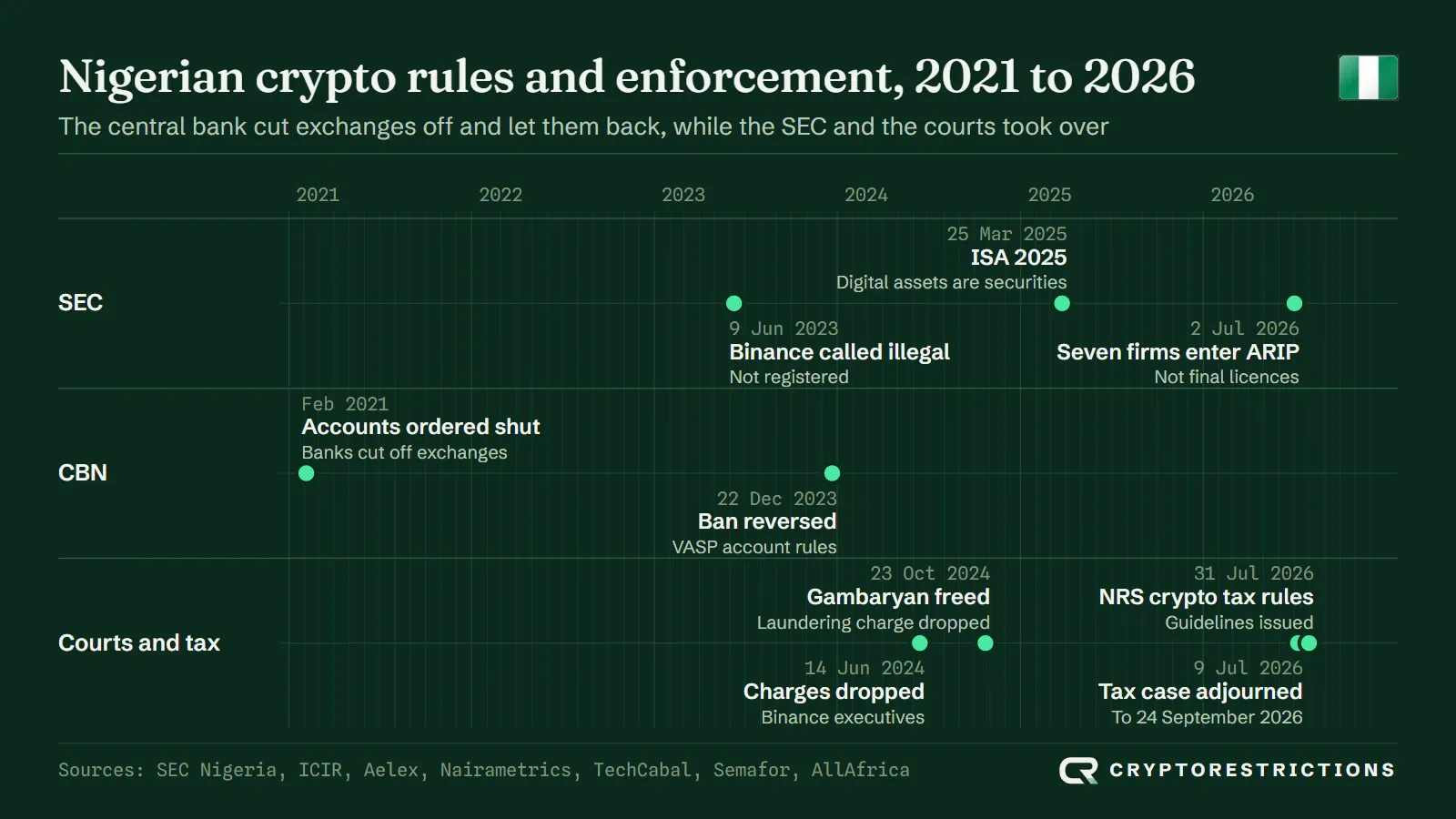
- SEC Nigeria. Registers digital asset exchanges and service providers under the 2025 Act. Its register page lists Busha and Quidax in ARIP, and it admitted seven more firms on 2 July 2026. It raised minimum capital on 16 January 2026 (see the products section). In the CBEX collapse of April 2025 TechCabal reports the SEC called the scheme unregistered and the anti-corruption agency, the EFCC, pursued its operators.
- Central Bank of Nigeria. Sets the rules for bank accounts of licensed providers and keeps banks out of holding crypto.
- Nigeria Revenue Service (NRS). The successor to the Federal Inland Revenue Service. It issued its virtual asset tax guidelines on 31 July 2026 (see the tax section).
- Courts. The Binance case runs in the Federal High Court in Abuja. The tax-evasion charges against two Binance executives were dropped on 14 June 2024 and refiled against Binance alone; the laundering charge against Tigran Gambaryan was dropped on 23 October 2024. DL News reported a civil demand of about $81 billion. On 9 July 2026 the court adjourned the tax case to 24 September 2026 for a settlement report or continuation. We found no report of that hearing, so the outcome is unknown, and the allegations are the state’s, not a finding.
Which crypto products are limited in Nigeria?
The bank side is the tight one: banks may serve licensed crypto firms but may not hold or trade crypto. On the platform side, Binance’s naira trading is gone and exchanges face a higher capital floor.
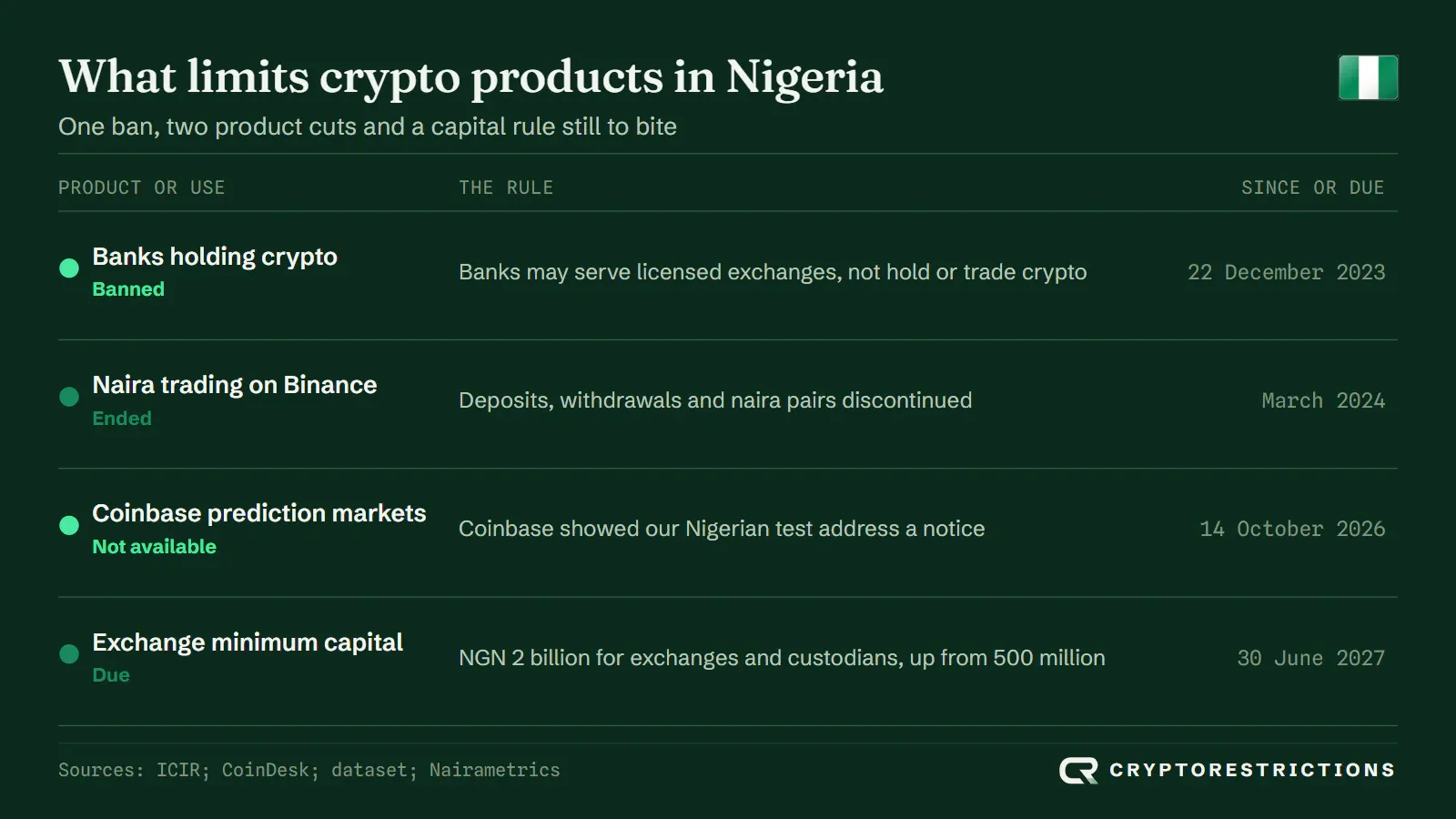
- Banks. The 22 December 2023 circular bars banks from holding or trading crypto on their own account, while letting them open designated accounts for SEC-licensed providers.
- Naira trading. Binance ended its naira services in March 2024 (see the blocked platforms section). We hold no equivalent source for other platforms’ naira peer-to-peer markets.
- Capital. Nairametrics reports that the SEC’s circular of 16 January 2026 raised the minimum capital for exchanges and custodians to 2 billion naira from 500 million, with compliance due by 30 June 2027. We did not locate the circular itself.
- Incubation firms. KuCoin Nigeria and the other approval-in-principle firms may not yet onboard clients or hold client assets until their conditions are met, per the SEC circular and KuCoin’s own post.
Are prediction markets legal in Nigeria?
The law is unsettled. The National Lottery Act of 2005 counts sporting-event outcomes as a lottery, and we found no ruling by a Nigerian regulator on Polymarket or Kalshi, both of which are open to Nigerians.
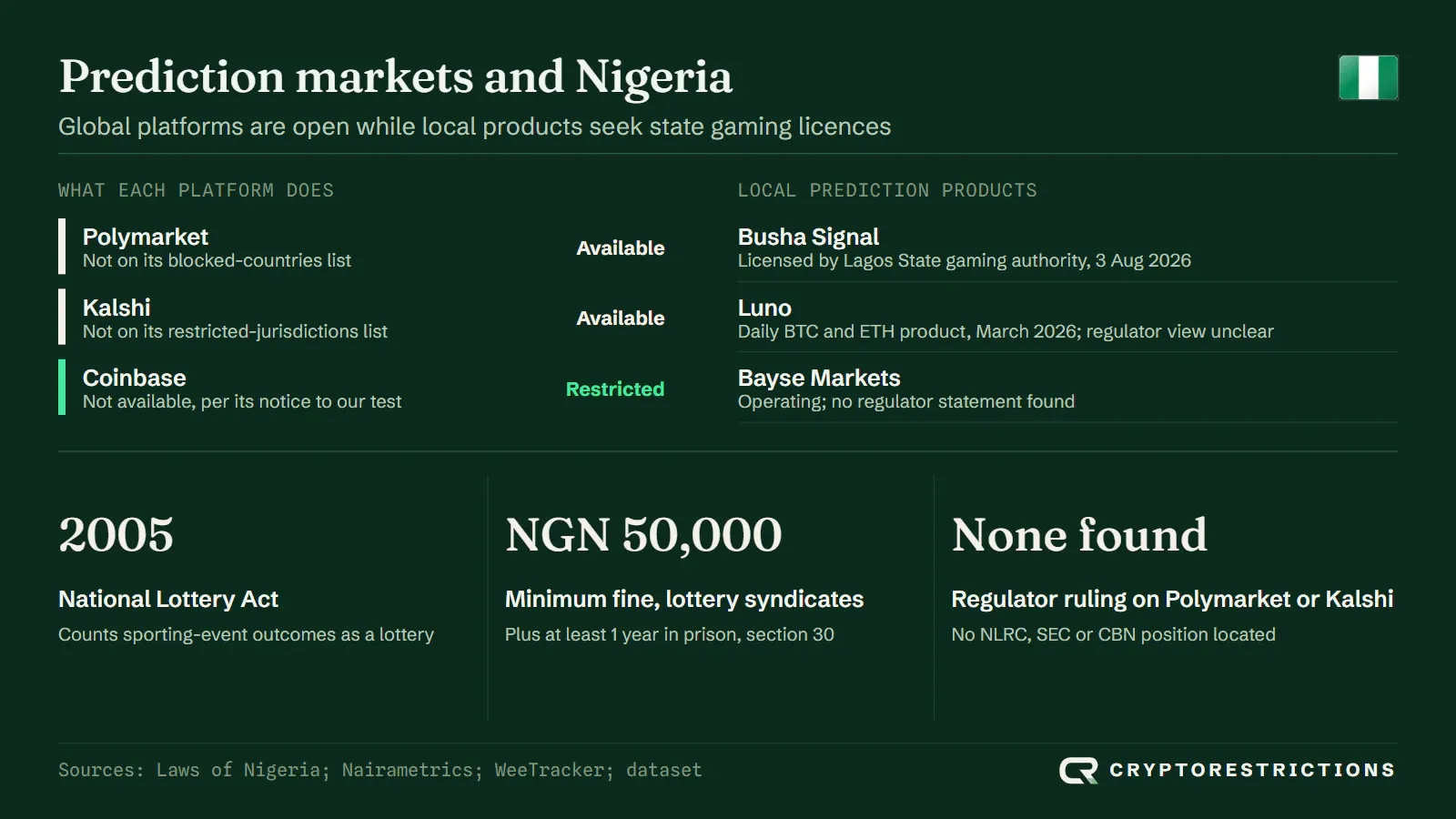
The National Lottery Act (in force 30 March 2005) defines a lottery as any game or scheme that distributes prizes by chance or a mix of skill and chance, including schemes based on the outcome of sporting events. It creates the National Lottery Regulatory Commission, makes unlicensed national or interstate lotteries unlawful, and sets a minimum fine of 50,000 naira and at least one year in prison for syndicates. The text does not name prediction markets, and we do not know how the Commission would apply it to one.
Local products have gone to the state level. Busha launched Signal on 3 August 2026, which Nairametrics describes as licensed by the Lagos State Lottery and Gaming Authority; the report gives no licence number or scope. Luno launched a daily Bitcoin and Ether up-or-down product in March 2026, and WeeTracker says it is unclear how regulators will treat it. Polymarket and Kalshi list no Nigerian restriction, and Coinbase showed our test address that prediction markets are not available.
How is crypto taxed in Nigeria?
Individuals pay income tax on crypto gains at progressive rates and companies pay 30%. Since the Nigeria Revenue Service guidelines of 31 July 2026, platforms must withhold tax on sales and yield and collect VAT on their fees.
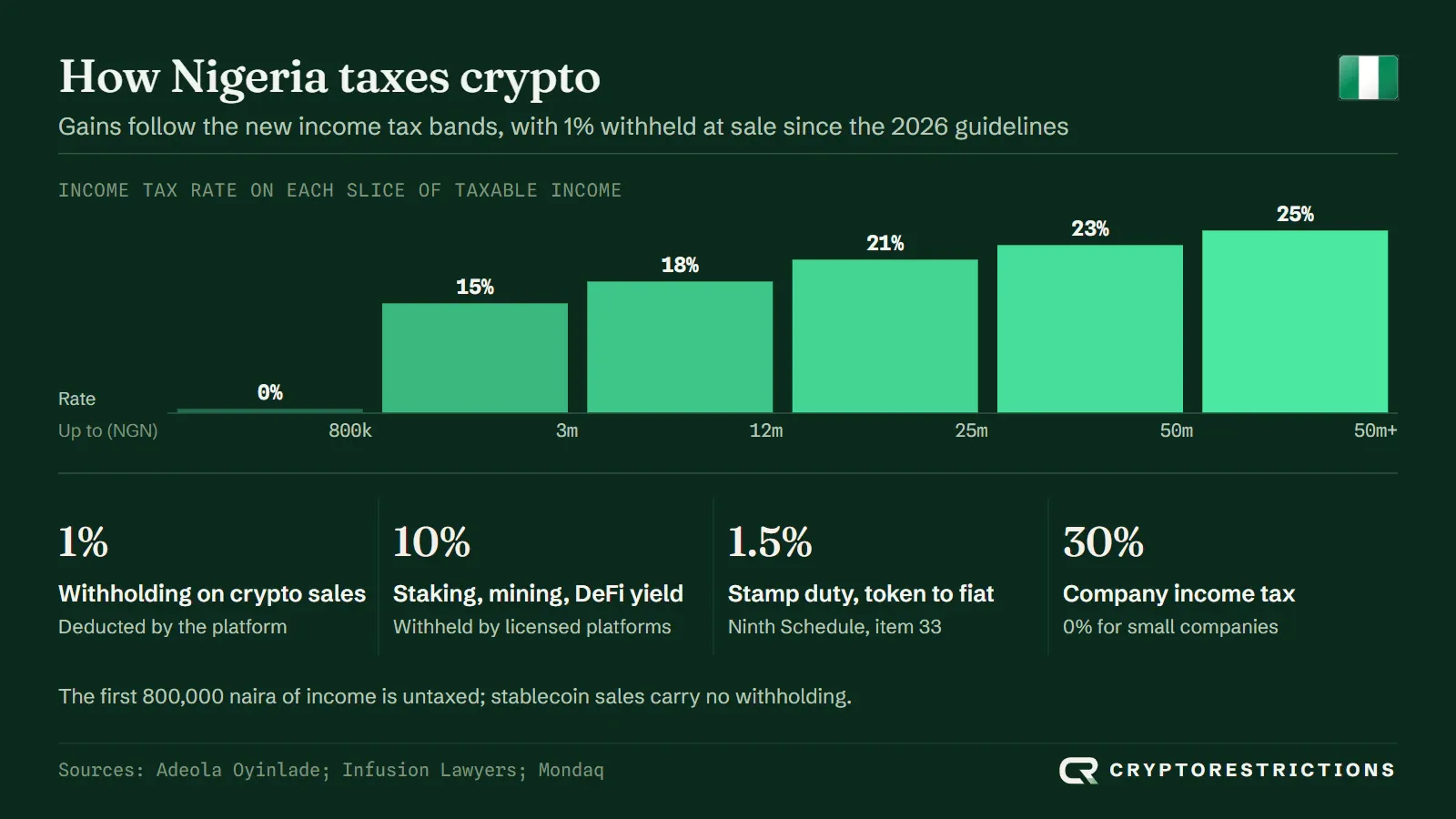
The Nigeria Tax Act 2025 was signed on 26 June 2025 and took effect on 1 January 2026. Its personal income tax bands run from 0% on the first 800,000 naira to 25% above 50 million naira, as the chart shows. The NRS issued its Guidelines on the Taxation of Virtual Assets (Information Circular 2026/21) on 31 July 2026 and made them public on 3 August. We could not read them on the NRS site, which served a bot check, so the figures below come from two law-firm summaries, Infusion Lawyers and Mondaq, which do not state an effective date.
- Withholding on sales. 1% of gross proceeds from selling crypto, security tokens and NFTs, deducted by the platform or escrow operator. Stablecoin sales carry no withholding.
- Passive income. 10% on staking, mining and DeFi yield, deducted by the distributor where it is a licensed platform. Where nothing is deducted, for example a non-resident payer, you declare it yourself.
- Stamp duty and VAT. Infusion Lawyers reports 1.5% stamp duty on token-to-fiat and fiat-to-token transfers, borne by the receiving party. VAT applies to platform fees, not to the transfer of ownership.
- Tax ID. People active in virtual assets must register for tax, and platforms must require a valid Tax ID before activating an account.
- Companies. 30% company income tax, and 0% for small companies under section 56 of the Act, per Infusion Lawyers.
The sequence below follows what those summaries state:

 Egypt
 Ghana
 South Africa
 Morocco
 Kenya
 South Sudan
 Mauritius
 Senegal
 Tunisia
 Angola
 Benin