Is crypto legal in Morocco?
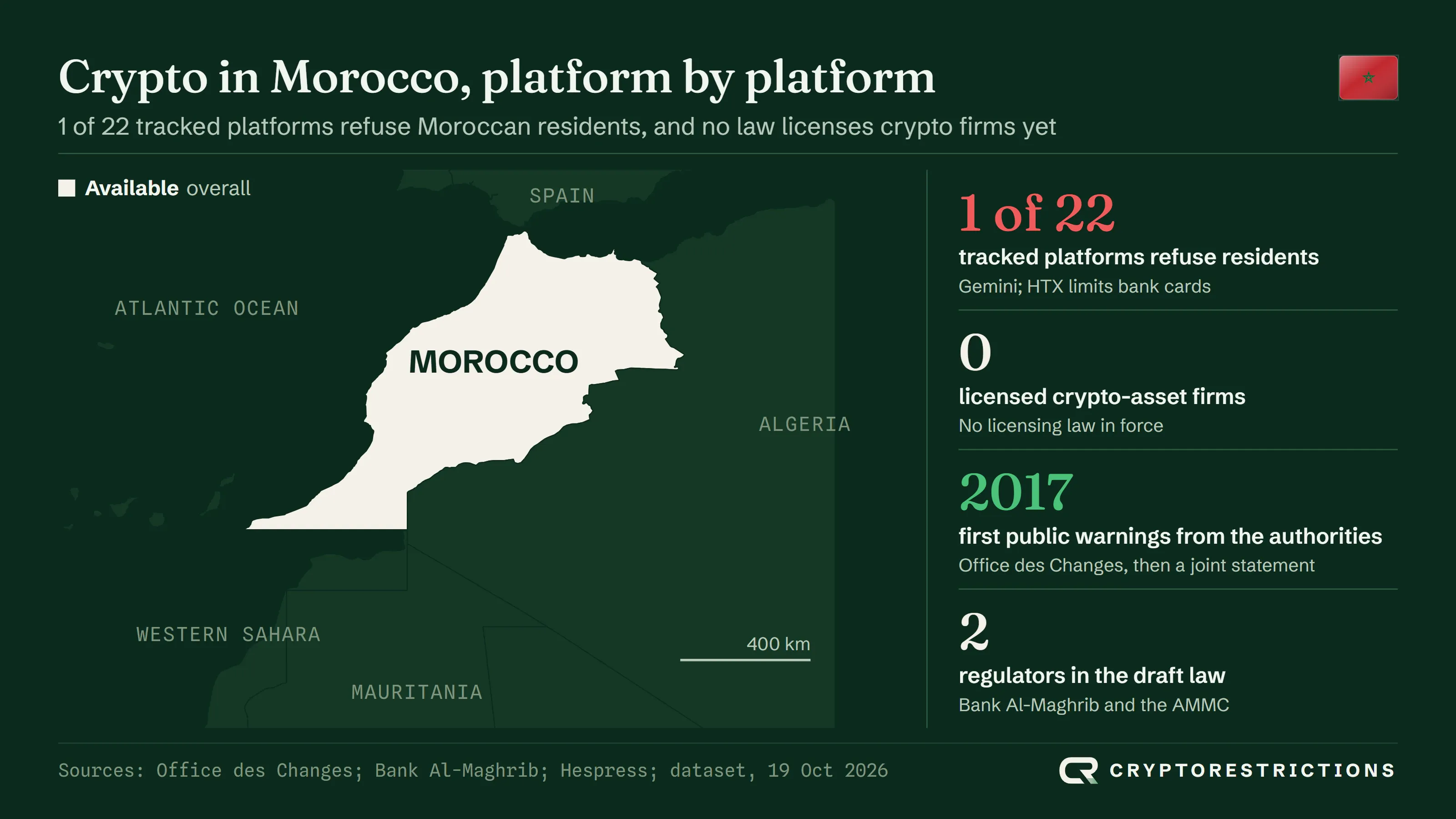
Not in any authorised sense. Morocco’s financial authorities have said since 2017 that virtual currencies are not authorised, and the Office des Changes treats transactions in them as a breach of the exchange rules. We found no provision in the texts we read that names holding crypto as an offence.
The Office des Changes, which enforces Morocco’s foreign exchange rules, said that transactions made through virtual currencies are an infraction of the exchange regulations and can bring the penalties and fines set out in current law. It told those concerned that cross-border financial transactions must go through approved intermediaries, and that it was watching the matter with Bank Al-Maghrib and the banks’ professional group. The page carries no date; Finances News Hebdo places the warning on 20 November 2017, the day before a joint statement.
That statement came from the Ministry of Economy and Finance, Bank Al-Maghrib and the capital markets authority (AMMC). It warned the public against using Bitcoin or other virtual currencies as a means of payment and named four risks: no consumer protection if a platform fails, sharp price swings, use for money laundering or terrorist financing, and possible breaches of capital market and exchange rules. Bank Al-Maghrib still carries the warning on its public information page. The text of the joint release is on the AMMC site.
The same three authorities, this time Bank Al-Maghrib, the AMMC and the Office des Changes, issued a new warning because people and firms kept using crypto. It calls virtual currencies an unregulated, highly volatile payment system and says they remain unauthorised in Morocco and could be used for money laundering or to finance crime. The page shows no date; Finances News Hebdo published it on 6 April 2022.
The ban has not stopped use. Morocco World News cites private-sector estimates of about six million Moroccan crypto holders, roughly 16% of the population, and stresses that this is not an official count. The sections below cover the draft law, who refuses Moroccans, the products that are cut, betting law and tax.
Which crypto exchanges work in Morocco?
None holds a Moroccan licence, because Morocco has no law that licenses crypto firms. The exchanges we track serve Moroccans under their own global terms, and a draft law would create the first licensing regime.
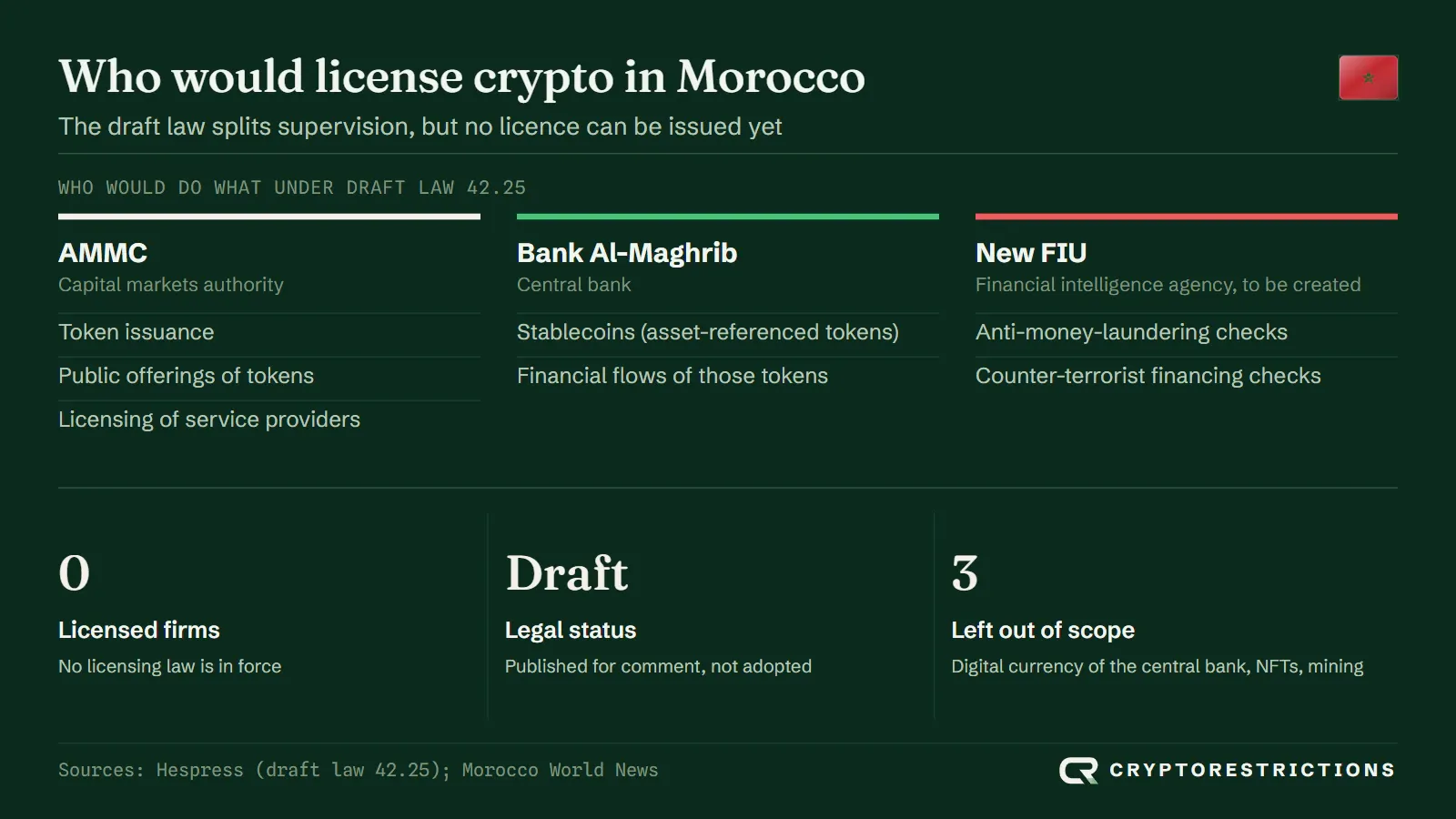
The draft, numbered 42.25, was prepared by the Ministry of Economy and Finance with Bank Al-Maghrib and the AMMC. Hespress reports from the ministry’s explanatory note that digital asset exchanges could run only through licensed providers, who must verify clients, keep transaction records for at least ten years and report suspicious transactions. It separates utility tokens from asset-referenced tokens (stablecoins), and says crypto-assets are not legal tender. We could not open the text on the government secretariat’s portal, so these details come from press reports of it.
On status, Morocco World News reported on 22 July 2026 that Bank Al-Maghrib, presenting its supervision report, said it was still working on finalising the law, with no date for parliament. We found no vote, no promulgation and no Official Bulletin entry. Until one exists, no firm can be licensed, and the platforms below are open to Moroccans only as unlicensed foreign services.
Best crypto platforms for Moroccan residents
By our access score, eight exchanges tie at 8.0 out of 10 for Moroccan residents, the ones our geo-access test loaded from Morocco. Coinbase, Kraken, Crypto.com and Bitstamp score 7.5 because we have not tested them from Morocco, and HTX scores 6.3 because of its card limit.
The score rates how fully a Moroccan resident can use each platform, not its fees or safety. It is computed from our data and moves when a row changes: access status (4 points), the share of the platform’s products open here (3), the Moroccan licences we hold on file (2) and what our geo-access test saw from a Moroccan address (1). We hold no licence row for Morocco, so every platform scores 0 on licences. Platforms that refuse Moroccan residents are not scored. The full method is on our methodology page.
Exchanges

Binance
Best for Spot trading under global terms
8.0/10- Access
- 4/4
- Products
- 3/3
- Licences
- 0/2
- Our test
- 1/1
Read our Binance reportPros
- Morocco is not on its prohibited-countries list
- Its sign-up page loaded in our test
Cons
- No Moroccan licence on file

Bitfinex
Best for Spot access under global terms
8.0/10- Access
- 4/4
- Products
- 3/3
- Licences
- 0/2
- Our test
- 1/1
Read our Bitfinex reportPros
- Morocco is not a prohibited jurisdiction in its terms
Cons
- No Moroccan licence on file

Bitget
Best for Spot and derivatives under global terms
8.0/10- Access
- 4/4
- Products
- 3/3
- Licences
- 0/2
- Our test
- 1/1
Read our Bitget reportPros
- Not on its prohibited-countries list of 16 October 2026
Cons
- No Moroccan licence on file

Bybit
Best for Spot and derivatives under global terms
8.0/10- Access
- 4/4
- Products
- 3/3
- Licences
- 0/2
- Our test
- 1/1
Read our Bybit reportPros
- Morocco is not on its excluded-jurisdictions list
- Its sign-up page names Morocco as a location
Cons
- No Moroccan licence on file

Gate
Best for Spot and derivatives under global terms
8.0/10- Access
- 4/4
- Products
- 3/3
- Licences
- 0/2
- Our test
- 1/1
Read our Gate reportPros
- Not named in its restricted locations
Cons
- Its list is non-exhaustive
- No Moroccan licence on file

KuCoin
Best for A global exchange with many listings
8.0/10- Access
- 4/4
- Products
- 3/3
- Licences
- 0/2
- Our test
- 1/1
Read our KuCoin reportPros
- Not a restricted location in its terms
Cons
- No Moroccan licence on file

MEXC
Best for Spot and derivatives under global terms
8.0/10- Access
- 4/4
- Products
- 3/3
- Licences
- 0/2
- Our test
- 1/1
Read our MEXC reportPros
- Not on its prohibited list of 13 October 2026
Cons
- No Moroccan licence on file

OKX
Best for A global exchange with broad products
8.0/10- Access
- 4/4
- Products
- 3/3
- Licences
- 0/2
- Our test
- 1/1
Read our OKX reportPros
- Morocco is not on its restricted list of 8 July 2026
Cons
- No Moroccan licence on file

Bitstamp
Best for Plain spot trading
7.5/10- Access
- 4/4
- Products
- 3/3
- Licences
- 0/2
- Our test
- 0.5/1
Read our Bitstamp reportPros
- No Bitstamp document excludes Morocco
Cons
- We have no geo-test result from Morocco
- No Moroccan licence on file

Coinbase
Best for Spot trading with a US-listed brand
7.5/10- Access
- 4/4
- Products
- 3/3
- Licences
- 0/2
- Our test
- 0.5/1
Read our Coinbase reportPros
- Morocco is a listed sign-up country in its identity verification guide
Cons
- We have no geo-test result from Morocco
- No Moroccan licence on file

Crypto.com
Best for Spot trading in the app
7.5/10- Access
- 4/4
- Products
- 3/3
- Licences
- 0/2
- Our test
- 0.5/1
Read our Crypto.com reportPros
- Morocco is not on its App geo-restriction list
Cons
- We have no geo-test result from Morocco
- No Moroccan licence on file

Kraken
Best for Spot trading under global terms
7.5/10- Access
- 4/4
- Products
- 3/3
- Licences
- 0/2
- Our test
- 0.5/1
Read our Kraken reportPros
- Morocco is not on its do-not-serve list
Cons
- We have no geo-test result from Morocco
- No Moroccan licence on file

HTX
Best for Spot and derivatives under global terms
6.3/10- Access
- 3/4
- Products
- 2.3/3
- Licences
- 0/2
- Our test
- 1/1
Read our HTX reportPros
- Trading is not restricted for Moroccan residents
Cons
- Bank cards issued in Morocco are not supported on its OTC page
Prediction markets

Kalshi
Best for US-regulated event contracts
7.5/10- Access
- 4/4
- Products
- 3/3
- Licences
- 0/2
- Our test
- 0.5/1
Read our Kalshi reportPros
- Morocco is not on its restricted-jurisdictions list
Cons
- No Moroccan regulator position found
- We have no geo-test result from Morocco

Polymarket
Best for Global event markets from a wallet
7.5/10- Access
- 4/4
- Products
- 3/3
- Licences
- 0/2
- Our test
- 0.5/1
Read our Polymarket reportPros
- Morocco is not on its blocked-countries list
Cons
- No Moroccan regulator position found
- We have no geo-test result from Morocco
DeFi

Aster
Best for Perpetuals and spot trading
8.0/10- Access
- 4/4
- Products
- 3/3
- Licences
- 0/2
- Our test
- 1/1
Read our Aster reportPros
- Perpetuals load in the trading app in our test
Cons
- No Moroccan licence on file

Hyperliquid
Best for Perpetuals from your own wallet
8.0/10- Access
- 4/4
- Products
- 3/3
- Licences
- 0/2
- Our test
- 1/1
Read our Hyperliquid reportPros
- Not blocked in our geo-access test
Cons
- No Moroccan licence on file

Lighter
Best for Perpetuals on its trading app
8.0/10- Access
- 4/4
- Products
- 3/3
- Licences
- 0/2
- Our test
- 1/1
Read our Lighter reportPros
- Not named in its terms
- The trading app loaded in our test
Cons
- No Moroccan licence on file

Jupiter
Best for Solana swaps
7.5/10- Access
- 4/4
- Products
- 3/3
- Licences
- 0/2
- Our test
- 0.5/1
Read our Jupiter reportPros
- Morocco is not named in its terms
Cons
- We have no geo-test result from Morocco

PancakeSwap
Best for BNB Chain swaps and pools
7.5/10- Access
- 4/4
- Products
- 3/3
- Licences
- 0/2
- Our test
- 0.5/1
Read our PancakeSwap reportPros
- Its terms bar only people and places under US sanctions
Cons
- We have no geo-test result from Morocco

Uniswap
Best for Swapping tokens from your own wallet
7.5/10- Access
- 4/4
- Products
- 3/3
- Licences
- 0/2
- Our test
- 0.5/1
Read our Uniswap reportPros
- Its terms bar only places under comprehensive US sanctions
Cons
- We have no geo-test result from Morocco
Which platforms block Moroccan users?
Gemini is the only tracked platform that refuses Moroccan residents outright, because Morocco is not on its list of supported countries. HTX limits one fiat product, and no Moroccan order blocks any platform we track.
Gemini serves only the countries on its areas-of-availability page, which lists just Egypt, Ghana and South Africa in Africa, and Morocco is on neither of its lists of supported countries. HTX still lets Moroccans trade; the limit is on its OTC page, covered in the products section.

We found no order by a Moroccan authority that blocks a tracked platform. The one blocking order we found is aimed at betting sites, and Médias24 reported it later suspended and annulled (see the prediction markets section).
What our geo-access test saw from Morocco
From a Moroccan virtual location on 14 and 16 October 2026 we loaded 12 of the 22 platforms we track, all with no barrier. We have not tested the other ten from Morocco.
The test uses a virtual location: an address registered to Morocco but served from another country, here Romania and the United Kingdom. It sees a platform’s own geo-blocking but not a block by a Moroccan internet provider. An open page is also not permission, since most platforms enforce at identity verification. The ten we did not test are Coinbase, Crypto.com, Gemini, Kraken, Bitstamp, Polymarket, Kalshi, Jupiter, PancakeSwap and Uniswap; their rows rest on the platform documents alone. Swipe through the screenshots below; each card says what the page showed.
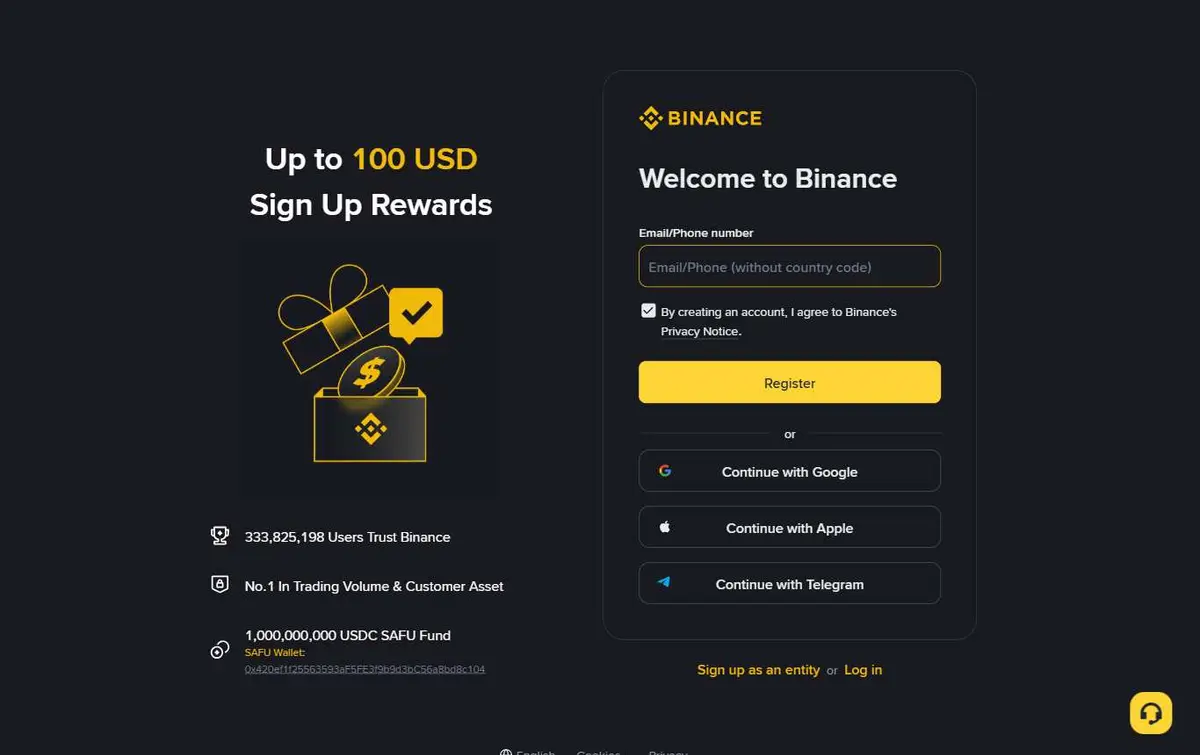
No barrier Binance · Sign-up page
Morocco: the Binance sign-up page loads with no barrier
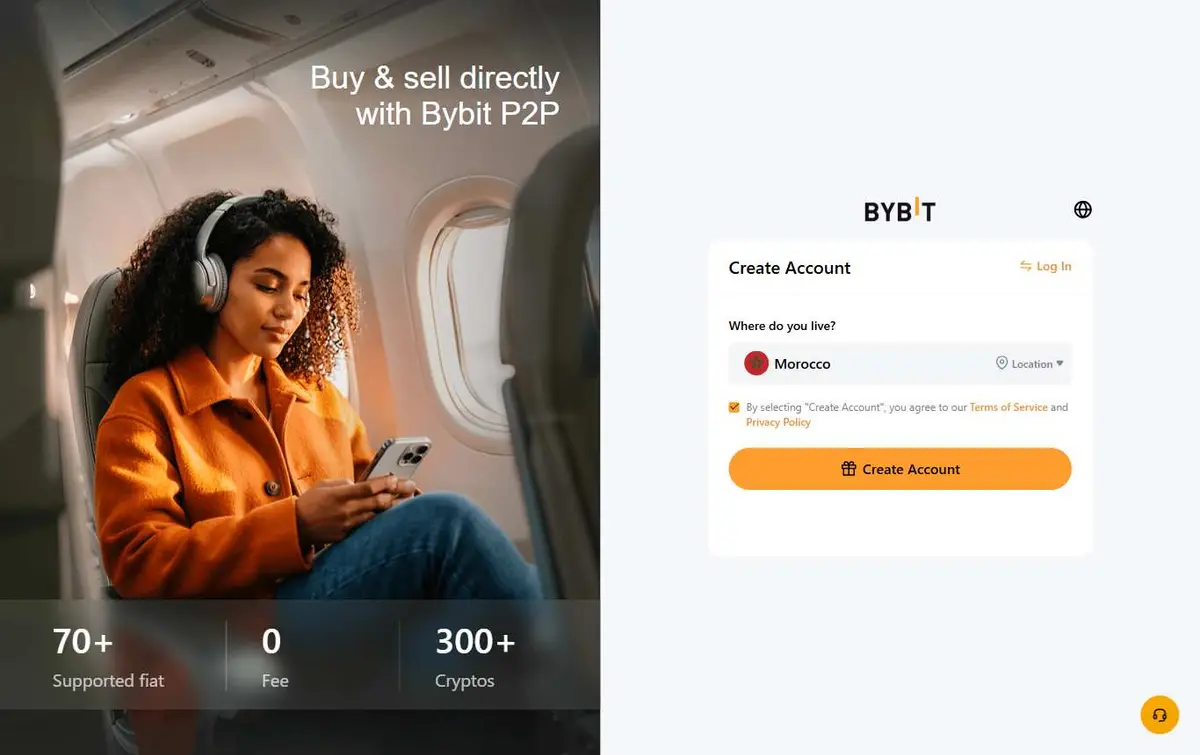
No barrier Bybit · Sign-up page
Morocco: the Bybit sign-up page lists Morocco as the location
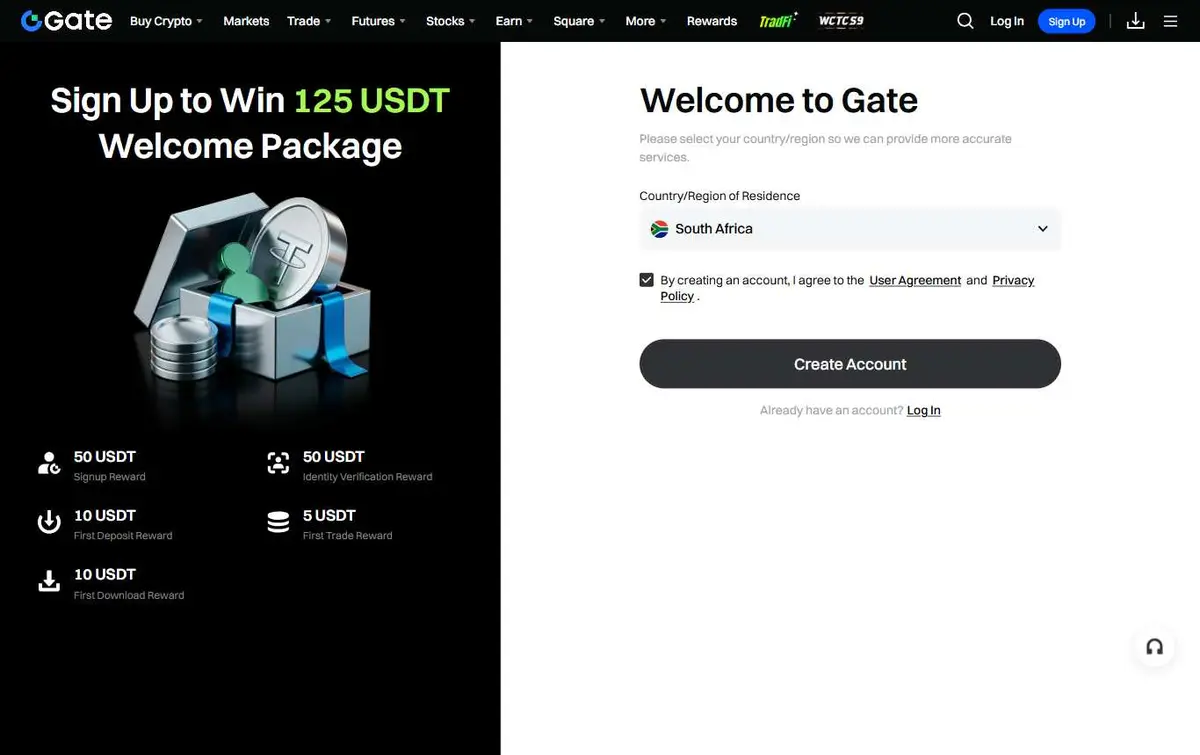
No barrier Gate · Sign-up page
Morocco: the Gate sign-up page loads with no barrier
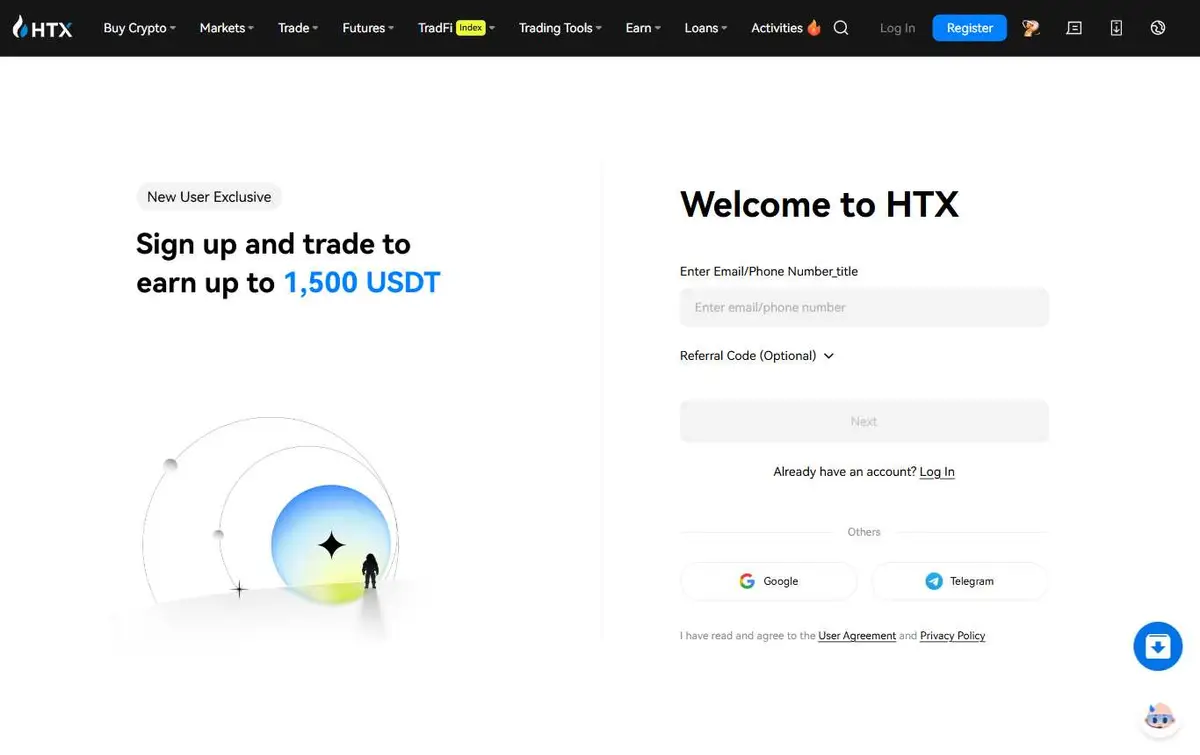
No barrier HTX · Sign-up page
Morocco: the HTX sign-up page loads with no barrier
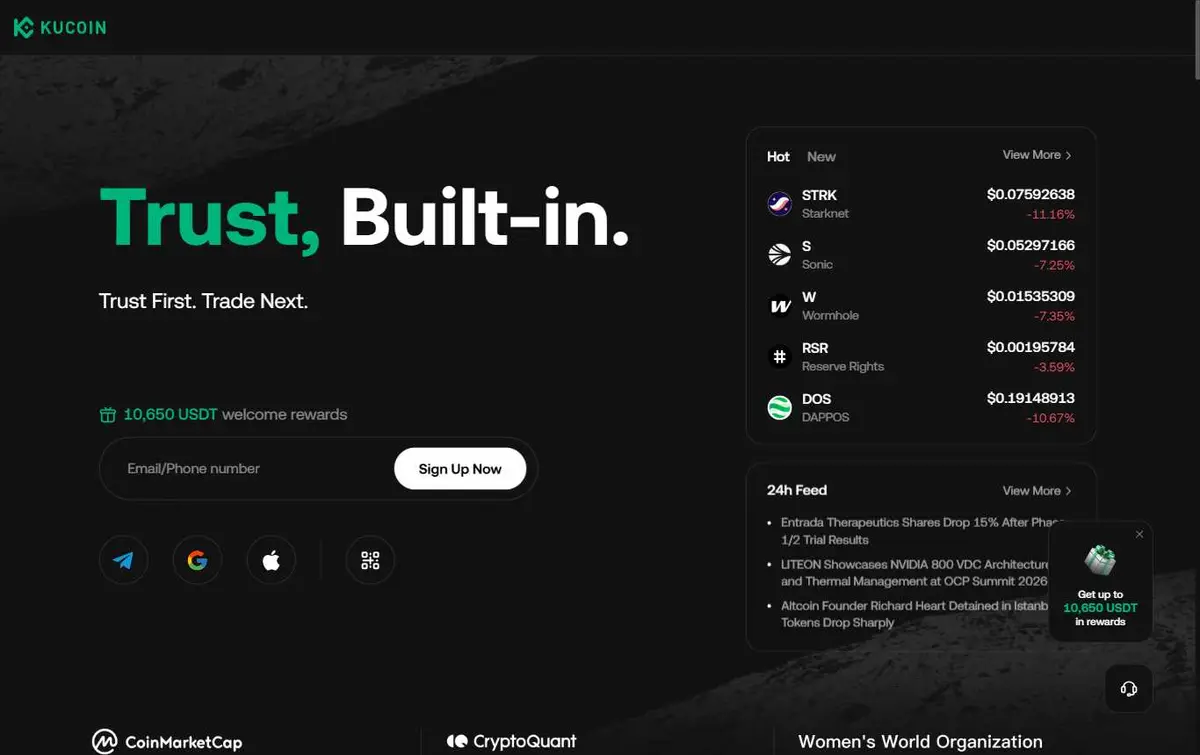
No barrier KuCoin · Home page
Morocco: the KuCoin home page loads with no notice
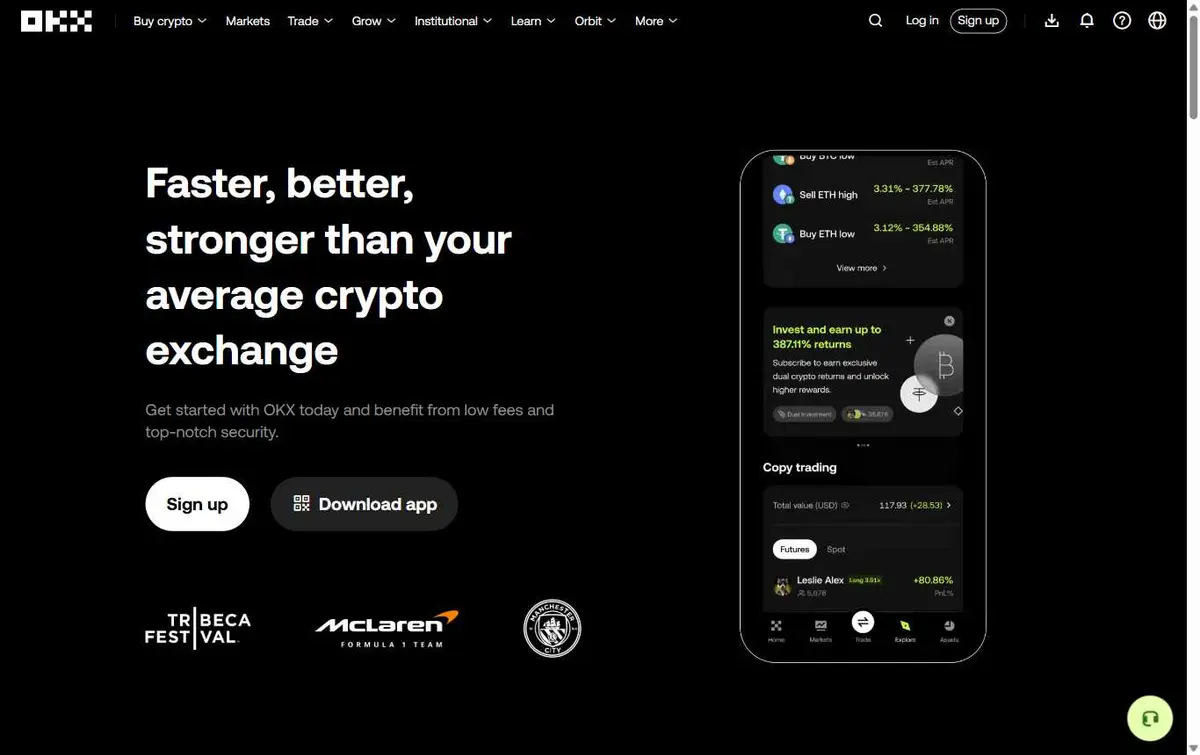
No barrier OKX · Home page
Morocco: the OKX home page loads with no notice
 CRYPTORESTRICTIONS
Who regulates crypto in Morocco?
No regulator licenses crypto today. Bank Al-Maghrib, the AMMC and the Office des Changes warn against it, and under the draft law the AMMC and Bank Al-Maghrib would share supervision.
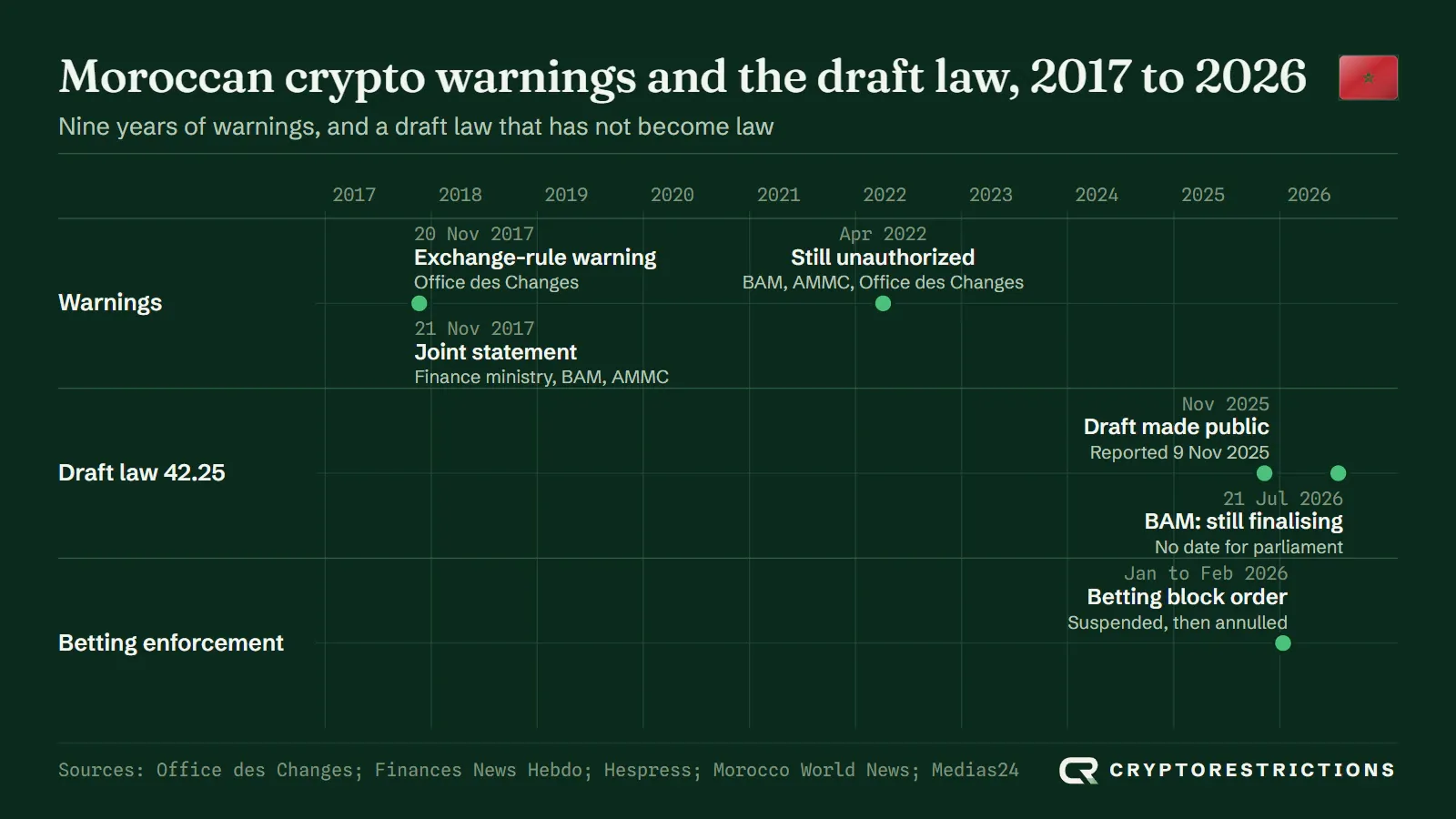
- Bank Al-Maghrib. The central bank. It publishes the public warning on virtual currencies and, under the draft, would supervise stablecoins. In July 2026 it said it was still working to finalise the law.
- AMMC. The capital markets authority. It co-signed the joint warnings and, under the draft, would supervise token issuance and public offerings and license service providers.
- Office des Changes. The foreign exchange authority. It treats crypto transactions as a breach of the exchange rules, and its page carries the 2022 joint warning.
- Ministry of Economy and Finance. It prepared the draft law with the two regulators and co-signed the 2017 statement.
Which crypto products are limited in Morocco?
The sharpest limit is on payments and cross-border transfers, which the Office des Changes treats as exchange-rule breaches. The draft law would also leave several crypto products outside any regime.
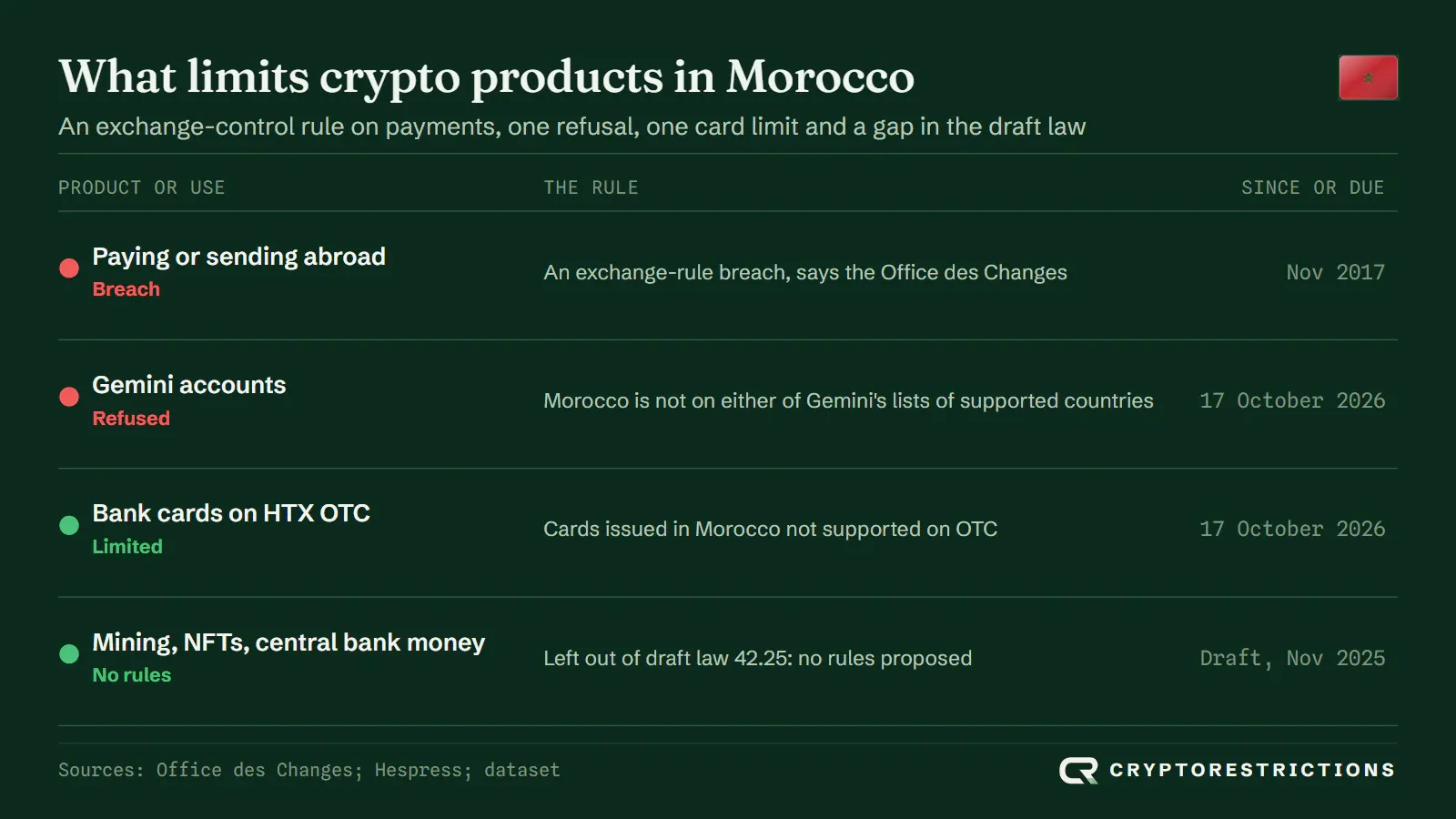
- Payments and transfers. The Office des Changes says cross-border financial transactions must go through approved intermediaries, and that using virtual currencies instead is a breach that can bring the fines and penalties in current law. We did not find the penalty amounts in the communique.
- HTX bank cards. HTX’s OTC page of 22 November 2023 lists Morocco among the countries whose bank cards it does not support. Spot and derivatives trading are not restricted.
- Outside the draft. Hespress reports that digital currencies of the central bank, NFTs and mining are excluded from draft law 42.25, so it would set no rules for them. The warnings stay in place in the meantime.
Are prediction markets legal in Morocco?
The law is unsettled. The Penal Code punishes unauthorised lotteries, which it defines as any chance-based offer to the public, but it does not name prediction markets, and we found no regulator ruling on Polymarket or Kalshi, both of which are open to Moroccans.
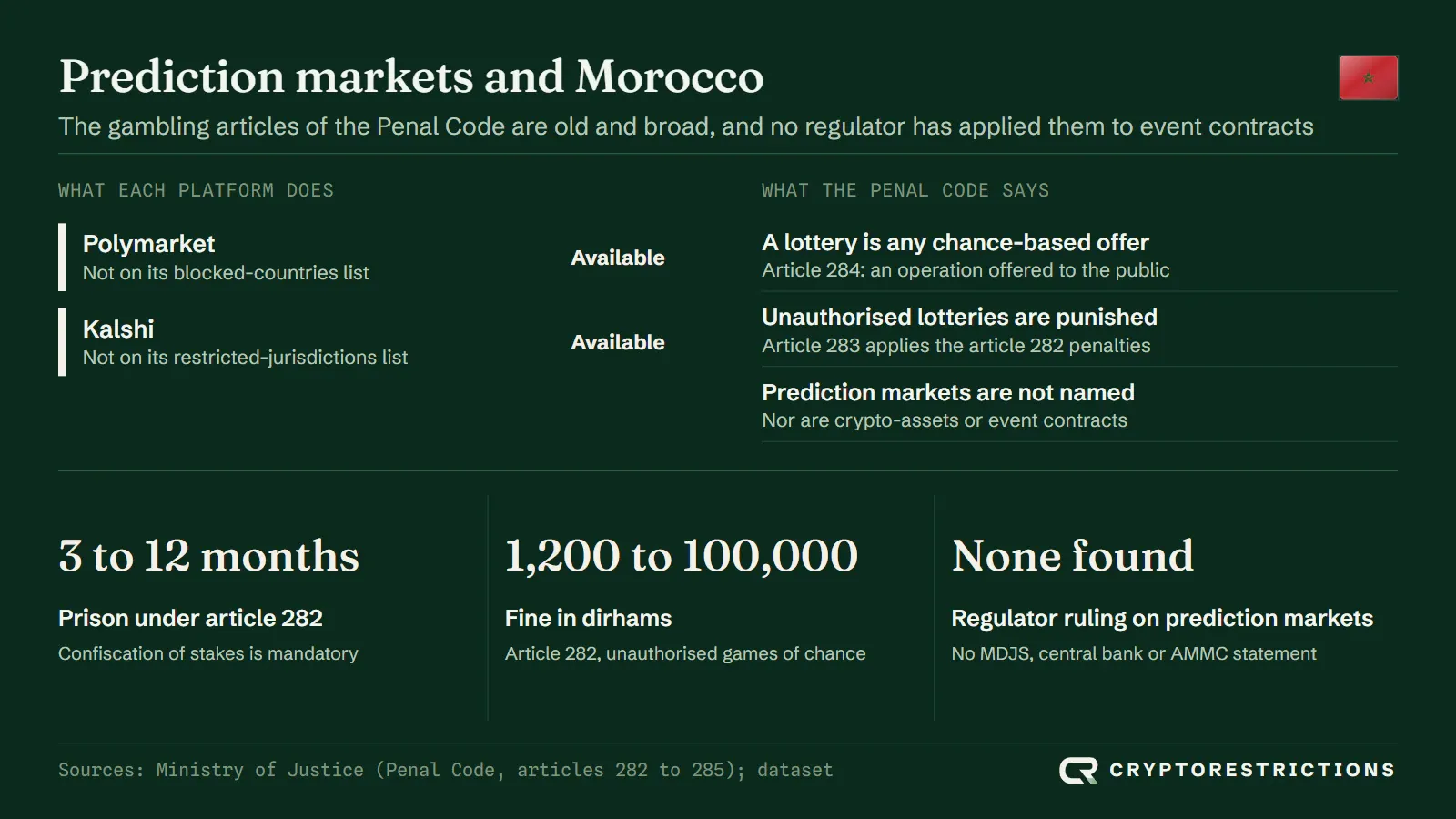
The Penal Code (consolidated version of 15 September 2011) punishes running a gambling house without authorisation with 3 months to 1 year in prison and a fine of 1,200 to 100,000 dirhams, and makes confiscation of the stakes mandatory (article 282). Article 283 applies the same penalties to organisers and agents of lotteries the public authority has not authorised, and article 284 defines a lottery as any operation offered to the public that creates the hope of a gain obtained by chance. Article 285 punishes selling or advertising unauthorised lottery tickets. None of these texts mentions crypto-assets or prediction markets, and we do not know how a court would apply them to an event contract.
Enforcement so far has been aimed at betting sites. Morocco World News reported on 13 January 2026 that, on a complaint by the state sports-betting monopoly MDJS, a court ordered telecom operators to block named platforms, including 1xBet, Betway and Stake, with a fine of 10,000 dirhams a day for delay. Médias24 later reported the blocking suspended on 26 January and annulled by 23 February 2026; we could read only those two headlines. The order named no prediction market.
How is crypto taxed in Morocco?
We found no Moroccan tax rule written for crypto. We could not locate guidance from the tax authority, and the crypto rates that circulate in the press describe proposals, not law.
The AMMC’s investor tax page sets out how gains on securities are taxed: 15% on listed shares and equity fund units, and 20% on bonds, unlisted shares and other fund units, under article 73 of the General Tax Code. It does not mention crypto-assets, so we cannot say whether those rates reach them.
Barlamane, citing unnamed sources close to the file on 26 June 2025, reported a plan to tax gains on exchange operations at 15% to 30%, treat mining, staking and airdrops as income under the progressive scale, and tax companies at 20% to 31%. The article describes this as in preparation and gives no legal reference. Treat it as a signal of direction, not a rate you can rely on, and ask a licensed Moroccan tax adviser before filing a return that includes crypto.
 Egypt
 Ghana
 South Africa
 Nigeria
 Kenya
 South Sudan
 Mauritius
 Senegal
 Tunisia
 Angola
 Benin