
Is crypto legal in Kenya?
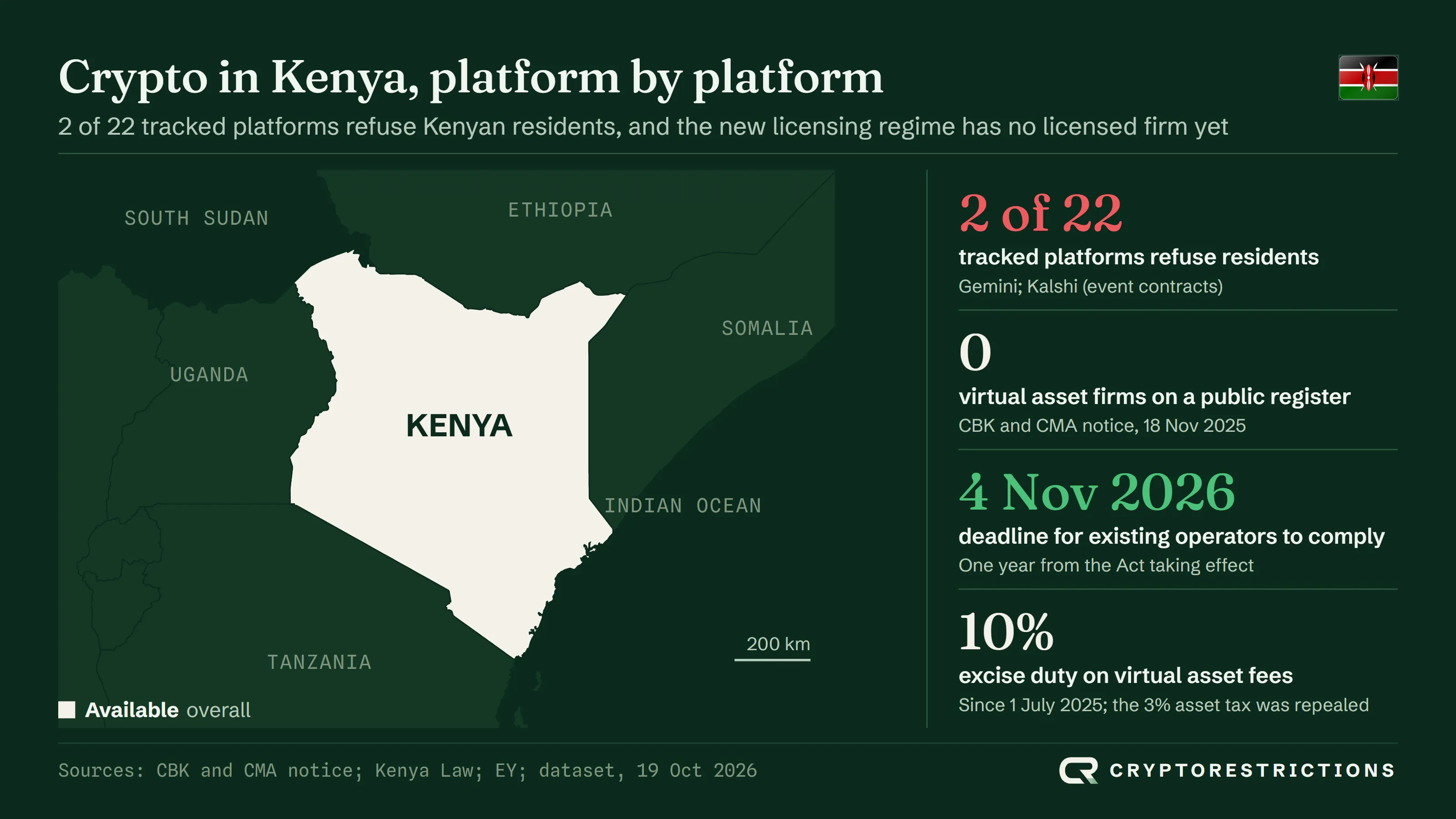
Yes. We found no Kenyan law that bans holding or trading crypto, and the Virtual Asset Service Providers Act 2025 sets up licensing for firms instead. The Act’s prohibition falls on businesses that run virtual asset services without a licence.
The Act was assented on 15 October 2025, gazetted on 21 October and commenced on 4 November 2025. It defines a virtual asset as a digital representation of value that can be traded or transferred and used for payment or investment. Central bank digital currencies, closed-ecosystem items and NFTs not used for payment or investment are outside it. Section 8(2) says no person may carry on virtual asset services “in or from Kenya” without a licence, and licence applicants must be companies registered in Kenya. Under section 40(3) an unlicensed operator faces a fine of up to 10 million shillings or five years in prison for an individual, and up to 25 million shillings for a company. Section 47 gave existing operators one year from commencement to comply, which puts the deadline at 4 November 2026.
Before the Act the official line was a warning. The Central Bank of Kenya (CBK) notice of December 2015 said Bitcoin and similar products are not legal tender and not regulated, and told the public to desist from transacting. It did not call them illegal, and we found no later CBK warning of that kind.
The sections below cover who holds approval, who refuses Kenyans, the products that are cut, enforcement, betting law and tax.
Which crypto exchanges work in Kenya?
Most of the exchanges we track serve Kenya, but none shows a Kenyan licence. When the CBK and the Capital Markets Authority (CMA) last said so, on 18 November 2025, they had licensed no virtual asset firm, and we found no register naming one since.
The joint notice said licensing would start once the Regulations were issued. The National Treasury gazetted the Regulations on 22 July 2026, according to a law-firm alert from Oraro; we could not read the Gazette notice itself. Another firm, Spencer West, says the regime is now operational. Section 17 of the Act makes each regulator publish a register of licences on its website. The CMA home page we read carried no notice on virtual assets, and we found no CBK or CMA announcement of a first licence.
The Regulations split the licence categories between the two regulators, and Oraro lists the minimum paid-up capital for each, as the chart shows. A company with more than one activity holds the highest category plus 50% of the capital for each extra one.
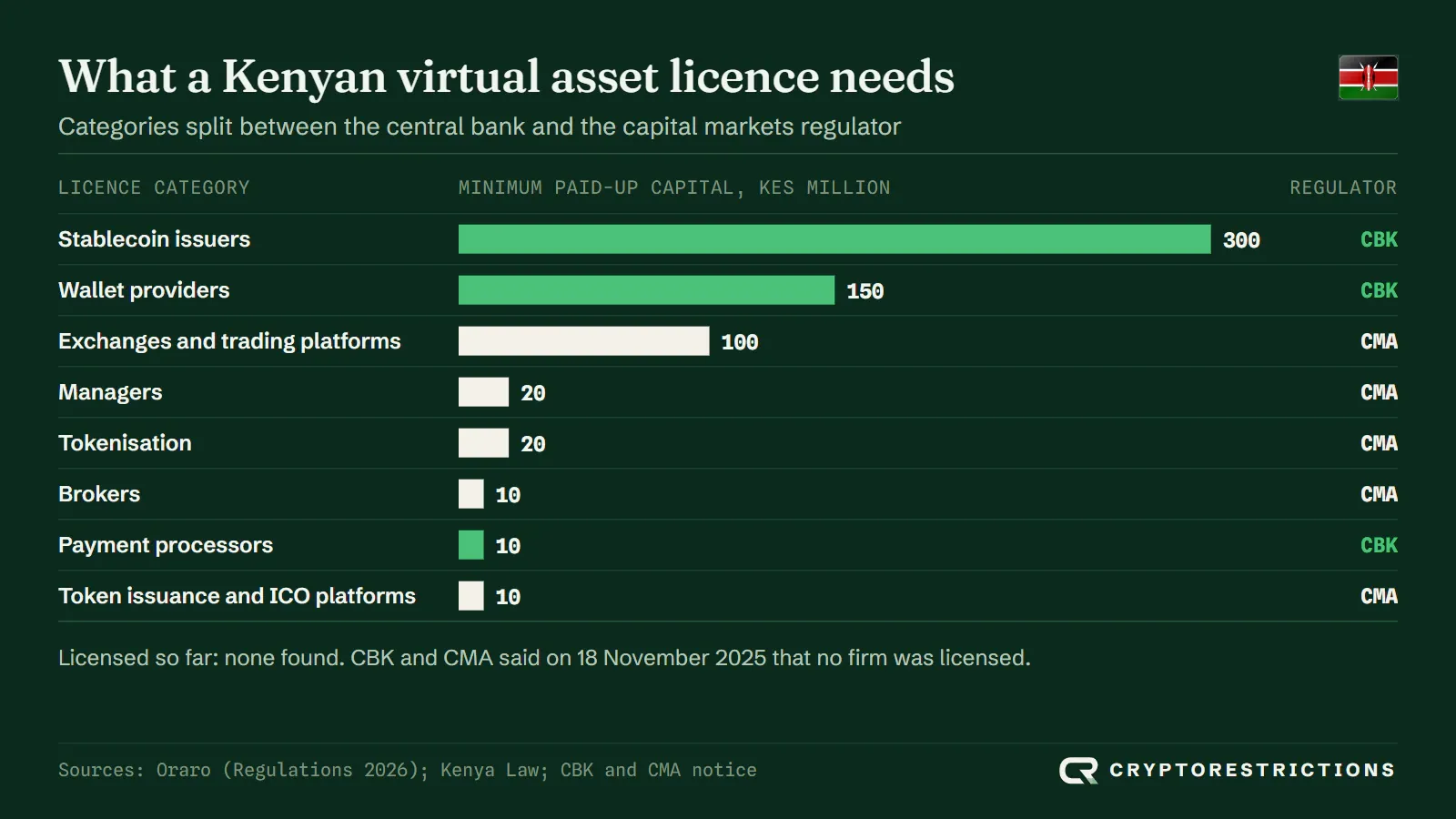
Brand Spur reported on 10 August 2026 that Binance, Luno, Yellow Card, VALR and Kotani Pay were preparing to seek Kenyan licences; it does not say any has applied. We found no Kenyan company or licence for any exchange we track, so the dataset holds no licence row for Kenya.
Best crypto platforms for Kenyan residents
By our access score, nine exchanges tie at 8.0 out of 10 for Kenyan residents, the ones our geo-access test loaded from Kenya. Coinbase, Kraken, Crypto.com and Bitstamp score 7.5 because we have not tested them from Kenya.
The score rates how fully a Kenyan resident can use each platform, not its fees or safety. It is computed from our data and moves when a row changes: access status (4 points), the share of the platform’s products open here (3), the Kenyan licences we hold on file (2) and what our geo-access test saw from a Kenyan address (1, or 0.5 when untested). No platform has a Kenyan licence on file, so every platform scores 0 on licences. Platforms that refuse Kenyan residents are not scored. The full method is on our methodology page.
Exchanges

Binance
Best for Spot trading with a large user base
8.0/10- Access
- 4/4
- Products
- 3/3
- Licences
- 0/2
- Our test
- 1/1
Read our Binance reportPros
- Kenya is not on its prohibited-countries list
- Our test loaded its home and sign-up pages
Cons
- Kenyan authorities froze some user accounts in April 2026
- No Kenyan licence on file

Bitfinex
Best for Spot access under global terms
8.0/10- Access
- 4/4
- Products
- 3/3
- Licences
- 0/2
- Our test
- 1/1
Read our Bitfinex reportPros
- Kenya is not a prohibited jurisdiction in its terms
Cons
- No Kenyan licence on file

Bitget
Best for Spot and derivatives under global terms
8.0/10- Access
- 4/4
- Products
- 3/3
- Licences
- 0/2
- Our test
- 1/1
Read our Bitget reportPros
- Kenya is not on its prohibited-countries list
Cons
- No Kenyan licence on file

Bybit
Best for Spot and derivatives under global terms
8.0/10- Access
- 4/4
- Products
- 3/3
- Licences
- 0/2
- Our test
- 1/1
Read our Bybit reportPros
- Kenya is not on its excluded-jurisdictions list
- Its sign-up page preselected Kenya in our test
Cons
- No Kenyan licence on file

Gate
Best for Spot and derivatives under global terms
8.0/10- Access
- 4/4
- Products
- 3/3
- Licences
- 0/2
- Our test
- 1/1
Read our Gate reportPros
- Kenya is not named in its restricted locations
Cons
- Its list is non-exhaustive
- No Kenyan licence on file

HTX
Best for Spot and derivatives under global terms
8.0/10- Access
- 4/4
- Products
- 3/3
- Licences
- 0/2
- Our test
- 1/1
Read our HTX reportPros
- Kenya is not on the restricted lists in its user agreement
Cons
- No Kenyan licence on file

KuCoin
Best for Spot and derivatives under global terms
8.0/10- Access
- 4/4
- Products
- 3/3
- Licences
- 0/2
- Our test
- 1/1
Read our KuCoin reportPros
- Kenya is not a restricted location in its terms
Cons
- No Kenyan licence on file

MEXC
Best for Spot and derivatives under global terms
8.0/10- Access
- 4/4
- Products
- 3/3
- Licences
- 0/2
- Our test
- 1/1
Read our MEXC reportPros
- Kenya is not on its prohibited list
Cons
- No Kenyan licence on file

OKX
Best for Spot and derivatives under global terms
8.0/10- Access
- 4/4
- Products
- 3/3
- Licences
- 0/2
- Our test
- 1/1
Read our OKX reportPros
- Kenya is not on its restricted-locations list of 8 July 2026
Cons
- No Kenyan licence on file

Bitstamp
Best for Plain spot trading
7.5/10- Access
- 4/4
- Products
- 3/3
- Licences
- 0/2
- Our test
- 0.5/1
Read our Bitstamp reportPros
- No Bitstamp document excludes Kenya
Cons
- Not tested from Kenya
- No Kenyan licence on file

Coinbase
Best for Spot trading with a US-listed brand
7.5/10- Access
- 4/4
- Products
- 3/3
- Licences
- 0/2
- Our test
- 0.5/1
Read our Coinbase reportPros
- Kenya is a listed sign-up country in its identity verification guide
Cons
- Not tested from Kenya
- No Kenyan licence on file

Crypto.com
Best for Spot trading in the app
7.5/10- Access
- 4/4
- Products
- 3/3
- Licences
- 0/2
- Our test
- 0.5/1
Read our Crypto.com reportPros
- Kenya is not on its App geo-restriction list
Cons
- Not tested from Kenya
- No Kenyan licence on file

Kraken
Best for Plain spot trading
7.5/10- Access
- 4/4
- Products
- 3/3
- Licences
- 0/2
- Our test
- 0.5/1
Read our Kraken reportPros
- Kenya is not on its do-not-serve list
Cons
- Not tested from Kenya
- No Kenyan licence on file
Prediction markets

Polymarket
Best for Global event markets from a wallet
7.5/10- Access
- 4/4
- Products
- 3/3
- Licences
- 0/2
- Our test
- 0.5/1
Read our Polymarket reportPros
- Kenya is not on its blocked-countries list
Cons
- No Kenyan regulator position found
- Not tested from Kenya
DeFi

Aster
Best for Perpetuals and spot trading
8.0/10- Access
- 4/4
- Products
- 3/3
- Licences
- 0/2
- Our test
- 1/1
Read our Aster reportPros
- Perpetuals load in the trading app in our test
Cons
- Prediction trading is barred under its prediction rules

Hyperliquid
Best for Perpetuals from your own wallet
8.0/10- Access
- 4/4
- Products
- 3/3
- Licences
- 0/2
- Our test
- 1/1
Read our Hyperliquid reportPros
- Its app loaded in our test from Kenya
Cons
- No Kenyan licence on file

Lighter
Best for Perpetuals on its trading app
8.0/10- Access
- 4/4
- Products
- 3/3
- Licences
- 0/2
- Our test
- 1/1
Read our Lighter reportPros
- Not named in its terms
- The trading app loaded in our test
Cons
- No Kenyan licence on file

Jupiter
Best for Solana swaps
7.5/10- Access
- 4/4
- Products
- 3/3
- Licences
- 0/2
- Our test
- 0.5/1
Read our Jupiter reportPros
- Kenya is not named in its terms
Cons
- Not tested from Kenya

PancakeSwap
Best for BNB Chain swaps and pools
7.5/10- Access
- 4/4
- Products
- 3/3
- Licences
- 0/2
- Our test
- 0.5/1
Read our PancakeSwap reportPros
- Its terms bar only people and places under US sanctions
Cons
- Not tested from Kenya

Uniswap
Best for Swapping tokens from your own wallet
7.5/10- Access
- 4/4
- Products
- 3/3
- Licences
- 0/2
- Our test
- 0.5/1
Read our Uniswap reportPros
- Its terms bar only places under comprehensive US sanctions
Cons
- Not tested from Kenya
Which platforms block Kenyan users?
Two tracked platforms refuse Kenyan residents. Gemini does not serve Kenya at all, and Kalshi bars Kenyan residents from its event contracts.
Gemini serves only the countries on its areas-of-availability pages, and Kenya is on neither of its lists of supported countries. Kalshi names Kenya among the restricted jurisdictions in its member agreement and on its sign-up page.


State action has not blocked a tracked platform. On 22 April 2026 Business Daily reported that Binance had restricted an undisclosed number of Kenyan accounts “at the request of law enforcement”. The report does not say how many or why, and it ties the move to pressure on Kenya to tighten oversight while it sits on the FATF grey list. We found no standing order that blocks a tracked platform’s site.
What our geo-access test saw from Kenya
From a Kenyan virtual location on 14 and 16 October 2026 we loaded 12 of the 22 platforms we track, all with no barrier. We have not tested the other ten from Kenya.
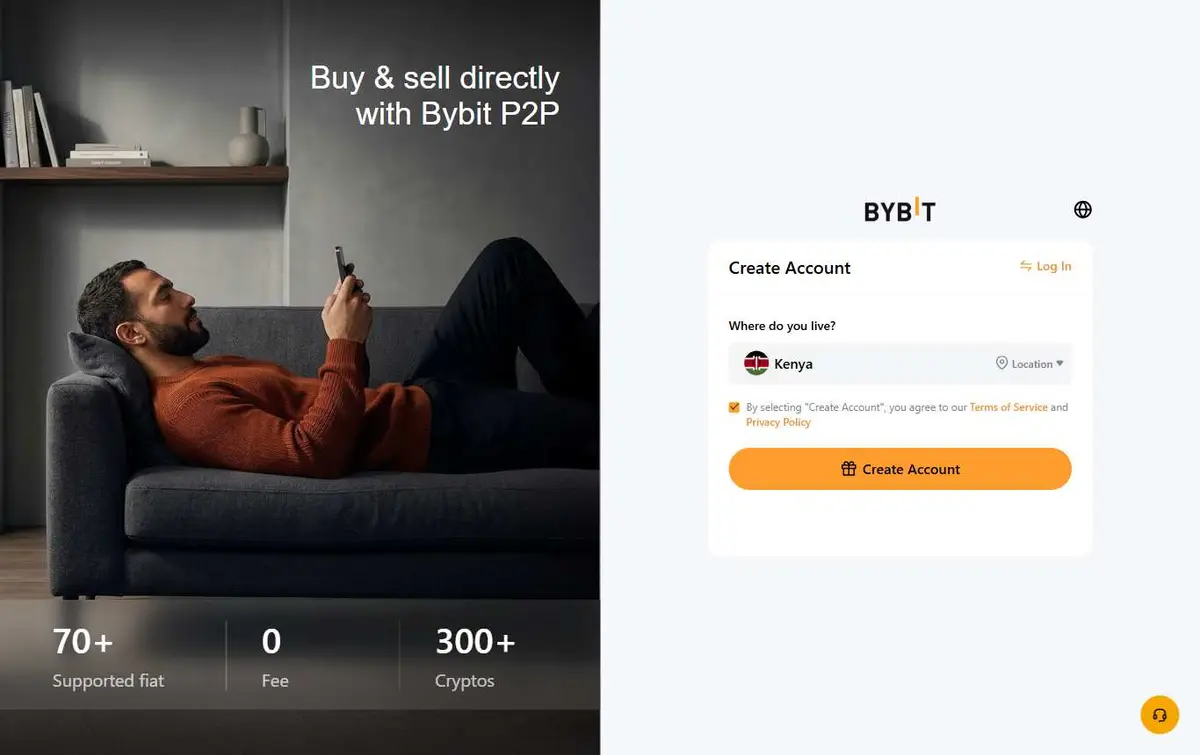
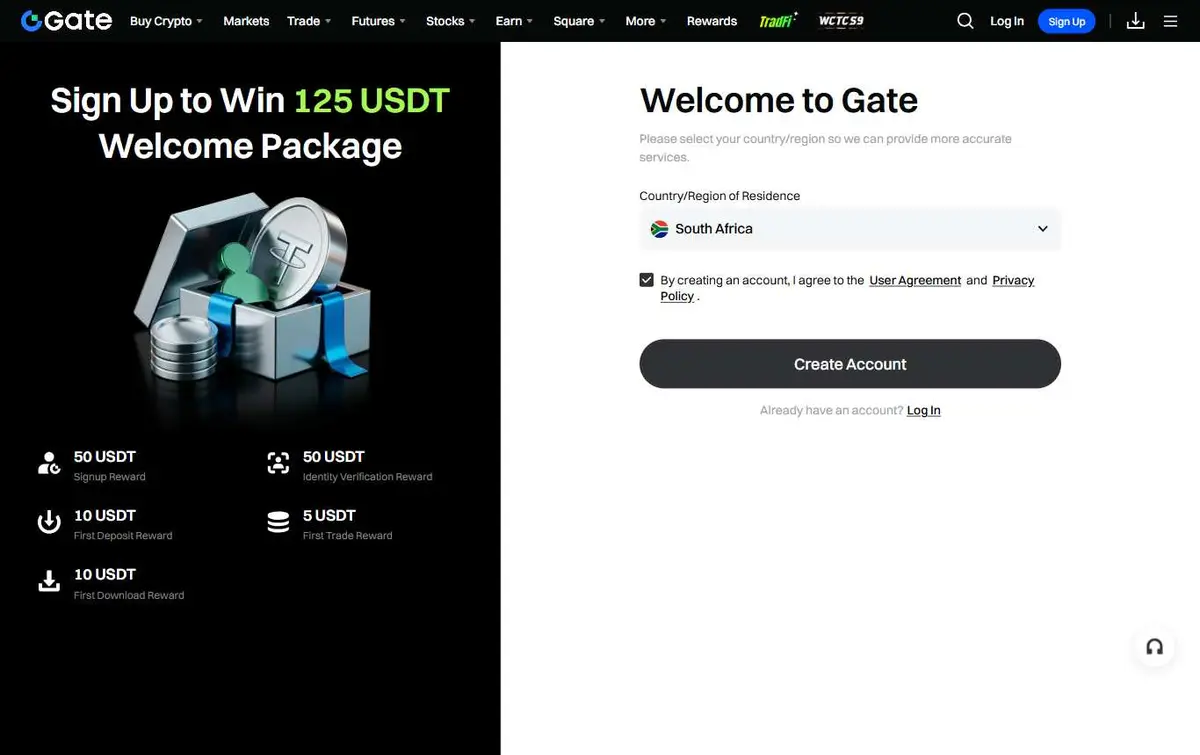
The 12 are Binance, Bybit, OKX, KuCoin, Bitget, Gate, MEXC, HTX, Bitfinex, Hyperliquid, Lighter and Aster. A virtual location tests a platform’s own geo-blocking but cannot see a Kenyan internet provider’s block. An open page is also not permission, because most platforms enforce at identity verification. Swipe through the screenshots below; each card says what the page showed.

No barrier Binance · Sign-up page
Kenya: the Binance sign-up page loads with no barrier
No barrier Bybit · Sign-up page
Kenya: the Bybit sign-up page preselects Kenya as the location
“Location Kenya”
No barrier Gate · Sign-up page
Kenya: the Gate sign-up form loads and asks for a country of residence
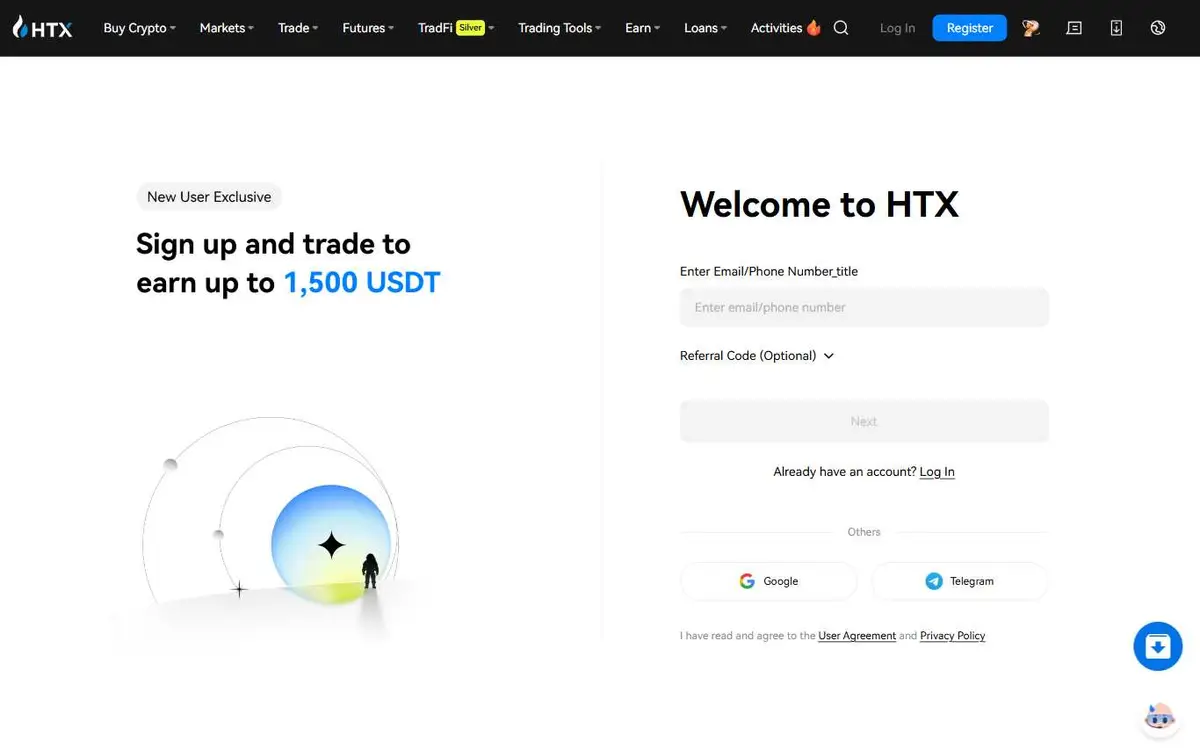
No barrier HTX · Sign-up page
Kenya: the HTX sign-up form loads with no notice

No barrier KuCoin · Home page
Kenya: the KuCoin home page loads with no notice
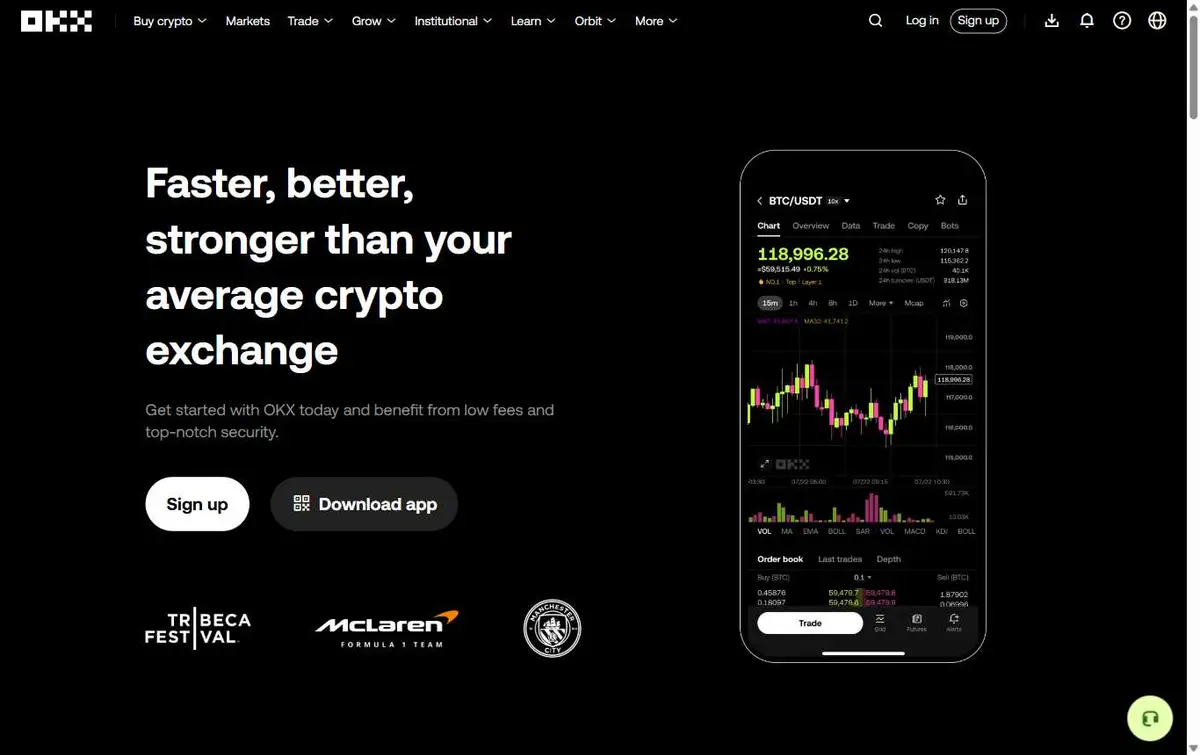
No barrier OKX · Home page
Kenya: the OKX home page loads with no notice
 CRYPTORESTRICTIONS
Who regulates crypto in Kenya?
The CBK and the CMA license and supervise virtual asset firms under the 2025 Act, the National Treasury writes the rules, and the Kenya Revenue Authority taxes them. The courts and the data protection regulator have so far dealt with Worldcoin.
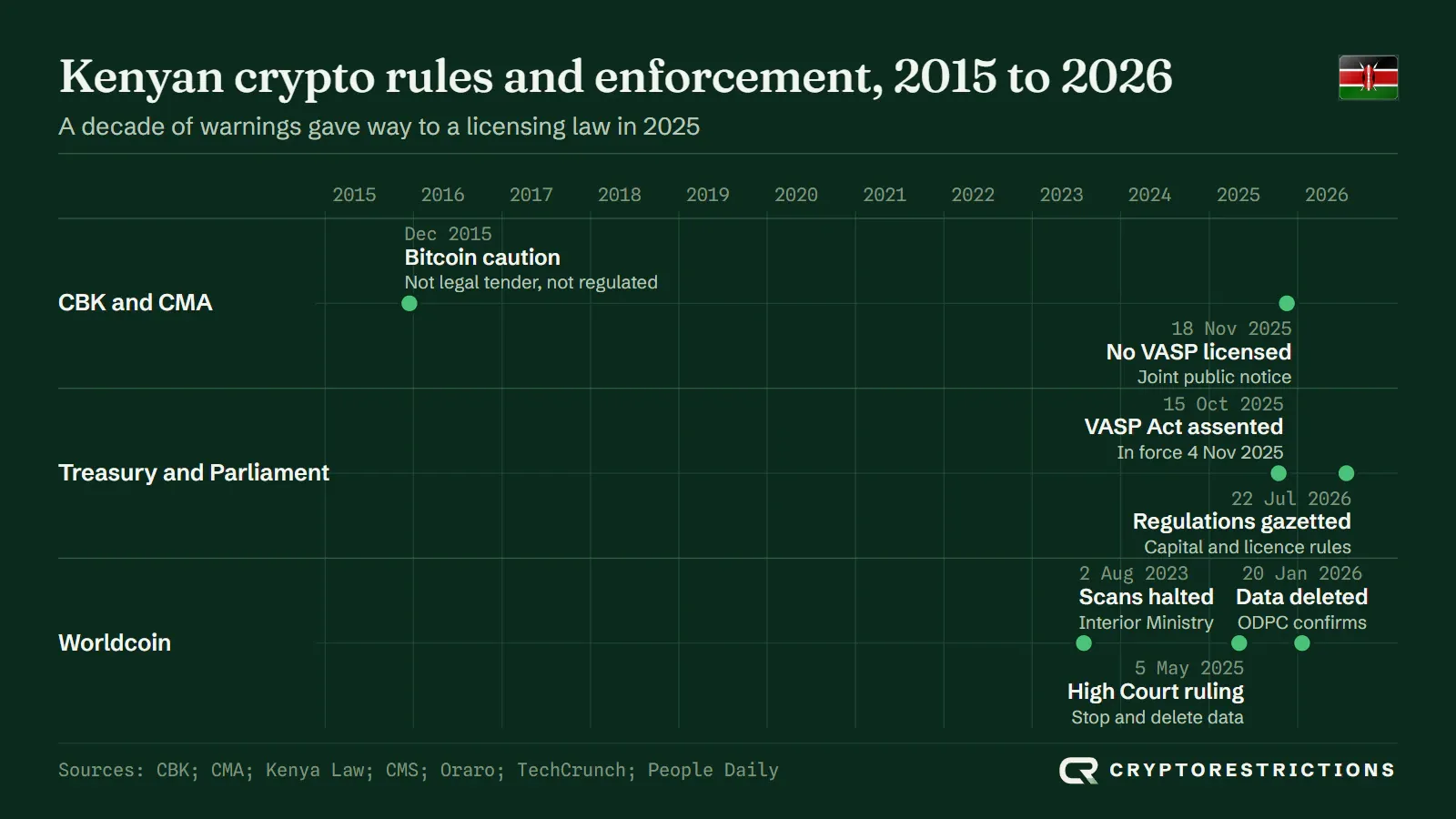
- Central Bank of Kenya. Under the first schedule of the Act it licenses virtual asset wallet providers, payment processors and stablecoin issuers.
- Capital Markets Authority. Licenses exchanges and trading platforms, brokers, advisers, managers, token issuance platforms and tokenisation.
- National Treasury. A draft national policy and the VASP Bill went to public comment, which CMS says closed on 29 January 2025. Treasury gazetted the Regulations in July 2026, and Oraro reports a coordination forum of 20 agencies chaired by Treasury.
- Kenya Revenue Authority (KRA). Collects the excise duty and, from 1 July 2026, receives annual returns from providers (see the tax section).
- Courts and the data protection regulator. The Interior Ministry suspended Worldcoin’s iris scans on 2 August 2023 pending inquiries. On 5 May 2025 the High Court ordered collection to stop and the data to be deleted, finding Data Protection Act breaches, per The Block. People Daily reported on 22 January 2026 that the Office of the Data Protection Commissioner confirmed the deletion. We did not locate the judgment or the notice themselves.
Which crypto products are limited in Kenya?
Providers are the tightest limit: from 4 November 2026 no virtual asset service may run in or from Kenya without a CBK or CMA licence, and only the CBK licenses stablecoin issuers. For users, the product cuts are Kalshi’s event contracts and Worldcoin’s iris scans.
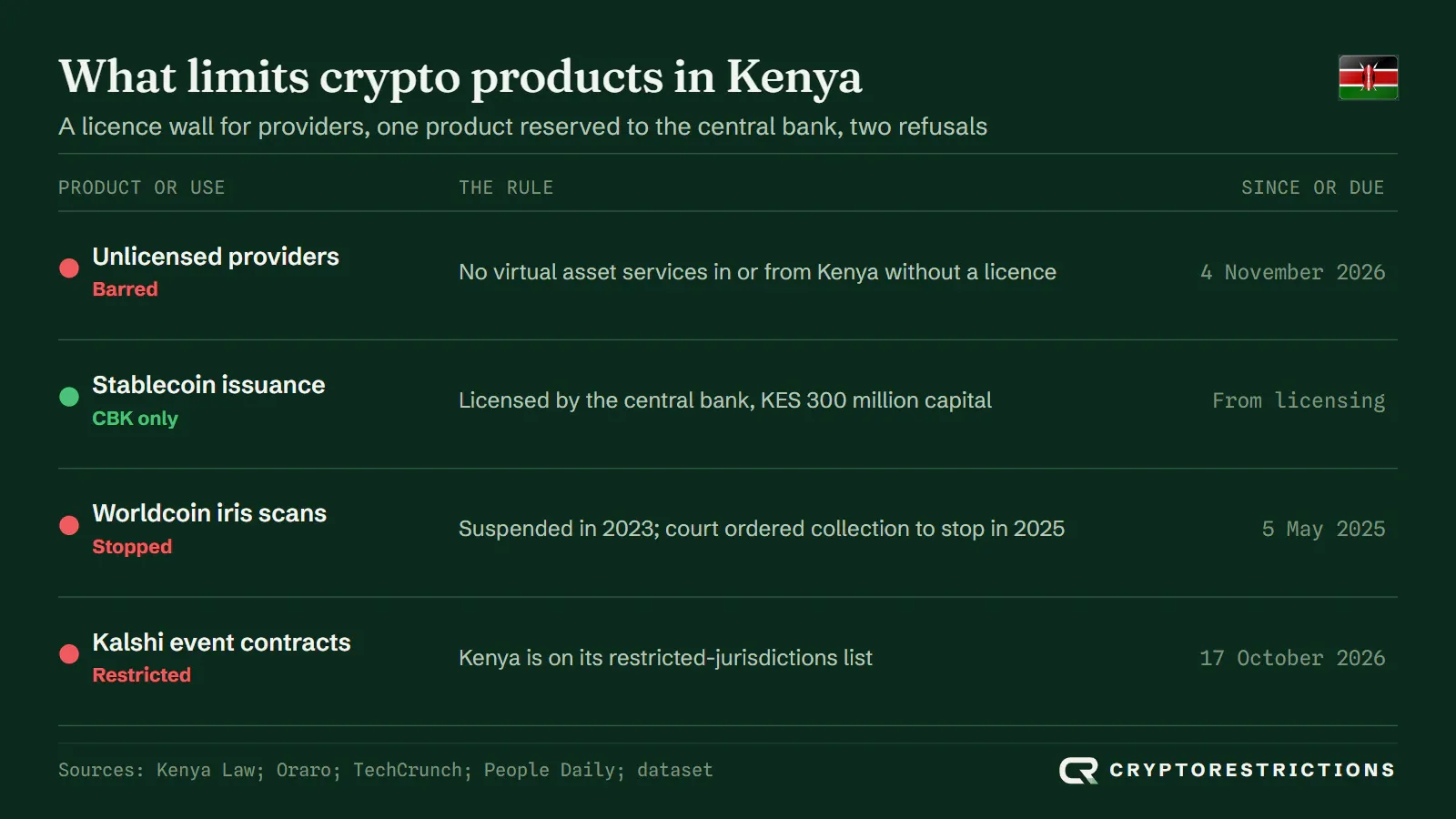
- Stablecoins. Oraro reports that issuers need full reserve backing and must let holders redeem at par within two working days, with KES 300 million minimum capital.
- Wallets and custody. Custodial wallet providers fall under the CBK, with KES 150 million minimum capital per Oraro.
- Consumer protection. Oraro lists segregation of consumer assets and reporting of cyber incidents within 24 hours.
- Binance P2P. The April 2026 account restrictions above came at the request of law enforcement, and we found no published rule that limits peer-to-peer trading itself.
Are prediction markets legal in Kenya?
The law is unsettled. The Gambling Control Act 2025 defines a bet broadly, and we found no ruling by a Kenyan regulator on Polymarket or Kalshi; Polymarket lists no Kenyan block, while Kalshi bars Kenya.
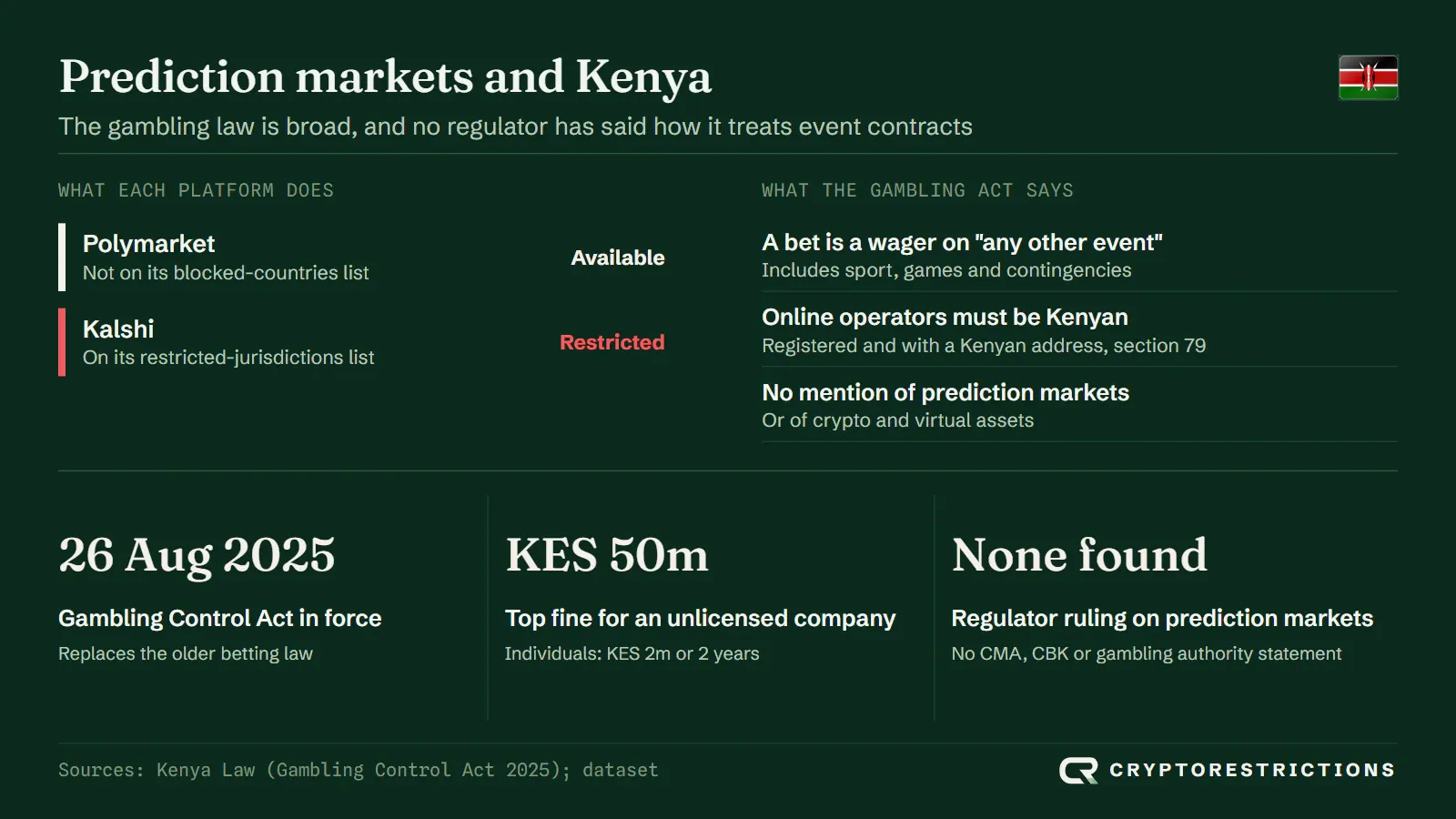
The Gambling Control Act was assented on 7 August 2025 and commenced on 26 August 2025. It defines a bet as a wager or stake of money or money’s worth “on a horse race, fight, game, sport, lottery or exercise or any other event, race or contingency”. Under section 79 a foreign-based operator can hold an online gambling licence only if it is registered in Kenya, has a physical address there and meets the regulator’s requirements. Providing online gambling without a licence carries a fine of up to 2 million shillings or two years for an individual and up to 50 million shillings for a company. The text does not mention prediction markets, event contracts or crypto, and the VASP Act does not mention gambling. We do not know how a regulator would apply either law to one. Law-firm summaries say the Act replaces the Betting Control and Licensing Board with a Gambling Regulatory Authority, but we could not open them, and we found no statement from it or from the CMA or CBK on prediction markets.
Polymarket lists no Kenyan restriction, and Kalshi bars Kenyan residents.
How is crypto taxed in Kenya?
Kenya’s 3% Digital Asset Tax was repealed from 1 July 2025 and replaced by a 10% excise duty on the fees virtual asset providers charge, according to EY. Since the Finance Act 2026, providers must also file annual returns on their users.
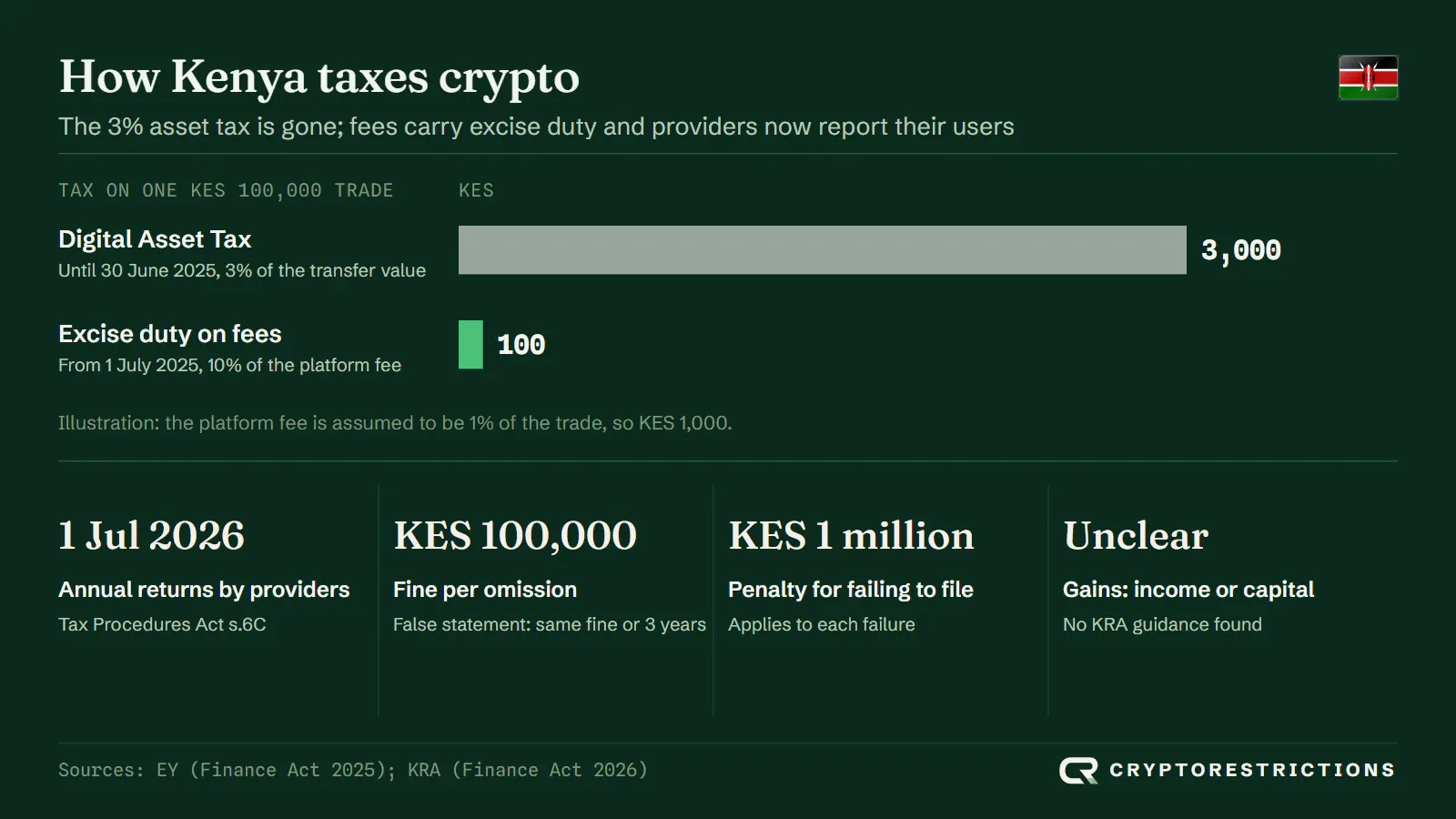
The Digital Asset Tax came in under the Finance Act 2023 and took 3% of the transfer or exchange value, not of the gain, which the platform withheld. The Finance Bill 2025 proposed halving it, but Parliament’s finance committee dropped it, and Business Daily reported on 22 June 2025 that MPs scrapped it and would tax fees instead. EY reports that the Finance Act 2025, signed on 27 June 2025, repealed the tax and set excise duty on virtual asset transaction fees at 10% of the fee, from 1 July 2025. We could not read the Act’s own text, so both figures rest on EY. The chart uses a 1% platform fee only as an illustration.
The Finance Act 2026 took effect for these provisions on 1 July 2026. It adds section 6C to the Tax Procedures Act:
- Annual returns. Each virtual asset service provider that runs an exchange or a trading platform files an information return on its reportable users and on controlling persons of entity users, in line with the Data Protection Act.
- Penalties. A fine of 100,000 shillings or up to three years in prison, or both, for a false statement; a penalty of 100,000 shillings per omission; and 1 million shillings for each failure to file a return or a nil return. A reasonable-effort defence exists.
- Information exchange. New section 6D lets Kenya sign agreements with other countries for automatic exchange of information on virtual asset transactions.
- Gaps. The text sets no filing deadline or form, and we found no KRA notice with them. We found no change to the 10% excise in the Act, and no KRA guidance on whether gains are income or capital.
What to expect, from those sources:
 Egypt
 Ghana
 South Africa
 Morocco
 Nigeria
 South Sudan
 Mauritius
 Senegal
 Tunisia
 Angola
 Benin