
The Crypto Travel Rule requires regulated crypto businesses to collect, keep and in many cases pass on information that identifies the people behind certain crypto transfers. For users it shows up as extra withdrawal questions, recipient details, wallet ownership checks, delays or manual review.
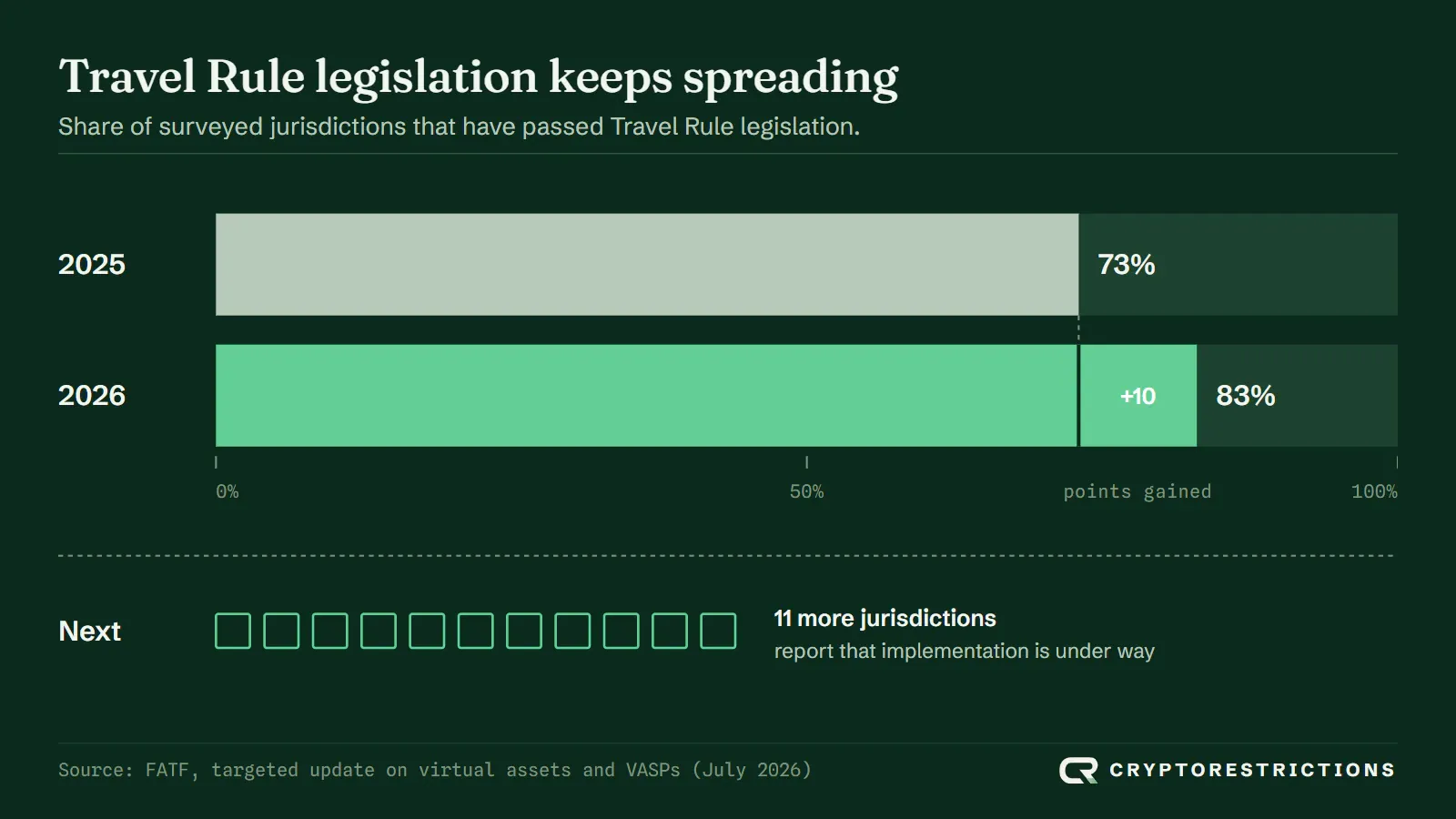
The rule comes from the Financial Action Task Force (FATF), which extended its funds transfer standard, Recommendation 16, to virtual asset service providers (VASPs). Each country then writes its own version, so thresholds, required data and enforcement differ. According to the FATF’s July 2026 update, 83 percent of surveyed jurisdictions have passed Travel Rule legislation, up from 73 percent in 2025, and 11 more report that implementation is under way.
This guide covers what the rule requires, how it differs across five jurisdictions, and how to tell a Travel Rule check from a real restriction. For the current status of a platform in a country, use the restriction explorer.
What is the Crypto Travel Rule?
The Travel Rule is an anti-money laundering and counter-terrorist financing requirement. It adapts the information that traditionally travels with a bank transfer to transfers of virtual assets. Its aim is to make the sender (the originator) and the recipient (the beneficiary) of a qualifying transfer identifiable to the regulated businesses involved.
Depending on local law, a provider may have to obtain, verify, keep or transmit information about both sides of a transfer. The rule is separate from sanctions screening, although the two checks often run together.
How does the Travel Rule work?
A blockchain shows addresses, amounts and transaction identifiers. It does not show who controls an address. The Travel Rule adds an identity layer on top: when a qualifying transfer involves regulated providers, they link the on-chain transaction to information about the originator and the beneficiary.
What information can be required?
The exact fields differ by jurisdiction. Common elements are:
- The originator’s name
- The originator’s account number or wallet address
- The originator’s address or other identifying detail
- The beneficiary’s name
- The beneficiary’s account number or wallet address
Dubai gives a concrete example. Under the VARA Compliance and Risk Management Rulebook, the minimum originator information is a name, a residential or business address, and an account number or wallet address. For the beneficiary it is a name and an account number or wallet address.
Where does the information go?
It does not go onto the blockchain. The EU regulation says the information does not have to be attached to, or included in, the crypto transfer itself. It has to be submitted before, with or alongside the transfer. The blockchain records the asset movement, and the providers exchange identity data through their own compliance systems.
What happens when information is missing?
A receiving provider can ask for more details when a transfer arrives incomplete. Depending on the jurisdiction, the risk assessment and the provider’s policy, the outcome can be a request for information, a temporary hold, manual review, or return of the transfer. The UK regulator, for example, expects a firm to make a risk-based decision on whether to make the assets available to the beneficiary at all.
Which crypto transfers are affected?
The rule matters when a regulated provider takes part in the transfer. Exchange-to-exchange transfers are the clearest case, but transfers between an exchange and a self-hosted wallet can also trigger extra requirements.
A user can meet Travel Rule questions when withdrawing from an exchange, depositing funds received from elsewhere, paying another person’s exchange account, or moving crypto between custodial and personal wallets. Typical withdrawal questions are:
- Is the destination another exchange, and which company operates it?
- What is the recipient’s name?
- Do you own or control the destination wallet?
Exchange-to-exchange transfers
When two regulated providers are involved, identifying information travels between them alongside the transfer. Problems arise when the receiving provider is under different rules, does not support the same messaging solution, or sits in a jurisdiction that has not implemented the rule.
Person-to-person transfers
The rule’s obligations fall on regulated intermediaries. A direct transfer between two people using wallets they control themselves does not involve a regulated provider, so it is a different case from a withdrawal through an exchange. The picture changes once an exchange or another regulated provider enters the chain.
How do rules differ by country?
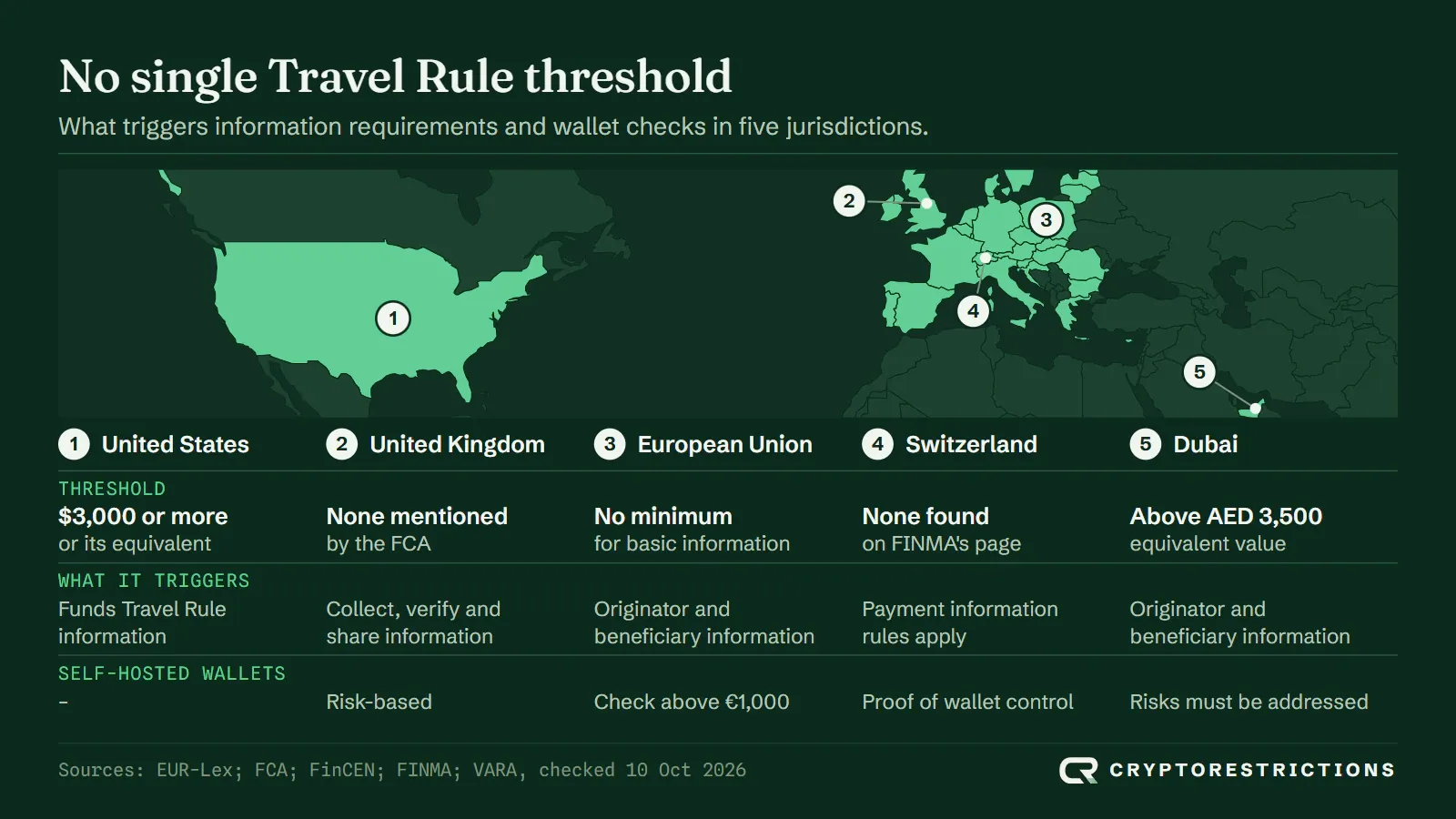
FATF sets the standard. National law decides thresholds, data fields, wallet checks and enforcement. There is no single worldwide threshold.
European Union
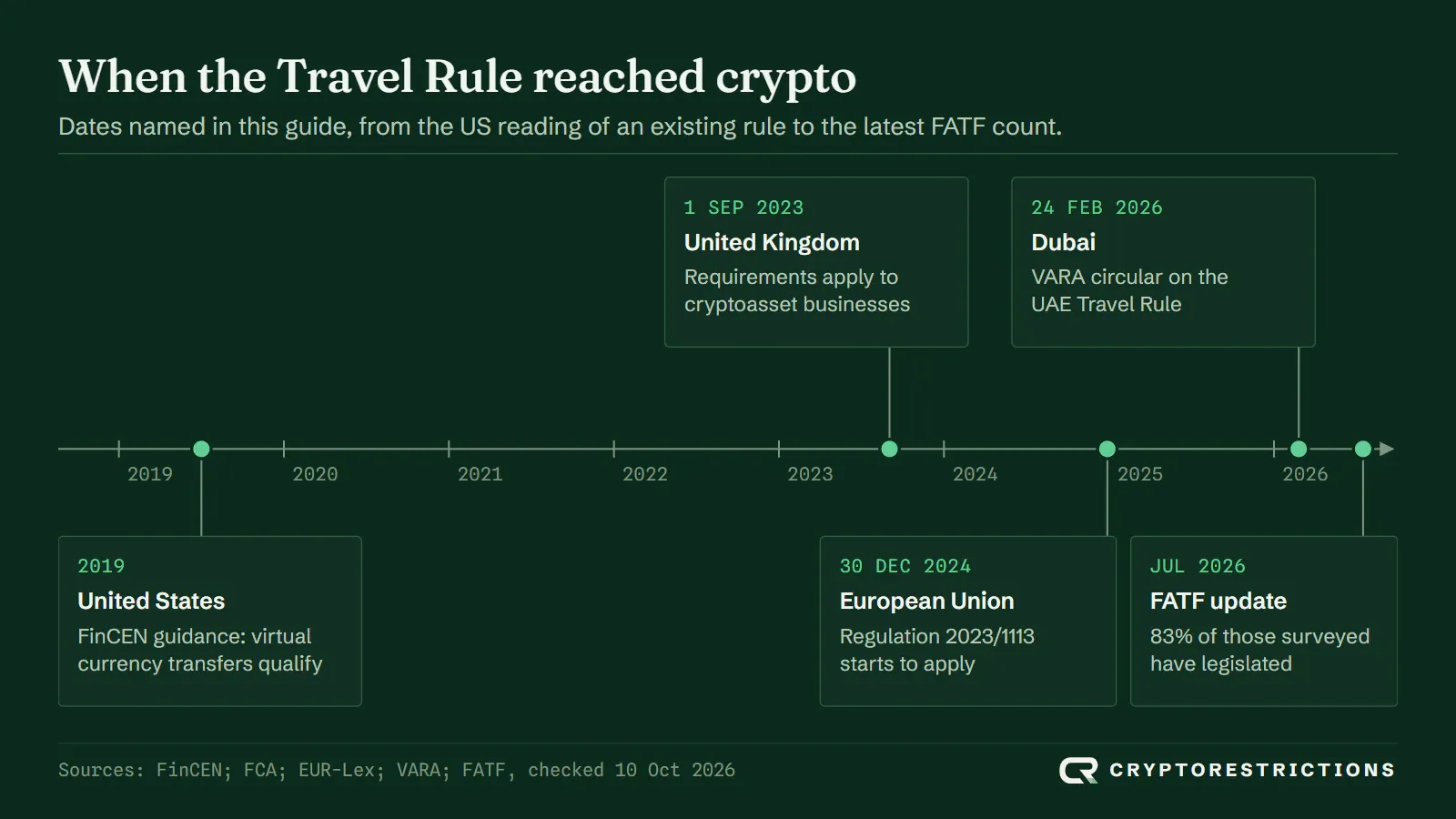
Regulation (EU) 2023/1113 has applied since 30 December 2024. It requires the originator’s provider to send originator and beneficiary information with every crypto transfer. The visible text sets no minimum amount for that basic requirement.
The 1,000 euro figure applies to self-hosted addresses only. For a transfer above 1,000 euros to or from a self-hosted address, the provider must take adequate measures to assess whether the originator or beneficiary owns or controls that address (Articles 14(5) and 16(2)). The EBA Travel Rule Guidelines add that providers should collect the originator or beneficiary information from their customer when a self-hosted address is on the other end, and they set out how to value the transfer: at the moment of order for the sender’s provider, and at receipt for the recipient’s provider. The Guidelines word the test as “amounts to or exceeds” 1,000 euros, while the Regulation says “exceeding”, so providers may apply the check at exactly 1,000 euros.
See the Germany page for an EU member state.
United Kingdom
The UK requirements for cryptoasset businesses have applied since 1 September 2023. The FCA says firms must collect, verify and share information about cryptoasset transfers.
It also covers cross-border cases. If a UK business sends crypto to a firm in a country without Travel Rule requirements, or to a firm that cannot receive the information, the UK business must still collect and verify the required information and store it before the transfer. For incoming transfers with missing or incomplete information, the firm should consider the sending firm’s country and its Travel Rule status in a risk-based assessment. The FCA does not mention a monetary threshold. See the United Kingdom page.
United States
The US has no crypto-specific Travel Rule. The existing Funds Travel Rule, 31 CFR 1010.410(f), already covered transmittals of funds, and FinCEN’s 2019 guidance says transactions involving convertible virtual currency qualify as transmittals of funds. A transmittal of $3,000 or more (or its equivalent in virtual currency) may therefore trigger requirements for a money transmitter acting as the sender’s institution, the recipient’s institution or an intermediary.
Under FinCEN’s Q&A, the transmittor’s institution must pass on the transmittor’s name, address and account number (if used), the identity of its own institution, the amount, the execution date and the identity of the recipient’s institution, plus recipient details it received. The rule has specified exclusions. See the United States page.
Switzerland
FINMA says the Swiss rules on information accompanying payments also apply to blockchain-based activity. According to its anti-money-laundering supervision dossier, intermediaries must confirm that their clients control the wallets used to access their crypto assets.
FINMA accepts several methods, among them a time-boxed transfer, where the client sends a small amount to an address the intermediary supplies within an agreed window, and logging into the wallet in the presence of the intermediary’s staff, if documented. We found no fixed monetary threshold on that page. See the Switzerland page.
Dubai
Under the VARA rulebook (Part III.G), for transfers with an equivalent value exceeding AED 3,500, the sending VASP must obtain and hold the required originator and beneficiary information before initiating the transfer. The receiving VASP must do the same before it lets its client access the assets. VARA also requires risk-based due diligence on a counterparty VASP before the first transaction with it, and monitoring for transfers structured to stay under the threshold.
VARA published a circular on the implementation of the UAE Virtual Assets Travel Rule requirements on 24 February 2026. See the United Arab Emirates page.
What about self-hosted wallets?
A self-hosted wallet is one the user controls directly, with their own keys, rather than one a custodial provider holds on their behalf. Hardware wallets and non-custodial software wallets are common examples.
The Travel Rule does not prohibit transfers to self-hosted wallets. It can require a regulated business to collect information about the wallet or establish who controls it. In the EU, the provider must assess ownership or control for transfers above 1,000 euros, and the EBA Guidelines require at least one of these methods:
- Unattended or attended verification under the EBA remote onboarding guidelines
- Sending a predefined amount from and to the self-hosted address
- A digital signature of a specific message with the key for that address
- Another suitable technical means that leaves the provider fully satisfied about who controls the address
Once a provider is satisfied, it may keep the address on a verified list and need not repeat the checks for later transfers. Switzerland takes the same approach with different methods, as covered above.
This distinction matters when classifying restrictions. “Self-hosted transfers need verification”, “a provider rejects an external wallet” and “self-hosted wallets are illegal” are three different statements. Only the last is a ban.
Why can transfers be delayed?
The Travel Rule runs alongside sanctions screening, customer due diligence, blockchain monitoring and an exchange’s own policies. A transfer can enter review even when the blockchain works normally. Common reasons are:
- Missing or incorrect beneficiary or sender information
- A recipient name that does not match the receiving account
- A destination provider that cannot be identified or cannot receive the data
- A self-hosted wallet that needs an ownership check
- Different Travel Rule requirements in the two jurisdictions
- Separate AML or sanctions concerns
Uneven implementation is a large part of the cause. The FATF’s July 2026 update reports significant progress in legislation but continuing gaps in supervision and enforcement. A delay therefore says little about the status of crypto in a country. It can relate to the route, the recipient, the wallet type, the provider or the risk assessment.
Does the Travel Rule affect privacy?
Yes. It increases the amount of identifying information that regulated crypto businesses hold about transfers. That information is not written onto a public blockchain. Three data layers stay separate:
The FCA describes the UK rule as a measure to add transparency to cryptoasset transfers, to help firms detect suspicious transactions and to support sanctions screening. For a user, the privacy effect depends on whether a regulated intermediary is involved and which jurisdiction governs it.
What does the rule mean for users?
Most users meet the rule at deposits and withdrawals, not in ordinary on-chain activity. An exchange can ask about the destination provider, the recipient, account ownership or the wallet controller before releasing assets. Incorrect answers can trigger extra review.
Before a significant transfer, check:
- Whether the receiving address belongs to an exchange or a self-hosted wallet
- Which company and which jurisdiction stand behind each platform
- Whether the recipient’s name must match the receiving account
- Whether wallet ownership verification or a threshold applies
- Whether the receiving service supports transfers from the sending service
A transfer can be restricted while the account itself stays fully usable. “Account available”, “spot trading available”, “withdrawal under review” and “external-wallet transfer unavailable” are separate classifications, and a Travel Rule problem belongs at the level where it occurs.
Common questions about the Travel Rule
Does the Travel Rule ban anonymous crypto?
No. It sets information requirements for regulated intermediaries. It does not put every peer-to-peer transaction under an identity exchange. The question is whether a regulated provider takes part and which law applies to it.
Does every country use one threshold?
No. The thresholds cover different things and should not be compared one to one.
Can an exchange reject a transfer?
Yes. A provider may have to resolve incomplete information, a failed verification, AML or sanctions concerns, or a problem with the counterparty before it releases a transfer. A rejection does not show that crypto is prohibited in the user’s country.
Is the Travel Rule global?
The FATF standard is global, but implementation is not. Legislation has spread to most surveyed jurisdictions, and supervision, technical systems and enforcement still differ widely.
Does the Travel Rule apply to personal wallets?
It can affect transfers that involve them. A wallet does not become a regulated service because an individual controls it, but an exchange that deals with that wallet may have to collect information or verify ownership. The EU and Switzerland are clear examples.
How should restrictions be classified?
A country can allow regulated crypto trading and still impose strict information requirements on transfers. An exchange can stay open to residents and still restrict withdrawals to certain wallet types or counterparties. In our dataset, restrictions are recorded by what actually applies: residency, licensing status, product, transfer type, sanctions exposure, wallet type or provider policy. Our methodology explains how each status is sourced and dated.
Related guides: crypto sanctions, stablecoin regulation and Binance alternatives.