Crypto sanctions are legal restrictions that stop people, companies, exchanges and wallet providers from dealing with designated persons, entities, addresses, assets or jurisdictions. They can require assets to be blocked, transactions rejected, services withdrawn or activity reported to the authorities.
Sanctions are not the same thing as crypto regulation. An exchange can hold a licence in a country and still have to reject a sanctioned customer there. In the other direction, a platform can refuse residents of a country for its own compliance reasons even where no sanction prohibits serving them.
In practice, access depends on several things at once: who the user is, where they live, who is on the other side of the transaction, the history of the wallet, which sanctions regime applies to the provider, and the provider’s own risk policy. This guide separates those layers. For the current status of a specific platform in a specific country, use the restriction explorer.
What are crypto sanctions?
Crypto sanctions are ordinary sanctions rules applied to transactions that involve cryptocurrency, stablecoins, tokens, wallet addresses, exchanges, custodians and other digital-asset services.
Governments do not treat crypto as a channel that sits outside financial sanctions. The US Treasury’s Office of Foreign Assets Control (OFAC) is asked in its published FAQs whether compliance obligations are the same for digital currency and traditional fiat currency. Its answer:
“Yes, the obligations are the same.”
OFAC, FAQ 560
A sanctions restriction can reach a crypto transaction for seven different reasons, and the legal effect is different for each. “Restricted”, “blocked”, “prohibited” and “unavailable” are not interchangeable terms.
Who imposes crypto sanctions?
Governments and regional authorities impose sanctions. Exchanges and wallet providers then build controls to comply with the regimes that apply to their business.
United States
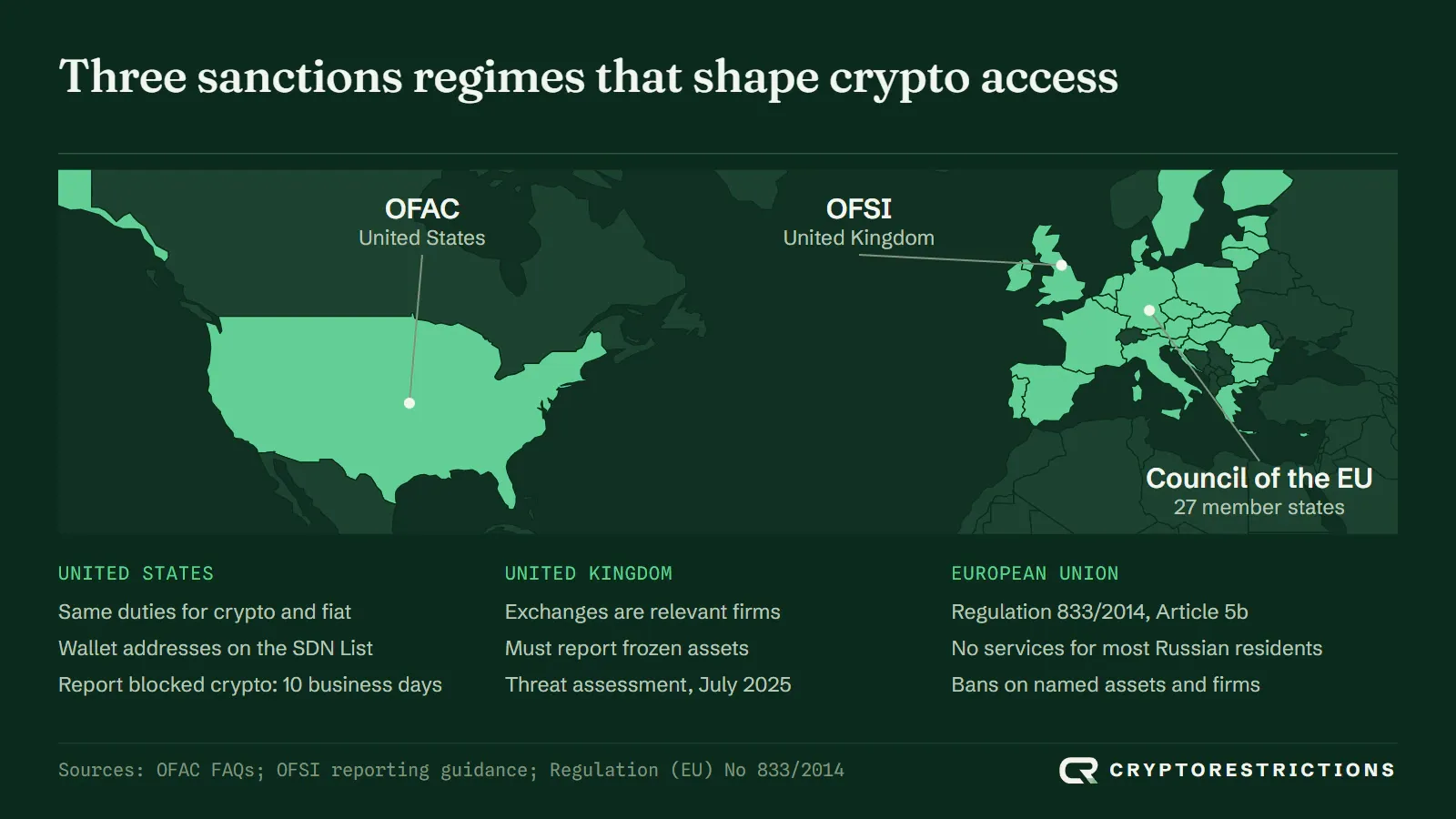
OFAC administers US economic sanctions. It designates individuals and entities, and it can add digital currency addresses to a sanctions-list entry as identifiers (FAQ 561). US persons, and others subject to OFAC jurisdiction, must not carry out prohibited transactions, and where property must be blocked, that covers virtual currency as well as traditional assets.
OFAC published dedicated Sanctions Compliance Guidance for the Virtual Currency Industry in October 2021.
European Union
EU sanctions are set in regulations that apply directly in every member state. The crypto provisions sit mainly in the measures on Russia. Under Council Regulation (EU) No 833/2014, EU operators may not provide crypto-asset services to Russian nationals, people residing in Russia, or entities established there.
The same article exempts nationals of an EU or EEA state or Switzerland, and anyone holding a residence permit in one of them. That is why nationality and residency have to be assessed separately.
United Kingdom
UK financial sanctions are implemented by the Office of Financial Sanctions Implementation (OFSI). Cryptoasset exchanges and custodian wallet providers are “relevant firms”. A relevant firm must report to OFSI if, in the course of its business, it knows or has reasonable cause to suspect that a customer is a designated person holding frozen assets, or that someone has committed a sanctions offence.
OFSI published a threat assessment for the cryptoassets sector on 21 July 2025.
What crypto activity can sanctions restrict?
Sanctions reach well beyond deposits and withdrawals at a centralized exchange. Depending on the regime, they can cover custody, token transfers, crypto-to-crypto conversion, fiat conversion, payment services, dealings with particular counterparties, and transactions involving named crypto businesses or assets.
Customer access
A provider may have to refuse or end a service when providing it would itself breach sanctions. The EU rules on Russia are the clearest example: the service is prohibited for the people the regulation describes, with stated exemptions.
That is different from an exchange choosing not to serve a country. In the first case the law compels the decision. In the second the service is unavailable under company policy.
Transfers and counterparties
A transaction can also be restricted because of who sends or receives the crypto. Under US rules, persons subject to OFAC jurisdiction must block property in which a blocked person has an interest. OFAC applies that to any entity owned 50 percent or more, directly or indirectly, by one or more blocked persons.
Tokens and payment systems
Sanctions can target one piece of crypto infrastructure instead of a class of users. In its 19th package of 23 October 2025, the EU prohibited transactions involving A7A5, a ruble-backed stablecoin that the Council described as a prominent tool for financing activities supporting the war. It also listed the coin’s developer, its Kyrgyz issuer and the operator of a platform where it trades.
A named-asset ban of this kind does not prohibit every crypto transaction by users in the same region.
How do exchanges enforce sanctions?
A centralized exchange sits between blockchain transactions and identified customer accounts. That position lets it combine identity information, sanctions lists, wallet data, transaction monitoring and location signals.
A user can therefore hit an account restriction while the blockchain itself keeps processing transactions. Whether an exchange may provide custody, conversion or withdrawal is a separate legal question from whether a blockchain can record a transfer.
Customer screening
Exchanges screen identifying information against sanctions lists and investigate possible matches: names and aliases, dates of birth, corporate ownership, citizenship and residency, beneficial owners and connected businesses.
A name match is not proof that a customer is a sanctioned person. Compliance teams need enough identifying detail to tell the listed individual from someone who shares a name.
Wallet screening
Blockchain analytics help providers find exposure to addresses associated with sanctioned parties.
- Direct exposure: a transfer to or from a listed address is an immediate compliance issue where the relevant programme applies.
- Indirect exposure: funds can pass through many addresses before reaching an exchange. Indirect links prompt further investigation, but they do not mean every later holder is sanctioned.
The legal question stays the same: does the transaction involve blocked property, a designated person or a prohibited activity under the regime that applies?
Geographic controls
Providers use location data alongside identity data. Location alone does not settle a sanctions question, because a country-related restriction can carry exemptions based on citizenship, residence status, purpose or a licence.
Geographic blocks can also be wider than the law. In October 2025, developers reported that the Uniswap Labs interface was blocking all Ukrainian IP addresses, although US sanctions cover only the occupied regions.
How are crypto businesses sanctioned?
Authorities can designate a crypto business itself.
The best-known case is Garantex. OFAC first designated the exchange on 5 April 2022. On 14 August 2025 it re-designated Garantex under cyber sanctions authorities and designated Grinex, which Treasury describes as the successor exchange set up after law enforcement actions against Garantex in March 2025. Treasury says Garantex processed over $100 million in transactions linked to illicit activities since 2019. Those are the US government’s findings, as stated in its announcement.
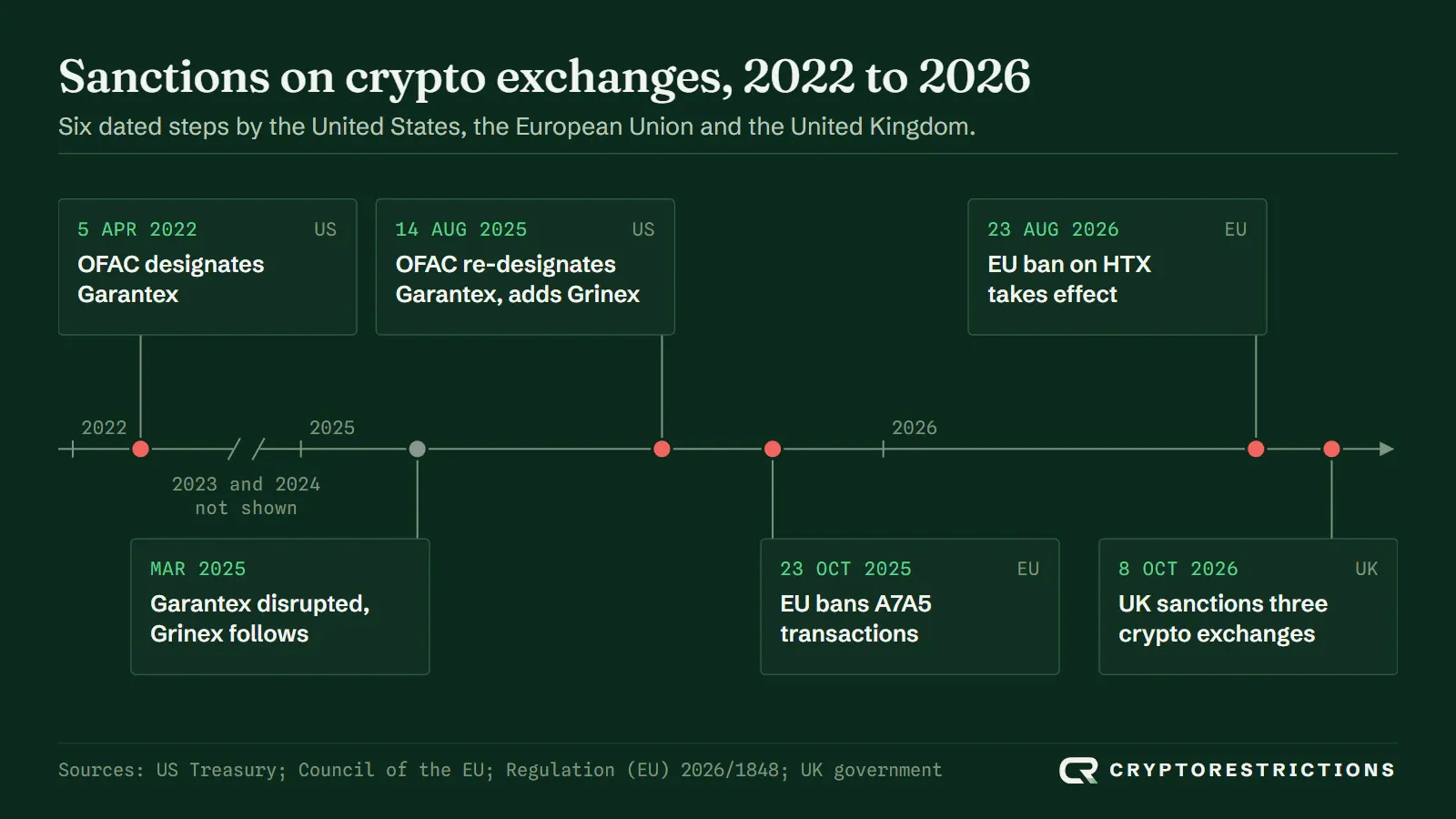
Sanctions can also reach a large, mainstream exchange. In July 2026 the EU adopted Regulation 2026/1848, which added 17 credit and financial institutions and crypto-asset or payment service providers to the EU’s Russia-sanctions list. One of them is HTX: since 23 August 2026, EU persons are barred from dealing with the platform. On 8 October 2026 the UK sanctioned three crypto exchanges and two payment platforms for helping Russia evade sanctions. None of those five is a platform we track. The UK had separately frozen the assets of Huobi Global S.A., HTX’s operating company, on 26 May 2026, and on 29 October 2026 the FCA announced that HTX had settled its court case over illegal crypto promotions and is no longer active in the UK.
A sanctioned exchange is unavailable for a reason that has nothing to do with licensing. The table separates the situations that readers most often merge into the word “ban”.
How do sanctions affect DeFi?
Decentralized finance is harder to police. A protocol can run on smart contracts while websites, developers, governance participants, front-end operators and regulated intermediaries each hold a different degree of control.
The FATF’s July 2026 report on DeFi says that applying its standards to DeFi requires a functional and risk-based approach, and it makes recommendations to help jurisdictions determine whether control over an arrangement exists. Sanctions analysis is narrower still, because it turns on the specific legal framework and the people, property or transactions involved.
The Tornado Cash example
Tornado Cash shows why sanctions status has to be checked against current official records. OFAC previously designated Tornado Cash and associated addresses. On 21 March 2025 it removed Tornado Cash and the listed smart-contract addresses from the SDN List.
That removal does not make every interaction with a privacy protocol free of sanctions risk. A transaction can still involve a separately designated person or their property, and regulated intermediaries keep their own obligations when they process related funds.
Technical accessibility and legal permission are separate questions. Our pages for DeFi protocols such as Uniswap, Hyperliquid and PancakeSwap track the interface-level blocks, which are the part a user actually meets.
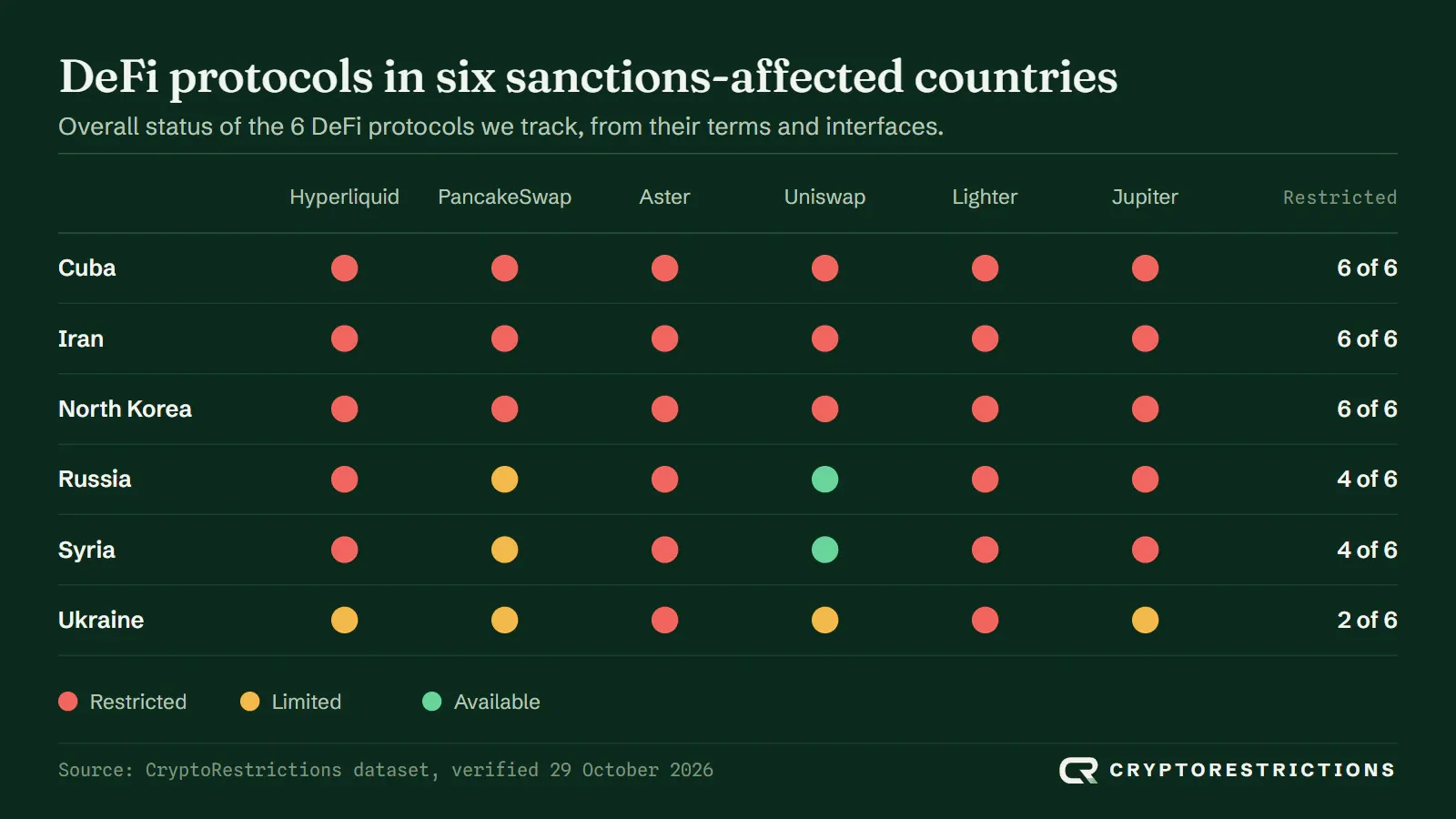
In our dataset, verified 29 October 2026, all six DeFi protocols we track are restricted in Cuba, Iran and North Korea, four in Russia and four in Syria.
How do major jurisdictions differ?
Crypto sanctions are not uniform. The United States, the European Union and the United Kingdom often coordinate, but their legislation, reach, exemptions, licensing systems and enforcement stay distinct.
United States
OFAC publishes digital currency addresses as part of SDN List entries. When virtual currency must be blocked, the holder has to deny all parties access to it. FAQ 646 says US persons are not obliged to convert blocked virtual currency into fiat, and that it must be reported to OFAC within 10 business days and then annually for as long as it stays blocked.
European Union
The EU has written crypto-specific provisions into its Russia measures step by step. The consolidated Regulation 833/2014 now carries them in Articles 5b to 5bc.
Two changes took effect in 2026. From 24 May, EU persons may not transact with crypto-asset providers established in Russia. From 25 August, the bar on Russian nationals and residents owning, controlling or sitting on the governing bodies of EU crypto firms widened from wallet, account and custody providers to every other crypto-asset service defined in MiCA.
Separately, the 18th package of July 2025 lowered the threshold for sanctioning third-country crypto-asset service providers that frustrate EU sanctions, and expanded the transaction ban on them.
United Kingdom
The UK applies financial sanctions to cryptoassets through its general framework. Where the legal conditions are met, crypto firms must report designated customers, frozen assets and suspected breaches to OFSI.
The same exchange can therefore be open in one of these jurisdictions and closed in another. Compare the entries for the United States, the United Kingdom and any EU member in the country directory.
What do platforms actually block?
Sanctions law sets the minimum. Platform terms usually go further, and they do not always follow the law back when it eases.
Our dataset, verified 29 October 2026, records the status of 22 platforms in each country, taken from each platform’s own terms and official notices. In five countries with a history of broad sanctions, most tracked platforms are restricted: Cuba, Iran and North Korea on 20 of the 22, Russia on 16 and Syria on 13.
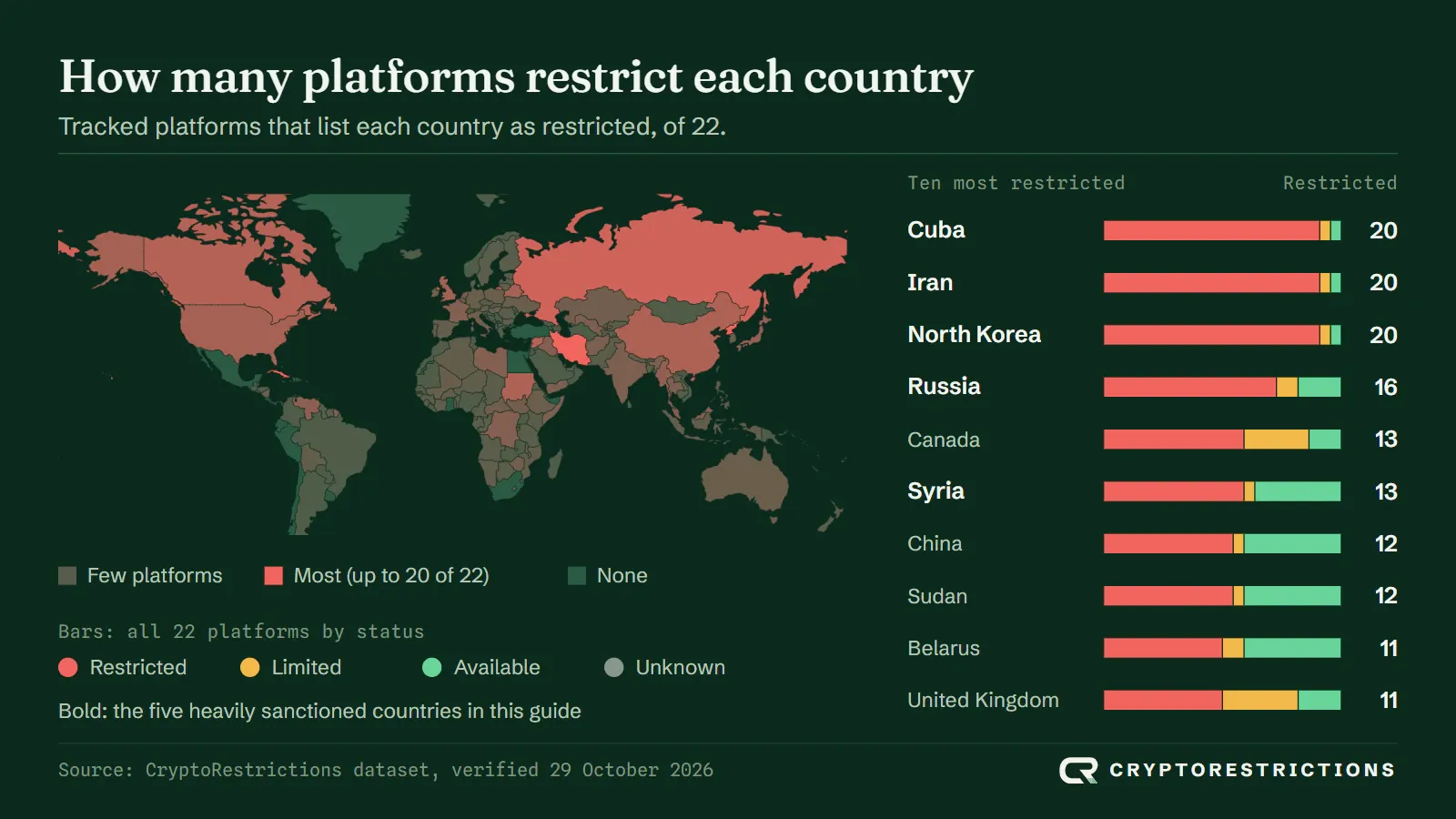
Sanctions are not the only driver. Canada, the United States and China also rank near the top, for licensing and regulatory reasons.
Syria is the instructive case. The United States revoked its Syria sanctions programme with effect from 1 July 2025, yet 13 of the 22 platforms we track still list Syria as restricted. A platform’s country list reflects its own risk policy, and that can outlast the legal measure that first prompted it. See the country pages for Iran, North Korea, Cuba and Russia for the platform-by-platform detail and sources.
What happens to blocked crypto?
Blocking does not transfer ownership to the government. Under OFAC rules, blocked property stays the property of its owner, but nobody may access or move it unless OFAC authorizes that or the blocking requirement ends.
OFAC explains that a company holding several wallets with blocked virtual currency can block each wallet or consolidate the blocked funds into one. What matters is that no party can access or transfer the property against the sanctions rules.
Several other outcomes look similar from inside an account and rest on a different legal basis.
A provider can also allow withdrawals while it winds down a customer relationship, where the law permits. When HTX blocked UK users in August 2026, for example, it gave them a 48-hour window to withdraw. An asset freeze on a designated person works the other way: the property has to stay where it is.
How can users assess restrictions?
Identify the legal basis of a restriction before drawing conclusions from an account message or a list of unsupported countries. Five questions do most of the work.
When you research an exchange, check whether it describes a country as restricted, unavailable or only unsupported for one product. None of those words proves that cryptocurrency itself is prohibited in that country.
Compare the platform’s eligibility rules with the relevant government sanctions list and the local licensing position. Exchange terms change faster than general regulatory summaries, especially after new designations. Every status on this site links to its source and shows when it was last verified. The methodology explains how, and the full register is on the sources page.
Common questions about crypto sanctions
Can a sanctioned person use Bitcoin?
A blockchain may still process the transaction. That does not make it lawful. People and companies subject to sanctions rules are prohibited from dealing with sanctioned individuals or their property whether the payment is in Bitcoin, another cryptocurrency or fiat. OFAC applies this principle to virtual currency expressly.
Is an entire sanctioned country blocked?
Not necessarily. Some sanctions are comprehensive or geographically broad. Others target specific people, companies, sectors, transactions or services, and many carry exemptions, general licences, specific licences or humanitarian provisions. The EU’s rules on Russian nationals and residents, with their exemption for EU, EEA and Swiss nationals and residence-permit holders, show the difference.
Can an exchange freeze crypto?
A custodial exchange can restrict access to assets it controls when sanctions or other law require it. OFAC sets out how virtual currency businesses should block digital currency once they determine it must be blocked.
Are wallet addresses sanctioned?
Addresses can be listed as identifiers on a sanctions-list entry for a designated person or entity. A listed address helps screening, but sanctions analysis cannot be reduced to checking one address, because ownership rules, counterparties and other restrictions also matter.
Are sanctions and AML rules the same?
No. Sanctions restrict dealings with designated parties, prohibited transactions and specified jurisdictions or activities. Anti-money-laundering rules require firms to identify and reduce the risk of money laundering, terrorist financing and related crime.
The two systems interact. The FATF’s July 2026 update on virtual assets reports continued progress on licensing and the Travel Rule, and highlights rising risks from the misuse of stablecoins, peer-to-peer transfers through unhosted wallets, offshore providers outside effective supervision, and DeFi arrangements. A transaction can draw AML scrutiny without being prohibited by sanctions, and a sanctions prohibition can apply with no allegation of money laundering.