
The Markets in Crypto-Assets Regulation, known as MiCA or MiCAR, is the EU’s common rulebook for crypto-assets and the firms that serve them. It sets rules for token issuers, stablecoins, exchanges, custodians and other crypto-asset service providers (CASPs). Regulation (EU) 2023/1114 applies directly in every Member State.
MiCA does not make crypto universally legal, approved or risk-free. It decides which activities need authorization, what firms must disclose, how client assets are held and when a token or service may be offered in the EU.
For access, MiCA matters at two levels. A firm needs authorization to serve EU clients. A token can also face separate restrictions, depending on how it is classified and who issued it. This guide covers the position on 1 November 2026. For the status of a platform in a country, use the restriction explorer.
What is MiCA?
MiCA is Regulation (EU) 2023/1114, adopted on 31 May 2023 and published in the Official Journal on 9 June 2023. It sets one framework in place of differing national rules for crypto-assets that other EU financial law does not already cover.
It covers three areas: the offer and admission to trading of crypto-assets, the issuance of stablecoins, and the authorization and conduct of CASPs. It also contains market abuse rules, which cover insider dealing and manipulation. Article 86 applies them to acts concerning crypto-assets admitted to trading, whether the acts take place in the EU or in a third country.
What is a CASP?
A crypto-asset service provider is a firm that provides one or more crypto-asset services to clients on a professional basis and is allowed to do so under Article 59. Article 3 lists ten services:
- custody and administration of crypto-assets on behalf of clients;
- operation of a trading platform;
- exchange of crypto-assets for funds;
- exchange of crypto-assets for other crypto-assets;
- execution of orders on behalf of clients;
- placing of crypto-assets;
- reception and transmission of orders;
- advice on crypto-assets;
- portfolio management; and
- transfer services on behalf of clients.
A firm cannot call itself a CASP on its own say-so. Article 59 allows only two routes: authorization as a CASP under Article 63, or a notification under Article 60 by an already-regulated entity such as a credit institution, investment firm or electronic money institution. Authorized CASPs need a registered office in a Member State, their place of effective management in the EU and at least one director resident in the EU. A firm that is not a CASP must not use a name or marketing that suggests it is one.
When did MiCA take effect?
MiCA did not apply in one step. That is why sources can say it took effect in June 2024 or in December 2024 and both be right. The regulation entered into force on 29 June 2023, its stablecoin titles applied from 30 June 2024, and the rest applied from 30 December 2024. The dates come from Article 149 and the transitional rules in Article 143.
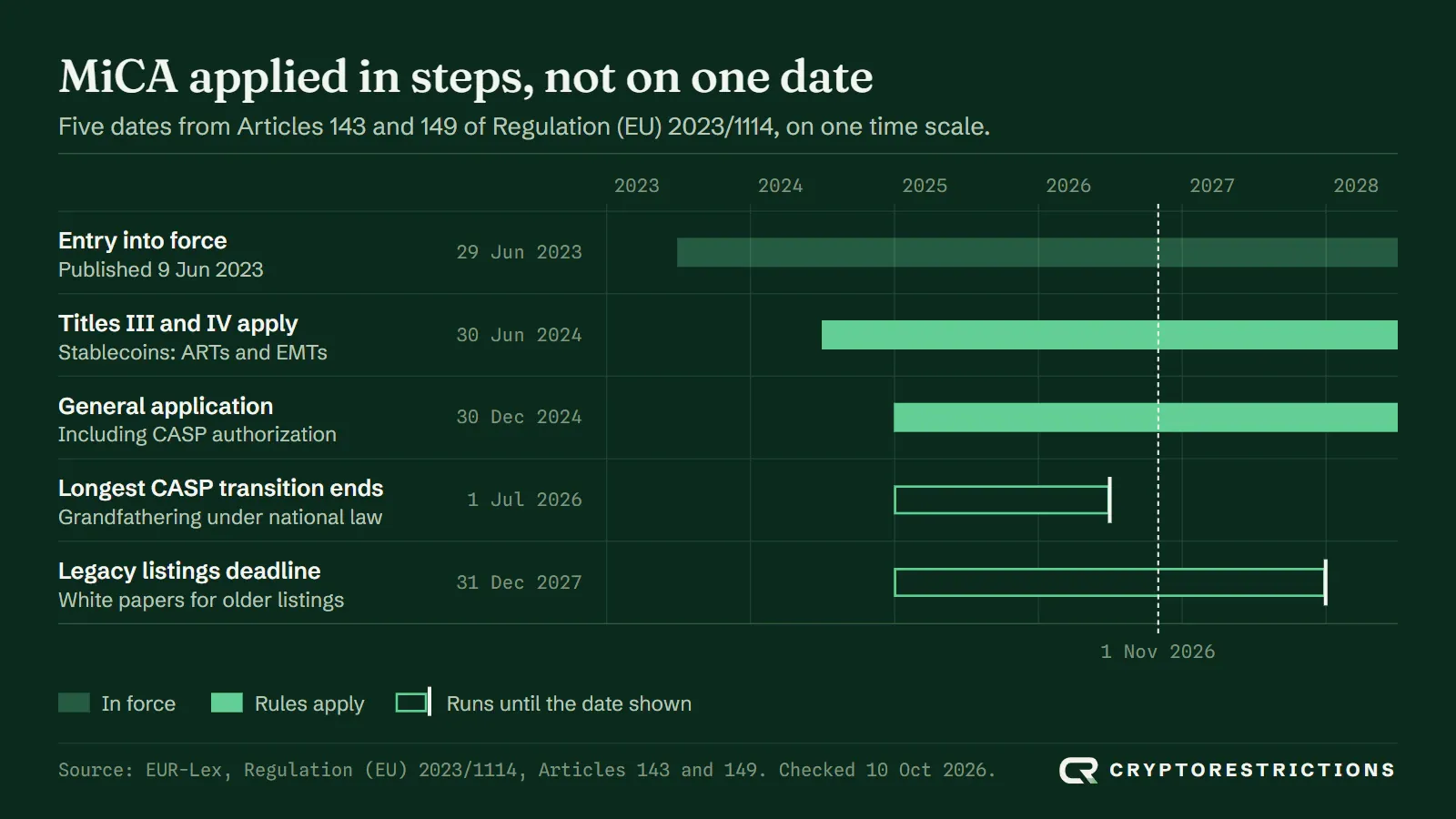
Article 149(2) sets the general date:
“This Regulation shall apply from 30 December 2024.”
Paragraph 3 makes an exception: Titles III and IV apply from 30 June 2024. Paragraph 4 applies a list of articles, mainly empowerments to adopt technical standards and guidelines, from 29 June 2023.
Article 143(2)(b) gives trading platforms until 31 December 2027 to make sure a white paper is drawn up, notified and published for crypto-assets other than stablecoins that were admitted to trading before 30 December 2024, in the cases where MiCA requires one.
The July 2026 licensing deadline
Article 143(3) lets CASPs that provided services lawfully under national law before 30 December 2024 continue “until 1 July 2026 or until they are granted or refused an authorisation”, whichever is sooner. A Member State could decline the transition or shorten it where its national rules were less strict than MiCA, and had to notify the Commission and ESMA by 30 June 2024. The transition was therefore not identical in every country. Article 143(6) also let Member States use a simplified procedure for applications submitted before 1 July 2026 by firms already authorized under national law. The text sets no extension for pending applications.
ESMA’s statement of 17 April 2026 says that after 1 July 2026 any entity providing crypto-asset services to EU clients without a MiCA licence is in breach of EU law and must stop. It adds that two groups were never covered by the transition: firms that were not providing services lawfully before 30 December 2024, and firms active in countries where the transition had already ended. ESMA said this applies whether or not a Member State has adjusted its national law to MiCA.
On 23 June 2026 ESMA issued a further statement on firms that would miss the deadline. They should stop onboarding clients and marketing at once. Their remaining services should be limited to what clients need to sell, transfer or close positions, and custody can continue only for the period strictly necessary for an orderly exit. ESMA also reminded clients of unauthorized providers that they do not benefit from MiCA safeguards, including protections for client assets.
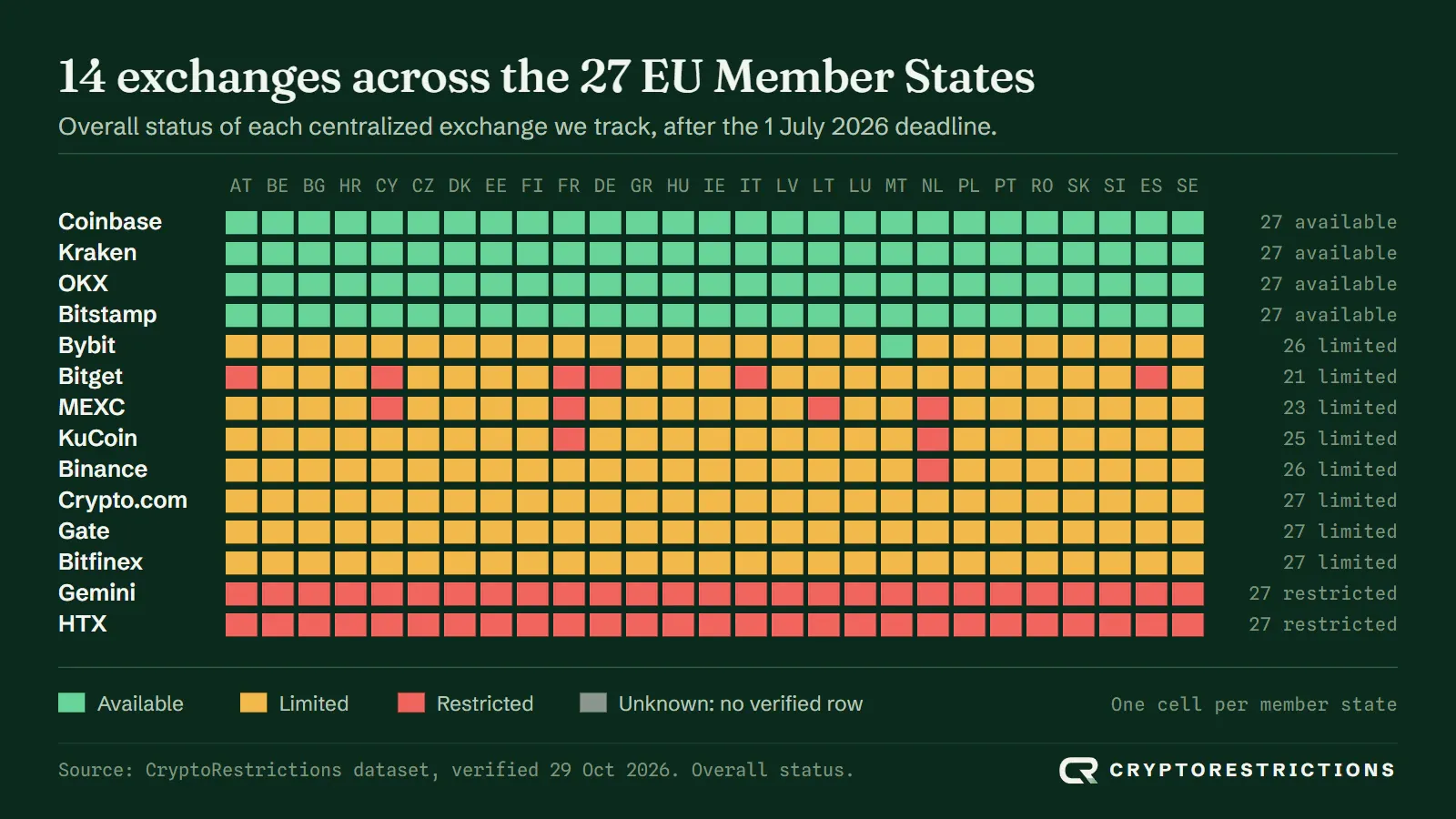
Registration under an earlier national regime was therefore not the same as a MiCA authorization. Our dataset records Binance as limited in 26 EU Member States because it had no MiCA authorization at the 1 July 2026 deadline: new sign-ups, deposits and trading are closed, while existing users can still withdraw. In the Netherlands, which Binance left in July 2023, it is recorded as restricted. See the Binance page and our guide to Binance alternatives.
In our dataset, verified 29 October 2026, four of the 14 centralized exchanges we track are available in all 27 EU Member States (Coinbase, Kraken, OKX and Bitstamp), and two (Gemini and HTX) are restricted in all 27. Eight hold a MiCA authorisation, but Bybit, Crypto.com and Gate are limited because their EU entities offer spot trading and no derivatives, and KuCoin is limited in 25 and restricted in France and the Netherlands. Binance is limited in 26 and restricted in the Netherlands. Bitget is limited in 21 and restricted in six, and MEXC is limited in 23 and restricted in four.
Two cases stayed open after the deadline. Binance withdrew its Greek application on 24 June 2026 and said it would seek authorisation in another Member State. Bitget EU applied to Austria’s FMA on 2 July 2026, the day after the transition ended, and says it will offer services only once authorised. Neither company has an entity in ESMA’s register, which was updated on 30 October 2026 and lists 389 authorised entities.
Which crypto assets does MiCA cover?
MiCA sorts covered crypto-assets into three types rather than treating Bitcoin, stablecoins and utility tokens alike:
- crypto-assets other than asset-referenced tokens and e-money tokens;
- asset-referenced tokens (ARTs); and
- e-money tokens (EMTs).
The first group covers most conventional crypto-assets and utility tokens. What applies to them depends on their structure and on whether another EU financial law already governs them.
Ordinary crypto-assets
For these assets MiCA relies mainly on disclosure. Where a white paper is required, Article 6 says it must cover the offeror, the issuer, the project, the offer, the crypto-asset, its rights and obligations, the underlying technology, the risks and the climate and environmental impacts of the consensus mechanism. Article 6 also sets the content of the warnings. A white paper must say that the crypto-asset may lose its value in part or in full, may not be transferable or liquid, and is not covered by investor compensation schemes or deposit guarantee schemes.
A white paper is not a regulatory approval. Article 6(3) requires this statement on the first page:
“This crypto-asset white paper has not been approved by any competent authority in any Member State of the European Union. The offeror of the crypto-asset is solely responsible for the content of this crypto-asset white paper.”
Environmental disclosures
The environmental rule is a disclosure rule. White papers must describe the principal adverse impacts of the consensus mechanism, and Article 6(12) tasks ESMA, working with the EBA, with drafting technical standards on the sustainability indicators. Article 66(5) requires CASPs to publish that information for each crypto-asset they serve. Nothing in these provisions bans proof-of-work, Bitcoin mining or Bitcoin trading.
How does MiCA regulate stablecoins?
Stablecoins get the strictest treatment because their issuers can create risks similar to those of payment systems and electronic money. MiCA splits them into e-money tokens and asset-referenced tokens. For the wider picture across the US, UK and Asia, see our stablecoin regulation guide.
E-money tokens
An e-money token purports to keep a stable value by referencing one official currency. Dollar-backed and euro-backed stablecoins can therefore be EMTs. The issuer must generally be a credit institution or an electronic money institution (EMI), and the token needs a published white paper.
Circle is the main example. It announced on 1 July 2024 that its French entity had obtained an EMI licence from the ACPR and could issue USDC and EURC under MiCA. Circle’s USDC white paper, published on 10 July 2026, identifies Circle Internet Financial Europe SAS as an EMI registered with the ACPR under number 17788. It also records that Circle’s French entity obtained a CASP licence from the AMF in April 2026 (number E2026-005) to provide custody and transfer services. Circle says it provides those services under Article 60, which lets an EMI offer custody and transfers for the e-money tokens it issues after notifying its regulator.
Asset-referenced tokens
An ART is a crypto-asset that is not an e-money token and purports to keep a stable value by referencing another value or right, or a combination, including one or more official currencies. Issuers other than credit institutions need authorization under Article 21 and must constitute and maintain a reserve of assets at all times under Article 36. The reserve must be legally segregated from the issuer’s own estate.
The ART and EMT rules have applied since 30 June 2024, six months before the general date.
Why USDT and other tokens face restrictions
The Regulation does not name any token. The words Bitcoin, Tether and USDT do not appear in its text. Restrictions arise when a token falls within the ART or EMT definitions and its issuer or offering does not meet the requirements.
ESMA’s statement of 17 January 2025 set the first expectations. National authorities should ensure CASP compliance no later than the end of the first quarter of 2025. Trading platforms were expected to stop making non-compliant ARTs and EMTs available for trading. Order execution, order reception and exchange services were to stop where they amounted to an offer to the public. CASPs could keep services on a sell-only basis until the end of the first quarter to let investors exit. ESMA said mere custody and transfer should remain possible.
That changed on 8 October 2026. ESMA’s opinion says CASPs should stop providing the full range of MiCA crypto-asset services in relation to non-compliant stablecoins, including trading platforms, exchange, order execution, placing, order transmission, advice, transfers, custody and portfolio management. National authorities should require remediation of remaining exposures within three months of publication, which is about 8 January 2027. Any continued activity should be strictly limited to liquidation, conversion, withdrawal, transfer or safekeeping.
Exchange restrictions show the impact
Platform policies show how those expectations reach users. A restriction on one exchange is a platform decision responding to the rules, and it differs from a law that bans a token.
Coinbase’s help page on non-compliant stablecoins says it can no longer support certain stablecoins for EEA customers. It lists 14: USDT, PAX, PYUSD, GUSD, GYEN, DAI, BUST, UST, RAI, PAXG, MUSD, USD1, USDS and TGBP. Buying, selling and converting them is restricted. Customers had until 30 October 2026 to withdraw, and on that date Coinbase said it would convert remaining balances at the market rate, into USDC where suitable or into another supported asset or currency. The page says it applies to retail customers.
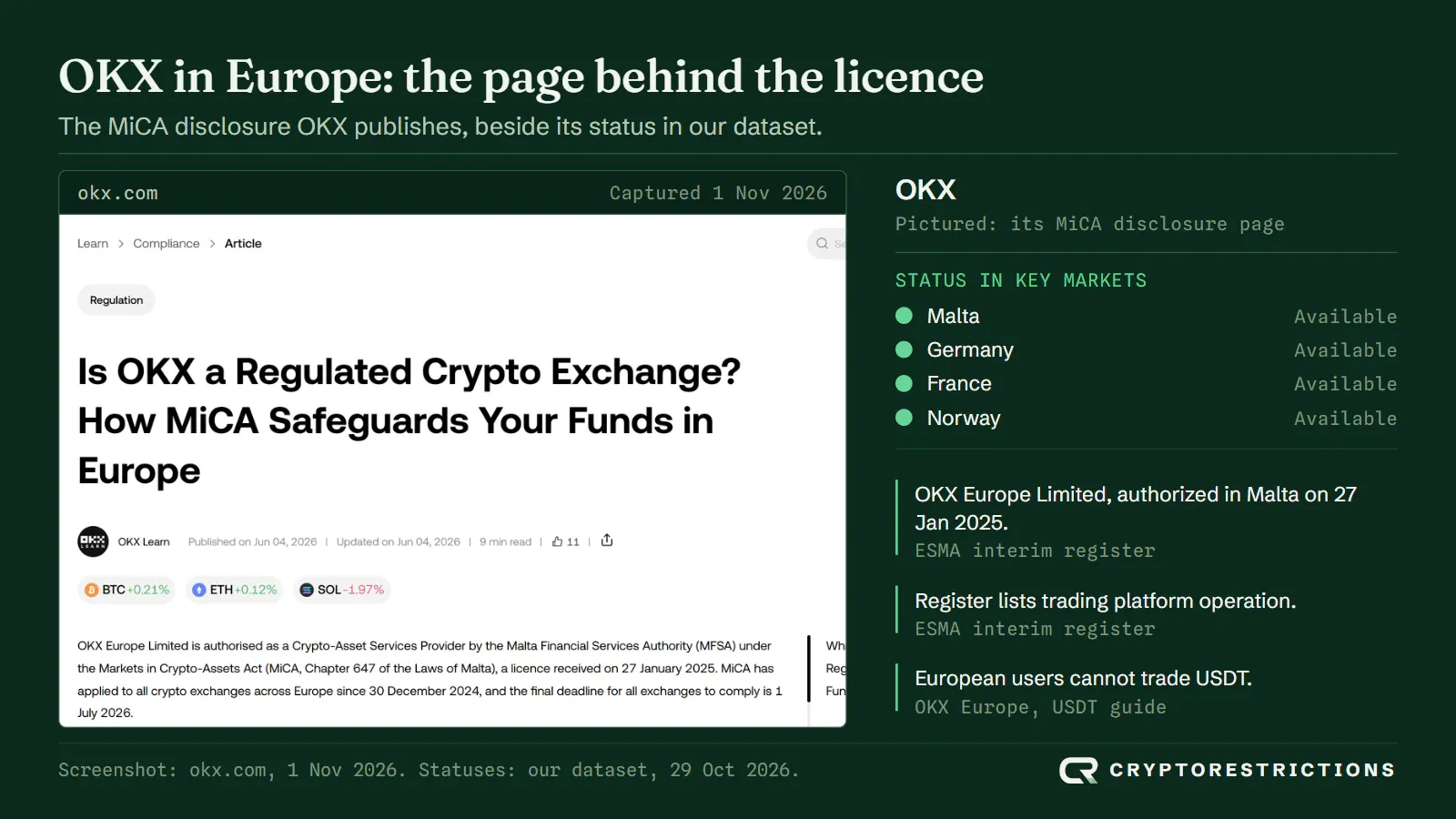
Kraken’s licensing page, last updated on 30 September 2026, says EEA clients cannot deposit or trade a long list of tokens that includes USDT, DAI, PYUSD, RLUSD, USDS, USD1 and USDE. An earlier Kraken notice, last updated on 13 April 2026, listed nine delisted stablecoins that could still be deposited or withdrawn but not traded. The two pages differ, so check the current one. OKX Europe says in its USDT guide that European users cannot trade USDT because Tether has not obtained MiCA authorization.
“Restricted on Coinbase for EEA users” is more precise than “illegal in Europe”. Which stablecoins a platform restricts is its own implementation of the rules.
What must crypto providers do?
Authorization under MiCA involves more than a company registration or an AML filing. CASPs must meet requirements on governance, capital, client protection, safeguarding and operations. The Regulation also puts limits on outsourcing. A CASP that provides custody can use another custody provider only if that provider is itself authorized under Article 59 (Article 75(9)). ESMA’s April 2026 statement draws the consequence: non-EU firms cannot serve EU clients through a business-to-business arrangement or through delegation of custody.
Minimum capital requirements
Article 67 requires a CASP to hold prudential safeguards equal to at least the higher of two amounts: the permanent minimum capital in Annex IV for the services it provides, or one quarter of its fixed overheads for the preceding year. Annex IV sets three classes.
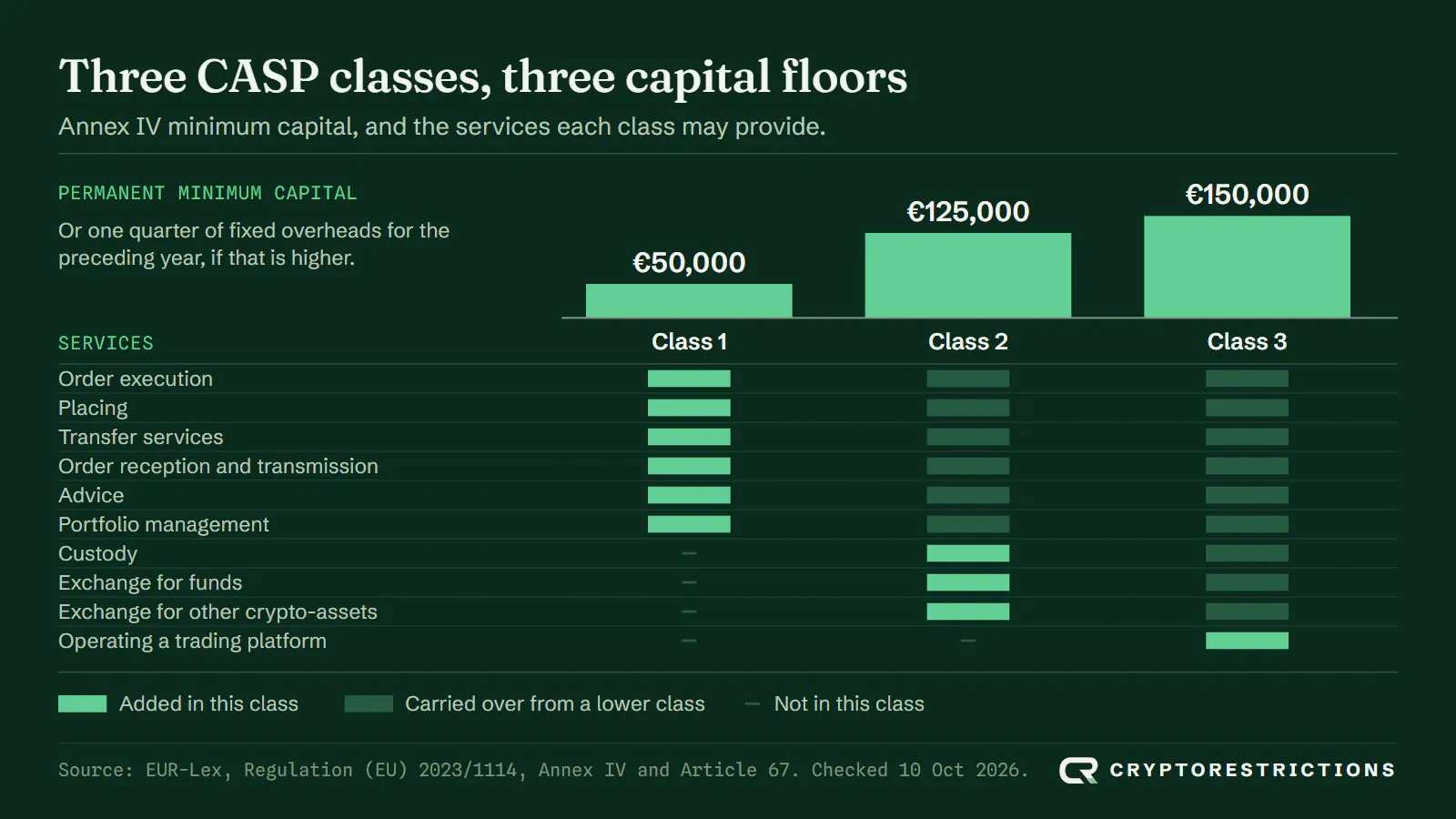
Annex IV assigns one amount per class, so a firm authorized for class 3 services does not add the lower amounts together. The Annex IV figure is a floor. A large exchange can be required to hold more if a quarter of its fixed overheads is higher.
Custody rules
Custody matters because users lose assets when a platform fails or mixes customer holdings with its own. Article 75 requires a CASP that provides custody to:
- sign an agreement with each client that sets out duties, the custody policy and the security systems used;
- keep a register of positions in each client’s name;
- have a custody policy that minimizes the risk of loss through fraud, cyber threats or negligence;
- send clients a statement of position at least every three months;
- have procedures to return assets or the means of access as soon as possible; and
- segregate client holdings from its own, legally, operationally and on the ledger.
Legal segregation means creditors of the CASP have no recourse to crypto-assets held in custody, in particular in an insolvency.
A CASP is liable to clients for the loss of crypto-assets or the means of access if the loss results from an incident attributable to it. Liability is capped at the market value of the lost asset at the time of loss. Incidents not attributable to the CASP include events that occurred independently of its service, such as a problem inherent in the operation of the ledger.
MiCA does not turn crypto balances into bank deposits. White papers under Article 6 must state that the crypto-asset is not covered by deposit guarantee schemes or by investor compensation schemes. Article 75 protects client assets through segregation and liability, not through insurance.
Trading platform obligations
Article 76 sets the duties of CASPs that operate a trading platform. They must:
- publish clear operating rules that cover admission, exclusion categories, fees, access, suspension and settlement;
- refuse to admit a crypto-asset for which a required white paper has not been published;
- assess the suitability of each asset before admission, including the reliability of its technical solution and any link to illicit or fraudulent activity;
- refuse assets with an inbuilt anonymisation function unless holders and their transaction history can be identified;
- not deal on their own account on the platform they operate;
- tell their regulator about market abuse or attempted abuse;
- publish bid and ask prices and the price, volume and time of executed trades;
- start final settlement on the ledger within 24 hours; and
- keep order data available to the regulator for at least five years.
How MiCA affects crypto exchanges
MiCA replaces much of the country-by-country licensing patchwork with an authorization that works across the EU. Under Article 59(7) a CASP may provide services throughout the Union, through a branch or on a cross-border basis, without a physical presence in each host country. Under Article 65 a CASP that wants to serve more than one Member State gives its home regulator a list of countries and services. The home regulator passes that information to the host countries, ESMA and the EBA within 10 working days, and the CASP can start from receipt of that communication or from the 15th calendar day after it submitted its information, whichever comes first.
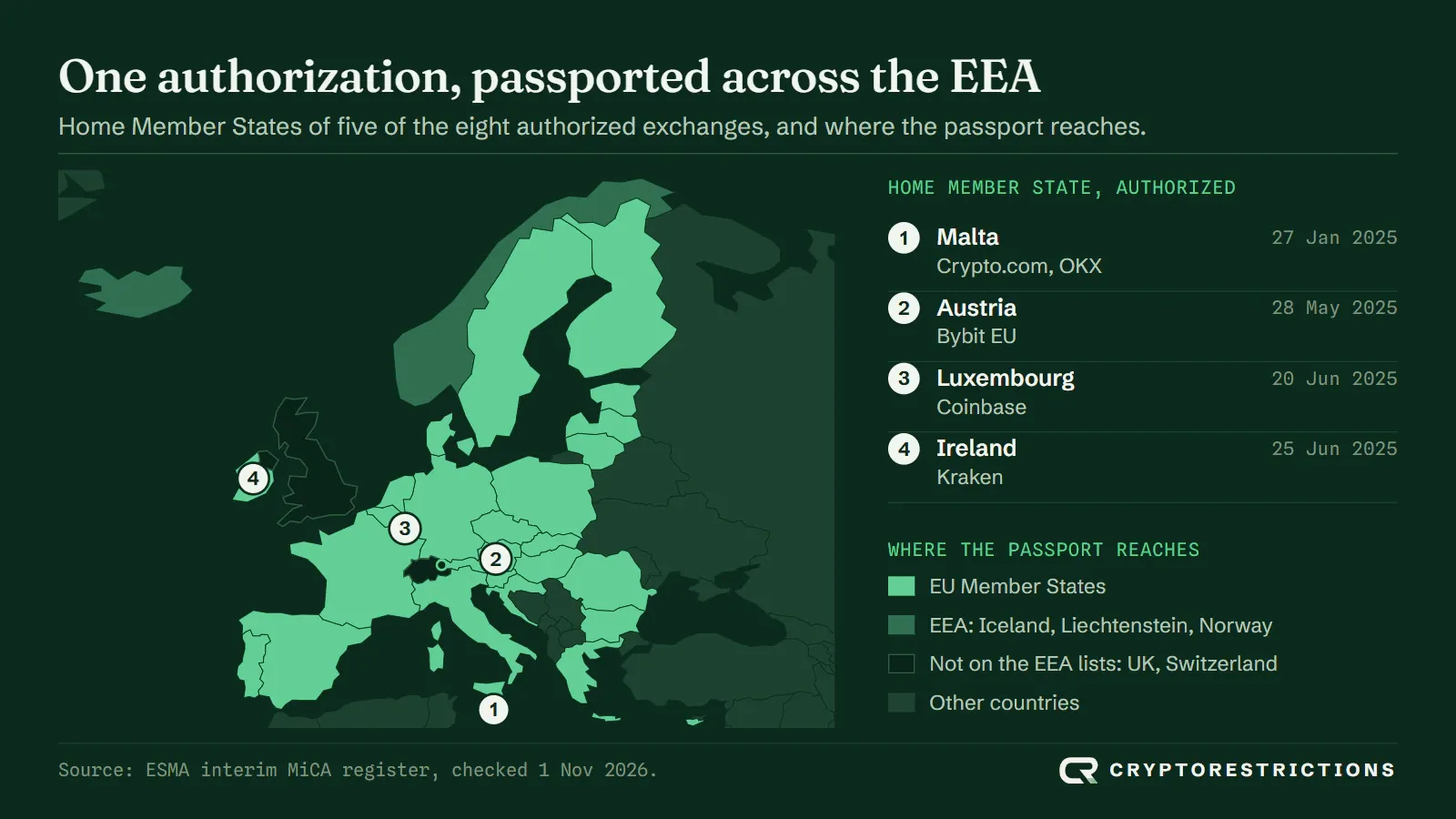
The passport extends to the EEA. Kraken says it is live in all 30 EEA countries, and Coinbase’s migration schedule includes Iceland, Liechtenstein and Norway. Large exchanges serve EU clients through dedicated EU entities such as those below.
Examples of MiCA-authorized exchanges
Eight of the 14 centralized exchanges we track hold a MiCA authorisation, and five are covered below. The dates are from ESMA’s interim register of CASPs. Our dataset records Coinbase, Kraken and OKX as available in Germany and France, and Bybit and Crypto.com as limited there, because their EU entities offer spot trading without derivatives.
Crypto.com announced on 27 January 2025 that Foris DAX MT Limited was authorized by the Malta Financial Services Authority for custody, exchange for funds and for other crypto-assets, order execution, order reception and transmission, and transfers, as its release states.
OKX says OKX Europe Limited received its authorization from the same regulator on 27 January 2025. The register lists the operation of a trading platform among its services. See Malta.
Bybit EU GmbH was granted authorization by the Austrian FMA under an administrative decision of 28 May 2025. The FMA’s notice lists five services: safekeeping and management of crypto-assets, conversion to funds, swapping one crypto-asset for another, placing and transfers. Trading platform operation is not among them. Bybit announced the licence on 29 May 2025 and said it had established its European headquarters in Vienna. See Austria.
Coinbase secured authorization from the CSSF in Luxembourg, announced on 20 June 2025. Its European disclosures state that Coinbase Luxembourg S.A. is authorized as a crypto-asset service provider by the CSSF under number N00000004. See Luxembourg.
Kraken received its MiCA licence from the Central Bank of Ireland, announced on 25 June 2025, and activated services in all 30 EEA countries by 12 August 2025. Its licensing page names two Irish CASP entities: Payward Europe Solutions Limited for most services, and Payward Global Solutions Limited to operate a trading platform. See Ireland.
The register also lists Bitstamp Europe S.A. (CSSF, 15 May 2025), Gate Technology Limited (MFSA, 29 September 2025), KuCoin EU Exchange GmbH (FMA, 27 November 2025) and Gemini Intergalactic EU Ltd (MFSA, 21 August 2025). An entry is not the same as a live service. KuCoin EU’s homepage says trading and deposits have been suspended since 4 February 2026, and Gemini closed its EEA accounts in April 2026.
These examples show why the legal entity matters. A global brand can include European, American and other regional companies. ESMA’s April 2026 statement warns that MiCA protections apply only to the specific authorized EU legal entity, not to other companies of the same group and not to non-EU entities, and that a provider may use the same brand across several companies.
Check the ESMA register
ESMA keeps an interim MiCA register as five files: CASPs, white papers for crypto-assets other than ARTs and EMTs, ART issuers, EMT issuers and non-compliant entities. The ESMA MiCA page listed them as last updated on 30 October 2026 when we checked on 1 November 2026. The CASPs file held 389 authorised entities. The register is a better test of authorization than an exchange’s marketing.
What does MiCA restrict?
MiCA can limit access in several different ways. A user may meet a restriction because the provider lacks authorization, because a stablecoin issuer does not meet MiCA, because a platform decides an asset does not satisfy its listing rules, or because another EU law governs the product. These words are not synonyms, and we use them as follows.
A stablecoin that a regulated platform has stopped serving may still be transferable between self-hosted wallets. A CASP’s inability to trade or hold a token does not by itself make owning the token an offence.
Non-EU exchanges face limits
MiCA also matters for exchanges based outside Europe. Article 61 contains a narrow exception: where a client established or situated in the EU initiates a service at its own exclusive initiative, the third-country firm does not need authorization for that service. It is not a general route into the EU market.
If the third-country firm, or anyone acting for it, solicits clients or prospective clients in the EU by any means, the service is not on the client’s own initiative. That holds regardless of any contractual clause or disclaimer saying otherwise. A client’s initiative also does not let the firm market new types of crypto-assets or services to that client.
ESMA’s final report on its reverse solicitation guidelines, dated 17 December 2024, says solicitation should be construed broadly and in a technology-neutral way. Its examples include websites, social media, mobile apps, messaging platforms, emails, retargeting of advertising, affiliation campaigns, trade fairs and sponsorship deals. It adds that brand advertising addressed to the broad public may also count. A foreign exchange that actively targets European users therefore cannot rely on reverse solicitation.
What does MiCA not cover?
MiCA is not an all-purpose law for every blockchain-based asset. Article 2 and the recitals exclude several categories.
Financial instruments
Article 2(4) excludes crypto-assets that qualify as financial instruments, deposits, funds (other than e-money tokens), insurance products, pension products and securitisation positions. Tokenized shares, bonds and derivatives that are financial instruments stay under the existing financial markets framework. Article 2(5) tasked ESMA with issuing guidelines on when a crypto-asset qualifies as a financial instrument.
NFTs
Article 2(3) excludes crypto-assets that are unique and not fungible with other crypto-assets. The exclusion is not a blanket exemption for anything sold as an NFT. Recital 11 says issuing non-fungible tokens in a large series or collection is an indicator of fungibility, and that a unique identifier alone does not make an asset unique. It also says fractional parts of a unique asset are not unique, and that authorities should look at substance over form, so features decide the classification and not the issuer’s label.
Decentralized finance
Recital 22 says MiCA applies to services and activities performed, provided or controlled, directly or indirectly, by persons, including when part of them is performed in a decentralized manner. Services provided in a fully decentralized manner without any intermediary fall outside the Regulation. The recital does not define “fully decentralised” or “intermediary”, so the boundary depends on the facts of each service.
The same recital says crypto-assets with no identifiable issuer fall outside Titles II, III and IV, which cover white papers and stablecoin issuers. CASPs that provide services in those assets are still covered.
What changes for crypto users?
MiCA gives European customers stronger protections, and it produces regional differences in what is on offer. A user may see their exchange move their account to a dedicated EU entity, ask them to accept new terms, remove stablecoins, change trading pairs or end services that ran under a national registration.
Coinbase shows the pattern. After it received its Luxembourg authorization, it moved European customers to Coinbase Luxembourg in phases and sent an email about a month before each effective date.
Coinbase’s page says customers who did not accept the updated terms had 30 days from the effective date to withdraw their assets and close their account. Open orders were cancelled on the effective date, and e-money services stayed with Coinbase Ireland.
A single authorization harmonizes who may offer services. It does not make every exchange offer the same products everywhere. Tokens, payments, derivatives and platform features can still differ because of other laws, regulators’ interpretations and business decisions. For country detail, see Germany and France.
Four checks before using an exchange
- Check the legal entity. Confirm which company holds your account instead of relying on the brand.
- Check MiCA authorization. Search the ESMA register and, where useful, the national regulator’s register.
- Check the exact product. Spot access does not imply access to derivatives, lending, staking or every stablecoin.
- Check residency rules. Restrictions often follow your legal residence and contracting entity, not your nationality.
These checks help separate a regulatory restriction from a platform’s commercial policy. Our methodology explains how we record each status and its source.
What happens after MiCA licensing?
The end of the transition does not mean implementation is finished. Supervision has moved from preparing firms for authorization to examining how authorized CASPs operate.
On 8 July 2026 ESMA launched a Common Supervisory Action on the digital operational resilience of CASPs’ custody activities. It covers governance, key and storage management, transaction controls, incident detection and response, smart contract risks and dependencies on third-party providers. National authorities carry it out on a risk-based sample of authorized CASPs from the second half of 2026 to the first half of 2027. They report to ESMA, whose final report goes to its Board of Supervisors in the second half of 2027.
Stablecoins remain an active area. The 8 October 2026 opinion shows that an exchange’s authorization does not settle every token-level question. CASPs must keep assessing whether the assets and services they offer remain compatible with MiCA, so availability can keep changing even at a fully authorized provider.
Common questions about MiCA
Is Bitcoin MiCA compliant?
“MiCA-compliant Bitcoin” is not a useful category. Bitcoin has no issuer or offeror that could seek authorization as an ART or EMT issuer or file a white paper. Under recital 22, crypto-assets with no identifiable issuer fall outside Titles II, III and IV, while CASPs that provide services in them remain covered. The question that matters is whether the provider offering Bitcoin is an authorized CASP.
Is USDT banned in Europe?
Calling USDT banned overstates the position. MiCA does not name any token. It restricts services involving ARTs and EMTs that do not meet its requirements, and ESMA’s October 2026 opinion says authorized CASPs should stop covered services involving non-compliant stablecoins, subject to limited wind-down activity.
Coinbase and Kraken therefore restrict USDT for EEA customers. That differs from saying EU residents commit an offence by holding USDT in a self-hosted wallet.
Does a MiCA licence cover all of Europe?
A MiCA authorization is granted by one EU Member State and passported across the EU under Articles 59 and 65. Firms such as Kraken and Coinbase extend it to all 30 EEA countries, including Iceland, Liechtenstein and Norway. Check the CASP’s notifications and customer terms to see which countries it actually serves.
The United Kingdom and Switzerland are not on the EEA country lists published by Coinbase and Kraken. The UK has its own regime, covered in our stablecoin guide.
Does MiCA protect users from exchange failure?
MiCA adds safeguarding, segregation, governance and custody requirements, but it cannot guarantee that an exchange will not fail or that assets will hold their value. Client crypto-assets must be segregated under Article 75, and custodians are liable for losses attributable to them, up to the market value at the time of loss. MiCA does not insure them: white papers must state that crypto-assets are not covered by deposit guarantee schemes. Other rules also shape what a regulated exchange can do for a customer, including sanctions and the travel rule.
Is every EU crypto exchange licensed?
Not every provider serving EU clients is a MiCA-authorized CASP. Article 59 allows only authorized CASPs and certain already-regulated entities that notify under Article 60. The longest transition ended on 1 July 2026, and ESMA has warned consumers to check their provider on its register. For what an exchange asks of you at sign-up, see our KYC guide.