
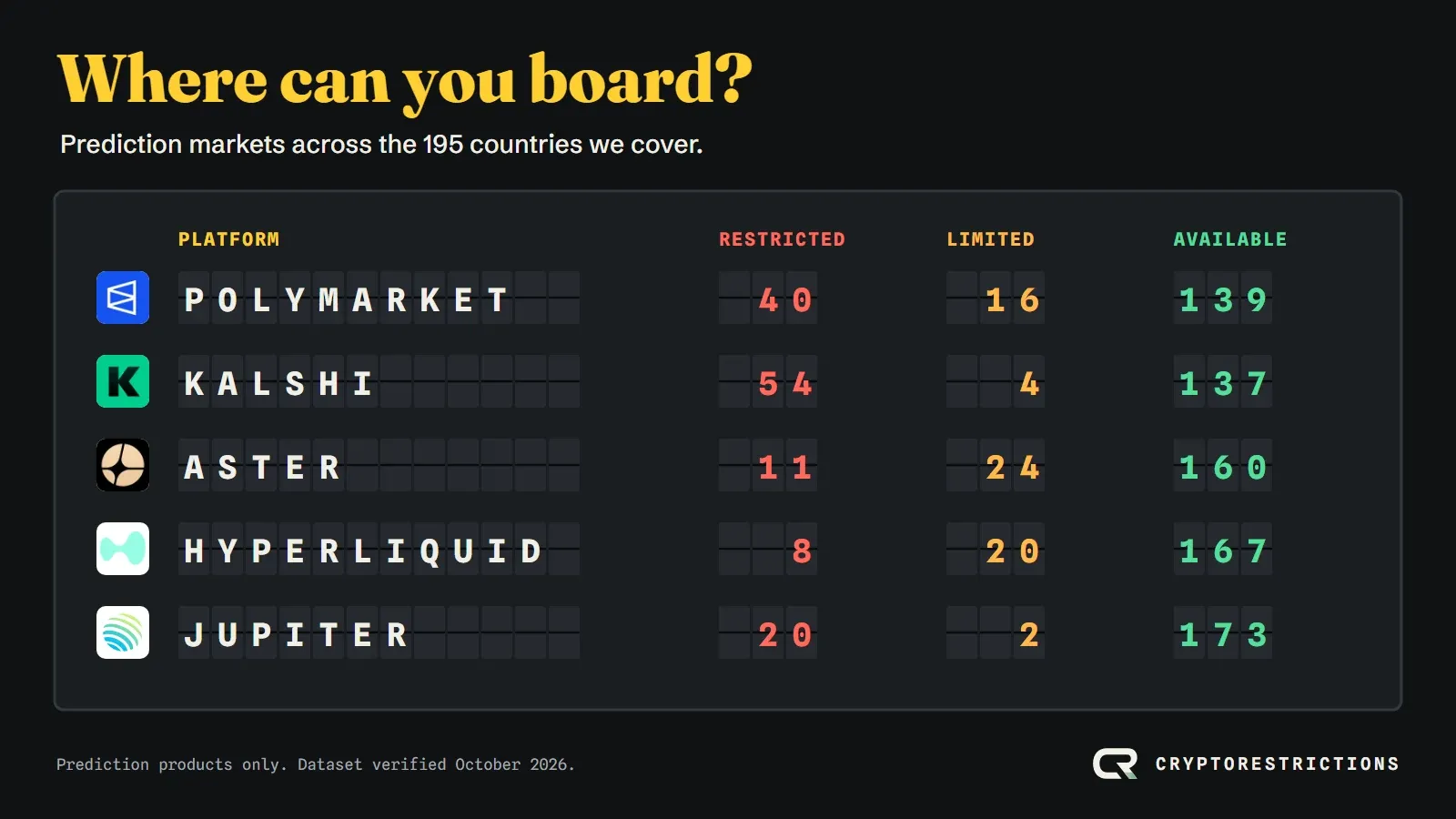
Polymarket is the platform most people name first, and it is closed to a long list of places. It refuses new trades in 40 of the 195 countries we cover and is limited in 16 more, mostly where a national regulator has ordered internet providers to block it. That leaves a practical question: which other prediction markets exist, and which of them take users in a given country?
This guide answers it from the platforms’ own terms and help pages, the CFTC’s records and our dataset. It compares availability, regulator, funding and the kinds of markets listed. It is not a recommendation of any platform or trade, and we do not track fees. For how event contracts work, read What is a prediction market?.
Which prediction markets exist besides Polymarket?
They fall into three groups, and the group decides who can use them.
- Prediction-native platforms: Kalshi, PredictIt and Manifold. Only Kalshi takes users in many countries.
- US brokers and exchanges with event contracts: Coinbase, Robinhood, Crypto.com, Gemini and Interactive Brokers, plus Polymarket’s own US exchange. Nearly all are for US residents.
- Onchain platforms: Hyperliquid, Aster and Jupiter. They need no ID check, but each can shut its prediction product in countries where the rest of the platform stays open.
Our platform pages cover Kalshi and Polymarket in full. A direct comparison of those two is a separate guide, so here they appear only as the two ends of the availability picture.
Do Polymarket and Kalshi close the same countries?
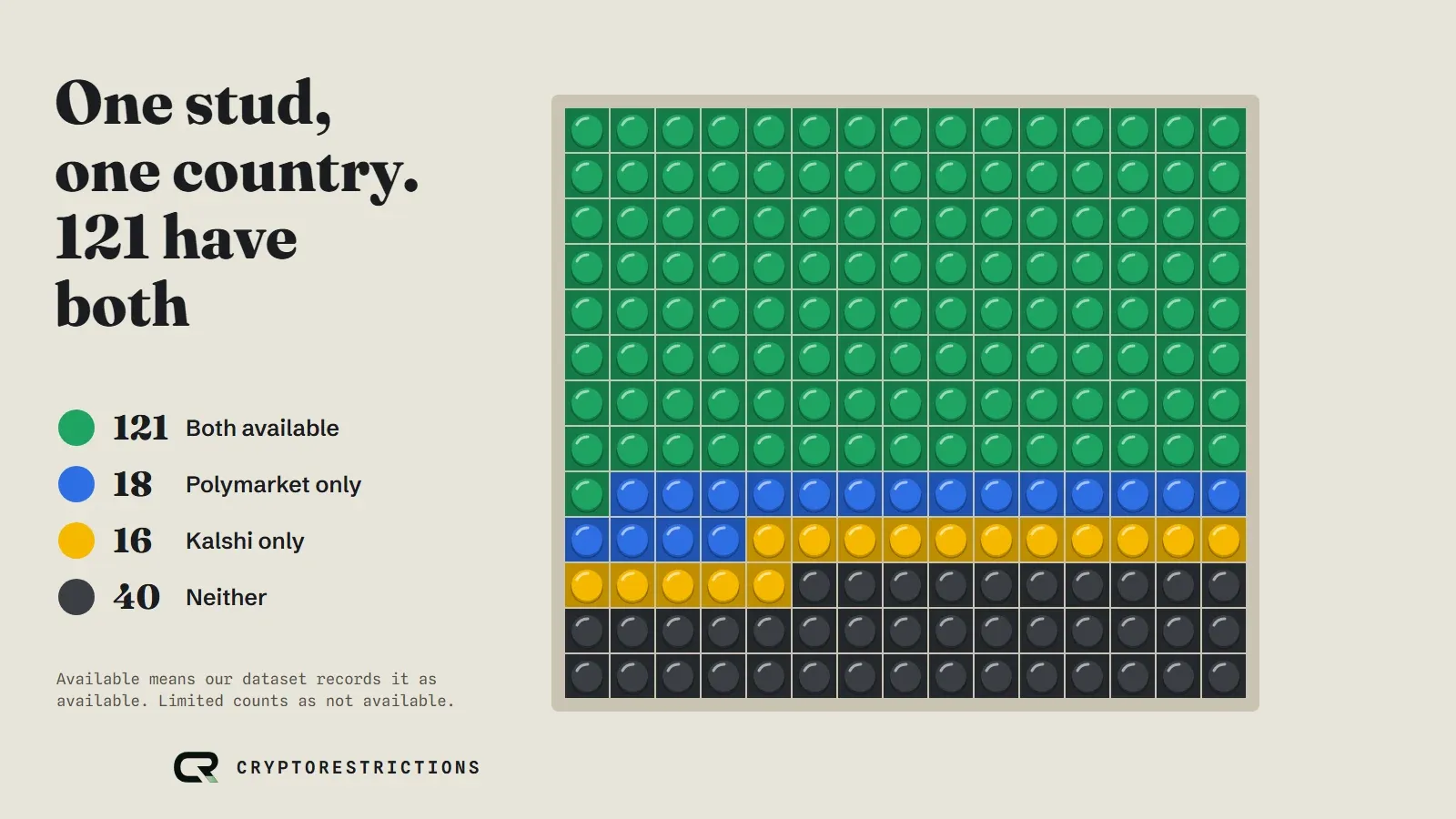
No, and the overlap is smaller than people assume. We count a platform as available in a country only when our dataset records it as available. Limited, such as a court-ordered cut of some contracts or a national blocking order, counts as not available. On that basis Polymarket and Kalshi are both available in 121 of 195 countries. Kalshi alone is open in 16 and Polymarket alone in 18, and 40 countries have neither, among them the United States, where both are limited.
The two lists have different origins. Polymarket publishes its own restricted list, which its help page and developer documentation sort into blocked, close-only and website-only tiers, and national regulators have added blocks beyond it. Kalshi’s list sits in its member agreement, and its help centre says members can trade from many countries, subject to that agreement. Germany shows the effect: Polymarket restricts it, Kalshi does not.
What are the prediction-native alternatives?
Kalshi is the broadest alternative. KalshiEX LLC was designated as a contract market by the CFTC on 4 November 2020, so its home regulator is American. It also takes members abroad. It is restricted in 54 of our 195 countries, limited in 4 (the United States, Spain, Brazil and Czechia) and available in 137. In the US, court orders make it geofence some contracts in Nevada, Washington and Michigan. Its help centre lists debit card, wire transfer from $1,000 and cryptocurrency as deposit methods for members outside the US. Contracts cover sports, elections, economics and crypto.
PredictIt is narrower. It is a not-for-profit political market that runs under CFTC no-action relief, not a licence. The CFTC’s July 2025 letter lets the Prediction Market Research Consortium operate it, lifts the old cap of 5,000 traders per contract, limits it to political events that do not involve war, terrorism or assassination, and covers offering the contracts to US persons. It sets each participant’s limit in a contract at the federal campaign contribution cap, which the letter gives as $3,500. In our dataset PredictIt is available in the United States and restricted in the other countries we hold rows for.
Manifold is not a real-money alternative. Its terms say mana, the trading currency, has no cash or redeemable value and cannot be cashed out. We list it because the search overlaps. Our dataset records it as limited in 23 countries, where only its prize drawings are closed, and available in the rest.
Which brokers and exchanges offer event contracts?
Several US firms list event contracts under their own CFTC-regulated structures or route them to a partner exchange. For a reader outside the US this group is mostly closed. Interactive Brokers is the one that names entities outside the US.
A few details matter for availability.
- Coinbase does not run its own exchange for these. Its help page says the markets are operated by Kalshi, a CFTC-regulated exchange, and are open to US residents excluding Nevada and Michigan. It says travelling abroad does not affect access. Listed markets include crypto prices, sports, weather, politics and economic data.
- Robinhood offers event contracts through Robinhood Derivatives, LLC, a registered futures commission merchant. Its restrictions page says Maryland residents cannot trade event contracts and Nevada residents cannot open new sports contracts, while its overview words the Maryland limit as sports contracts only. Michigan residents cannot open new sports contracts from 9 September 2026. Rothera, one of its exchanges, is a CFTC-licensed exchange and clearinghouse that launched in June 2026 as a joint venture with Susquehanna International Group, according to Robinhood’s second quarter filing.
- Crypto.com says its sports event trading is available in the United States only.
- Gemini says Predictions is for US users only and operated as a federally regulated exchange. The CFTC lists Gemini Titan, LLC as a designated contract market, dated 10 December 2025.
- Interactive Brokers shows event contracts from ForecastEx, Kalshi and CME Group in one platform. Its page limits them to eligible clients of Interactive Brokers LLC, Canada Inc., Hong Kong Limited, Ireland Limited and Singapore Pte. Ltd. ForecastEx is an Interactive Brokers subsidiary that received CFTC designations as a contract market and clearing organization in 2024. Its first contracts were on economic and climate indicators, and the current page adds political events. Which countries an eligible client can live in depends on those entities’ account rules, which we do not track.
The common thread is a US regulator. These products are for people the broker can onboard under US rules, and a state can still cut a contract inside the US.
What about onchain alternatives?
Three onchain platforms we track list prediction markets. None holds a licence, and none asks for ID to trade, so each enforces by location at the door.
- Aster has a separate prediction user agreement. Its service region page says orders from restricted places are rejected, and lists the United Kingdom, France, Germany, Japan, Singapore, Australia and more. In our dataset Aster is restricted in 11 countries, limited in 24 where only prediction trading is closed (Germany, France, Japan, Australia and Singapore among them), and available in 160.
- Hyperliquid calls its prediction markets outcome markets. Its trading app hid the Outcomes tab in 18 countries in our geo-access test, among them the United Kingdom, France, Japan, Australia and Singapore, while perpetuals and spot still loaded. It is restricted in 8 countries, limited in 20 and available in 167.
- Jupiter blocks United States and South Korean IP addresses from its Prediction Market API, according to its developer docs. Orders are funded in JupUSD or USDC. Its Predict FAQ says the Browse markets are currently sourced from Polymarket, so Jupiter is another route to Polymarket’s markets rather than an independent one. It is restricted in 20 countries, limited in 2 and available in 173.
How do the platforms compare by country?
The matrix shows the status our dataset records for each platform in 14 countries. Select a marked cell for the reason.
Two patterns stand out. In the United Kingdom, France and Australia, where Polymarket and Kalshi are both restricted, Jupiter is the only one of the three onchain platforms with an available status, and it mostly shows Polymarket’s markets. In Singapore none of the three is available. And a status of limited can mean three different things: a court order inside the US, a national blocking order, or a prediction product closed on a platform that otherwise works.
How do regulators and funding differ?
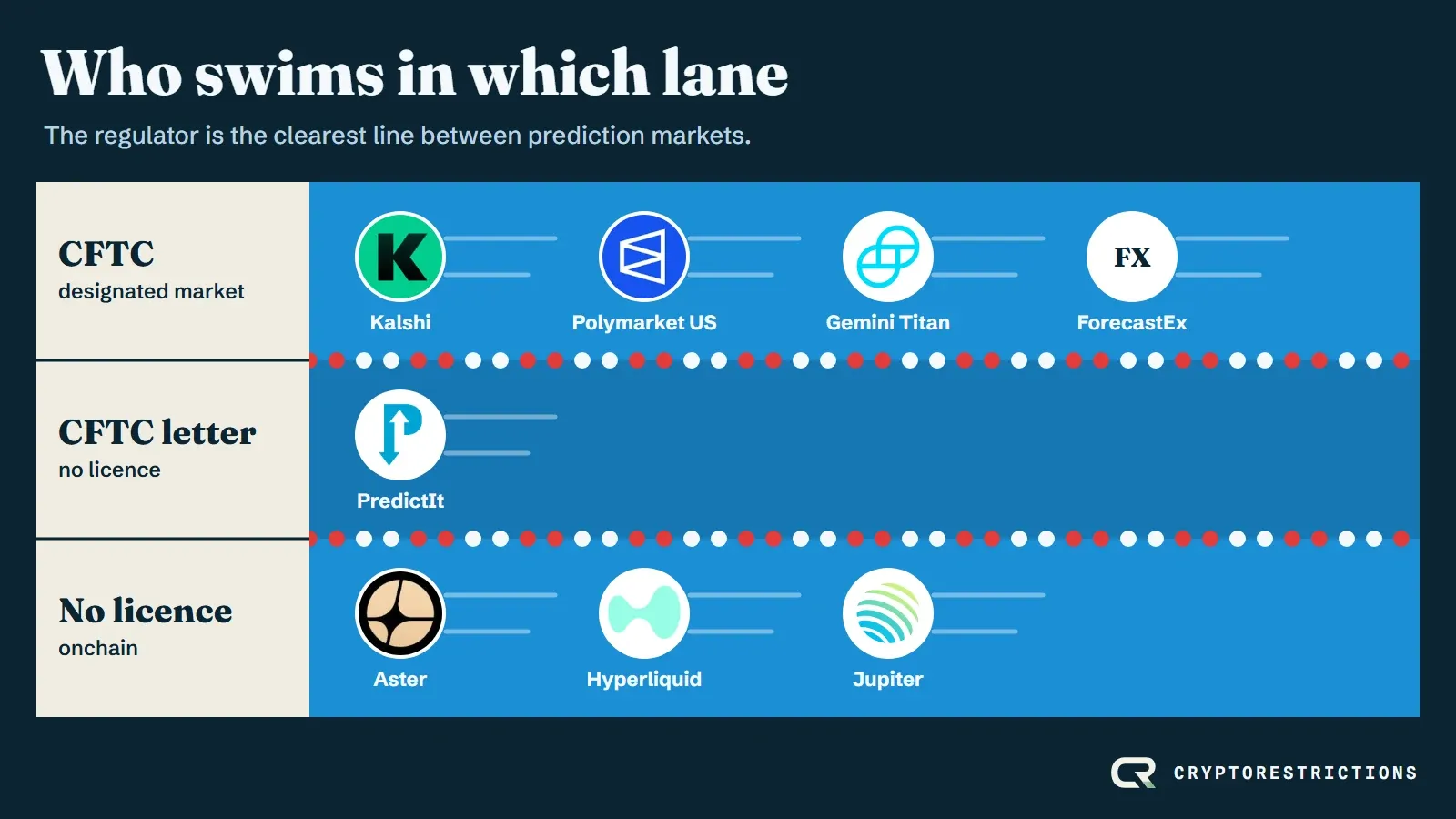
The regulator is the clearest line between groups. Kalshi, Polymarket US, Gemini Titan, ForecastEx and the exchanges behind Robinhood and Coinbase answer to the CFTC in the United States. PredictIt answers to a CFTC letter instead of a licence. The onchain platforms hold no licence, and several national regulators have acted against Polymarket and Kalshi as unlicensed gambling, which is why Spain is limited for both. Those actions are listed on the Polymarket and Kalshi platform pages.
Funding follows the same split. The US brokers settle in dollars: Coinbase takes settled USD and USDC, Crypto.com and Gemini use a USD balance. Kalshi takes card, wire or crypto from members abroad. Jupiter takes JupUSD or USDC. Polymarket’s international site trades from a crypto wallet, which our Polymarket page describes.
What this guide does not tell you
Availability in our dataset means a platform serves a country, not that local law allows prediction markets or that a platform’s licence reaches there. Several regulators treat the same products as gambling. Platform rules and lists change, and a restricted-country list is part of the terms you agree to, so check the platform’s current terms before relying on a status. We do not track fees and do not recommend a platform. For one platform in one country, use the restriction explorer.