

Only two countries have ever put Bitcoin into law as legal tender: El Salvador in 2021 and the Central African Republic in 2022. As of 2 November 2026 the Central African Republic has reversed its law, and El Salvador has kept the wording but made acceptance voluntary. We found no country where businesses must accept Bitcoin.
This page is a dated record of each law, what changed and where it stands. It does not rank countries by how friendly they are to crypto. For that, see countries where crypto is banned, and for platform access use the restriction explorer. Our access statuses describe whether platforms serve a country, so they say nothing about currency law and we did not use them here.
What does legal tender mean?
Legal tender is a rule of debt law. Money that is legal tender is a valid offer of payment: a creditor cannot refuse it as settlement of a debt. The Federal Reserve gives the US example. 31 U.S.C. 5103 makes US coins and currency legal tender for all debts, public charges, taxes and dues. The Fed adds that no federal statute makes a private business accept cash for goods or services, so the status is narrower than people assume.
The label is a legislative choice about payment, and it needs a statute. That is why this page tracks laws, not market use.
How is legal tender different from crypto being legal?
Allowing people to hold or trade crypto does not make it money in the legal sense. A country can license exchanges and tax gains while the law says nothing about payment of debts. The reverse also holds: a legal tender label tells you nothing about licensing, tax or bans.
Which countries have made Bitcoin legal tender?
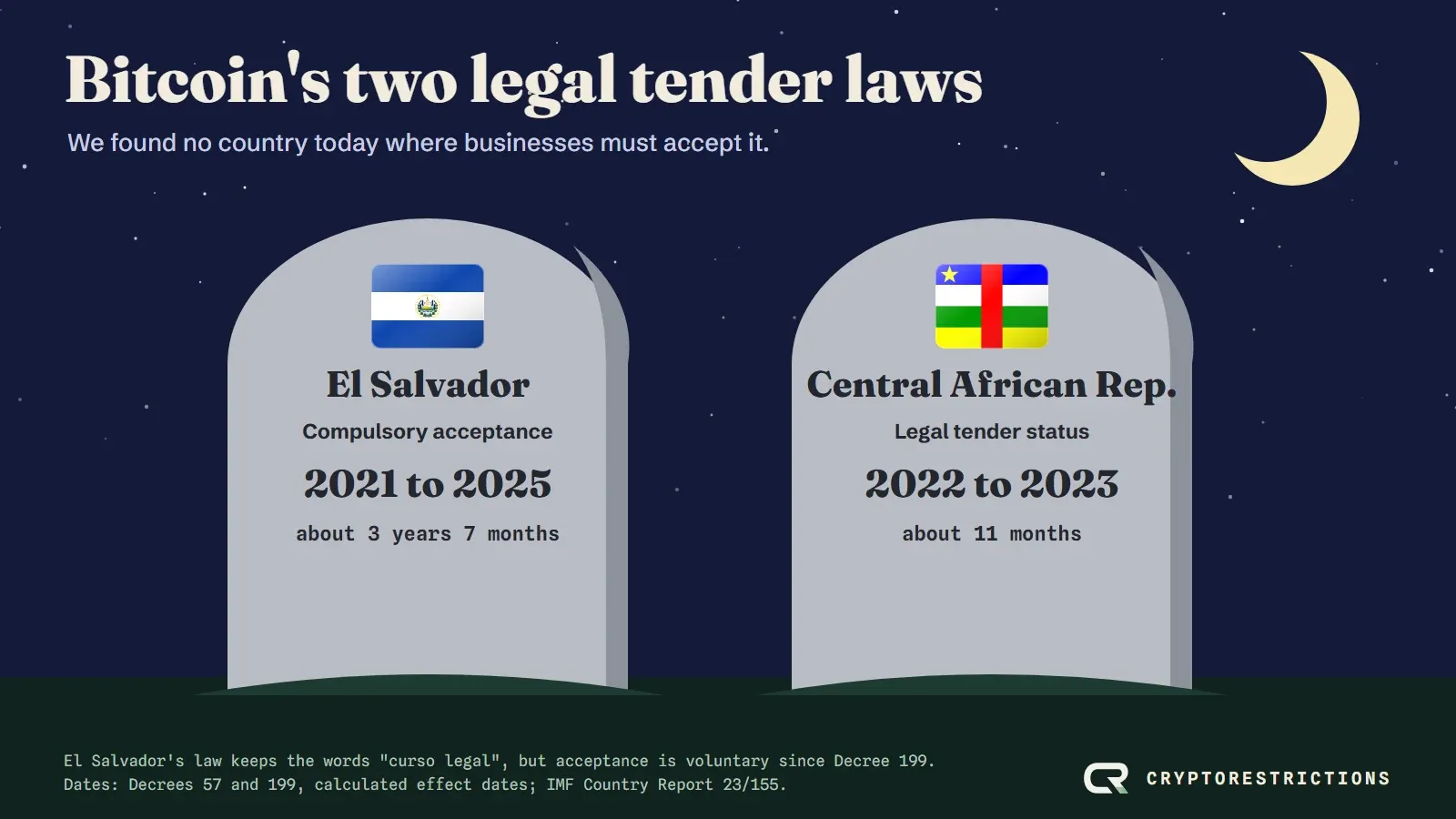
The answer to “which countries today” is therefore short: one country keeps the words in its statute, with voluntary private acceptance, and none obliges anyone to take Bitcoin. Both entries rest on the primary texts below.
El Salvador
Decree 57, the Bitcoin Law, was issued on 8 June 2021. Article 1 made Bitcoin “curso legal” with unlimited power of discharge. Article 7 required every economic agent to accept it when offered, and article 4 let taxes be paid in it. The law took effect 90 days after publication in the Diario Oficial on 9 June 2021, which we calculate as about 7 September 2021.
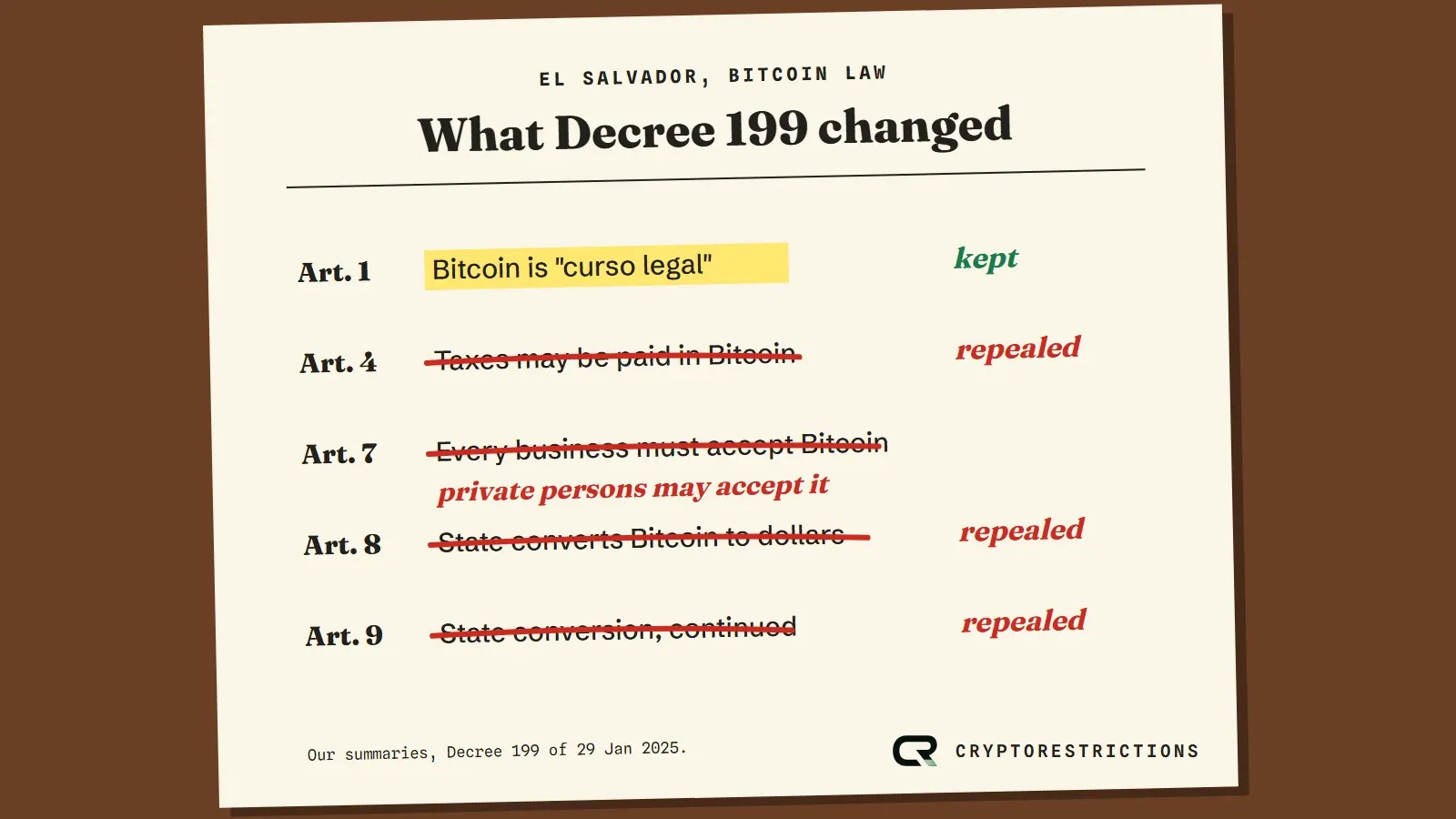
Decree 199 of 29 January 2025, published on 30 January, rewrote the law. The new article 1 keeps the words “curso legal” but adds voluntary acceptance by persons with wholly private participation. The new article 7 lets only private persons accept Bitcoin, and only when it is offered to them. Articles 4, 8 and 9 are repealed, which ends tax payment in Bitcoin and the state’s conversion alternatives. The decree took effect 90 days after publication, about 30 April 2025 by our calculation.
Press reports often say Bitcoin lost legal tender status in 2025. The text we read does not say that, so we describe it as legal tender wording with voluntary, private-sector acceptance. The consolidated text of the Bitcoin Law is the one to check for any later change.
The IMF links the change to its programme. Its release of 26 February 2025 lists legal reforms making private-sector acceptance voluntary and tax payments only in US dollars. On 3 September 2026 staff said public participation in the Chivo wallet had been substantially unwound and that Bitcoin accumulated since the first review reflects private donations. On 1 October 2026 the Board completed two reviews. Our El Salvador guide covers the wider crypto rules.
Central African Republic
The IMF’s May 2023 country report names the cryptocurrency law n. 22.004 of 22 April 2022 and describes it as granting legal tender status and guaranteed convertibility to crypto assets. We did not find the original text on an official government site, so the date and the description rest on the IMF report.
The IMF says the law violated the exclusive right of the regional central bank, BEAC, to issue legal tender in the monetary union. The report adds that the regional banking supervisor COBAC had criticised it. As one of the prior actions for a new IMF arrangement, the law was amended in March 2023 to repeal the legal tender and convertibility status of Bitcoin. The authorities’ own letter in the report lists articles 1, 4, 5, 7, 10, 11, 12, 20, 22, 23 and 24 as amended. Central Banking reported on 27 March 2023 that parliament adopted the amended law unanimously on 23 March. That is a news report, so treat the day as a lead.
The IMF Board considered the programme on 27 April 2023. We could not open the Official Journal or the amended text, and the later IMF reviews of 2024 and 2025 did not load for us. We therefore state the status as of the May 2023 report and found no later law or official statement restoring it.
When did each change happen?
Does holding Bitcoin in a state reserve make it legal tender?
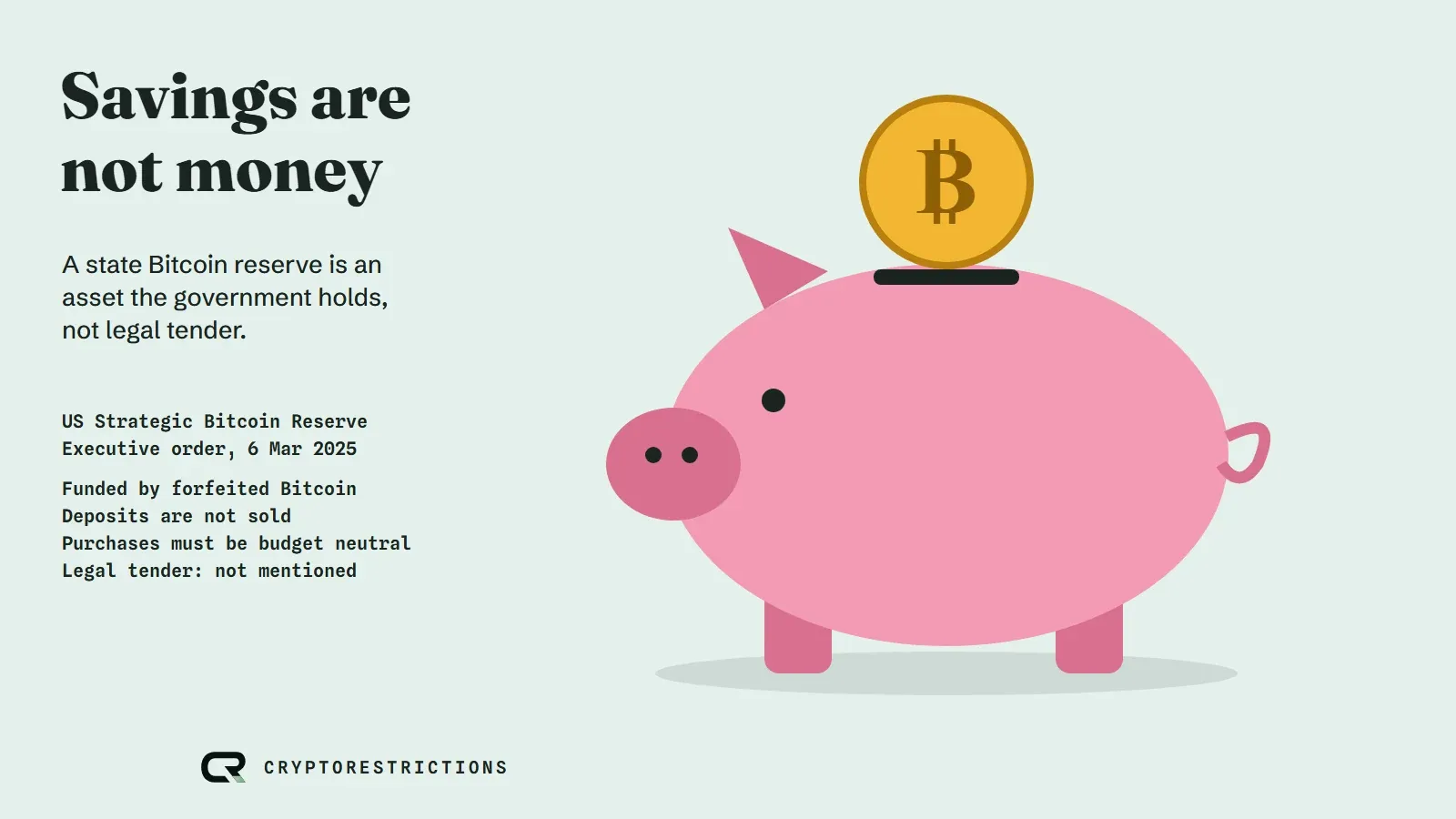
No, and this page does not count it. A reserve is an asset the government holds. The US executive order of 6 March 2025 on the Strategic Bitcoin Reserve says the reserve is capitalised with Bitcoin finally forfeited to the Treasury, that deposited Bitcoin shall not be sold, and that any acquisition strategy must be budget neutral. The order does not mention legal tender, and the United States guide covers what US rules do apply to crypto.
El Salvador also holds public-sector Bitcoin. The IMF’s release of 1 October 2026 lists more transparency and disclosure of those holdings among priority actions and says no further accumulation is envisaged beyond documented donations. That is a government balance sheet matter and separate from the payment rule above.
Common questions
Is Bitcoin legal tender anywhere in 2026?
Only in the narrow sense above. El Salvador’s article 1 still says “curso legal”, with acceptance voluntary and open only to private parties. The Central African Republic repealed its provisions in 2023.
Can a shop in El Salvador refuse Bitcoin?
Under the new article 7 only private persons may accept Bitcoin, and only when it is offered to them. The compulsory acceptance rule of the 2021 article 7 is gone from the text we read.
Is Bitcoin legal to buy where it is not legal tender?
Usually yes, but that depends on the country. Legal tender status says nothing about licensing, tax or bans. Check the country guide and the list of countries where crypto is banned.