

The CLARITY Act is the common name of H.R. 3633, the Digital Asset Market Clarity Act. It is the main US attempt to write one set of market structure rules for crypto: which agency oversees which tokens, and which trading platforms, brokers and dealers must register with whom.
It is a bill. This guide describes the position on 2 November 2026 and writes every provision as what the bill would do, not what the law does. For stablecoins, which a separate law covers, see our GENIUS Act guide. For the rules that apply to US users today, see the United States page.
Is the CLARITY Act law?
No. The bill passed the House and then stalled in the Senate. The Library of Congress bill status record, the data behind congress.gov, shows these actions.
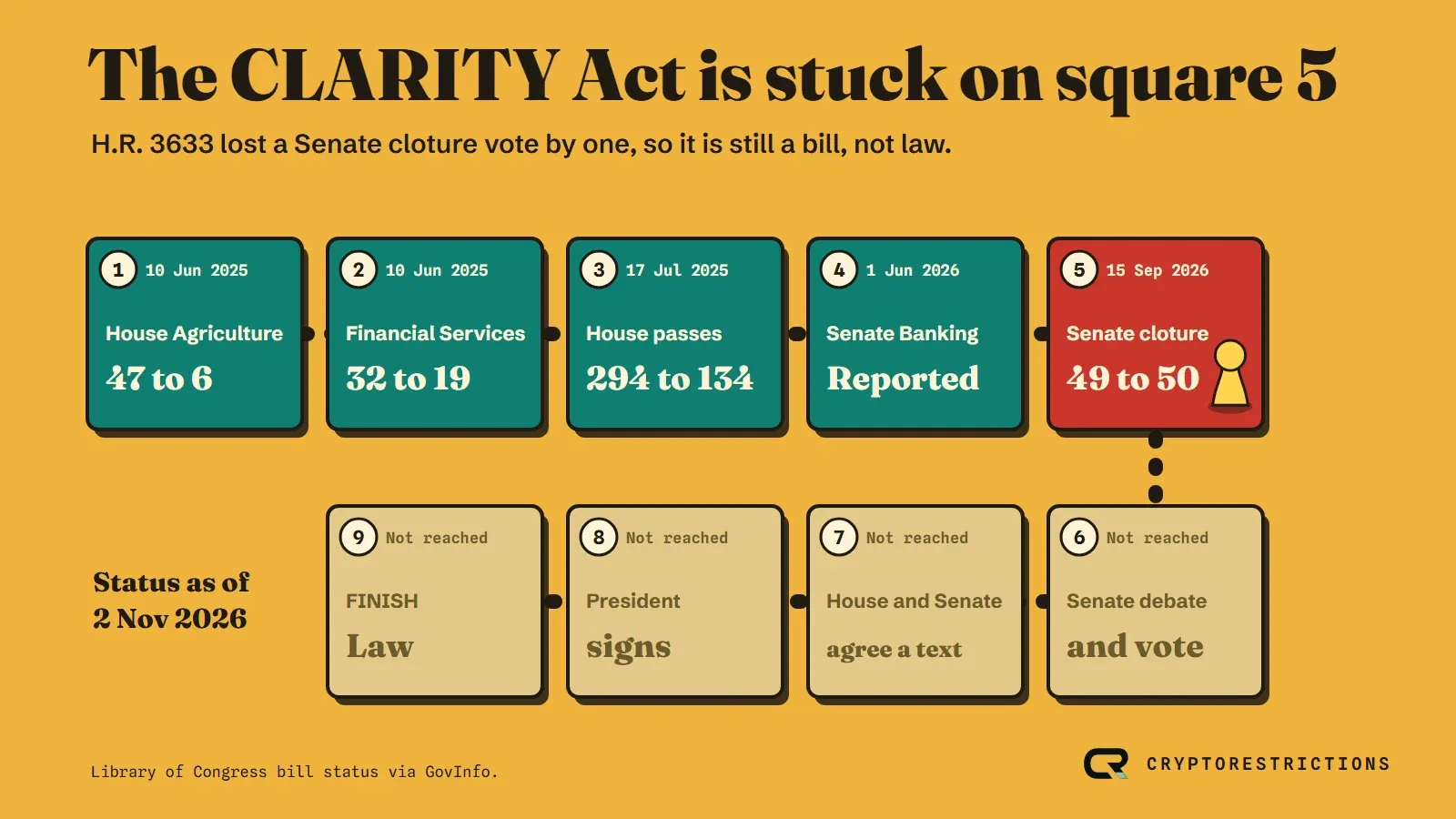
Two details matter. The 15 September vote was on cloture for the motion to proceed, so the Senate never began debate on the bill itself. And because the Senate committee reported a substitute amendment, the text before the Senate is not the House text.
We read the bill status record directly because congress.gov blocks automated reading. If a later action has been recorded, this section is out of date.
What does the CLARITY Act say?
The House-passed text has six titles. The Senate Banking Committee’s reported version, which replaces House text with a substitute, keeps the same six-title outline and the same short titles, including the Anti-CBDC Surveillance State Act. We read the House-passed text in detail and only the opening and contents of the Senate version, so the provisions below are the House text. The Senate substitute may differ on points we have not checked.
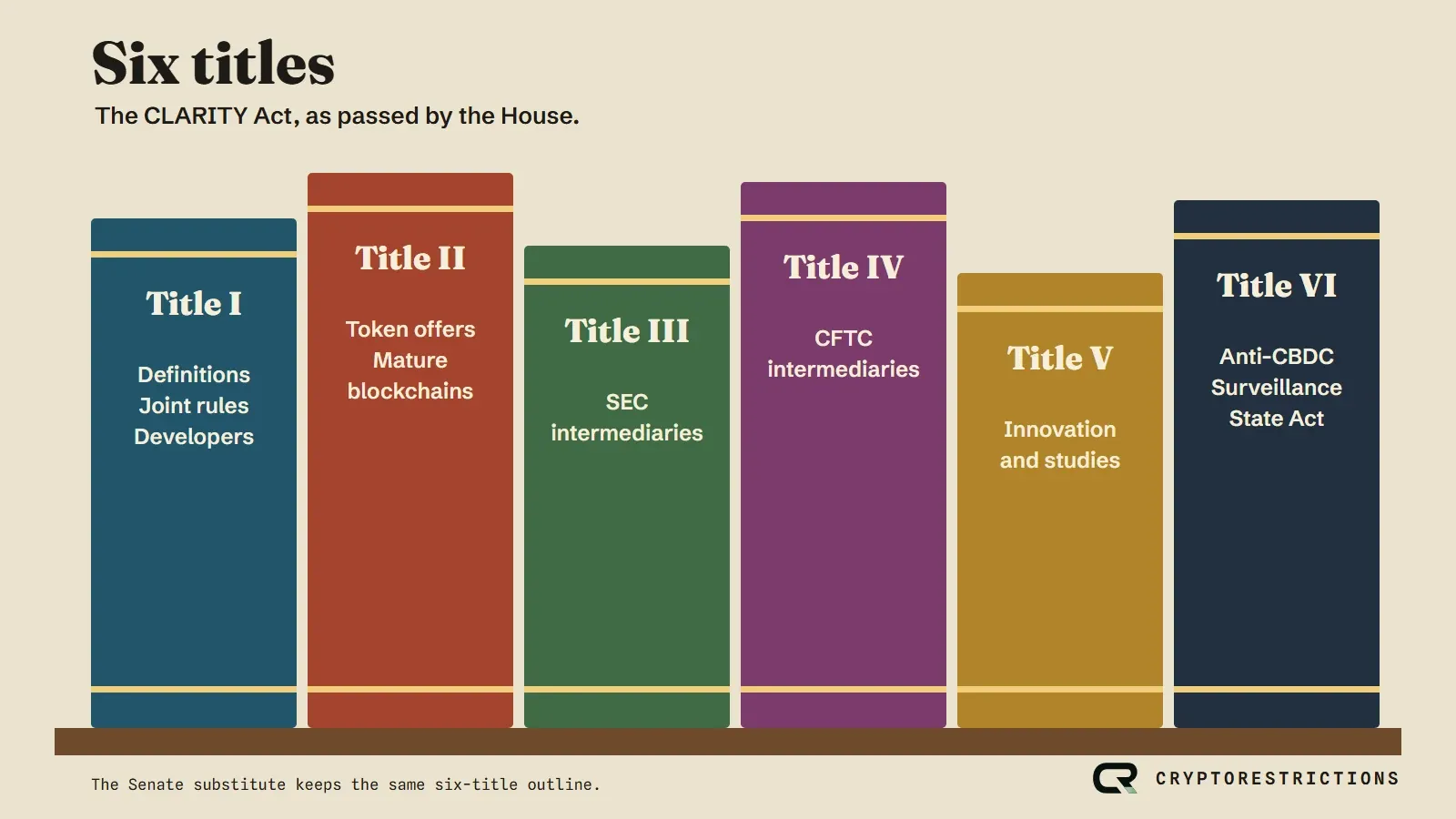
- Title I: definitions, joint SEC and CFTC rulemaking, expedited CFTC registration, savings provisions, treatment of developers and the Bank Secrecy Act.
- Title II: how token issuers may offer and sell digital commodities, and how a blockchain becomes “mature”.
- Title III: registration of intermediaries at the SEC.
- Title IV: registration of digital commodity intermediaries at the CFTC.
- Title V: innovation provisions and studies.
- Title VI: the Anti-CBDC Surveillance State Act.
What is a digital commodity?
The bill adds the term to the Commodity Exchange Act in section 103. A digital commodity is a digital asset “intrinsically linked to a blockchain system”, and its value must be derived, or reasonably expected to be derived, from the use of that blockchain system. The definition excludes securities and permitted payment stablecoins, among other things. Section 301 repeats the point on the securities side: the SEC definitions it amends do not include a digital commodity or a permitted payment stablecoin.
A “permitted payment stablecoin” is a payment stablecoin as defined in the GENIUS Act, issued by a permitted issuer. That is why the two laws fit together: the stablecoin rules live in the GENIUS Act, and this bill only carves stablecoins out.
What is a mature blockchain system?
Section 101 defines it as a blockchain system and its related digital commodity that is “not controlled by any person or group of persons under common control.” Section 205 lets a certifying party certify to the SEC that a system is mature. The section sets a 60-day period and a test that the issuer and its affiliates do not hold 20 percent or more of the units. Title II ties its ongoing reporting duties to systems that are still maturing.
How would the CLARITY Act split crypto between the SEC and the CFTC?
In short, the SEC keeps securities and the offering stage, and the CFTC gets the spot market for digital commodities. The table shows the bill against the position today.
What would the CFTC get?
Section 401 gives the CFTC exclusive jurisdiction over any account, agreement or contract involving a digital commodity, with listed exceptions. Two exceptions are visible in the text: custodial or depository activity by an entity regulated by a bank regulator, and a mixed digital asset transaction. The Commodity Exchange Act defines the latter as a transaction in which a digital commodity is traded for a security.
Section 404 requires a trading facility that offers a cash or spot market in at least one digital commodity to register with the CFTC as a digital commodity exchange. Section 405 sets up a “qualified digital asset custodian”. Section 403 lets an eligible entity certify to the CFTC that a digital commodity meets the Act’s requirements, and sets a 20 business day review for a commodity that has not been certified. Title IV takes effect 270 days after enactment (section 414).
Section 106 requires the CFTC to adopt an expedited registration process within 180 days of enactment.
What would the SEC keep?
The SEC keeps securities and the offering stage. Section 201 defines an “investment contract asset” as a digital commodity that can be exclusively possessed and transferred, person to person, without necessary reliance on an intermediary, and that is sold under an investment contract. An investment contract, in several statutes, would not include that asset.
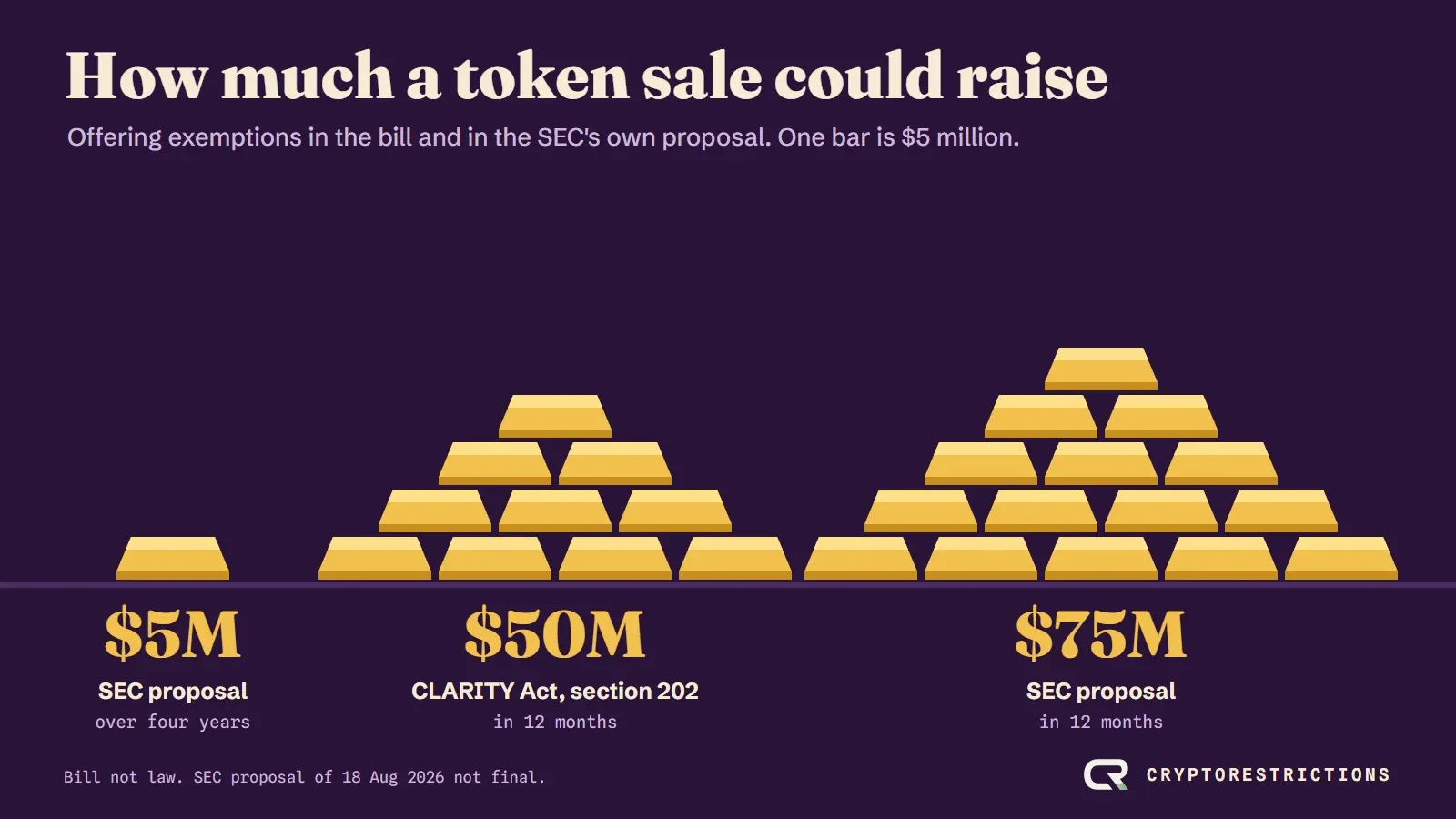
Section 202 adds an exemption to the Securities Act for the offer or sale of an investment contract involving units of a digital commodity. Total consideration in the 12 months before the offering, including that offering, may not exceed $50,000,000, adjusted yearly for inflation. A purchaser may not own more than 10 percent of the units afterwards. Issuers must file an offering statement under a new section 4B and meet ongoing reporting duties.
Section 203 says a secondary sale is not an offer or sale of the investment contract, and that an end user distribution does not involve the offer or sale of a security. Section 204 adds a duty on “digital commodity affiliated persons” not to resell improperly acquired units. Title II takes effect 360 days after enactment, subject to delays tied to rulemaking (section 206).
Title III covers intermediaries at the SEC, including trading systems and recordkeeping. Where a token is a security, the SEC rules still apply.
Who would the CLARITY Act affect?
- Spot crypto exchanges, brokers and dealers. They would register with the CFTC. Section 110 adds digital commodity brokers and dealers, and exchanges that permit direct customer access, to the Bank Secrecy Act’s list of financial institutions, and directs FinCEN to set tailored anti-money-laundering rules.
- Token issuers. They would use the new offering exemption and disclosure regime, or certify a mature system.
- Custodians. Banks and others would work under the qualified custodian rules in section 405 and the custody provisions in title III.
- Software developers. Section 109 says a non-controlling developer is not treated as a money transmitter solely because of activities such as creating or publishing software.
- Decentralized protocols. Section 309 says a person is not subject to the SEC registration title based on listed activities, but keeps the SEC’s anti-fraud and anti-manipulation authority. Section 107 leaves existing futures, swaps and securities law untouched.
- The Federal Reserve. Title VI says Federal Reserve banks may not offer a central bank digital currency directly or indirectly to an individual, and the Board may not test, study, develop, create or implement one. It exempts any dollar-denominated currency that is open, permissionless and private. Our CBDC guide covers the global picture.
For an ordinary user the effect would be indirect. Which tokens a platform lists, and which regulator supervises that platform, would change. The bill does not name individual tokens or platforms, and it would not by itself change what a country allows. Platform access in the United States stays on our Coinbase and Kraken pages.
What are US agencies doing without the bill?
Three actions in 2026 cover part of the same ground under existing law. None of them is a statute, and each can change.
17 March 2026: the joint interpretation. The SEC issued an interpretation of the term “security” as it applies to crypto assets, with a taxonomy of five groups: digital commodities, digital collectibles, digital tools, stablecoins and digital securities. It also covers how a non-security crypto asset can become subject to an investment contract and stop being subject to one, and how securities law applies to airdrops, protocol mining, protocol staking and wrapping. The CFTC joined, and said it will administer the Commodity Exchange Act consistently with the SEC’s reading and that certain non-security crypto assets could be commodities. SEC Chairman Paul Atkins said the interpretation fills the gap while Congress works on market structure legislation (CFTC release 9198-26).
18 August 2026: SEC proposed Regulation Crypto Assets. It would create a tailored offering regime for certain investment contracts involving crypto assets: an exemption for offerings of up to $5 million during a four-year period, and a second for up to $75 million in each 12-month period, with disclosure in both. It also proposes a conditional safe harbor under which a crypto asset would be deemed not subject to an investment contract once its conditions are met. It was published in the Federal Register on 21 August 2026, and comments were due on 20 October 2026 (SEC press release 2026-76). We found no final rule when we checked.
5 October 2026: CFTC advance notice. The CFTC asked for comment on a planned framework, Regulation Crypto Asset Transactions and Regulation Crypto Asset Markets, for retail commodity transactions in crypto assets under section 2(c)(2)(D) of the Commodity Exchange Act, including a “crypto asset market” subcategory of designated contract market. It is an advance notice, which asks questions before any proposed rule. The Federal Register publication was on 13 October 2026 (CFTC release 9307-26).
The agencies’ actions differ from the bill in one basic way. An interpretation, a proposal or an advance notice can be changed by a later commission, while the bill, if enacted, would be a statute. The bill’s registration duty for spot exchanges has no counterpart in these three actions.
What should you watch?
- The Senate calendar. A new cloture vote on H.R. 3633, or action on Sen. Tillis’s motion to reconsider, would appear in the bill’s action list on congress.gov.
- A Senate text that differs from the House’s. Any change would need to be reconciled with the House.
- Final agency rules. A final Regulation Crypto Assets would settle the offering questions without the bill.
- Stablecoin dates. These come from the GENIUS Act, not this bill; see that guide.
We will update this page when the bill status record shows a new action. For the rules that apply to a platform in your country today, use the restriction explorer.