

The GENIUS Act is the United States’ first federal law for payment stablecoins. It sets who may issue them, what must back them, how holders can redeem them and which intermediaries may offer them. The full name is the Guiding and Establishing National Innovation for U.S. Stablecoins Act.
It is not a licence for crypto exchanges, and it does not cover Bitcoin, tokens in general or stablecoins that are not payment instruments. This guide covers the position on 2 November 2026. For how the US compares with other regimes, see our stablecoin regulation guide. For where each platform is available to US users, use the restriction explorer.
What is the GENIUS Act?
The GENIUS Act was approved on 18 July 2025 as Public Law 119-27 (S. 1582). It is codified at 12 U.S.C. 5901 and the sections that follow.
Section 2 defines a payment stablecoin as a digital asset that is, or is designed to be, used as a means of payment or settlement. Its issuer must be obligated to convert, redeem or repurchase it for a fixed amount of monetary value, and must represent that it will keep a stable value. National currency, deposits and securities are excluded, as the OCC’s final rule restates in a footnote.
The Act also moves permitted payment stablecoins out of securities law. It amends the Investment Advisers Act, the Investment Company Act and the Securities Act so that a payment stablecoin issued by a permitted issuer is not a security. It states that these stablecoins are not backed by the full faith and credit of the United States and are not insured by the FDIC or the NCUA, and it makes it unlawful to say otherwise.
Is the GENIUS Act in effect?
Not yet. Section 20 says the Act takes effect on the earlier of two dates: 18 months after enactment, or 120 days after the primary federal payment stablecoin regulators issue any final regulations implementing it. Treasury describes 18 January 2027 as the expected effective date, and the OCC’s final rule takes effect on the same day.
Section 13 told the regulators and Treasury to issue regulations within one year of enactment, which was 18 July 2026. The OCC’s final rule, published on 23 October 2026, is the first final rule we found.
Who can issue a payment stablecoin under the GENIUS Act?
Section 3(a) makes it unlawful for anyone other than a permitted payment stablecoin issuer to issue a payment stablecoin in the United States. Knowing participation in a violation carries a fine of up to $1 million per violation, up to five years in prison, or both.
A permitted payment stablecoin issuer must be formed in the United States and be one of three types:
- a subsidiary of an insured depository institution that has been approved to issue payment stablecoins;
- a Federal qualified issuer: a nonbank entity, an uninsured national bank or a Federal branch approved by the Comptroller of the Currency; or
- a State qualified issuer.
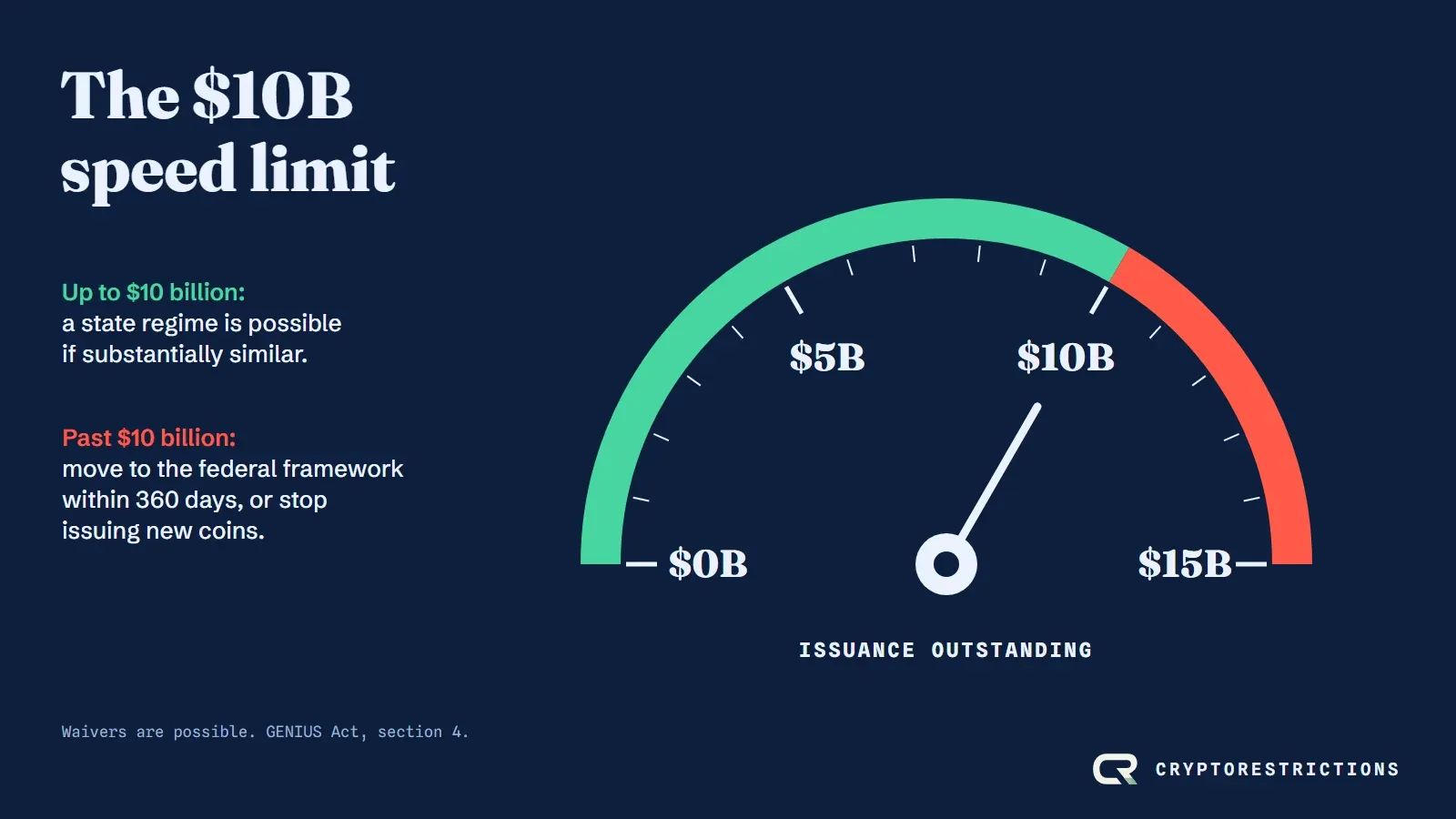
A state route exists for smaller issuers. A State qualified issuer with consolidated outstanding issuance of not more than $10 billion may opt for a state regime if it is substantially similar to the federal framework. Treasury sets the principles for that test through rulemaking. An issuer that passes $10 billion must move to the federal framework within 360 days or stop issuing new coins until it is back under the threshold, unless a regulator grants a waiver.
How do issuers get approved?
Under section 5, the primary federal regulator decides on a substantially complete application within 120 days. It may deny only if the applicant’s activities would be unsafe or unsound. The Act says that issuing on an open, public or decentralized network is not a valid ground for denial. If the regulator misses the deadline, the application is deemed approved.
Can a large technology or retail company issue one?
A public company that is not predominantly engaged in financial activities, and its majority-owned subsidiaries and affiliates, may not issue a payment stablecoin unless the Stablecoin Certification Review Committee votes unanimously that it poses no material risk to the banking system, financial stability or the Deposit Insurance Fund. The company must also meet data-use limits and the Act’s tying prohibitions (section 4(a)(12)). On 30 September 2026 the committee published an interim final rule on the forms and procedures for state certifications. It is effective now, but certifications are not accepted until Paperwork Reduction Act approval and a Treasury notice, and comments are due on 30 November 2026.
What reserve and disclosure rules apply?
Section 4(a) sets the core requirements for permitted issuers. The permitted reserve assets and the 1 to 1 rule also appear on the Cornell Legal Information Institute copy of 12 U.S.C. 5903.
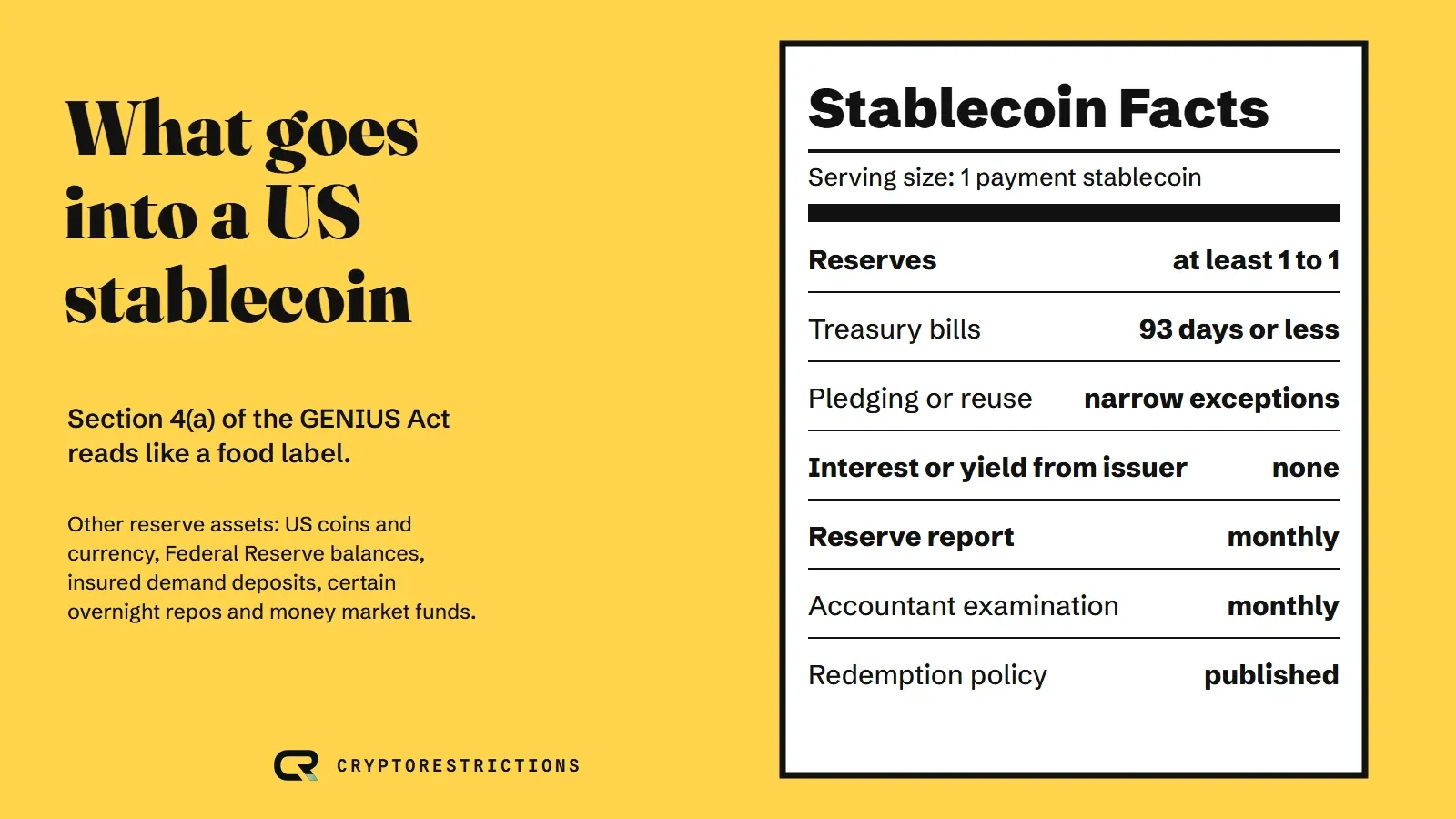
- Reserves. Identifiable reserves of at least 1 to 1 against outstanding stablecoins. Permitted assets include US coins and currency, balances at a Federal Reserve Bank, demand deposits at insured institutions, and Treasury bills, notes or bonds with 93 days or less remaining. Certain overnight repurchase agreements and money market fund shares are also on the list.
- No reuse. Reserves may not be pledged, rehypothecated or reused, except for narrow purposes such as margin on permitted reserve investments, custody services and meeting redemption liquidity needs.
- Monthly disclosure. The issuer publishes on its website the total outstanding coins and the amount and composition of reserves each month, including the average tenor and the geographic location of custody of each category. A registered public accounting firm must examine the previous month-end report each month.
- Redemption. The issuer must publish a redemption policy with clear and conspicuous procedures for timely redemption and must disclose all fees in plain language.
- No yield. Neither a permitted issuer nor a foreign issuer may pay a holder interest or yield, in cash, tokens or other consideration, solely in connection with holding, using or retaining the coin.
- Holder priority. Holders’ claims on the reserve assets rank senior to those of non-stablecoin creditors.
- Financial crime controls. Issuers must have the technical capability to block, freeze and reject impermissible transactions, and must run anti-money-laundering and sanctions programs. Our guides to sanctions and the Travel Rule cover how those obligations reach exchanges.
The statute leaves some numbers to the regulators. The OCC’s final rule sets an outer limit of two business days for timely redemption by issuers it supervises, and the FDIC’s proposal also generally requires redemption within two business days. The OCC rule allows extensions in limited cases.
The yield ban names issuers. The Act’s text does not say how it applies to a rewards program run by an exchange or another third party, so we do not state a position on those.
What does the GENIUS Act mean for foreign stablecoin issuers?
A foreign payment stablecoin issuer is one organized or domiciled outside the US (or in a US territory) that is not a permitted issuer. Section 18(a) exempts it from the section 3 prohibitions only if all of the following hold:
- Its home regulator operates a regime that Treasury has determined to be comparable, on a recommendation from the Stablecoin Certification Review Committee.
- It is registered with the Comptroller. A complete registration is deemed approved 30 days after receipt unless the Comptroller rejects it in writing.
- It holds reserves in a US financial institution sufficient to meet the liquidity demands of US customers, unless a reciprocal arrangement allows otherwise.
- It has the technological capability to comply, and will comply, with lawful US orders.
Treasury must decide a request for a comparability determination within 210 days of a substantially complete request. It may also negotiate reciprocal arrangements with other jurisdictions, and the Act says it should complete them within two years of enactment. The OCC’s final rule leaves the assessment of a foreign regime’s quality to Treasury and handles registration and supervision of foreign issuers itself.
The yield ban applies to foreign issuers as well. If a foreign issuer fails to comply with a lawful order for 30 days after written notice, section 8(b) requires Treasury to publish the finding and bar digital asset service providers from facilitating secondary trading of that issuer’s coins in the US. That prohibition takes effect 30 days after the Federal Register notice. A provider that knowingly violates it can face a civil penalty of up to $100,000 per violation per day.
We did not find a published Treasury comparability determination for any country when we checked on 2 November 2026. Check Treasury’s site before relying on that.
How does the GENIUS Act affect crypto exchanges?
The Act calls them digital asset service providers. The definition covers a person that, for compensation or profit, does business in the United States, including for US customers, in exchanging digital assets for money or for other digital assets, transferring digital assets to a third party, acting as a custodian, or taking part in financial services relating to digital asset issuance. It excludes distributed ledger protocols, immutable self-custodial software interfaces, validators and liquidity pool participation.
For these providers the Act’s main rule is section 3(b)(1). From 18 July 2028, three years after enactment, it is unlawful for one to offer or sell a payment stablecoin to a person in the United States unless a permitted payment stablecoin issuer issued it, subject to the foreign route above and limited safe harbors that Treasury may create. Section 3(e) says the section is intended to have extraterritorial effect when the offer or sale reaches a person located in the United States. Section 3(b)(2) adds a separate condition for coins from foreign issuers: the issuer must be able to comply with lawful orders.
Treasury’s proposed rule on section 3 would define what it means to issue a payment stablecoin in the United States and to offer or sell one to a person there. It says the Act clearly contemplates secondary market transactions in the US in coins from foreign issuers, and it discusses a foreign issuer that issues to a person outside the US, such as a foreign exchange, which then sells to US customers. Comments closed on 19 October 2026, and the rule is not final.
The ban applies to the provider’s offer or sale. Section 3(h) also says section 3 does not reach a direct transfer between two individuals acting for their own lawful purposes without an intermediary, or a transaction by means of a wallet that facilitates an individual’s own custody, as Treasury’s proposal describes it. What changes is which coins a US-facing exchange may sell. See our United States page for which platforms serve US users today.
What rules have been written so far?
Every agency named in the Act writes rules for its own group of issuers, and Treasury writes the rules for the cross-cutting parts. As of 2 November 2026 we found nine rule documents: one final rule, one interim final rule and seven proposals. Treasury’s expected effective date, 18 January 2027, is 77 days away.
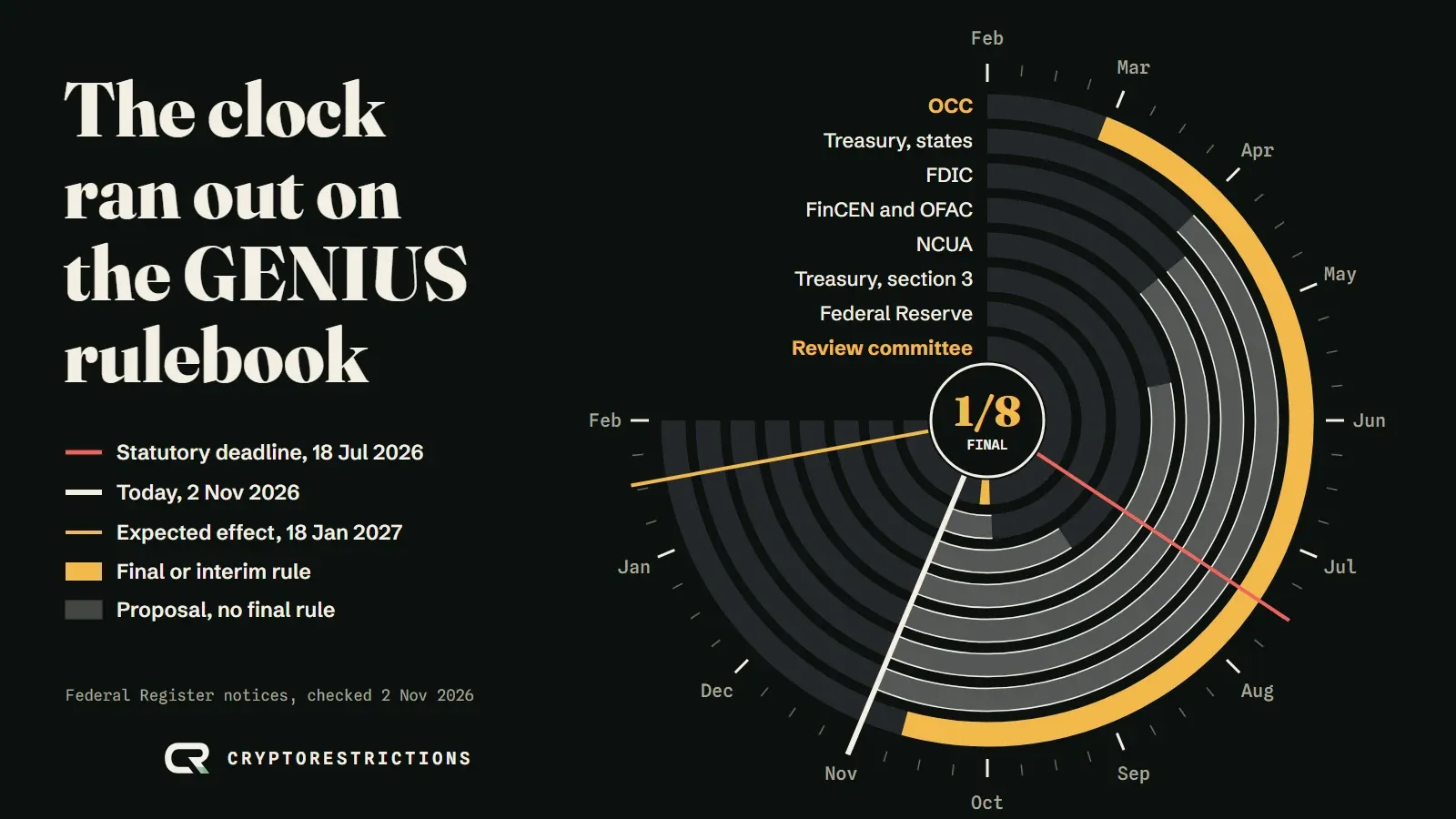
The OCC rule is the one to watch first. It addresses all the regulations the OCC must write under the Act except Bank Secrecy Act, anti-money-laundering and OFAC sanctions requirements, which are left to a separate rulemaking with Treasury. It applies to national banks and their subsidiaries, federal savings associations, federal branches and agencies, Federal qualified issuers, certain state qualified issuers and foreign issuers. The OCC bulletin is dated 21 October 2026.
The Federal Reserve announced its two proposals on 24 September 2026. One covers reserves, capital, risk management and safekeeping for Board-supervised issuers. The other sets an application process for banks it supervises. The FDIC’s proposal says deposits held as reserves would not be insured to stablecoin holders on a pass-through basis. We found no final FDIC, NCUA, Federal Reserve or FinCEN rule yet, so those details can still change.
How does the GENIUS Act differ from MiCA?
Both laws regulate stablecoins at the issuer, and both put a redemption right and reserve rules at the centre. They differ in scope, timing and what they do about intermediaries. Our MiCA guide covers the EU rules in full; the comparison below uses the stablecoin provisions only.
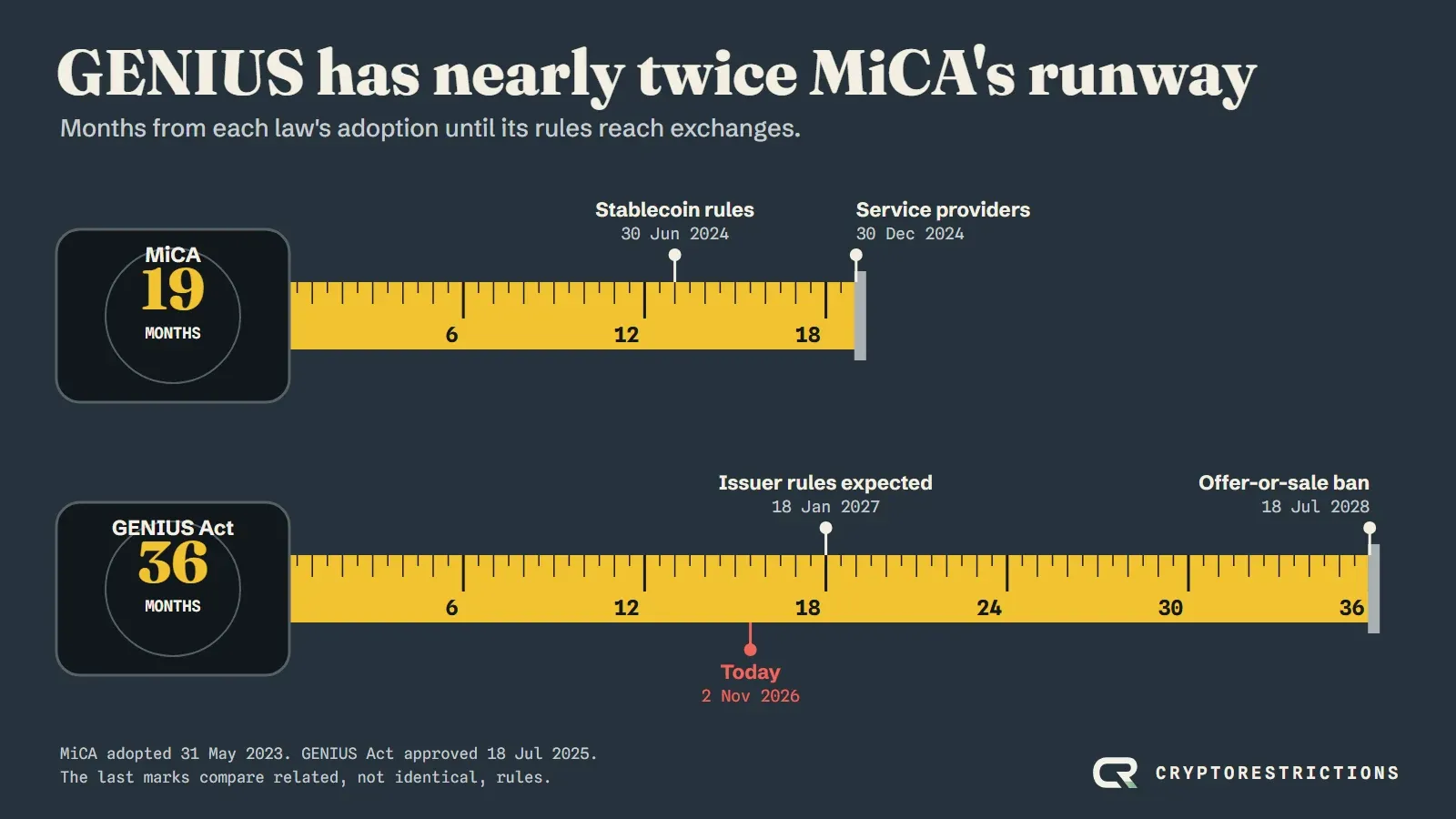
The widest difference is scope. MiCA is a framework for crypto-assets in general, and it authorizes the firms that serve clients. The GENIUS Act covers payment stablecoins only, and for exchanges it works through what they may offer, not through a licence. A second difference is timing. MiCA was adopted on 31 May 2023, its stablecoin rules have applied since 30 June 2024 and its authorization rules for service providers since 30 December 2024 (Regulation (EU) 2023/1114, Article 149). The GENIUS Act was approved on 18 July 2025, its effective date is expected on 18 January 2027, and the ban on exchanges offering non-permitted coins starts on 18 July 2028.
MiCA’s e-money token rules differ from the Act in some details. MiCA bans interest for issuers and for crypto-asset service providers (Article 50), while the Act’s yield ban names issuers. MiCA requires redemption at par on request, at any time and free of charge (Article 49), while the Act leaves timing to regulators’ rules. MiCA requires at least 30% of funds received to sit in separate bank accounts, with the rest in secure, low-risk, highly liquid assets in the same currency (Article 54).
There is also a difference in how foreign tokens are handled. Under MiCA, Article 48 limits offers to the public of an e-money token to its issuer, or other persons with the issuer’s written consent, and requires the issuer to be a credit institution or an electronic money institution. The Act has no automatic recognition of another regime. Treasury makes a comparability determination country by country, and the Act’s rules have not started to apply yet. An issuer authorized in the EU therefore still needs a US route.
For ESMA’s expectations of 8 October 2026 on non-compliant stablecoins in the EU, see the MiCA guide.
What should you check before using a stablecoin?
- Check the issuer and its home regime. Find out who issues the coin, where it is formed and who supervises it.
- Check the date. The issuance rules are expected to start on 18 January 2027. The exchange-side ban starts on 18 July 2028.
- Check the service, not just the coin. Holding a coin in your own wallet and buying it through a US exchange are different questions.
- Check the status of the rule you rely on. Only the OCC’s rule is final. A proposed rule can change before it takes effect.
Our methodology explains how we record statuses and sources.