No country bans “crypto” in one clean sentence. The laws we found ban different things: owning and using virtual assets, running a trading business, letting banks serve crypto customers, or paying with crypto. This guide lists the countries where we could read the legal text, groups them by what is banned, and gives the instrument, the authority and the date for each.
It is not a claim of completeness. A country appears here only if we opened a primary text: a statute, a central bank circular or a regulator notice. Countries known only from press reports are listed at the end and left out of the count.
Which countries ban crypto?
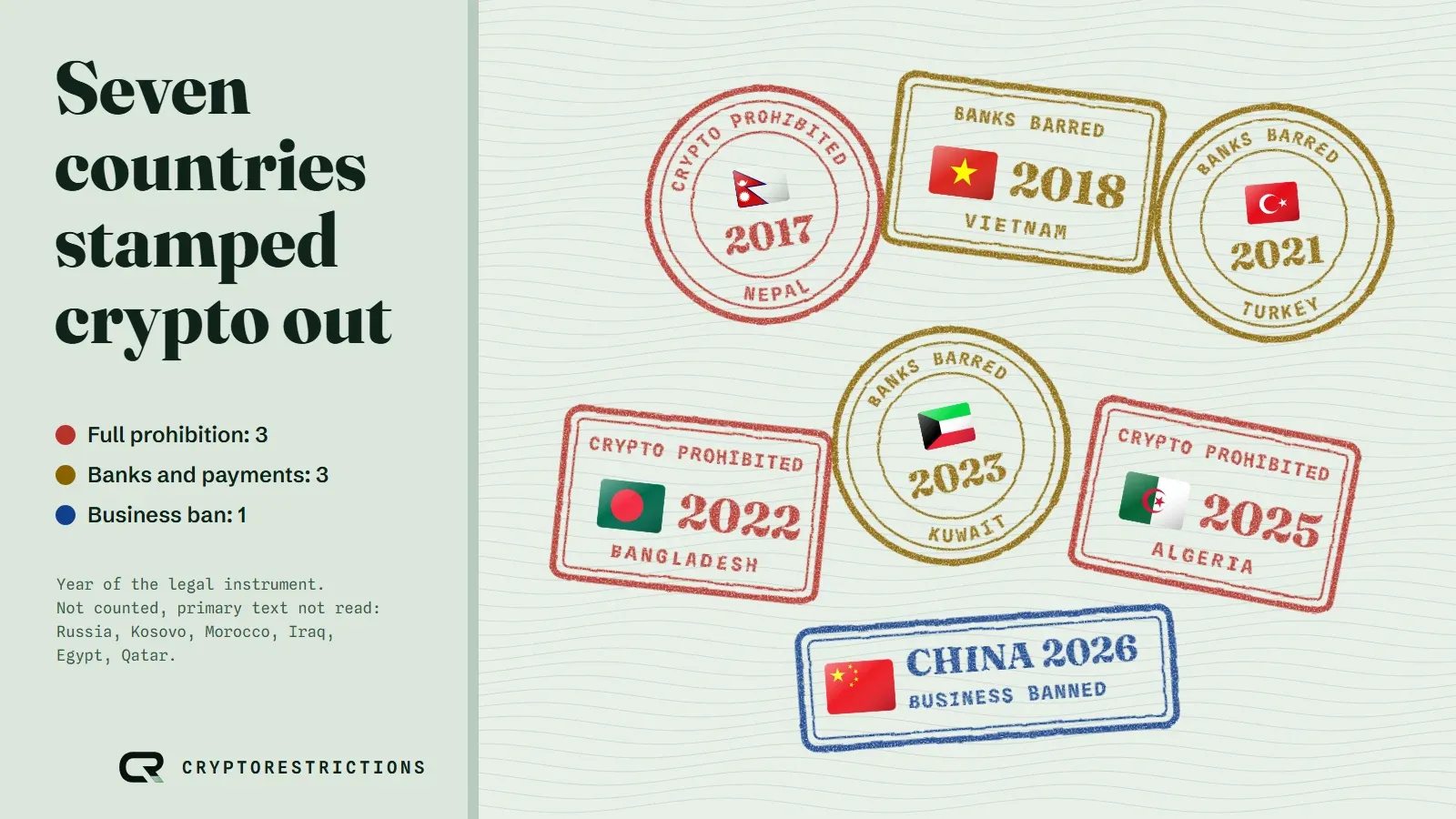
Seven countries, grouped into three types. The map shades each by the type of ban. Select a country for the law behind it.
What are the types of crypto ban?
- Full prohibition. Individuals as well as businesses are covered. Algeria, Nepal and Bangladesh are in this group.
- Business ban. Running or serving a crypto business is illegal, while holding is not mentioned as an offence. China is the example.
- Banks and payments ban. Banks, payment firms or regulated businesses may not handle crypto, or crypto may not be used to pay. Turkey, Vietnam and Kuwait are in this group.
- Mining-only ban. A ban on mining alone. We found none confirmed to a primary text. China, Algeria and Kuwait ban mining as one part of a wider ban.
What does each country’s law say?
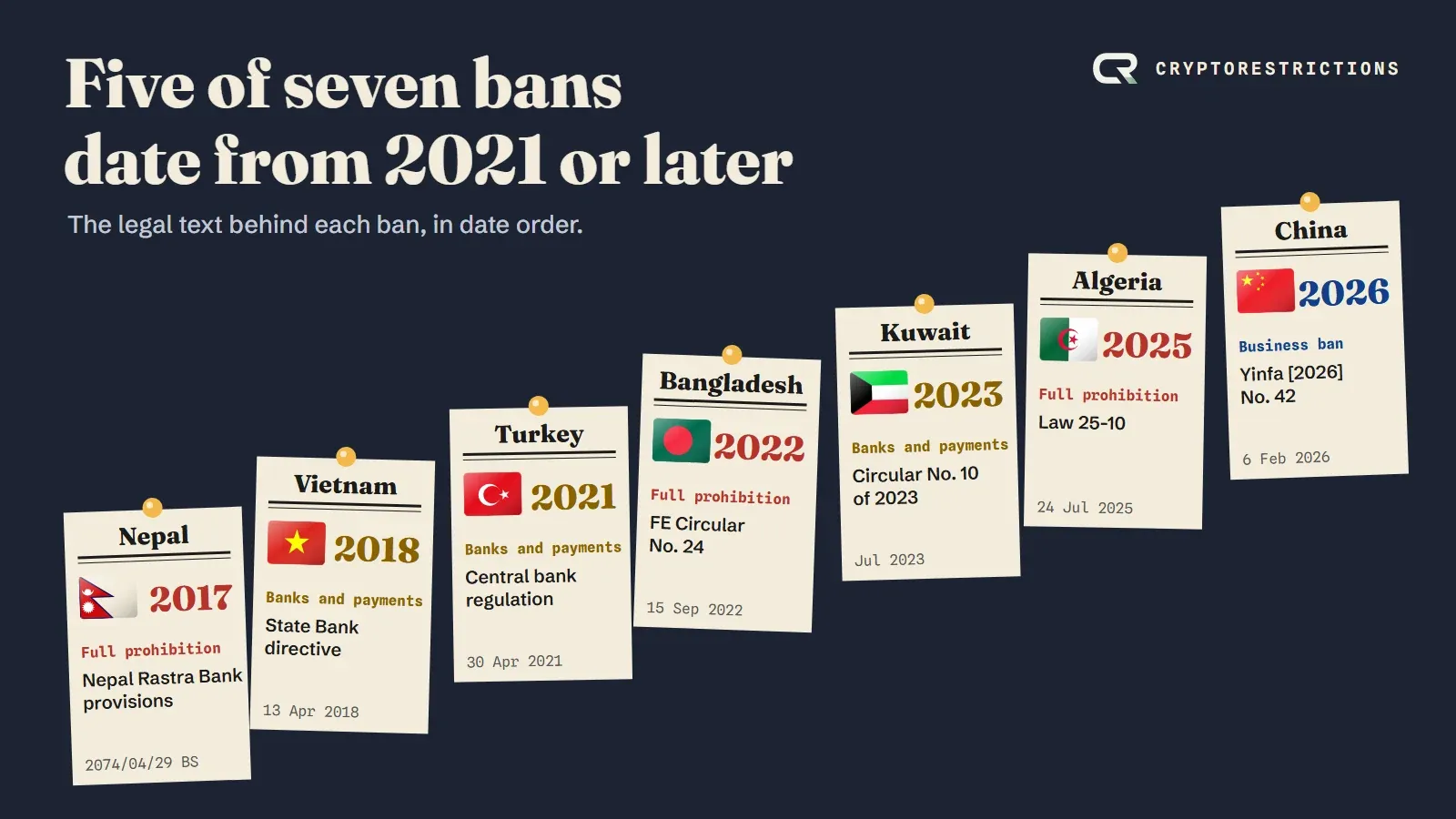
Set out in date order, five of the seven instruments date from 2021 or later.
Algeria
Law 25-10 of 24 July 2025 amends the 2005 anti-money-laundering law. The new Article 6 bis bans issuing, buying, selling, using or holding virtual assets, trading them, promoting them or running exchange platforms, where the assets serve as a means of payment or recognised currency, or as an investment instrument. The article adds that the ban includes cryptocurrency mining. It appeared in Official Journal No. 48.
Nepal
Nepal Rastra Bank says restrictive provisions on cryptocurrency took effect on 2074/04/29 BS (2017) and that investing in crypto is treated as investing abroad, which its rules restrict. The FIU-Nepal newsletter of April 2024 quotes Section 262(A) of the National Penal Code: apart from the central bank’s currency, no one may produce, sell, transact, exchange, transfer or hold virtual currency, with confiscation and up to five years in jail. We read that section only as quoted, and the newsletter gives no date for it.
Bangladesh
FE Circular No. 24 of 15 September 2022 says that any transaction made in, from or to Bangladesh to obtain virtual assets is not permitted, and neither is facilitating their trading. It treats breaches as contraventions of the Foreign Exchange Regulation Act, 1947. The circular says nothing about owning coins already held.
China
Yinfa [2026] No. 42, issued by eight agencies on 6 February 2026, states that virtual currency business is illegal financial activity and bars offshore providers from serving people in China. It prohibits new mining projects. It does not ban holding. Our China guide covers the full position.
Turkey
The central bank’s regulation, in force since 30 April 2021, says crypto assets cannot be used in payments, directly or indirectly. It is a payments rule, not a trading ban. See the Turkey guide.
Vietnam
The State Bank’s directive of 13 April 2018 bars banks and payment intermediaries from payment, card, transfer, clearing and exchange services linked to virtual currency. Our Vietnam guide covers the licensed trading pilot that sits beside it.
Kuwait
Circular No. 10 of 2023 bans using virtual assets as a payment tool, offering them as an investment to clients, issuing licences for virtual asset services, and mining. Securities regulated by the central bank or the CMA are exempt. It is addressed to financial institutions and specified non-financial businesses.
Does a platform restriction mean a country bans crypto?
No. Our dataset records whether platforms serve people in a country. A platform can refuse a country over sanctions, its own policy or licensing, while crypto stays legal there. A ban needs its own source. The restriction explorer shows platform access, and our methodology explains how statuses are sourced.
Which countries are left out?
We left out countries whose position rests on a press report, a secondary summary, or a regulator site we could not open. That is not a finding that they allow crypto.
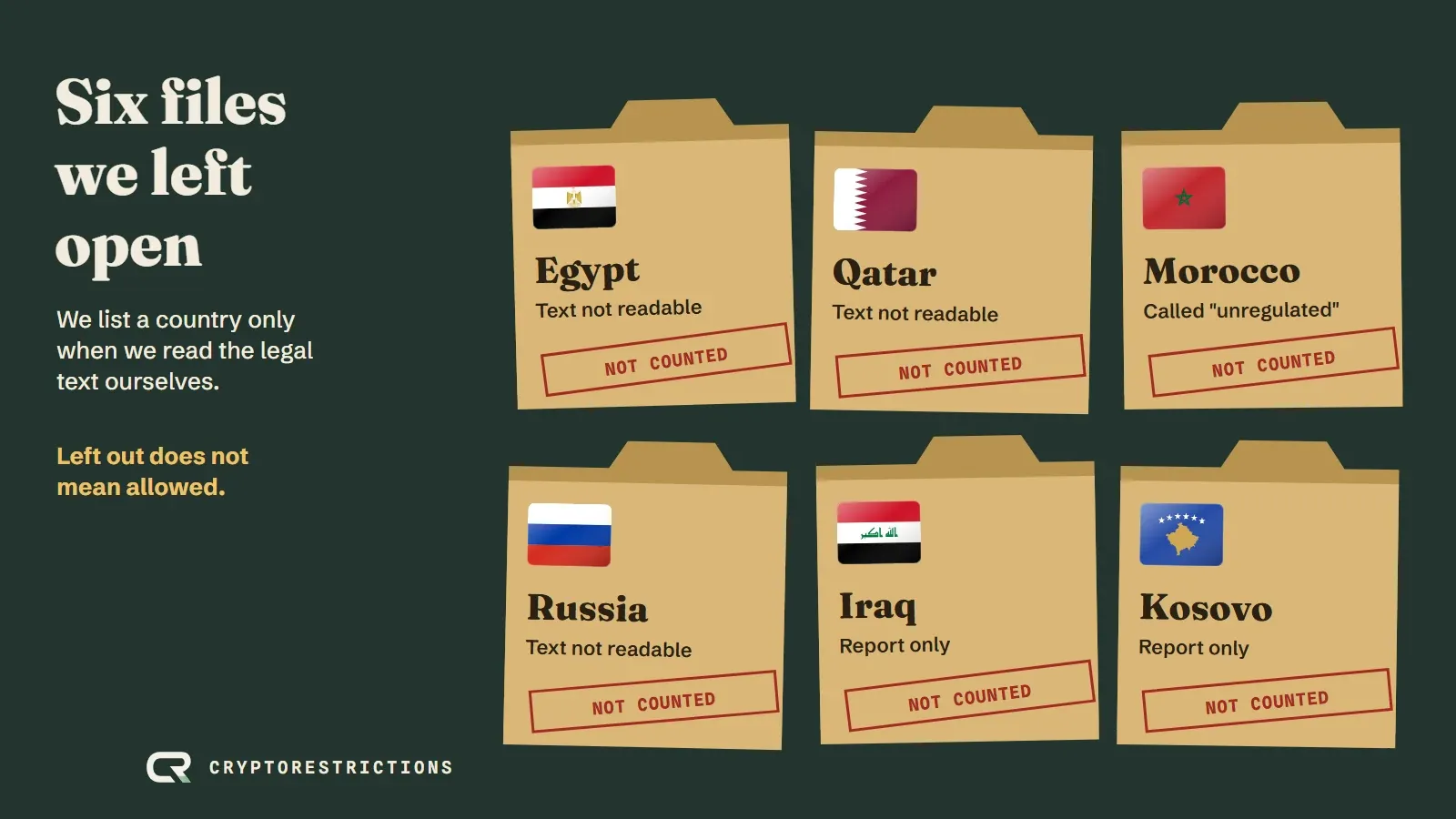
- Egypt, Qatar, Morocco and Russia. Our country guides describe a central bank law, circular or payment ban in each, but the primary texts were not readable to us. See the Egypt, Qatar, Morocco and Russia guides for what is known.
- Iraq, Kosovo and others. Reports describe a central bank directive in Iraq and a temporary emergency mining ban in Kosovo in 2022. We did not open either text.
- Contested cases. Bank Al-Maghrib calls crypto “unregulated” on its public page, not banned. That is why Morocco is not listed.
Laws change. Treat each entry as the text on the date we checked it, and see our sanctions guide for restrictions that come from sanctions, a separate question.